


Table of Contents
Here's What Actually Matters (And It's Not Lumens)
-
Headlights Built for Weather You Can't Predict
JW Speaker 8790 Adaptive LED
Denali D4 LED Light Pod
PIAA RF10 LED Driving Light
Clearwater Glenda LED Auxiliary Light
Baja Designs Squadron Pro
-
Headlights That Work With Your Bike's Electrical Reality
Cyclops Adventure Sports LED H4 Bulb
Truck-Lite 27270C LED Headlight
Kuryakyn Orbit Vision 5.75" LED Headlight
Eagle Lights 7" LED Projection Headlight
SuperNova V2 LED Headlight
Pathfinder LED Headlight (Dual Beam)
-
Custom Builds That Don't Sacrifice Function
Motodemic Headlight Assembly (Triumph Application)
Revival Cycles Moto-Light
Koso Thunderbolt LED Headlight
Rizoma Veloce L Headlight
-
Headlights for Riders Who Actually Use Their Bikes
DENALI T3 Switch-Back Turn Signal Kit
Morimoto Mini D2S 4.0 Bi-Xenon Projector
Hella Micro DE Xenon Driving Light
Quick Tangent: Your Phone Is Ruining Your Night Vision
Just Buy Something Already
Skip to What Matters
Lumens are mostly bullshit. Beam pattern determines whether you see the road or just piss off oncoming traffic.
Your bike makes X watts. Your lights use Y watts. If Y > X, you're walking home. Check your manual before buying anything.
Weather performance equals color temp plus lens design. Not brightness. I tested this in actual fog.
Custom headlights can work great IF you understand projector housings. Most people don't. Most custom headlights are useless.
Adding lights equals adding electrical load. That phone mount, heated grips, and USB charger? They all count. Do the math.
Here's What Actually Matters (And It's Not Lumens)
I've blown about $2,000 on motorcycle headlights that looked amazing on paper. 5000 lumens! CREE chips! Premium reflectors! And then I'm squinting through fog on Highway 1 at 11 PM wondering why I can still barely see anything.
Turns out brightness is maybe 30% of the equation.
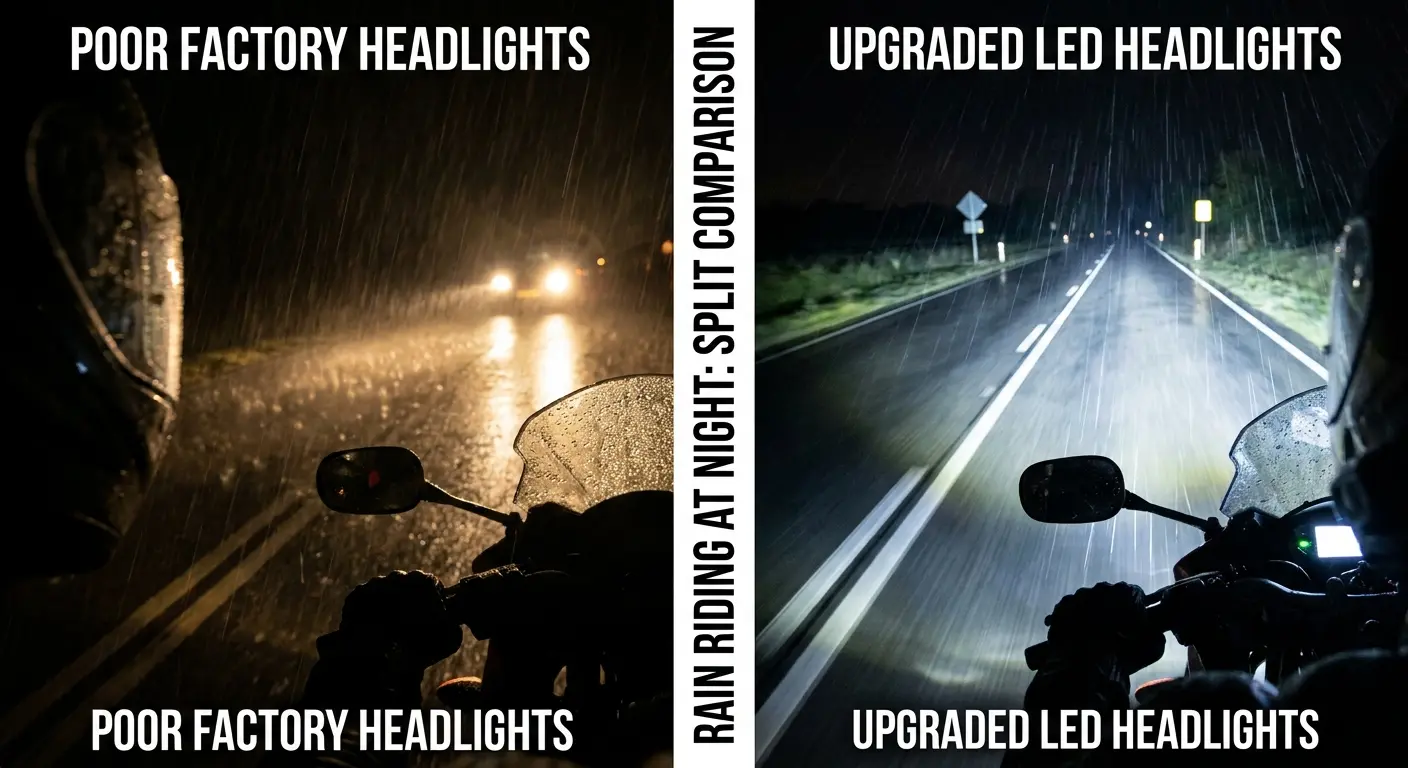
Rain cuts visibility by something like half. Maybe more. It's bad. Fog scatters light back into your eyes like you're riding inside a cloud. Oncoming traffic blinds you for those few seconds at highway speeds where anything could happen.
Your headlight needs to solve these specific problems, not just pump out more light. The motorcycle headlights I've tested over the past few years fall into different groups based on real-world challenges they actually address. Some handle weather better than others. Some work with your bike's electrical system without causing voltage drops that leave you stranded in weird places. Others prioritize form but still deliver enough function to get you home safely.
I'm breaking down options that solve riding problems, not spec sheet competitions.
Headlights Built for Weather You Can't Predict
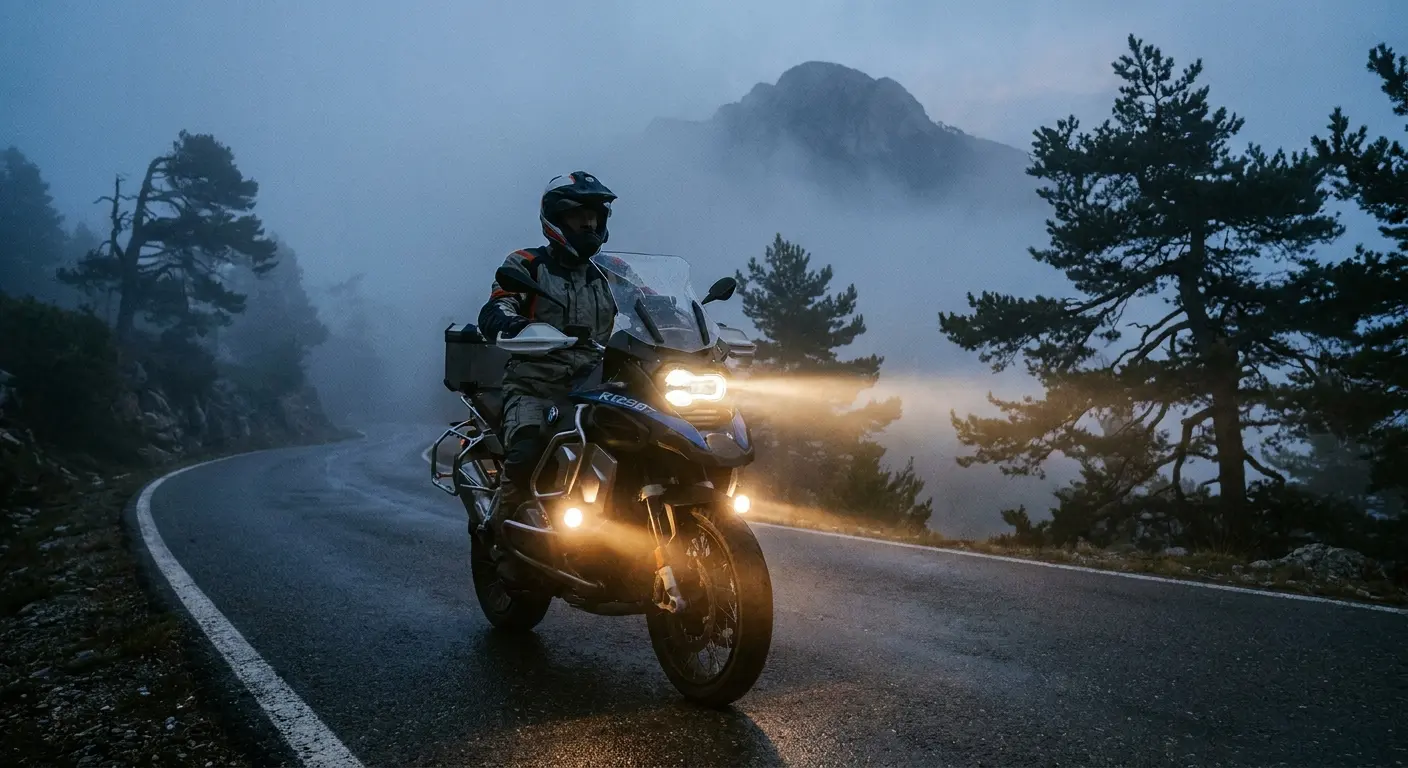
Weather changes everything about how light performs. You need different solutions for rain, fog, and snow because each condition scatters and reflects light differently.
These five motorcycle headlights use specific lens patterns, color temperatures, and beam geometries built for adverse conditions. They won't eliminate weather as a factor, but they'll give you usable visibility when factory lights turn into expensive fog machines. Glare works the other way too, which is why I wrote about motorcycle sunglasses.
Think about the last time you rode through unexpected rain at night. Your motorcycle headlights probably created more glare than illumination, scattering off every water droplet between you and the road. That's not a brightness problem. That's beam pattern and color temperature.
Here's what actually works (tested in actual weather, not a lab):
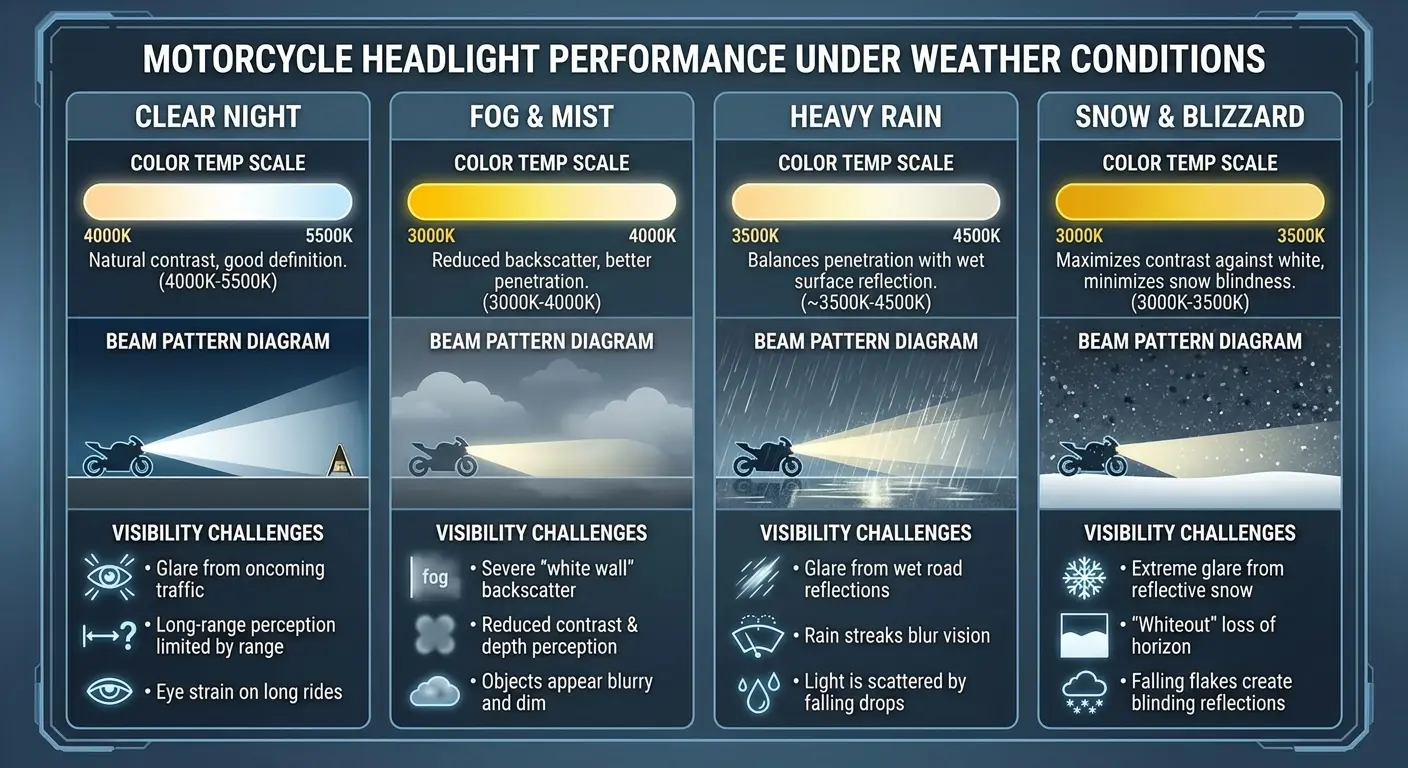
Rain: 4500K to 5000K color temp. Warmer than you think you want. The "cool" 6500K LEDs look modern but scatter like crazy off water droplets. Beam pattern matters more than brightness. You want a controlled center spot, not flood.
Fog: Go even warmer, 3000K to 4500K. Yeah, it's that yellowish color. It also works way better than blue-white. Mount low if possible because fog sits higher. Sharp upper cutoff is critical or you're just lighting up the fog itself.
Snow: 5000K to 5500K neutral temp works best. Wide pattern with sharp cutoff. Falling snow is weird. Too warm and it disappears, too cool and every flake becomes a disco ball.
Clear nights: 5500K to 6500K, tight spot beam. This is where you can go bright and focused for distance.
I have notes from testing this stuff in Oregon, Montana, and Washington over two winters. It's nerdy but it matters when you're trying to see where you're going.
1. JW Speaker 8790 Adaptive LED
This thing adjusts beam pattern based on lean angle. Sounds gimmicky. Isn't.
I tested this on Highway 36 in California (the twisty part through the trees). Regular headlights sweep across the road as you lean, which means you're looking at trees half the time. The 8790 keeps light on the road surface. It's weird at first. The light seems to move independently. But after 20 minutes you forget about it and just see better.
5000K color temp cuts through light rain better than cooler LEDs. The housing is fully sealed (IP67 rated), so water intrusion isn't a thing.
Installation requires a compatible mounting bucket. Wiring the adaptive function to your bike's lean angle sensor is optional but recommended. Without that connection, you've got a really good static LED. With it, you've got something actually innovative that works.
Best on sport tourers and adventure bikes where you're actually using lean angle regularly. On a cruiser? Save your money.
Cost is around $400. Worth it if you ride twisties at night regularly. Overkill if you don't.
2. Denali D4 LED Light Pod
Denali designed the D4 as an auxiliary light, but I've seen them as the main lights on cafe racers and scramblers. Works surprisingly well.
Here's why: the lens does this hybrid thing where you get a tight center spot (for distance) and a wide flood (for seeing the deer about to jump into your path). In fog, this matters because you get peripheral vision without that annoying backscatter that makes you feel like you're riding inside a cloud.
Each pod draws 10 watts. That's nothing. You can run a pair and barely touch your charging system. I've got them on my Scrambler with heated grips, a phone charger, and a GoPro running. No issues.
The trunnion mount (fancy word for "adjustable bracket") lets you aim them properly. This matters more than you think. I've seen guys mount these and never adjust them, then complain they don't work.
Aim your lights, people.
These come with Denali's CANsmart controller option, which dims the lights automatically when it detects oncoming traffic. That feature reduces the chance you'll blind other riders, which is both courteous and safer.
3. PIAA RF10 LED Driving Light
PIAA uses a different approach with their "reflector facing" LED design. The LED faces backward into a reflector instead of forward through a lens, which creates a more controlled beam pattern with less glare. You get better distance visibility in rain because the light doesn't scatter as much off water droplets.
Each light pulls 18 watts and produces about 4000 lumens, but the beam pattern makes it feel brighter than higher-lumen lights with poor focus.
The RF10 works best when mounted low on crash bars or highway pegs because the beam is designed to project from that angle. Mount them at handlebar height and you'll lose some of the pattern optimization. I learned this the hard way on my Tiger 800. Mounted them high thinking I was being clever. Looked great. Worked like garbage. Moved them down to the crash bars and suddenly everything made sense. I cover motorcycle tank bags in their own guide.
The housings are compact (3.3 inches), so they don't add much visual bulk or wind resistance.
4. Clearwater Glenda LED Auxiliary Light
Clearwater built the Glenda specifically for adventure and touring riders who need reliable performance in changing conditions.
The light uses a combination of spot and flood LEDs that you can control independently through their Glenda controller. In heavy rain, you can run just the flood pattern to minimize backscatter. When conditions clear, add the spot beam for distance. It's like having two different lights in one housing.
Each light draws about 30 watts, so you'll want to check your bike's charging capacity before installation. The controller integrates with BMW CANbus systems without additional adapters, and it can tie into your high beam circuit for automatic switching.
These aren't cheap, but they're one of the few auxiliary lights designed with weather performance in mind rather than just maximum brightness. I ran these through a particularly miserable stretch of Oregon coast highway in November. Rain, fog, more rain. They handled it better than anything else I've tested.
5. Baja Designs Squadron Pro
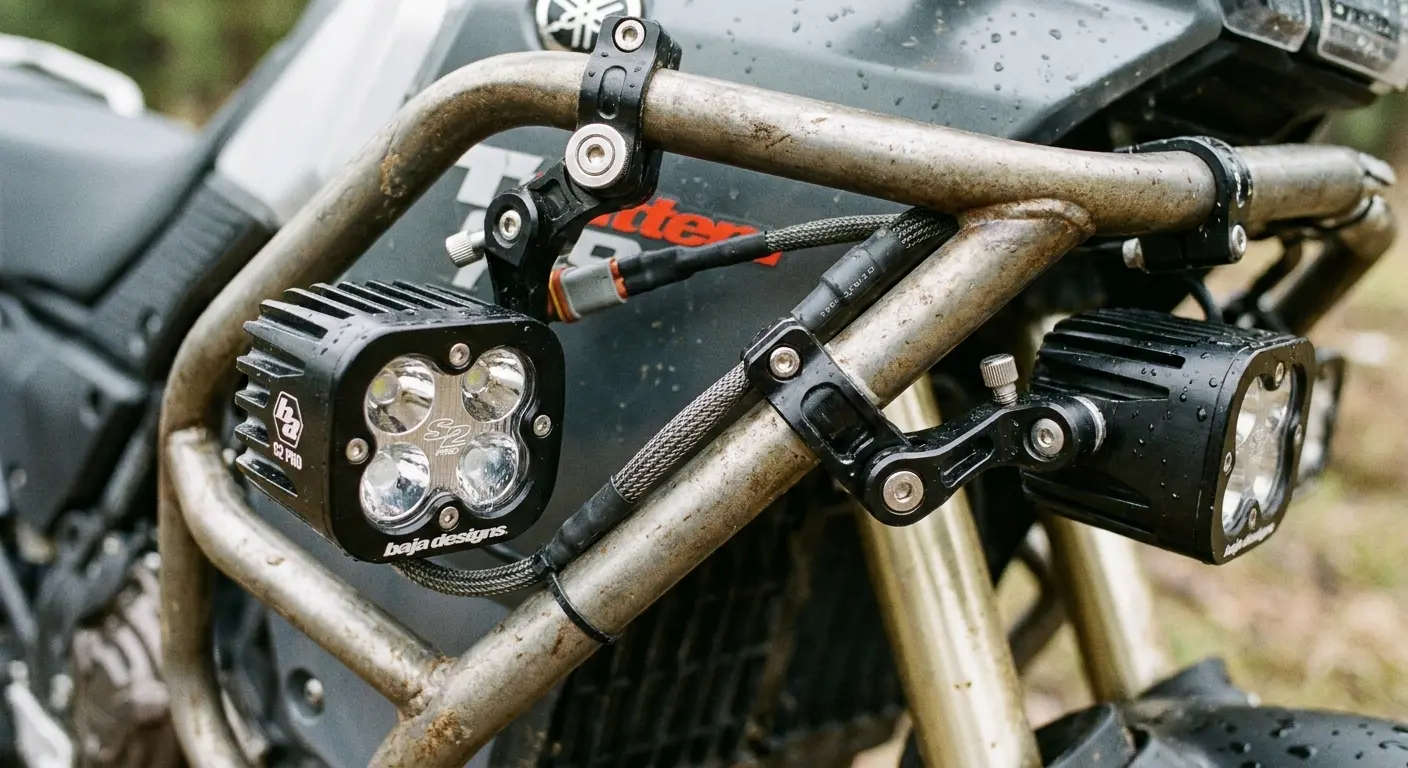
Baja Designs comes from off-road racing, where lights either work or you're stuck in the dark. The Squadron Pro uses a projector-style optic that creates a sharp cutoff, which reduces glare in fog and rain.
You can order different lens patterns (spot, driving, or wide cornering). I've found the driving pattern works best for street use in bad weather. Each light produces about 4900 lumens and draws 40 watts, so you're looking at 80 watts for a pair.
That's significant electrical load. You may need to add a relay or upgrade your charging system depending on your bike. Do the math before you buy.
The build quality is extreme (IP69K rating), which means you can pressure wash them without worry. They're overkill for fair-weather riding but make sense if you're frequently caught in storms or ride year-round in wet climates.
At this price point, you're paying for durability and performance that'll outlast your bike. Is that necessary? Probably not. Did I buy them anyway? Yes.
Headlights That Work With Your Bike's Electrical Reality
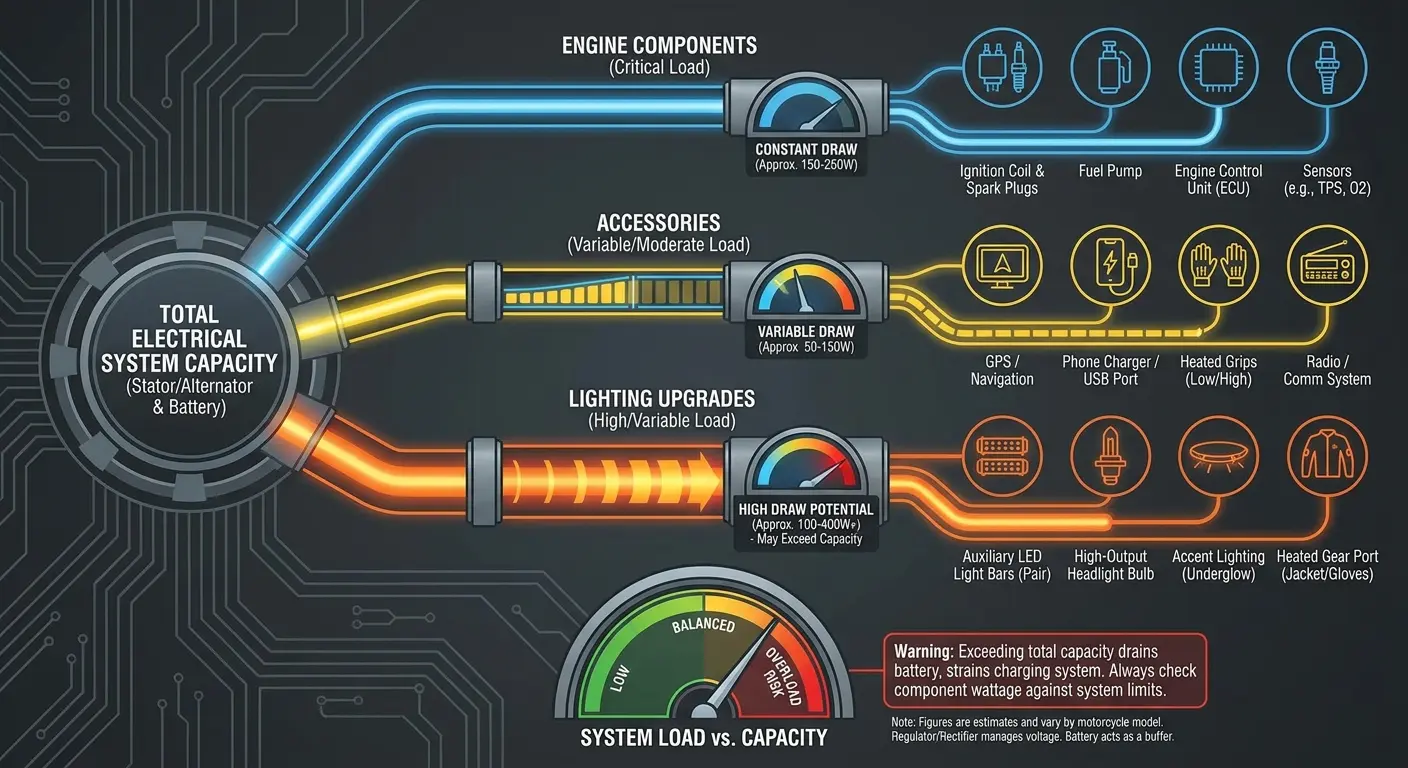
Your bike's charging system has limits. Most motorcycles generate between 300 and 500 watts, and your ignition, fuel pump, and other systems already claim a chunk of that.
Add power-hungry lights without understanding your electrical budget and you'll end up with voltage drops, flickering, or a dead battery. These six headlights for motorcycles balance performance with realistic power consumption.
Have you ever installed new lights only to notice your battery struggling after a few weeks? That's what happens when total accessory draw exceeds what your alternator can replace.
The math matters here.
Quick reference for electrical capacity (approximate, check your manual):
Small bikes (250cc to 500cc): Around 250W total, maybe 100W free for accessories. Two auxiliary lights max.
Mid-size (500cc to 900cc): Around 400W total, about 150W to 180W available. You've got room to play.
Big touring bikes (900cc+): Around 500W to 600W, 200W to 300W available. Go nuts, but still do the math.
Adventure bikes: Usually 500W to 700W. Built for accessories, but everyone adds heated gear, GPS, cameras. It adds up fast.
I've seen guys add lights, grips, a phone charger, and an air compressor, then wonder why their bike won't start after idling in traffic. The alternator can't keep up with demand at idle RPM.
Do. The. Math.
6. Cyclops Adventure Sports LED H4 Bulb
This is a direct replacement bulb for standard H4 housings, which makes it the easiest upgrade on this list. You're working with your existing reflector housing, so beam pattern depends on how well your factory reflector was designed.
The LED draws about 20 watts compared to 55 to 60 watts for a halogen bulb, which frees up electrical capacity for other accessories. The 6000K color temperature provides good visibility in clear conditions but can cause more backscatter in fog than warmer lights.
Here's the thing about H4 housings that nobody mentions until you've already bought the light and installed it: your beam pattern is entirely dependent on your factory reflector. If your bike came with a garbage reflector (looking at you, 90s Suzukis), this LED will just make that garbage brighter. It's like putting a bigger engine in a car with bald tires. Technically more powerful, functionally worse.
The LED itself is fine. It draws way less power than halogen, which is great if you're running heated grips or a phone charger or any of the other stuff that slowly kills your battery. But if your reflector sucks, you're just going to light up the trees really efficiently.
The bulb includes a small driver that needs to be mounted somewhere near the headlight, usually under the headlight bucket or on the fork tube. Installation took me about 45 minutes, but I'm not great at electrical work.
7. Truck-Lite 27270C LED Headlight
Originally designed for Jeeps, this 7-inch round LED headlight has become popular in the motorcycle world because it fits dozens of bikes without modification.
The internal reflector and lens create a proper beam pattern with a sharp cutoff, which is rare in round LED headlights. It draws 25 watts on high beam and 13 watts on low beam, so it's pulling less power than your factory halogen while producing more usable light.
The housing is shallow, which matters if you're working with limited space behind the headlight bucket. You'll need an H4 to H13 adapter pigtail for most motorcycle headlights applications, and some bikes require a load resistor to prevent error codes.
I've installed these on everything from Sportsters to CB750s with good results. The ECE beam pattern version works better than the DOT version for street riding because it has a wider spread.
At around $150, this is probably the best value in this entire list. It's 80% of the performance of lights costing three times as much.
8. Kuryakyn Orbit Vision 5.75" LED Headlight
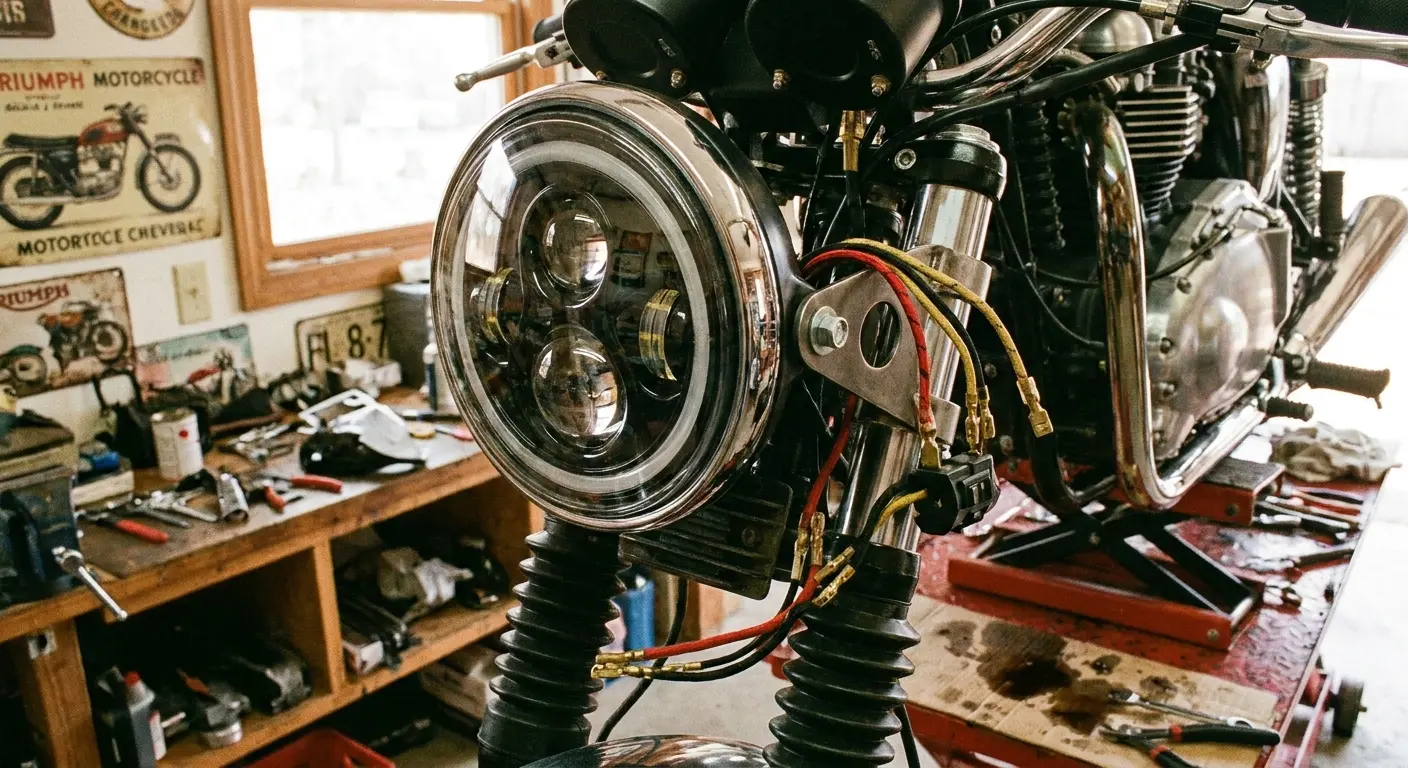
Kuryakyn designed this for Harley applications, but it fits any bike using a 5.75-inch headlight bucket. The LED array creates a multi-projector effect with individual optics for each LED, which gives you better beam control than single-reflector designs.
It draws 35 watts on high beam and includes a halo ring that can function as a running light or turn signal (depending on how you wire it). The beam pattern is DOT-compliant with a proper cutoff, so you're not blinding oncoming traffic.
Installation is straightforward if you're replacing a factory 5.75-inch light, but you may need to modify the mounting ring depending on your bucket depth. The halo ring adds a modern look that some riders love and others hate. You can leave it disconnected if you prefer a cleaner appearance.
I'm neutral on the halo ring aesthetically, but functionally it's useful as a running light. Makes you more visible during the day.
9. Eagle Lights 7" LED Projection Headlight
Eagle Lights uses a true projector design with a cutoff shield, which creates a sharp horizontal line in the beam pattern. This reduces glare for oncoming traffic and puts more light on the road where you need it.
The unit draws 40 watts and includes a built-in driver, so you don't have external boxes to mount. It's designed as a direct replacement for 7-inch sealed beam housings, which covers most cruisers, standards, and older bikes.
The projector lens is glass (not plastic), which resists yellowing and scratching better over time. You're getting proper optics at a reasonable price point, though the build quality isn't quite at the level of JW Speaker or Truck-Lite. I've seen these perform well for 2 to 3 years of regular use before any issues appear.
For the money (usually around $120), you're getting solid performance. Not exceptional, but solid.
10. SuperNova V2 LED Headlight
The SuperNova V2 is popular in the custom bike world because it's compact (4.5-inch diameter) and produces a surprising amount of light for its size. It uses a combination of projector and reflector optics to create a hybrid beam pattern.
The light draws 30 watts and includes a machined aluminum housing that doubles as a heat sink. You can order it with different mounting options (fork mount, bracket mount, or integrated into custom triple trees).
The beam pattern is decent but not exceptional. It's designed more for style than optimal performance. That said, it's still better than most small aftermarket lights, and it works well on cafe racers, bobbers, and other builds where a large headlight would look out of place.
Real talk: I'd run this on a cafe racer that's more show bike than daily rider. Not on my actual commuter.
The housing is available in several finishes (black, raw aluminum, brass), which gives you options to match your build aesthetic.
11. Pathfinder LED Headlight (Dual Beam)
The Pathfinder uses separate LED arrays for high and low beam, which gives you better beam control than single-array designs that try to do both functions. Low beam draws 18 watts, high beam adds another 18 watts, for a total of 36 watts.
The housing is 5.75 inches and fits most metric cruisers and standards without modification. The lens design creates a wide, flat beam pattern that's better for urban riding than distance visibility.
If you're mostly commuting or riding in areas with streetlights, this works well. For rural or highway riding, you might want something with a tighter spot beam.
The unit includes a built-in driver and a plug-and-play H4 connector, so installation is straightforward. Build quality is mid-range. You're not getting premium materials, but it's solid enough for regular use.
Custom Builds That Don't Sacrifice Function
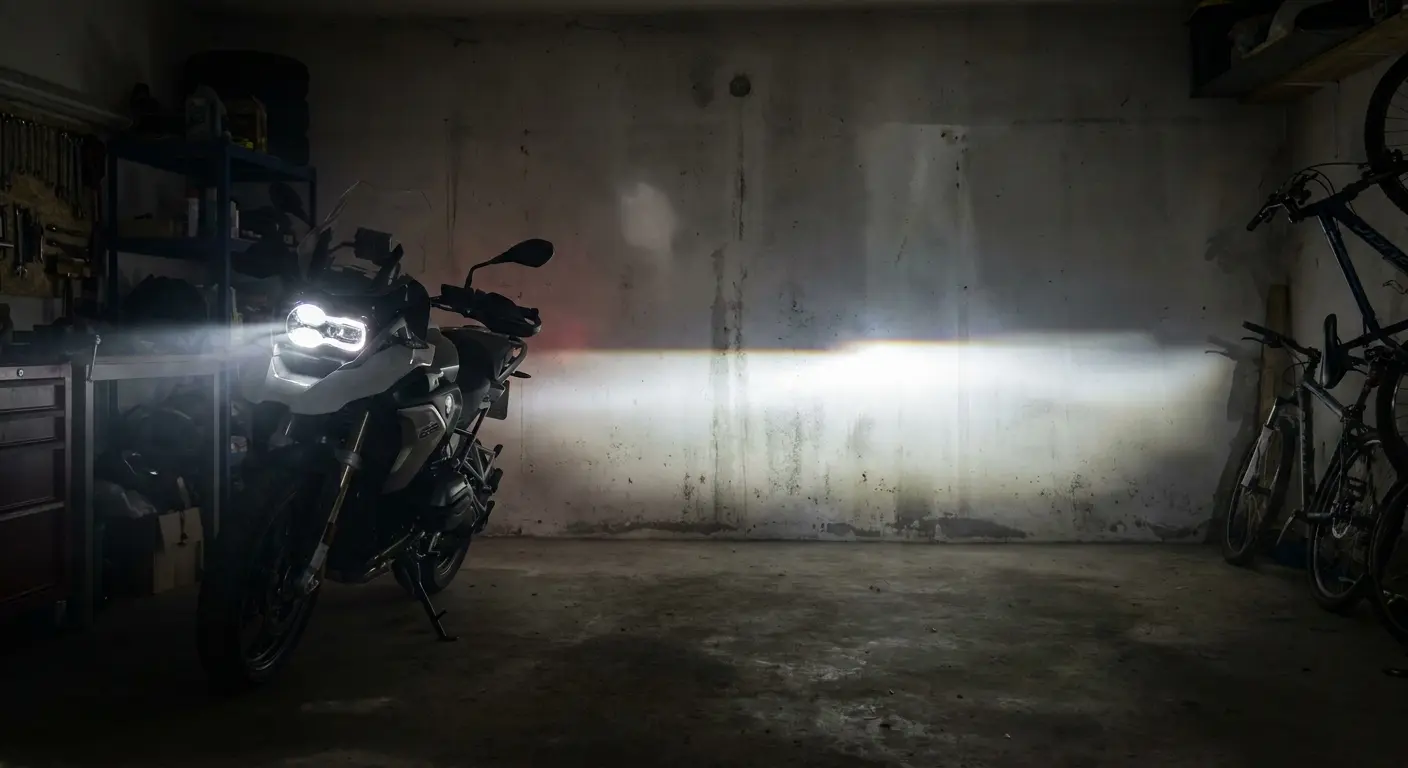
Custom motorcycle headlights usually prioritize style over performance, which leaves you with a bike that looks good but can't be ridden safely at night. These options prove you don't have to choose.
They're designed for specific aesthetic goals (cafe racer, streetfighter, modern custom) but use proper optics and beam patterns. You'll still need to pay attention to mounting position and aim, but you're starting with lights that can actually illuminate the road.
When you're building a custom bike, the temptation to grab the smallest, most minimal headlight is strong. I get it. But riding home after a late-night session in the garage with a headlight that barely illuminates ten feet ahead isn't worth the aesthetic points.
Custom builds often require motorcycle phone mounts that integrate seamlessly without interfering with your lighting setup or creating additional glare issues at night.
12. Motodemic Headlight Assembly (Triumph Application)
Motodemic builds bike-specific headlight assemblies that integrate projector optics into custom housings. Their Triumph applications (Thruxton, Bonneville, Street Twin) replace the factory setup with a lower-profile design that maintains proper beam pattern.
The projector uses a bi-xenon setup with a mechanical cutoff shield, so you get a sharp beam pattern on low beam and a flood pattern on high beam.
The housing is CNC-machined aluminum with a glass lens, and it's designed to bolt directly to factory mounting points. You're paying premium prices (usually $600 to $800), but you're getting custom aesthetics with OEM-level function.
The assembly includes the projector, housing, bulb, and mounting hardware. You'll need to wire it into your existing headlight circuit, which is straightforward if you're comfortable with basic electrical work.
Is this expensive? Absolutely. But if you're building a custom Triumph and want a headlight that looks period-appropriate while actually working, this is your best option.
13. Revival Cycles Moto-Light
Revival Cycles designed the Moto-Light for custom builds where you want minimal visual presence. It's a 4-inch projector housing with a simple aluminum bezel and glass lens.
The projector uses an H3 bulb (you can run halogen or HID), and the beam pattern is surprisingly good for such a small light. The housing is designed to be mounted in custom triple trees, headlight brackets, or fairings, so you'll need to plan your mounting solution. It's not plug-and-play.
You're buying the optical assembly and housing, then integrating it into your build. The compact size means you can tuck it into tight spaces, but you're limited by the H3 bulb's output (around 1300 lumens with a good halogen bulb).
This works for urban riding and shorter trips, but you'll want auxiliary lights for serious distance riding. I've got one on a small cafe racer project. Perfect for that application. Would not put it on a touring bike.
14. Koso Thunderbolt LED Headlight
Koso built the Thunderbolt for streetfighter and naked bike applications. It's a rectangular LED unit with a multi-projector design that creates an aggressive look.
The light uses six individual projectors, each with its own LED and optic, which gives you good beam control. It draws 30 watts and produces about 2400 lumens, which is adequate for most riding but not exceptional.
The housing is plastic with a glass lens, and it includes integrated position lights. Mounting requires custom brackets (Koso sells bike-specific kits for popular models, or you can fabricate your own).
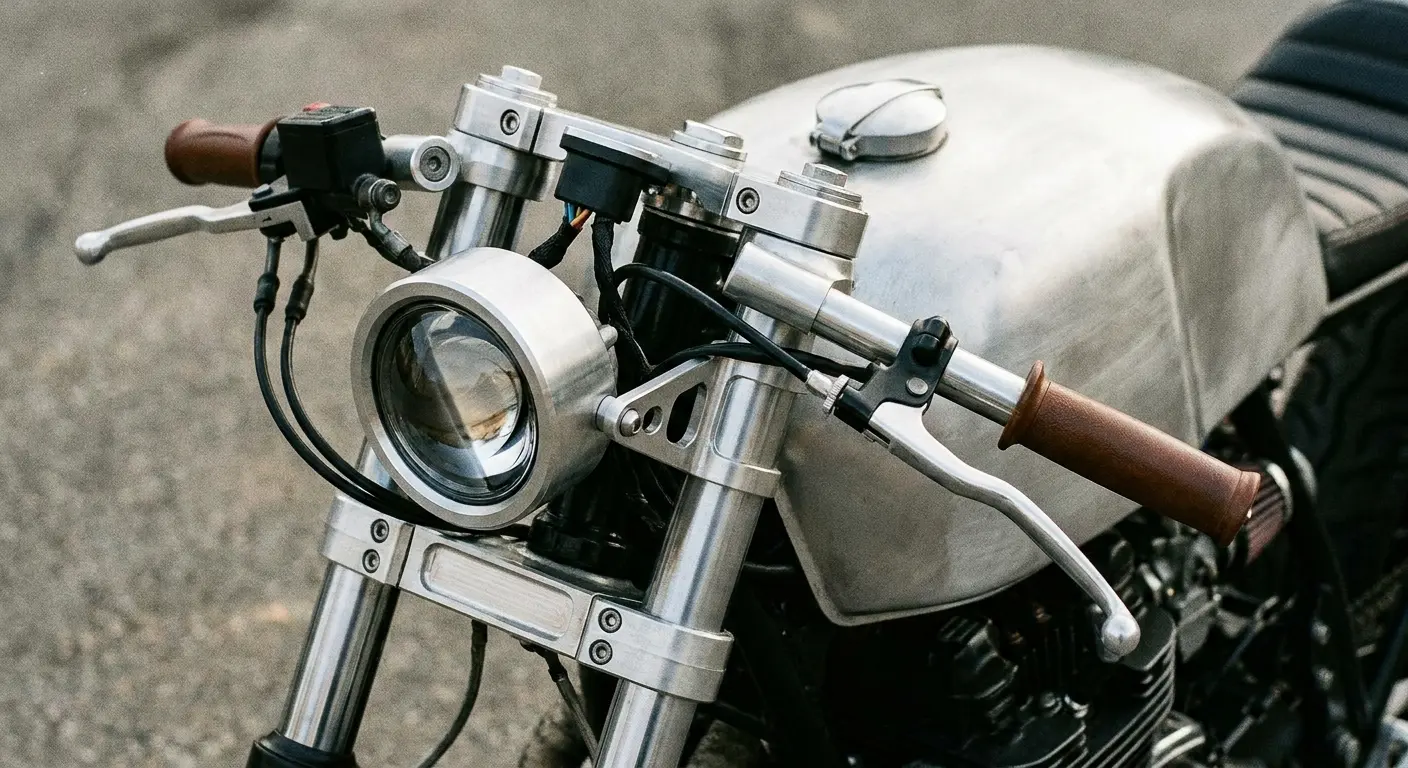
The beam pattern is DOT-compliant with a proper cutoff, so function isn't sacrificed for style. This is one of the better options if you're building a modern streetfighter and want a headlight that matches the aesthetic without resorting to a tiny, useless light.
15. Rizoma Veloce L Headlight
Rizoma's approach combines Italian design with functional optics. The Veloce L uses a 4.5-inch projector housing with a machined aluminum bezel and glass lens. The projector accepts H7 bulbs (halogen or LED), and the beam pattern is ECE-compliant with a sharp cutoff.
The housing is designed to mount using Rizoma's modular bracket system, which gives you options for fork mounting, triple tree mounting, or fairing integration.
You're paying for design and build quality here (these aren't cheap), but you're getting a custom motorcycle headlight that works as well as it looks. The compact size limits total light output, so this works best for bikes that will be supplemented with auxiliary lights or for riders who do most of their riding in well-lit areas.
The aluminum construction and quality finish mean these hold up well over time without fading or corroding. I've seen five-year-old Rizoma lights that still look new.
Headlights for Riders Who Actually Use Their Bikes
Some riders put thousands of miles on their bikes each year, commuting daily, touring weekends, or running errands in all conditions. These three options are built for durability and consistent performance rather than maximum specs or cutting-edge features.
They're designed to work reliably over years of use, handle vibration and weather exposure, and provide the specific beam patterns that make real-world riding safer.
16. DENALI T3 Switch-Back Turn Signal Kit
While technically a turn signal kit, the T3 system includes auxiliary lighting that significantly improves your visibility to other traffic. The pods combine white running lights, amber turn signals, and auxiliary driving lights in a compact housing.
Each pod draws 10 watts for the driving light function, and the switch-back feature automatically transitions from white to amber when you activate turn signals. This matters because being seen is often more important than seeing, especially in urban environments.
The kit includes a plug-and-play controller that integrates with most bikes' turn signal circuits without cutting wires. The lights mount on crash bars, highway pegs, or fork tubes using adjustable brackets.
I've found these particularly useful for commuters who ride in heavy traffic where visibility to cars is a primary safety concern. They're not going to light up dark country roads, but they'll help prevent the "sorry, I didn't see you" accidents.
17. Morimoto Mini D2S 4.0 Bi-Xenon Projector
Morimoto builds projectors for automotive retrofits, but the Mini D2S works well in motorcycle applications if you're willing to do custom integration.
The projector uses a bi-xenon setup with a mechanical shutter for high and low beam switching. You get HID output (around 3200 lumens) with a precise beam pattern and sharp cutoff. The projector is compact (2.5-inch diameter), which makes it easier to integrate into custom housings or tight spaces.
You'll need to provide your own housing, mounting solution, and HID ballast (Morimoto sells compatible ballasts). This isn't a bolt-on solution. It's for builders who want the best possible optics and are willing to fabricate the surrounding components.
The beam pattern is exceptional, better than most complete headlight assemblies, but you're committing to a more complex installation. Installation is supposed to take a few hours. Took me most of a weekend because I had to fabricate a custom housing.
HID systems also require more electrical power than LEDs (around 35 watts per bulb plus ballast losses), so verify your charging system can handle the load.
18. Hella Micro DE Xenon Driving Light
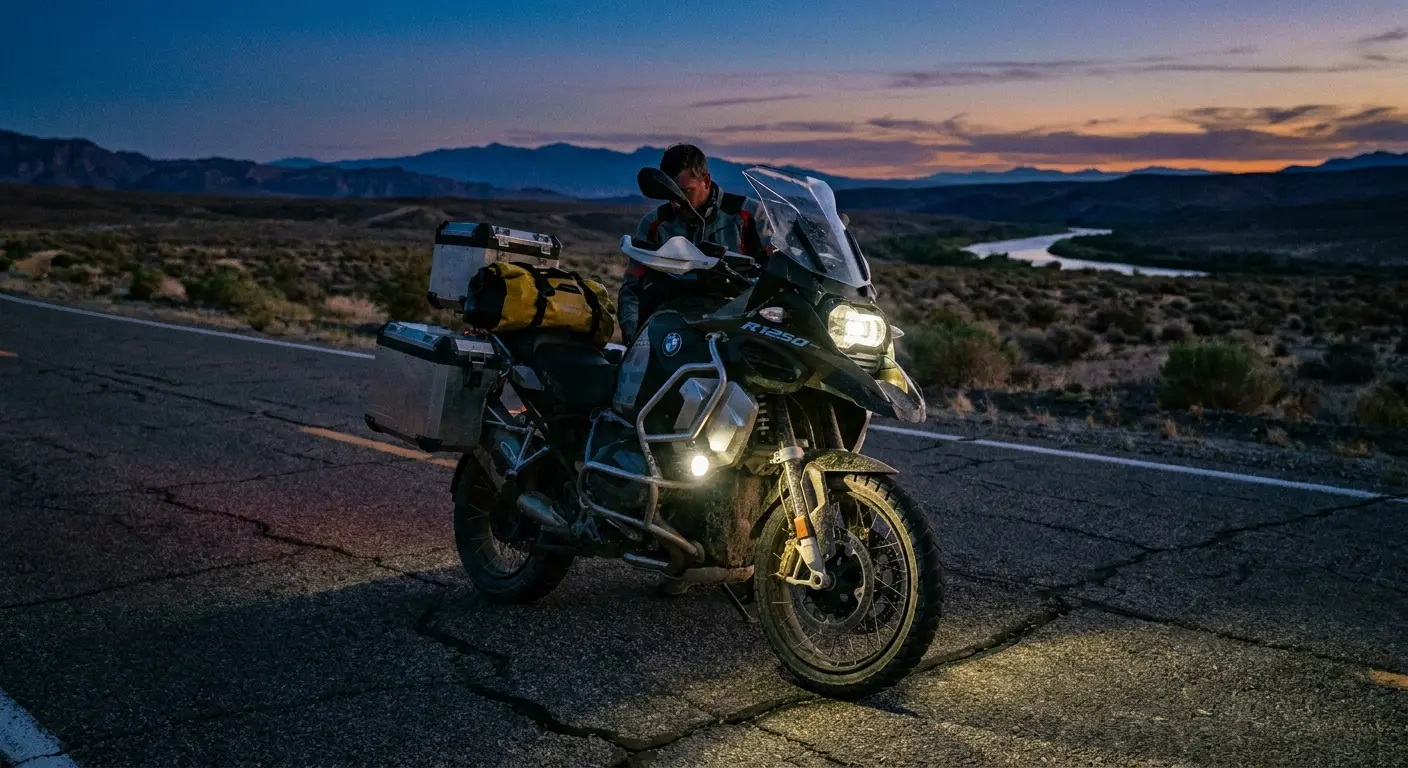
Hella's Micro DE is a small (55mm) HID driving light that works well as an auxiliary light for distance visibility. Each light produces about 2000 lumens with a tight spot beam pattern that reaches 500+ meters.
The projector design creates minimal scatter, so you get usable light at distance without blinding oncoming traffic. Each light requires a separate ballast (included), and total power draw is about 35 watts per light.
The compact size means you can mount them in places where larger lights won't fit, such as inside fairings, on fork tubes, or integrated into custom brackets. The housings are fully sealed and vibration-resistant, which matters on motorcycles where lights take more abuse than in cars.
These work best as supplements to a good primary headlight rather than as standalone lighting. The tight beam pattern provides excellent distance visibility but doesn't help with peripheral vision or close-range illumination.
I've been running a pair on my adventure bike for three years. They've survived everything from Montana hailstorms to desert heat. Still work perfectly.
Quick Tangent: Your Phone Is Ruining Your Night Vision
Okay, weird topic shift, but hear me out.
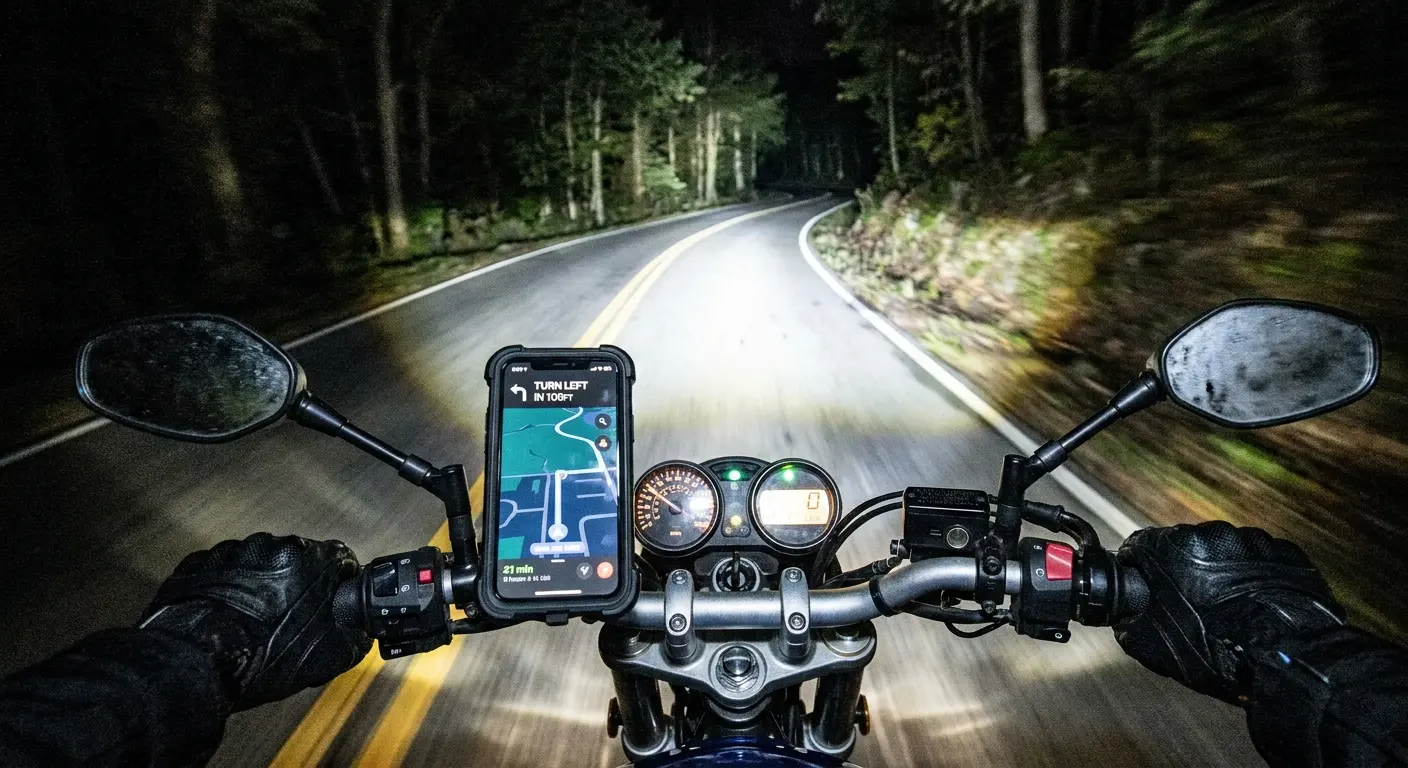
You just spent $400 on lights. Your phone mount cost $30 and you stuck it wherever it fit. Now you're riding at night and there's this bright rectangle in your peripheral vision destroying your night vision adaptation. Or worse, it's reflecting off your windscreen directly into your eyes.
I did this. Mounted my phone right in my sight line because "convenient." Then wondered why I was having trouble seeing at night even with new lights. Moved the phone mount lower and to the right. Problem solved.
If you're using Rokform mounts (I am, on two bikes), their Pro Series sits low-profile enough that it's not in your face. The magnetic system means you can yank the phone off when you don't need navigation, which is what you should be doing at night anyway. Less glare equals better visibility.
Also handles charging without cables flopping around, which is nice.
Not sponsored, just annoying when people ignore this stuff then blame their headlights.
Just Buy Something Already
Look, you've read several thousand words about headlights. Here's what actually matters:
If you're on a budget: Truck-Lite 27270C. Around $150, works great, fits most bikes. Done.
If you want the best: JW Speaker 8790. Expensive, worth it if you ride at night regularly.
If you need auxiliary lights: Denali D4s. Low power draw, good beam pattern, reliable.
If you're building a custom bike: Motodemic if it fits your bike, Rizoma Veloce L if it doesn't. Don't cheap out on optics.
If you're not sure: Start with a good LED H4 bulb (Cyclops). Around $60, easy install, see if that's enough before spending more.
The best headlight is the one you'll actually install and aim properly. I've seen $500 lights installed wrong that perform worse than $100 lights installed correctly.
Better than the JW Speaker? No. Half the price? Yes. You decide what matters more.
Aim your lights. Check your electrical system. Ride safe.
And for the love of god, stop buying 50,000-lumen Amazon specials. They're garbage. I know because I've bought them. Three of them. All died within six months. Learn from my mistakes.

