


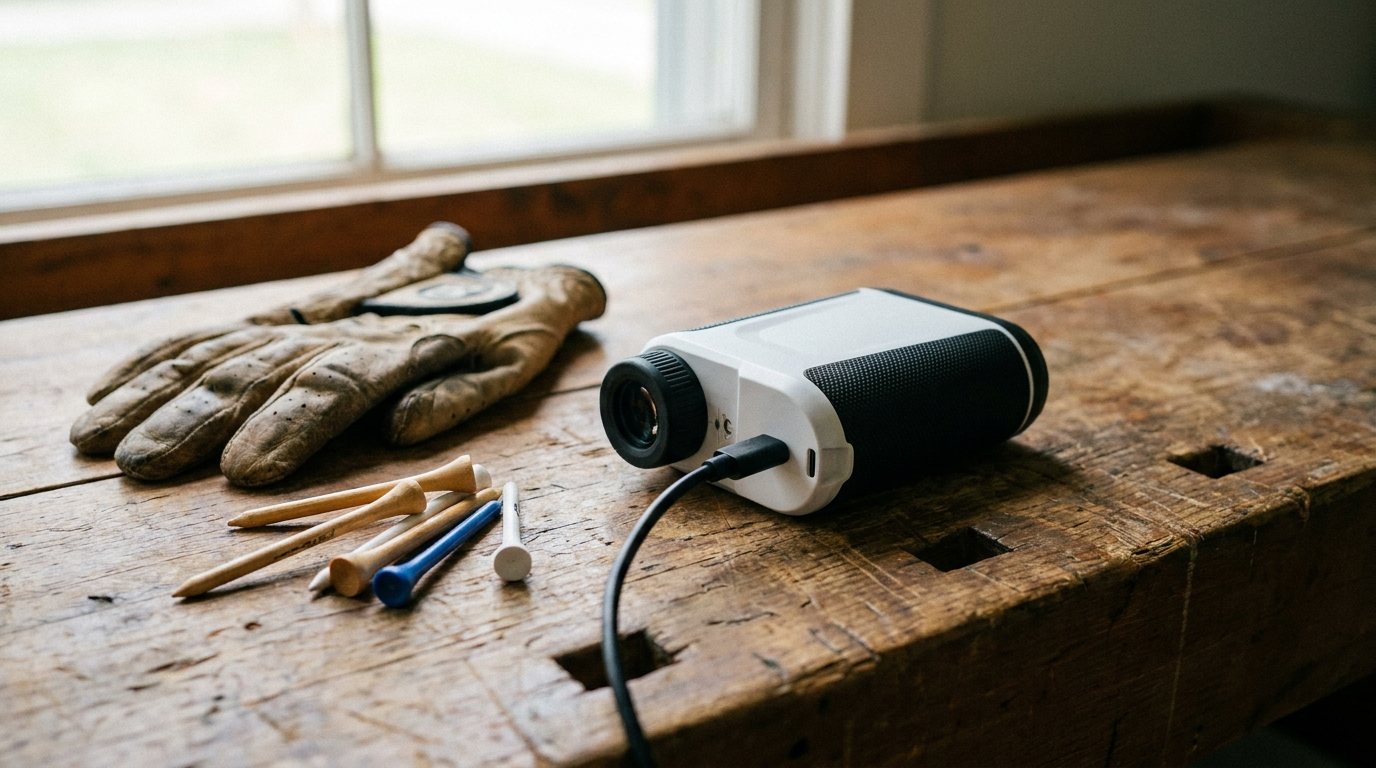
Rokform 18x: USB-C charging in the box, September.
17 rechargeable golf rangefinders, real published battery figures, and the manual warning about storing a cell you cannot replace.
Bushnell's own A1-Slope manual contains a sentence worth more than any spec on the box. It recommends recharging every 60 days and warns that storing the battery at 0% for over 80 days could cause permanent damage.
That cell is not user-replaceable. And Bushnell's warranty separately excludes batteries as a wear item, listing them alongside battery doors and eye cups as parts that might wear out over time.
Put those two facts together and a rechargeable rangefinder left flat over a winter is a device whose lifespan is a warranty exclusion. That is not an argument against rechargeables, which are genuinely convenient. It is an argument for knowing which one you are buying and how to store it. So here are 17, with the published figures and the honest comparison against a coin cell.
Table of Contents
- Rechargeable Or Replaceable
- The Best Rechargeable Lasers
- Rechargeable GPS And Hybrids
- Budget Rechargeable
- The Coin Cell Alternative
- What The Manuals Say About Storage
- What Rokform Is Bringing To This In September
- Final Thoughts
TL;DR
- Bushnell warns that storing a rechargeable at 0% for over 80 days can cause permanent damage.
- Bushnell's warranty excludes batteries as a wear item, on a cell you cannot replace.
- Bushnell's entire current line is coin cell except one model. Nikon publishes no rechargeable at all.
- A CR2 costs $2.30 in bulk and lasts roughly 50 rounds, so the running cost argument is close to zero.
- Precision Pro publishes that Bluetooth drops battery from 40 rounds to 10 on the same charge.
- The Rokform Golf Range Finder 18x lands September 2026 with a USB-C charging cable in the box.
Rechargeable Or Replaceable
The split runs cleanly along brand lines, which tells you the two camps disagree on principle rather than on engineering. Our golf accessories every golfer needs list has the same split running through it.
USB-C rechargeable: GOGOGO, MILESEEY, REDTIGER, WOSPORTS, Blue Tees, Precision Pro's Titan Elite, Bushnell's A1-Slope, Voice Caddie's SL3, Garmin's Z82.
Coin cell: almost all Bushnell, all Nikon, Shot Scope, Callaway, TecTecTec's KLYR, Precision Pro's NX line, Voice Caddie's TL1 and L6, Garmin's Z30, Vortex on CR123.

The Running Cost Argument Does Not Hold
A CR2 costs $8.44 in a retail two-pack and $2.30 per cell in a twelve-pack. At Precision Pro's published figure of roughly 50 rounds per cell, or Nikon's 13,000 actuations, a golfer playing forty rounds a year uses about one battery annually.
So the ongoing cost is $2 to $8 a year, which is not a reason to choose either way. Duracell advertises ten year shelf storage, so buying a twelve-pack once effectively ends the question, which is the kind of purchase our holiday gift guide for golfers keeps recommending. Convenience is the real argument for rechargeable, not economics. Our best golf rangefinders guide covers the rest of the buying decision.
| Rechargeable | Coin cell | |
|---|---|---|
| Running cost | Zero | $2 to $8 a year |
| Failure mode | Degrades, cannot be replaced | Runs out, swap in 30 seconds |
| Winter storage | Needs charging every 60 days | Nothing to do |
| Mid-round failure | Round over | Carry a spare |
| Warranty | Battery often excluded | Not applicable |
| Convenience | Higher | Lower |
The Best Rechargeable Lasers
Five devices where the rechargeable cell is paired with a rangefinder worth owning.
1. Bushnell A1-Slope
$299.99, 6x, 145 grams, the smallest golf rangefinder by volume at 206 cubic centimetres, single button ranging, and 50-plus rounds or 3,000 target acquisitions per charge with a four hour full charge.
Bushnell publishes the most complete rechargeable figures in golf, and also the storage warning above. Recharge every 60 days and it is fine. Leave it flat all winter and you may not have a device in spring.
2. Precision Pro Titan Elite
$399.99, 18mm eye relief, GPS distances in the viewfinder, Find My Precision Pro, three year warranty, no subscription, and roughly 50 rounds per charge.
Precision Pro also publishes the figure nobody else will: up to 40 rounds without Bluetooth and up to 10 rounds with it. A 75% reduction, independently corroborated. Their US site quotes a flat 50 rounds with no Bluetooth qualifier, so treat the UK split figure as the informative one.

3. Blue Tees Series 3 Max+
$199.98, 6x, 900 yards, IPX4, USB-C, magnetic strip, and three separate display elements for distance, adjusted distance and slope angle. Blue Tees publishes no battery life figure for any model, which is a gap.
Acquisition is the weakness, needing five or six attempts past 150 to 200 yards against a backdrop.
4. Voice Caddie SL3
$599.99, 6X, 1,000 yards, a 1,000mAh lithium polymer cell, and genuinely useful published figures: 45 hours in laser mode and 20 hours with GPS Pin Assist running. Hours rather than rounds, which is more precise than most.
Breaking Eighty found the GPS Pin Assist feature actively degraded acquisition, so switching it off both improves the lock and more than doubles the battery.
5. Garmin Approach Z82
$599.99, 6x with image stabilization, IPX7, accuracy within 10 inches of the flag, and up to 15 hours of typical use. Garmin does not isolate what Bluetooth costs.

Rechargeable GPS And Hybrids
Four devices where rechargeable is the norm rather than a choice.
6. Garmin Approach G12
$99.97, a clip-on GPS puck with 42,000-plus preloaded courses and up to 30 hours of battery, which is the strongest figure in this piece. Its big-numbers mode is the only named large-font option anywhere in the category.
7. Shot Scope G6
$149.99 GPS watch, rechargeable, and backed by Shot Scope's position of being 100% subscription free for life.

8. MILESEEY GenePro G1
Touchscreen GPS rangefinder with app connectivity for firmware and course data, no subscription, and MILESEEY states a phone is not required during normal play. Battery figures are not published.
9. Blue Tees Captain Pro
$299.98, 7x, GPS in the display, shot tracking, AI recommendations, Find My Rangefinder, $79 a year after six months free. No published battery figure, and a connected feature set that will draw on it heavily.
Budget Rechargeable
Four devices under $170 where USB-C is now standard.
10. GOGOGO Sport PocketPin
$55.00, rechargeable, a 750mAh cell, 60-plus rounds per charge and 0 to 80% in 45 minutes. The cheapest credible laser in golf and the best published charge figures at any price.
11. REDTIGER GolfVue Series 1
$109.99, 7X, 1,200 yards, accurate to half a yard, IP54, magnetic stripe with a belt clip in the box. Flag lock sits inside a six mode selector rather than being the default.
REDTIGER states outright the IP54 rating is unsuited to rainy or foggy rounds.

12. MILESEEY PF260 Tour
$169.99, 6X, 1,100 yards, 350 yard flag lock, IP54, magnetic mount with a green LED for slope state, and published acquisition timings of 0.3 seconds general and 0.8 seconds for a flag lock.
13. Gogogo ZeroIn Rechargeable
$149.99, the top of the GOGOGO range and the point where the brand competes on features rather than price alone.
The Coin Cell Alternative
Four devices worth considering precisely because they are not rechargeable.

14. Nikon Coolshot 50i
$299.95, 6x, 176 grams, 17mm eye relief, ±3 degree diopter, and roughly 13,000 actuations per CR2, which is the highest published figure in golf by a wide margin. Nikon's five year warranty is also the longest term.
Nikon publishes no rechargeable rangefinder at all, across the entire Coolshot line.
15. Shot Scope Pro L2
$149.99, x6, 700 yards, one button for power and measurement, plus or minus one yard. Golf Insider scored it 100% on accuracy and Plugged In Golf found it as fast as lasers three times the price.
Coin cell, no Bluetooth, no subscription, and nothing to charge. The simplest ownership experience in golf.
16. Garmin Approach Z30
$499.99, CR2, and Garmin quotes battery life at up to a year. A rechargeable measured in hours against a coin cell measured in years is a fair summary of the whole debate.
17. TecTecTec KLYR
$199.99, 6x, 118 grams and the lightest device in this roundup, CR2, built-in magnet, and a case, ball marker and belt clip in the box. A replaceable cell in the lightest body is a genuinely good combination for a walking golfer.
What The Manuals Say About Storage
This is the part nobody reads and the part that decides whether your rangefinder survives five years.
Bushnell's A1-Slope manual recommends recharging every 60 days and warns that storing the battery at 0% for over 80 days could cause permanent damage. Bushnell's warranty page then lists a two year term on laser rangefinders and excludes normal wear and tear including parts that might wear out over time, giving batteries as the first example.
For a device with a user-replaceable cell that exclusion is irrelevant, because you buy a new battery. For a sealed rechargeable, the excluded wear item is effectively the device's lifespan.
| Brand | Battery type | Published life | Storage guidance |
|---|---|---|---|
| Bushnell A1-Slope | Sealed rechargeable | 50+ rounds, 3,000 acquisitions | Recharge every 60 days |
| Precision Pro Titan Elite | Rechargeable | 50 rounds, 10 with Bluetooth | Not published |
| GOGOGO PocketPin | Rechargeable 750mAh | 60+ rounds | Not published |
| Voice Caddie SL3 | Rechargeable 1,000mAh | 45 h laser, 20 h GPS | Not published |
| Garmin Approach Z82 | Rechargeable | Up to 15 h | Not published |
| Nikon Coolshot 50i | CR2 | ~13,000 actuations | None needed |
| Garmin Approach Z30 | CR2 | Up to 1 year | None needed |
Nobody Documents The Failures
I looked for a body of evidence on rechargeable rangefinders degrading in practice and could not find one. Forum threads exist and are not verifiable at any useful scale.
Treat the risk as manufacturer-acknowledged rather than empirically documented. Bushnell wrote the warning into its own manual, which is the strongest evidence available, and it is a warning rather than a defect report. Store it charged and the question likely never arises. Our winter golf courses list is exactly the scenario where it might, since a device that comes out four times over a cold season sits flat for months.


Which Should You Actually Buy
Rechargeable if you play regularly year-round, keep chargers where you can see them, and value never buying a battery. Coin cell if you play seasonally, store your clubs for months, or want the option of carrying a $2.30 spare in the bag that solves any mid-round failure in thirty seconds.
That second scenario is the one people underweight. A rechargeable that dies on the eighth hole ends your yardages for the round, and there is nothing you can do about it. A coin cell failure is a thirty second inconvenience if you carry a spare and a full round of guessing if you do not. Our golf accessories every golfer needs list has room for one CR2.


Switch Bluetooth Off If You Have It
Precision Pro's 40-rounds-to-10-rounds figure is the only published Bluetooth battery cost in golf, and there is no reason to think other brands escape the same physics.
If your connected features are mostly course updates and firmware, they happen at home rather than on the course, so leaving the radio off during play costs you nothing and roughly quadruples your charge interval. Our golf accessories for accuracy roundup covers the rest of the kit worth setting up once and forgetting.
What Rokform Is Bringing To This In September
The Rokform Golf Range Finder 18x arrives September 2026 and ships with a USB-C charging cable in the box alongside a carrying case, a microfibre lens cloth and a quick start guide.
The more relevant number is the warranty behind it: two years, with 60 day money back. Read that against the storage caveats above, because a rechargeable device is only as good as the company standing behind the cell inside it.
8x to 18x adjustable magnification is a category first, and no other golf laser rangefinder offers that range. Zoom in on the flag on a long par 5, dial back for a quick read on a short approach. Flag lock with vibration confirms the pin the moment you lock it, the 1,200 yard range reads anything visible on the course, and the tournament-legal slope toggle covers practice and competition on one device. IPX6 handles dew, rain delays and humid summer rounds.
Apple Find My and Android Find Hub tracking are built in, so a charged rangefinder never gets left on a tee box. MagMax magnetic mounting snaps it to cart rails and any MagMax surface, running on the same system as our top golf cart accessories lineup. $499.99.
Reserve yours ahead of the September launch: Rokform Golf Range Finder 18x. Swing hard, make putts.
Final Thoughts
Buy rechargeable for the convenience and then treat the cell like a cell. Charge it every couple of months whether you played or not, never store it flat, and check whether the brand's warranty excludes batteries before you assume you are covered, because at least one major brand does.
If you play four times a year and store your clubs the rest of the time, the best rechargeable golf rangefinder may not be rechargeable at all. A coin cell at $2.30 that sits in a drawer for a decade and still works in April is the unglamorous right answer for a seasonal golfer, and it is why Nikon has never shipped a rechargeable rangefinder. Our most common golf mistakes piece covers what actually costs you strokes.

