


Rokform 18x: 8x to 18x zoom, arriving September.
17 types of golf rangefinder explained, what each one can and cannot measure, and why 41% of golfers now carry two of them.
Most people frame this as laser versus GPS. That is the wrong question, because a July 2026 Shot Scope survey found 80% of golfers use a GPS device, 51% use a laser, and 41% carry both.
Forty-one percent is the interesting number. Those golfers are not undecided. They worked out that the two technologies fail in opposite directions and stopped treating it as a choice.
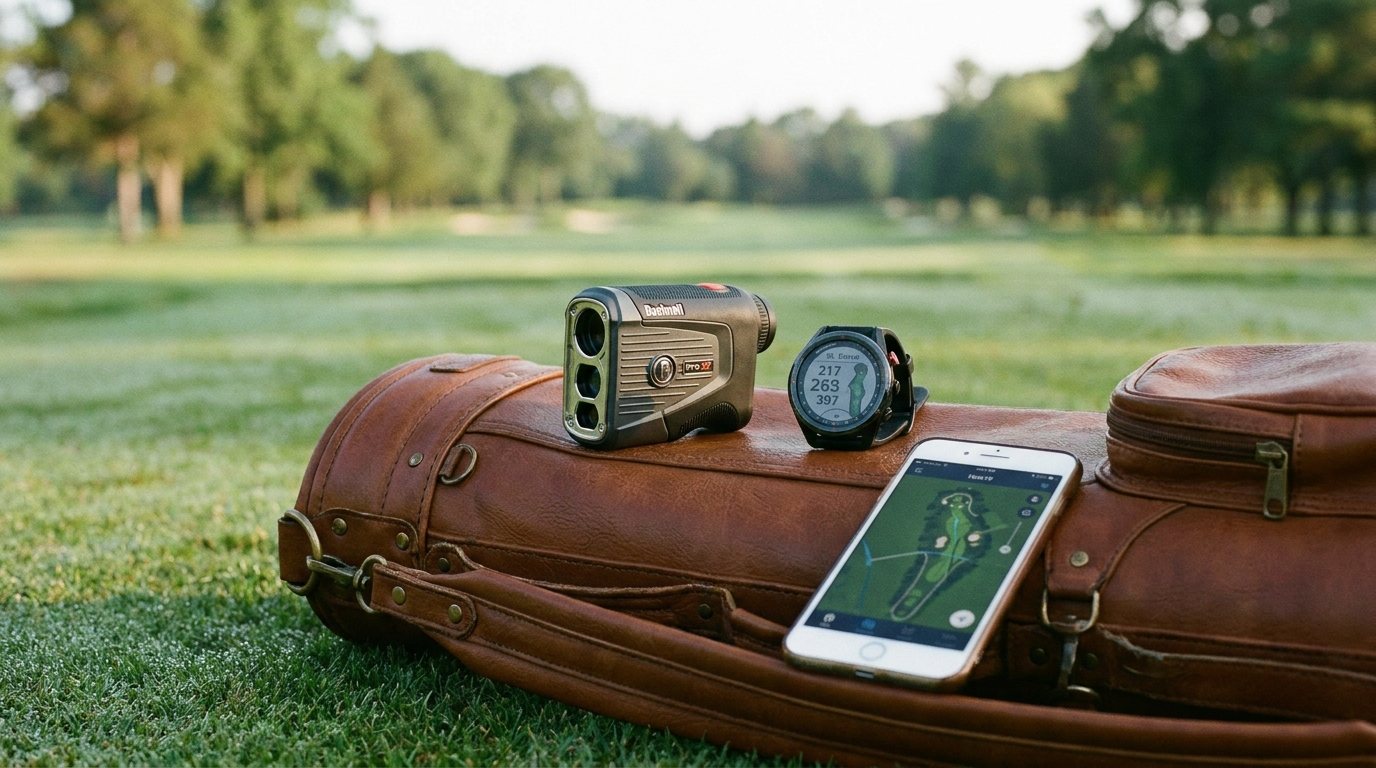
A laser measures what you can see, to within a yard, and is useless on a blind shot, a dogleg or a ball in the trees, which our golf accessories for accuracy roundup runs into constantly. GPS knows the whole hole and cannot tell you where today's pin is. So here are 17 distinct types, sorted by what they physically measure, with what each one genuinely cannot do.
Table of Contents
- The Two Underlying Technologies
- Laser Types
- GPS Types
- Hybrid And Combination Types
- Specialist Types
- Which Type Suits Which Course
- What Rokform Is Bringing To This In September
- Final Thoughts
TL;DR
- A laser measures line of sight to a target you can see. GPS reads a stored map of the hole.
- 41% of golfers now carry both, which is the honest answer rather than a compromise.
- A laser gives you the pin. GPS gives you front, centre, back, hazards and doglegs.
- GPS accuracy depends on satellites and degrades under trees. Laser accuracy does not.
- Handheld GPS with a big-numbers mode is the most overlooked type for anyone with poor eyesight.
- The Rokform Golf Range Finder 18x lands September 2026 with 8x to 18x adjustable magnification.
The Two Underlying Technologies
Everything on this page is one of two things wearing different clothes.
A laser fires a pulse, times the return, and reports the distance to whatever the beam hit. It is accurate to roughly a yard, needs line of sight, and knows nothing about the hole beyond the object in front of it. It requires you to aim.
GPS compares your position against a stored map of the course. It knows the shape of the hole, the front and back of the green, the hazards and the carry distances, and it never needs you to point at anything. It does not know where the pin is today, because the map does not move when the greenkeeper does.

Where Each One Fails
A laser fails on any target you cannot see. Blind shots over a ridge, doglegs, a ball under trees, and a green fronted by a mound are all situations where pointing a laser gets you nothing.
GPS fails on precision and on pin position. UDisc, whose data covers a comparable sport, is candid that narrowing your location to within 10 metres requires a signal from seven or more satellites and that tree cover degrades it. Ten metres is roughly 11 yards on a shot where a laser is accurate to one. Our best golf rangefinders guide covers the laser side in depth.
| Situation | Laser | GPS |
|---|---|---|
| Pin you can see | Excellent, to a yard | Approximate, centre only |
| Blind shot over a ridge | Useless | Excellent |
| Dogleg carry distance | Useless | Excellent |
| Ball in the trees | Useless | Works, degraded |
| Front and back of green | Not possible | Standard |
| Today's pin position | Exact | Not known |
| Hazard carries | Only if visible | Standard |
Laser Types
Six distinct types of laser device, differing in what they add on top of the measurement.
1. Standard Laser Rangefinder
The baseline. Fires, locks the flag, gives you a yardage. 6x magnification, roughly a yard of accuracy, a coin cell or a rechargeable, and nothing else. Shot Scope's Pro L2 at $149.99 is the archetype and one of the best devices in golf.
2. Slope Laser Rangefinder
Adds an inclinometer and returns a plays-like number adjusted for elevation. Now effectively universal, including on sub-$100 models.
Two things to know. Measuring elevation change is prohibited by Rule 4.3a(1) in every round, not only in competition, and no brand publishes an accuracy tolerance for the adjusted number even though every one of them publishes a tolerance for the measured distance.

3. Stabilized Laser Rangefinder
Adds optical or electronic stabilization to steady the view and, on Nikon and Leupold, the laser itself. Roughly eleven SKUs exist across eight brands. Nikon quantifies the effect at around 80% shake reduction, the only published figure in golf.
4. Environmental Laser Rangefinder
Adds temperature, barometric pressure or altitude to the slope calculation. Bushnell calls it Elements, Leupold calls it True Golf Range. Arccos goes furthest with wind, gusts and humidity too.
Every added variable is a further Rules problem, and all of them switch off with slope.
5. Connected Laser Rangefinder
Adds Bluetooth for course updates, shot tracking, club recommendations or a find-my-device function. Precision Pro publishes that the connection costs 75% of the battery, from roughly 40 rounds down to 10.
6. Screen-Based Laser Rangefinder
No eyepiece at all. Callaway's Screen View shows the reading on an external OLED you hold up like a phone, which removes eye alignment entirely. Genuinely the most accessible laser type and almost nobody covers it.

GPS Types
Five types of GPS device, differing mainly in where you wear them.
7. GPS Golf Watch
Worn on the wrist, glanceable without reaching for anything, and by far the most common type given that 80% of golfers use GPS. Shot Scope's G6 at $149.99 sits at the value end.
The tradeoff is screen size, which is why several brands built a big-numbers mode into watches specifically.
8. Clip-On GPS Puck
Garmin's Approach G12 at $99.97 is the pattern: a small unit that clips to a belt or bag, with 42,000-plus preloaded courses, up to 30 hours of battery, and front, centre and back numbers plus hazards and doglegs.
Its big-numbers mode is the only named large-font option I found anywhere in this category, which makes it the most underrated device in this piece for anyone with poor eyesight.

9. Handheld GPS
A larger screen with a full hole map, like the IZZO Swami 7000i at $149.99. More information than a watch and more to carry.
10. Touchscreen GPS Rangefinder
MILESEEY's GenePro G1 combines a touchscreen GPS interface with a laser, with app connectivity for firmware and course data and no subscription.
11. Phone App GPS
Free or near-free, running on hardware you already carry, and the type most golfers actually start with. The limitation is battery and the temptation to look at everything else on the phone. Our roundup of the top GPS golf apps covers the field.
Hybrid And Combination Types
Three types that put both technologies in one device, which is where the 41% figure is heading.

12. Laser Plus Onboard GPS
The Bushnell Tour Hybrid at $499.99 is a single unit with GPS stored on the device and no phone required. It shows slope-compensated laser distances and slope-compensated GPS distances at the same time.
This solves the laser's structural weakness properly. You get the pin number and the front and back numbers together, from one device, without pairing anything.

13. Laser Plus Phone GPS
Voice Caddie's SL3 at $599.99 has course data fully onboard, while other hybrids lean on a paired phone. Worth checking which you are buying, since a phone-dependent hybrid stops being a hybrid when the battery dies.
14. Laser Plus Watch Relay
Garmin's Approach Z30 pushes the pin location you just lasered straight to a paired Garmin watch, so the yardage ends up on your wrist. A clever division of labour rather than a merged device.
Specialist Types
Three types built for a job the mainstream category does not serve.
15. Disc Golf Rangefinder
Reads in feet rather than yards, has slope permanently enabled because the PDGA allows it with no restriction, and offers a closest-or-farthest target priority mode so you can shoot past branches. Ball golf models offer none of that.
16. Hybrid Camera Rangefinder
Canon's PowerShot GOLF at $350 is a camera architecture with two-axis stabilization, 6x optical to 12x digital zoom, stills, video and a microSD slot. Strange, and MyGolfSpy named it best hybrid in 2026 testing.
17. Shot Tracking System
Not a rangefinder at all, but the type most likely to actually lower your scores. Club tags and an app record every shot for post-round analysis. Shot Scope's Pro LX+ splits a detachable GPS and tracking handheld away from the laser so the laser's battery is not paying for it, and Shot Scope charges no subscription ever.
Which Type Suits Which Course
Match the type to the terrain rather than to a review score.
Open parkland with visible pins wants a laser, full stop. Everything GPS adds is redundant when you can see the flag.
Tree-lined or elevated courses with blind shots wants GPS at minimum and probably both. A laser cannot help over a ridge.
Links with wind as the main variable wants a laser plus your own judgement, since wind measured at the course is prohibited anyway and forecast wind is what the connected devices are showing you.
| Course type | Best single type | Best pairing |
|---|---|---|
| Open parkland, visible pins | Laser | Laser plus phone app |
| Tree-lined, blind shots | Hybrid | Laser plus GPS watch |
| Elevated, big carries | GPS | Hybrid |
| Links, wind dominant | Laser | Laser plus judgement |
| Unfamiliar course | GPS | Hybrid |
| Competition | Laser, slope off | Laser alone |
The Case For Carrying Two
The 41% are onto something. A laser and a cheap GPS puck together cost less than one premium hybrid, and each covers the other's blind spot completely.
The Shot Scope Pro L2 at $149.99 plus a Garmin Approach G12 at $99.97 is $249.96 for a combination that beats a $599.99 single device on capability, if not on convenience. Two devices means two things to charge and two things to lose, which is the honest counterargument. Our golf accessories every golfer needs list covers what else earns bag space.

The Rules Apply To The Type, Not The Device
Whatever type you choose, the same line applies. Rule 4.3a(1) allows getting distance information and prohibits interpreting it, and separately prohibits measuring elevation change in any round.
So a plain laser and a plain GPS are both fine. Slope, club recommendations and plays-like numbers are not, on any type. And a Committee can prohibit distance devices entirely by Local Rule, which sits above all of this. Our golf etiquette guide covers the conventions around using any of them without holding up the group.


What To Buy First
If you own nothing, start with a phone app, because it is free and it teaches you what information you actually use. Most golfers discover they look at the front and back of the green far more than they expected.
Then buy the type that covers what the app cannot, which for almost everyone is a laser, because pin position is the one number GPS structurally cannot give you. Our types of golf clubs breakdown is the necessary companion, since a yardage only helps once you know what you hit at that number.
What Rokform Is Bringing To This In September
The Rokform Golf Range Finder 18x arrives September 2026 as a laser, and it adds a capability no other type in this list has.
8x to 18x adjustable magnification is a category first, and no other golf laser rangefinder offers that range. A laser's weakness is targets you cannot resolve, and adjustable zoom directly attacks that. Dial up to 18x to pick a flag out of a cluttered wooded backdrop on a long par 5, dial back for a fast wide-field read on a short approach. It does not turn a laser into GPS, and it does meaningfully widen the range of shots where a laser still gives you an answer.
Flag lock with vibration confirms the pin the moment you lock it, so there is no guessing whether you got the flag or the bunker behind it. The 1,200 yard range reads anything visible on the course, the tournament-legal slope toggle covers practice and competition on one device, and IPX6 handles dew, rain delays and humid summer rounds.
Apple Find My and Android Find Hub tracking are built in, which matters more when you carry two devices than one. MagMax magnetic mounting snaps it to cart rails and any MagMax surface, running on the same system as our top golf cart accessories lineup. Two year warranty, 60 day money back, $499.99.
Reserve yours ahead of the September launch: Rokform Golf Range Finder 18x. Swing hard, make putts.
Final Thoughts
Stop asking which is better and start asking which failure you can live with. A laser is precise and blind. GPS is comprehensive and approximate. Neither is a compromise version of the other, and the 41% who carry both are the ones who worked that out.
Pick your type from the courses you actually play rather than the ones in the review photographs. Among the types of golf rangefinders available today, the one that suits a flat open muni and the one that suits a tree-lined layout with three blind approaches are genuinely different purchases, and no single spec sheet will tell you which you are buying for. Our most common golf mistakes piece covers what costs strokes once the number is right.

