



Table of Contents
The Clubs You Swing for Distance (But Probably Shouldn't)
Standard Driver
Adjustable Driver
Mini Driver
Strong 3-Wood
High-Launch 5-Wood
7-Wood
The Clubs That Get You Out of Trouble (When Your Driver Doesn't)
Traditional Hybrid
Driving Iron
Utility Iron
Rescue Wood
The Clubs You Actually Hit (Pay Attention Here)
Cavity Back Irons
Blade Irons
Game Improvement Irons
Wedge-Iron Combo
Approach Wedge
The Clubs That Save Your Score (Or Destroy It)
Sand Wedge
Lob Wedge
Chipper
Putter
TL;DR
You're obsessing over your driver. Meanwhile, you hit your 7-iron and wedges literally 60% more often. See the problem?
Adjustable drivers and mini drivers aren't just marketing gimmicks, they're legitimate alternatives when your big stick keeps finding the trees
If you think hybrids are for beginners, you haven't played with a good player lately. Tour pros carry them. Your ego is costing you strokes.
That gap between your pitching wedge and sand wedge? You're bleeding strokes there and don't even know it
Rescue woods and chippers get mocked until you're in deep rough or chipping from hardpan. Then they're genius.
Your putter touches the ball 40% of the time. When's the last time you got fit for one?
Stop carrying what looks cool and start carrying what actually works when you're standing over a shot that matters

I spent three hours last weekend watching a guy at the range hit every club in his bag. He striped his 7-iron. Pured his wedges. Then pulled out his 4-iron and 5-iron and proceeded to chunk, thin, and shank his way through twenty balls.
He's not alone. Most of you are carrying 3-4 clubs you can't hit, while missing 2-3 clubs that would actually save you strokes.
The Clubs You Swing for Distance (But Probably Shouldn't)
1. Standard Driver
Your driver. You probably hit it 14 times a round and miss the fairway with nine of them.
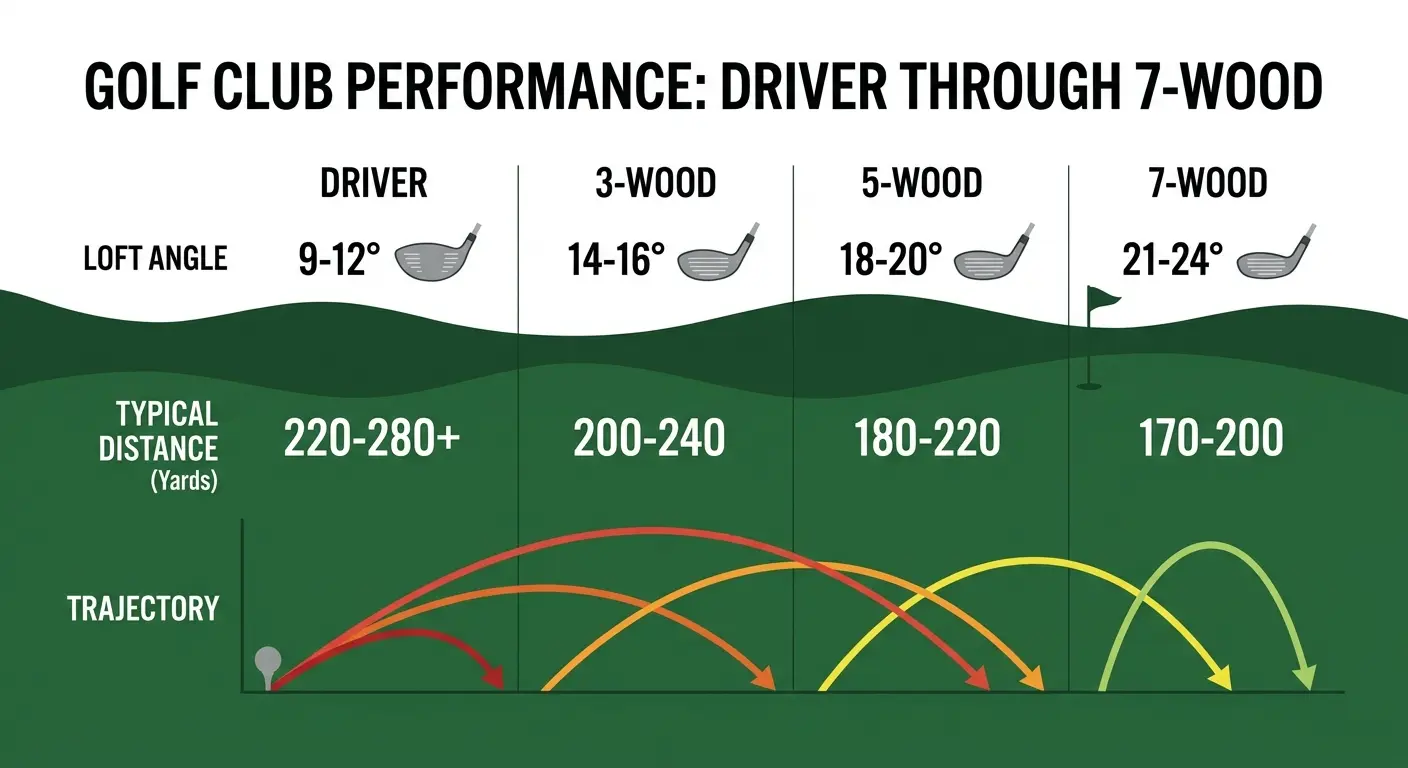
Standard drivers come with the biggest clubhead the USGA allows (460cc), usually 9 to 12 degrees of loft. Companies sell them on forgiveness and high MOI, which sounds great until you realize they only work if you're swinging 95+ mph and hitting the sweet spot most of the time.
Below that threshold? You're sacrificing control for distance you'll never actually achieve. The standard driver sits in most bags because tradition says it should, not because anyone genuinely evaluated whether it's their best option off the tee.
I've watched countless golfers struggle with their 460cc drivers on tight courses, losing balls and confidence, when something smaller would serve them better. The marketing around maximum distance has convinced us we all need the biggest possible clubhead, regardless of whether we can control it.
When you're picking a driver, question whether bigger actually means better for your swing speed.
2. Adjustable Driver
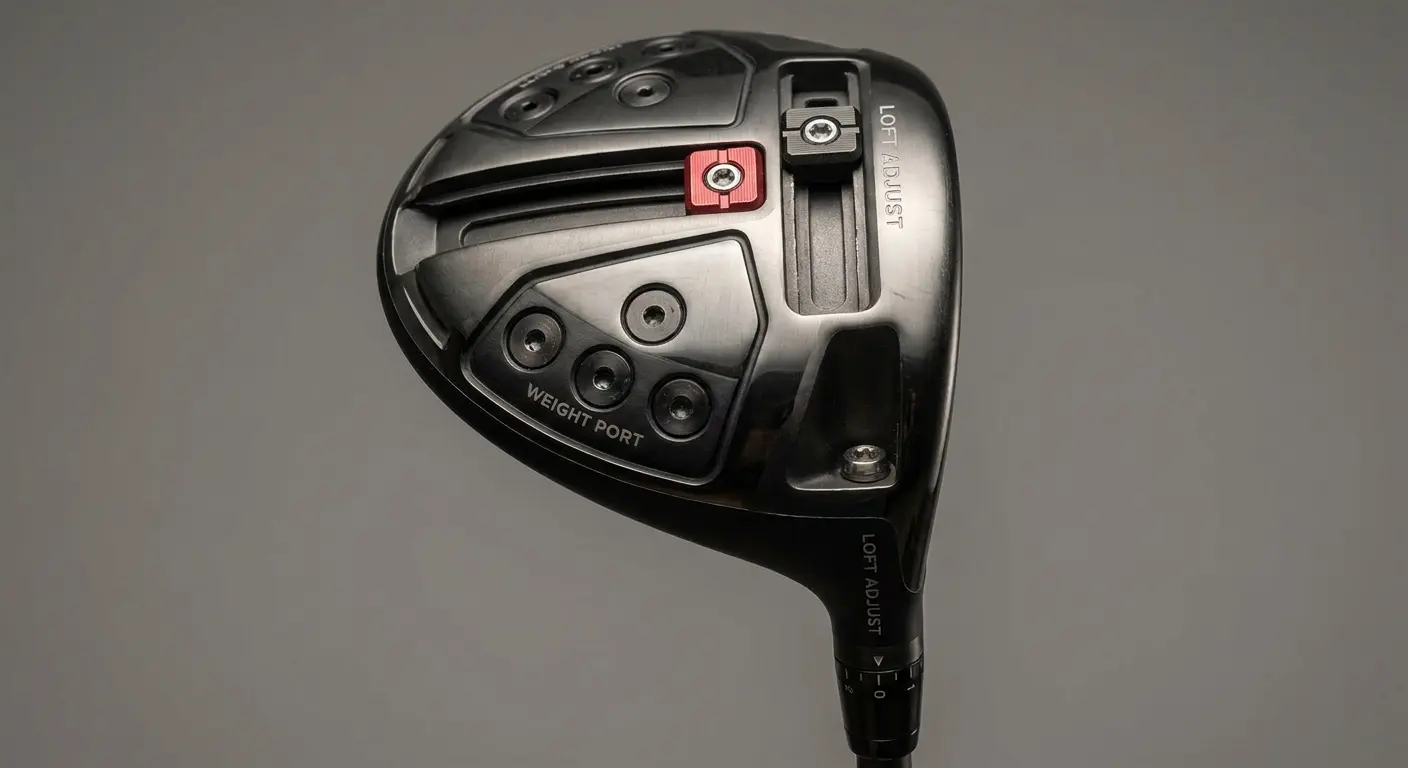
These things let you modify loft, lie angle, and weight distribution without buying multiple clubheads. You can add loft for more carry, shift weight to promote a draw, or adjust the face angle to fight a persistent slice.
Here's what actually happens: You're not locked into one setup as your swing evolves or as course conditions change.
I've seen players drop two strokes per round just by tweaking their driver settings based on whether they're playing in wind or on firm fairways. The downside is that endless adjustability can become a crutch. You might spend more time on the range fiddling with settings than improving your swing mechanics.
These drivers run about $100-150 more than fixed options, so the investment only pays off if you'll use the adjustability instead of setting it once and forgetting it exists. And let's be real, most of you will set it once.
3. Mini Driver
Mini drivers (275-300cc with 11.5-13 degrees of loft) sit between your standard driver and 3-wood. They're shorter (43-44 inches vs. 45+ for standard drivers), easier to control, and surprisingly effective for players who struggle with consistency off the tee.
The smaller head reduces your margin for error but also makes it easier to square the face at impact. You'll give up maybe 10-15 yards of maximum distance compared to a standard driver. Probably less if we're being honest.
But you'll hit more fairways and avoid the penalty strokes that come from wild misses.
These clubs shine on tight courses where accuracy matters more than pure distance. They're also brilliant for players with moderate swing speeds who can't fully compress a larger driver head. The mini driver represents a smart compromise that more golfers should consider, especially if your driver is currently the least reliable club in your bag.
4. Strong 3-Wood
Strong 3-woods (13-14 degrees of loft) blur the line between traditional 3-woods and mini drivers. They're designed for players who want a reliable alternative off the tee without the commitment of a full driver swing.
Unlike a standard 15-degree 3-wood, you get more roll and a flatter trajectory that's easier to control in wind. These clubs work brilliantly off the deck on par 5s when you need to cover ground but can't risk the thin contact that comes from trying to sweep a standard 3-wood.
The shorter shaft (42.5-43 inches) makes them more versatile than drivers while still providing enough distance to keep you competitive. Strong 3-woods are valuable if you play courses with narrow fairways or forced carries where your driver creates more problems than it solves.
This is one of the most underrated options for players who prioritize smart course management over ego-driven distance.
5. High-Launch 5-Wood
High-launch 5-woods (17-18 degrees) serve a specific purpose that many players overlook. They're your go-to club when you need height and soft landing but still want meaningful distance. The higher loft creates more backspin, which helps the ball stop quickly on firm greens.
Use these from the fairway on approach shots to long par 4s or second shots on par 5s where you need to clear hazards and hold the green.
The increased loft also makes them more forgiving from marginal lies in the rough compared to lower-lofted woods. You're looking at 200-220 yards for most players, which fills a gap that hybrids can't quite replicate due to their different ball flight.
Different animal entirely.
High-launch 5-woods work especially well for players with slower swing speeds who struggle to get enough height with traditional fairway woods.
6. 7-Wood
I watched a 12-handicap bury his playing partner's 4-iron last month. His secret? A 7-wood he bought used for sixty bucks.
7-woods (20-21 degrees) get dismissed as "senior clubs" or beginner equipment, which is complete nonsense. They're precision instruments that replace long irons for players who value consistency over perceived machismo.
The 7-wood launches higher than any hybrid with the same loft, making it ideal for hitting into elevated greens or carrying trouble. The longer shaft compared to a hybrid gives you more clubhead speed, while the wood design makes it easier to sweep the ball cleanly from tight lies. You'll hit it 210, give or take, with a soft landing.
These clubs are valuable on courses with small greens where holding the surface matters more than maximizing distance. If you're still carrying a 3-iron or 4-iron that you hit pure maybe twice a season, a 7-wood is probably the smarter choice regardless of what your ego tells you.
The Clubs That Get You Out of Trouble (When Your Driver Doesn't)
7. Traditional Hybrid
Hybrids (18-24 degrees) combine the forgiveness of a wood with the control of an iron, featuring a lower center of gravity that helps you launch the ball even from difficult lies.
The design works well from the rough, where the rounded sole glides through grass instead of getting caught like an iron's leading edge.
You'll see hybrids labeled as 3H, 4H, or 5H, roughly corresponding to the iron they replace. A 4-hybrid is easier to hit than a 4-iron for about 95% of golfers, with minimal distance sacrifice. These clubs excel on approach shots from 170-200 yards where you need both distance and accuracy. They're also surprisingly effective from fairway bunkers due to their low profile and forgiving design.
I can hear you now: "But I hit my 3-iron great!" Sure you do. On the range. With a perfect lie. We're talking about the course, under pressure, from the rough on the 16th hole when you're one down.
The stigma that they're only for beginners or high handicappers is outdated. I see scratch golfers carrying hybrids because they understand that scoring matters more than pride.
Club Type |
Typical Loft |
Best Used From |
Launch Height |
Workability |
Best For |
|---|---|---|---|---|---|
Traditional Hybrid |
18-24° |
Rough, fairway, light sand |
High |
Moderate |
Forgiveness and versatility |
Driving Iron |
16-18° |
Tee, fairway, firm lies |
Low to mid |
High |
Shot shaping and wind control |
Utility Iron |
19-24° |
Fairway, tight lies, hardpan |
Mid |
Moderate-high |
Controlled trajectory with forgiveness |
Rescue Wood |
22-26° |
Deep rough, sand, recovery shots |
High |
Low |
Difficult lies and trouble situations |
Yeah, I know that table is a lot. I almost cut it, but the side-by-side comparison helps. Skip it if your eyes are glazing over.
8. Driving Iron
Driving irons (16-18 degrees) are the anti-hybrid, designed for players who want a penetrating ball flight and maximum control in windy conditions. These clubs feature stronger lofts than traditional long irons, hollow body construction for added forgiveness, and tungsten weighting that lowers the center of gravity without creating excessive spin.
You'll sacrifice some launch height compared to a hybrid, but you gain the ability to flight shots down and work the ball both ways.
Use these off the tee on tight holes where accuracy trumps distance. They're also brilliant into the wind when you need a boring trajectory that won't balloon.
The trade-off? You need consistent contact and reasonable clubhead speed (85+ mph) to make them work. These clubs appeal to better players who value shot-making over pure forgiveness.
Do NOT buy a driving iron because you watched Collin Morikawa hit one on TV. You are not Collin Morikawa. You will hit it 40 yards shorter and twice as inconsistent.

9. Utility Iron
Utility irons (19-24 degrees) sit between driving irons and traditional hybrids in both loft and design philosophy. They feature slightly more offset than driving irons, making them easier to square at impact, while maintaining a more compact profile than hybrids for better turf interaction.
The hollow-body construction provides forgiveness on off-center hits without the ballooning flight that some players dislike about hybrids. Utility irons work well from tight lies, hardpan, or thin rough where you need clean contact but can't risk the digging action of a traditional iron. You're looking at 180-210 yards depending on loft and your swing speed.
These clubs have become popular among better players who want the workability of an iron with some of the forgiveness benefits of modern technology. They're especially valuable if you play firm, fast courses where controlling trajectory matters more than maximizing height.
10. Rescue Wood
Rescue woods and chippers are both specialty clubs that people mock until they try them. Then they're genius.
Rescue woods (22-26 degrees) are essentially high-lofted fairway woods designed for difficult lies. They feature a smaller head than standard fairway woods, a lower profile for better turf interaction, and rails or channels on the sole that help the club glide through rough or sand.
Ever been stuck in deep rough on a par 5 when you need to advance the ball 150-170 yards but can't make clean contact with a traditional club? That's where these shine. The design also works well from fairway bunkers where you need to clear a lip but don't have room for a full swing with something more lofted.
Rescue woods represent a specialized solution that most players don't know exists, which is why they're often missing from bags that would genuinely benefit from having one.
The Clubs You Actually Hit (Pay Attention Here)
11. Cavity Back Irons
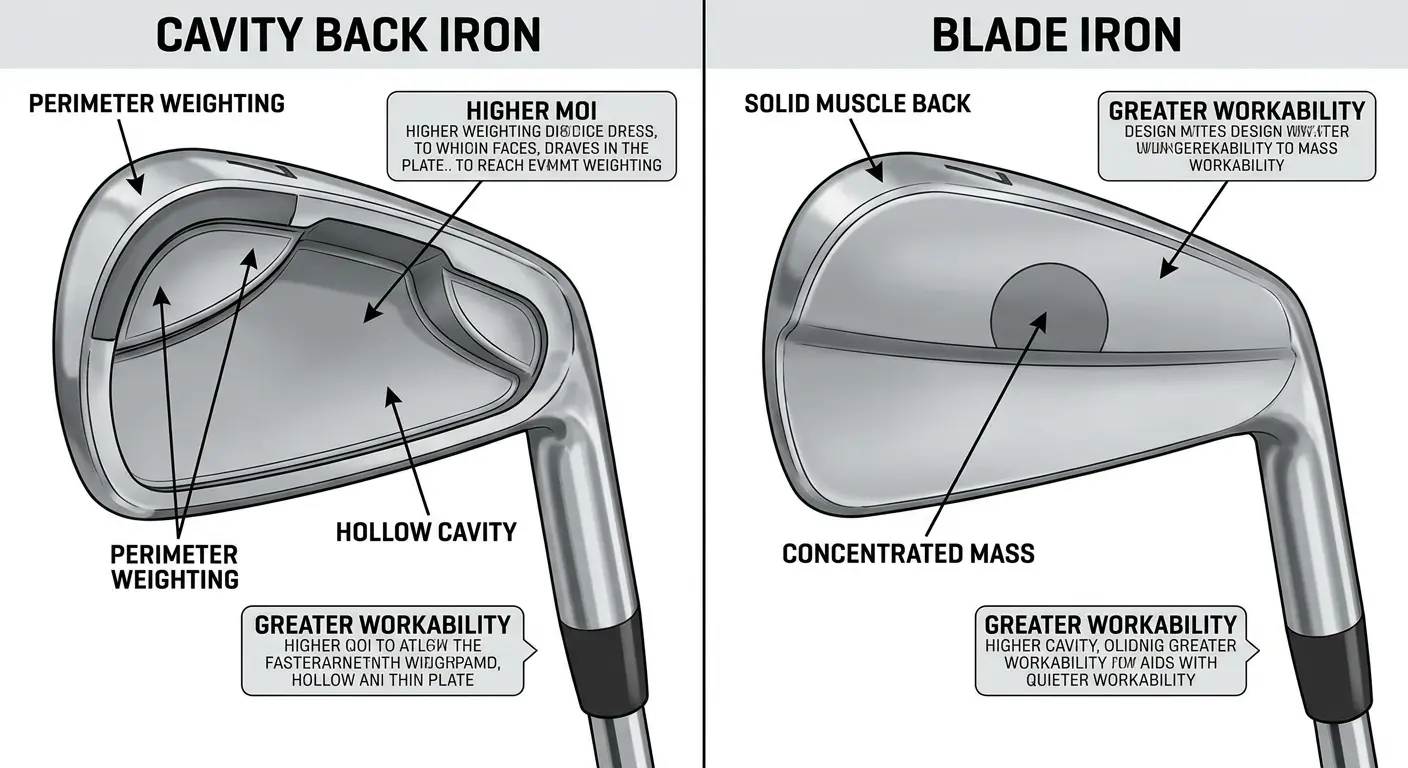
Cavity back irons distribute weight around the perimeter of the clubhead, creating a larger sweet spot and more forgiveness on mishits. The hollowed-out back allows manufacturers to position weight low and deep, which helps you launch the ball higher with less effort.
These irons feature wider soles, more offset, and stronger lofts than traditional designs. You'll see them labeled as "game improvement" or "distance" irons, though those terms have become somewhat meaningless as technology has evolved.
Here's what actually happens: You can miss the center of the face by a quarter-inch and still achieve 85-90% of your optimal distance and accuracy. The trade-off is reduced workability and feedback compared to blade-style irons.
Cavity backs work for the vast majority of golfers because they prioritize results over feel. They've evolved significantly over the past decade, with some models now offering nearly blade-like profiles with cavity-back forgiveness hidden from view.
12. Blade Irons
Blade irons (also called muscle-backs) feature a solid construction with weight concentrated behind the sweet spot. They offer maximum feedback, superior workability, and a traditional look that appeals to accomplished players.
The compact head size and minimal offset allow you to shape shots both ways and control trajectory with precision.
The downside? Mishits are severely punished. Strike the ball a quarter-inch toward the toe or heel and you'll lose 15-20 yards plus significant accuracy.
Unless you're striping it 8 out of 10 times, blades are just expensive ego props. I said it. Your 14-handicap buddy who games blades? He's lying to himself, and his scores prove it.
Blades require consistent ball-striking and a relatively flat swing path to produce good results. They're genuinely beneficial if you're a single-digit handicap who values shot-making over forgiveness, but they're counterproductive for most players.
Blades won't improve your game if you're not already striking the ball consistently. They're tools for specific players with specific needs, not status symbols that automatically make you a better golfer.
13. Game Improvement Irons
Game improvement irons take cavity back technology to its maximum expression, featuring oversized heads, extreme perimeter weighting, and design elements aimed at helping inconsistent ball-strikers. They include wide soles that prevent digging, strong lofts that add distance, and low centers of gravity that promote higher launch.
These irons also feature the most offset of any iron category, which helps square the face at impact and reduce slices.
You'll gain significant forgiveness and distance compared to traditional irons, but you'll sacrifice some precision and the ability to work the ball. Game improvement irons work brilliantly for high handicappers and beginners who need maximum help with contact and launch. They're also smart choices for mid-handicappers who value consistency over shot-making.
If you're real with yourself and you're not hitting at least 50% of greens in regulation, these irons will help your scores more than any blade ever could.
Before you run out and buy half these clubs, hit what you have for another month and track where you're losing strokes. You might not need new equipment. You might need lessons.
Iron Type |
Forgiveness |
Workability |
Ideal Handicap Range |
Sweet Spot Size |
Primary Benefit |
|---|---|---|---|---|---|
Game Improvement |
Maximum |
Low |
15+ |
Largest |
Distance and consistency on mishits |
Cavity Back |
High |
Moderate |
8-20 |
Large |
Balance of forgiveness and control |
Blade |
Minimal |
Maximum |
0-8 |
Small |
Feedback and shot shaping precision |
Wedge-Iron Combo |
Moderate-high |
Moderate |
10-25 |
Moderate-large |
Gap filling and versatility |
14. Wedge-Iron Combo
Wedge-iron combos blur the line between your shortest iron and your highest-lofted wedge, featuring 44-48 degrees of loft. These clubs are designed to fill the distance gap that many players experience between their pitching wedge and gap wedge.
The design incorporates more bounce than a traditional iron but less than a full wedge, making them versatile from both fairway and rough lies. You'll find these clubs useful for full swings from 100-130 yards, where you need the control of an iron but the stopping power of a wedge. They also work well for bump-and-run shots around the green where a traditional wedge would create too much spin.
Wedge-iron combos solve problems for players who struggle with distance control in the critical scoring range, though they're often overlooked in favor of carrying more long clubs that get used far less frequently.
15. Approach Wedge
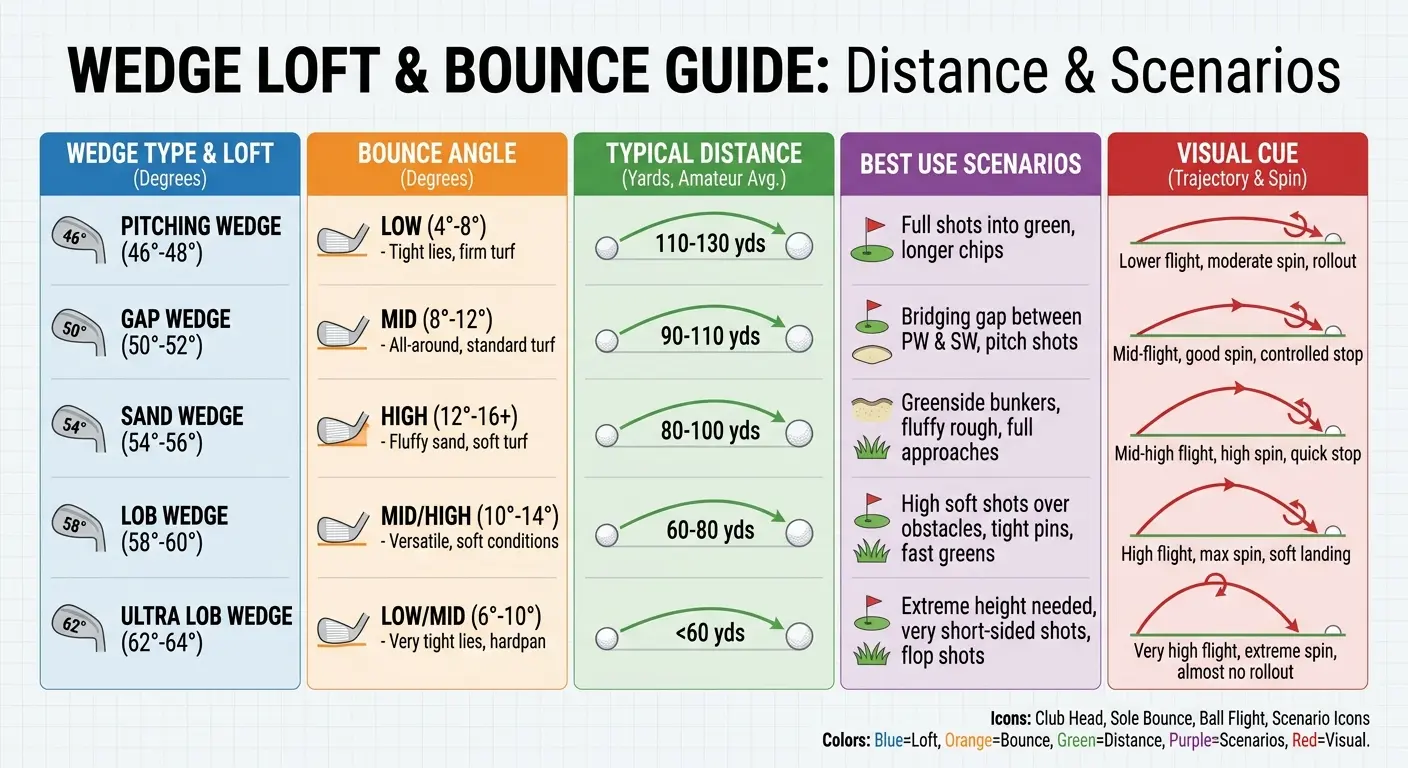
Approach wedges (also called gap wedges, 50-52 degrees) fill the distance void between your pitching wedge and sand wedge. Most iron sets include a pitching wedge around 44-46 degrees, then jump to a sand wedge at 54-56 degrees.
That's a 10-degree gap that translates to roughly 20-25 yards of distance difference. Huge in the scoring zone.
The approach wedge splits that difference, giving you a full-swing option from 90-110 yards depending on your swing speed.
These wedges feature moderate bounce (8-10 degrees) that works from most lies without being too specialized. They're essential for consistent distance control in the range where you should be hitting most greens. If you're currently trying to hit soft pitching wedges or hard sand wedges to cover distances in this range, you're making scoring harder than it needs to be.
An approach wedge is one of the most practical additions you can make to your bag.

Understanding the nuances of how to choose a putter is just as critical as selecting the right wedges for your short game.
The Clubs That Save Your Score (Or Destroy It)
16. Sand Wedge
Sand wedges (54-56 degrees with 10-14 degrees of bounce) are designed for bunker play but serve multiple purposes around the green. The bounce angle (the curve on the sole) prevents the club from digging into sand, allowing it to slide underneath the ball and splash it out.
From the fairway, sand wedges work well for full shots from 70-90 yards and pitch shots that need to fly high and stop quickly.
Here's the thing: the bounce is your friend in soft conditions but can cause issues from tight lies or hardpan.
You'll want to open the face for high, soft shots and square it up for lower, spinning shots. Most players carry a sand wedge by default, but many don't understand how to use the bounce effectively, which limits the club's versatility. Proper sand wedge technique involves hitting the sand (or turf) before the ball, using the bounce to control depth of contact.
When you sole it, you'll see more of the trailing edge off the ground than your 9-iron, but it doesn't sit as open as a lob wedge would. The feel at impact? That satisfying thump of a well-struck wedge shot.
For golfers who want to track their performance accurately, exploring best golf rangefinders can help you dial in those critical wedge distances.
17. Lob Wedge
The lob wedge is simultaneously the most fun and most infuriating club ever designed. It's made me look like a hero and an idiot, sometimes on the same hole.
Lob wedges (58-64 degrees) are your highest-lofted clubs, designed for shots that need maximum height and minimal roll. They excel in situations where you have limited green to work with, need to clear an obstacle, or want to stop the ball quickly on a downhill lie.
The high loft creates significant backspin when struck cleanly, but it also makes these clubs less forgiving than lower-lofted wedges. You need precise contact to avoid chunks or thin shots that go nowhere or fly over the green.
Lob wedges work brilliantly from tight lies around the green where you need to fly the ball onto the putting surface with minimal roll. They're also effective from fluffy sand where you need maximum loft to clear the lip.
Miss the ball slightly heavy and it goes 10 yards. Catch it thin and it flies 30 yards too far.
These clubs are most valuable for players who have developed consistent contact and understand how to control trajectory through face angle and swing path. If you're still struggling with basic wedge play, you'll get more value from mastering your sand wedge before adding a lob wedge to your bag.
Quick sidebar: if someone tells you they "spin it too much" with their wedges, they're either a scratch golfer or they're full of it.

18. Chipper
You're thinking a chipper is embarrassing. You know what's actually embarrassing? Chunking three chips in a row while your buddies watch.
Chippers are specialty clubs designed for short shots around the green where you want the ball to roll more than fly. They feature 32-37 degrees of loft (similar to a 7 or 8-iron) but with a putter-length shaft and a more upright lie angle. The design lets you use a putting stroke while getting the ball airborne just enough to clear the fringe before rolling toward the hole.
Chippers get dismissed as gimmicks or beginner crutches, but they solve a real problem for players who struggle with standard chip shots.
The shorter shaft and upright design make it easier to control distance compared to a traditional iron, while the extra loft compared to a putter helps you navigate uneven fringe grass. You'll find chippers most useful on courses with thick fringe or when chipping from tight lies where a wedge feels too risky.
If you're not getting up and down at least 30% of the time with your current chipping technique, a chipper will probably improve your scores regardless of what it looks like in your bag.
I gamed a chipper for two years and dropped three strokes off my handicap. My buddies gave me endless grief. I didn't care. I was taking their money.
19. Putter
Here's the thing about putters: you probably haven't been fit for one, you're using whatever came with your iron set or what looked cool in the shop, and you wonder why you three-putt six times a round.
Putter designs vary wildly in terms of head shape (blade vs. mallet), alignment aids, weighting, and length.
Blade putters offer better feel and feedback but require more precise contact. Mallet putters provide more forgiveness through perimeter weighting and often include extensive alignment features.
The length matters more than most players realize. Standard putters are 34-35 inches, but you might need something shorter or longer depending on your height and setup. Face inserts (polymer, aluminum, or steel) affect how the ball comes off the face and the sound/feel you experience.
Your putter needs to match your stroke type (straight-back-straight-through vs. arc) and provide consistent distance control. Testing putters on an actual green with real holes beats any amount of research or advice. You're looking for a combination of proper length, comfortable alignment, and consistent roll.
The putter you use matters enormously, but only if it fits your stroke and gives you confidence when you're standing over a knee-knocker to save par.
Your putter touches the ball 40% of the time. When's the last time you got fit for one? Get fit. Seriously.
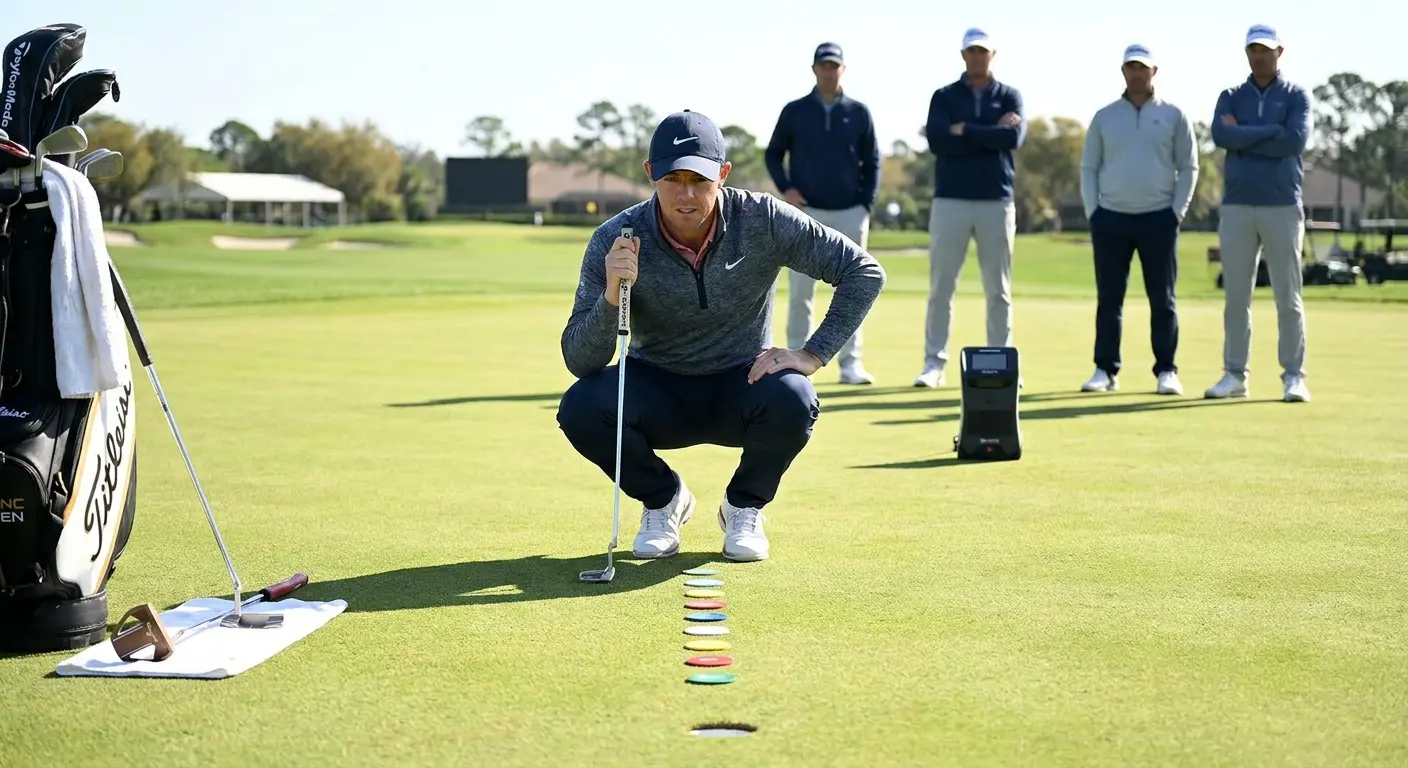
While you're evaluating your equipment needs, protecting your phone on the course matters too. Check out Rokform's golf phone mounts and cases to keep your device secure whether you're using GPS apps or capturing swing videos. We've also covered the best golf GPS apps that pair perfectly with a reliable phone mount system.
What's Actually In My Bag Right Now
Driver: Adjustable, because I tinker too much
3-wood: Strong 13-degree that I hit off the tee more than my driver
Hybrid: 4H that replaced my 4-iron three years ago (best decision I've made)
Irons: 5-PW cavity backs, because I'm not good enough for blades
Wedges: 50°, 54°, 58° (still not sure I need all three)
Putter: Blade style that I got fit for last year
Notice what's NOT in there? A 3-iron I can't hit. A lob wedge I chunk half the time. A driver I can't control.
Nobody's going to build the perfect 14-club set on their first try. You'll waste money on clubs that sounded good in theory. You'll stubbornly keep carrying that 3-iron you can't hit because "real golfers" carry long irons.
I used to think rescue woods were gimmicks. Then I hit one from thick rough on a par 5 and advanced it 160 yards. I was wrong. The game keeps humbling me.
Eventually, you'll get real with yourself about what works when you're standing over a shot that matters.
That's when you'll start shooting better scores. Not because you bought better clubs, but because you bought the RIGHT clubs for your game instead of the ones your ego wanted.
Build your bag around your actual game, not the one you wish you had. Stop carrying four wedges if you can't tell me the exact yardage you hit each one. You're just hauling around expensive confusion.
Your job is figuring out which clubs address your specific weaknesses and which ones you're carrying just because everyone else does.
That distinction makes all the difference when you're trying to break your next scoring barrier.

