


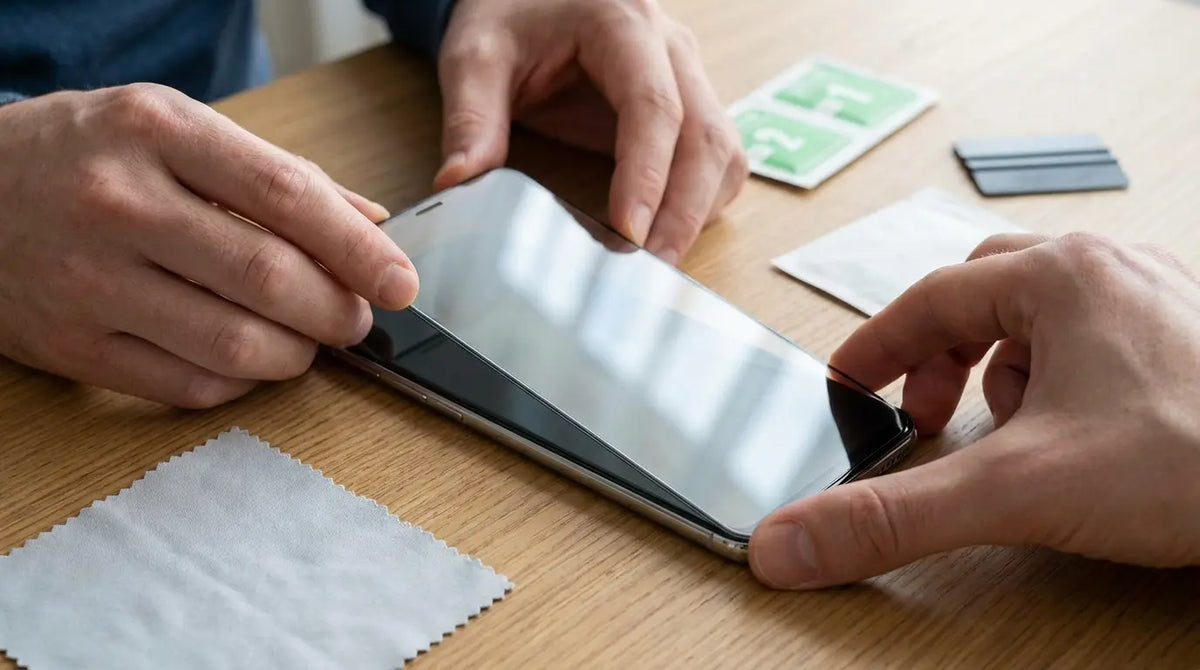
When's the last time you actually thought about your screen protector? Like, really thought about it?
You don't. Nobody does.
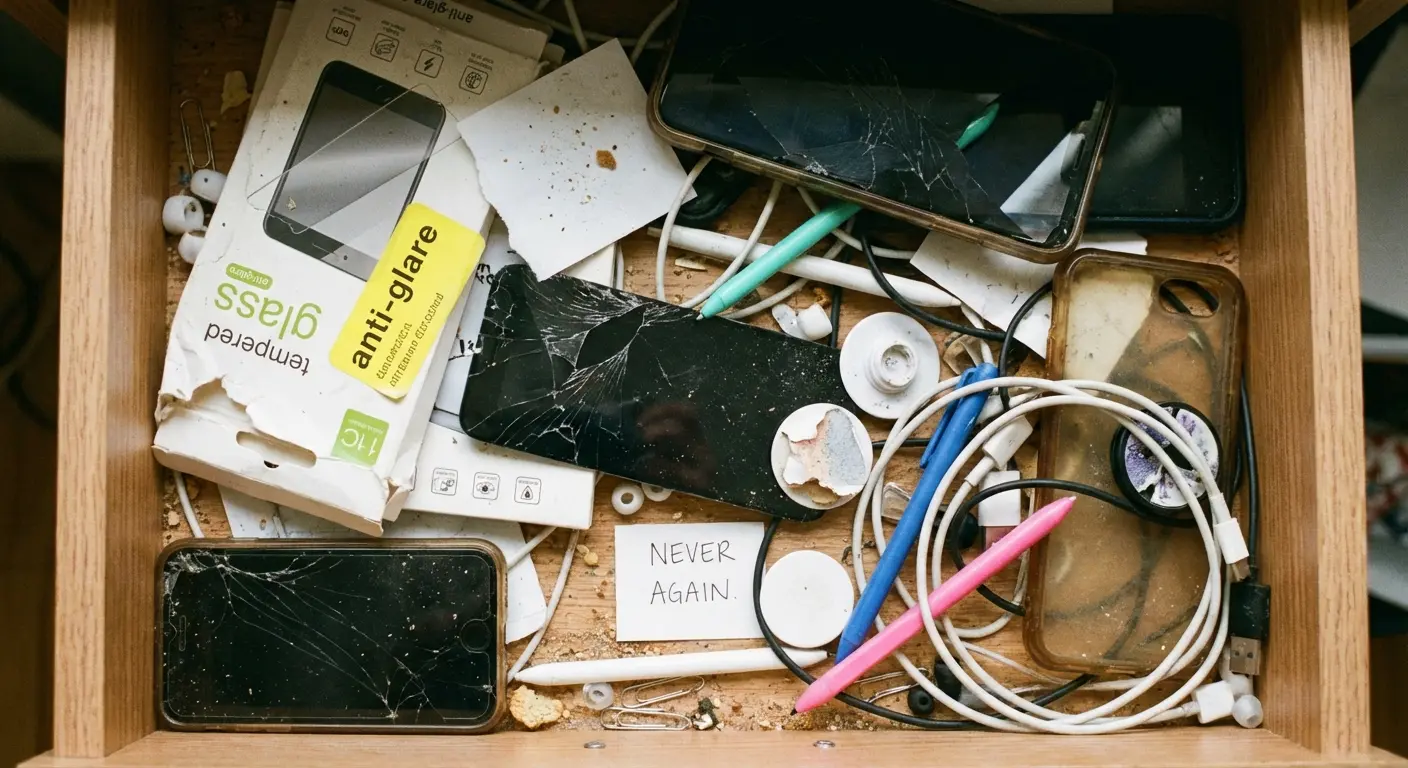
You slap one on within hours of unboxing because you're supposed to, then forget it exists until it cracks or starts peeling at the edges. I've got a drawer full of failed screen protectors. You probably do too. Each one represents about ten bucks you wasted and half an hour you'll never get back trying to get the bubbles out.
Here's what happened: Somewhere along the way, cell phone screen protectors stopped being protection and became a checkbox. The market flooded with cheap options. Gas stations, mall kiosks, Amazon listings with thousands of reviews and $7 price tags. When something becomes that accessible and that cheap, we stop expecting it to work well. We start treating it as disposable, which means manufacturers started designing for disposability instead of durability.
The screen protector industry is worth nearly $50 billion, heading to $90+ billion by 2033 according to SNS Insider. That's BILLION. With a B. And somehow, despite all that money, most of us are using $7 pieces of garbage that fail within weeks. Where's all that money going? Not into better products, that's for sure.
The Race to the Bottom
The commodification of cell phone screen protectors happened fast. Ten years ago, you might have paid $30-40 for a quality protector and expected it to last. Today, you can get a three-pack for less than $10. That pricing fundamentally altered expectations on both sides of the transaction.
Manufacturers aren't incentivized to engineer for longevity when consumers are shopping primarily on price. Racing to the bottom on cost means cutting corners on materials, skipping rigorous testing, and eliminating quality control steps that add expense. You get a market saturated with products that technically function but don't protect in real-world scenarios.
Go look at Amazon right now. Search "iPhone screen protector." The top result probably has 47,000 reviews and costs $7.99 for a 3-pack. I've bought that exact pack. Twice. Both times, it cracked within a month.
According to independent testing, most mid-range tempered glass protectors ($15-25) perform nearly identically to premium options ($40+), with differences mainly in oleophobic coatings and installation tools rather than protection level. But here's the thing: that reveals the manufacturing cost for most tempered glass protectors is under $2. The rest is supply chain and profit margins. You're not paying for better materials. You're paying for better engineering and quality control.
It's a vicious cycle. You buy cheap cell phone screen protectors, they fail, you buy cheap again because "they all fail anyway." The assumption that screen protectors are inherently fragile becomes accepted truth, even though it's a reflection of choosing products engineered to hit a price point rather than a performance standard.
You're Worried About the Wrong Thing
Everyone obsesses over drop protection. Can this phone screen protector survive a six-foot fall onto concrete? That's the headline feature, the dramatic test that makes for good marketing videos.
But here's what actually degrades your screen: the 50 times a day you slide your phone across a table. The keys sharing pocket space with your device. The fine grit that works its way into every bag and case.
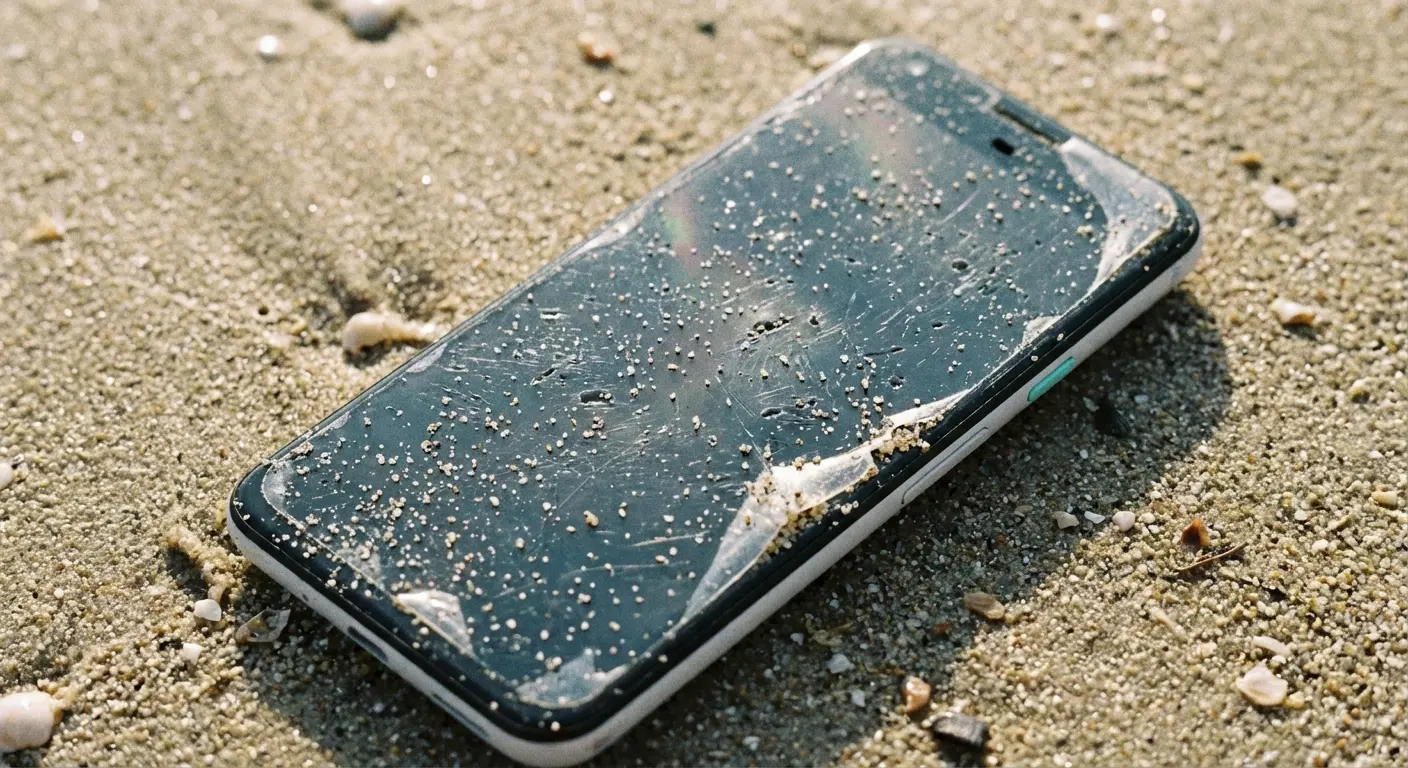
Beach sand is silica. Mohs hardness of 7. That's harder than cheap phone screen protectors, meaning a single afternoon at the beach can leave your protection scratched beyond usability even if you never drop your phone. Same goes for construction dust or the fine grit that accumulates in gym bags. These abrasive particles cause more cumulative damage than occasional drops.
I watched my $8 screen protector turn into frosted glass after one afternoon at Huntington Beach. Took me three days to notice because the scratches were so fine, but once I saw them in sunlight, I couldn't unsee them. Looked like someone took 400-grit sandpaper to my phone.
Micro-scratches accumulate invisibly until one day you're looking at your screen in sunlight and realize it's hazed over with thousands of tiny abrasions. The oleophobic coating (the thing that makes your screen feel smooth and repels fingerprints) wears down, turning your pristine display into a smudge magnet. Edge chipping happens from repeated impacts too small to notice individually but cumulatively destructive.
Most phone screen protectors are engineered for the catastrophic moment but ignore the cumulative assault. They'll market drop ratings and impact resistance while using materials that scratch if you look at them wrong.
The Real Cost of "Good Enough"
Let me show you the math I did after my fourth screen protector failure this year.
Four cheap protectors at $8 each: $32
Time spent installing them (including two failed attempts): Maybe 90 minutes total?
Weeks of using a phone with reduced touch sensitivity: 6 months
Weeks with a scratched protector I was too lazy to replace: 8 weeks
One premium protector: $40
Installation time: 15 minutes
Months of perfect clarity and touch response: Still going at 6 months
I'm an idiot for not doing this math sooner.
You've spent maybe $30 total on cell phone screen protectors over the life of your current phone. That seems reasonable, right? But that's the visible cost, the dollars you can track.
What about the degraded experience you've been tolerating? Every time you have to press harder to register a touch, every moment you spend wiping away bubbles that never quite disappear, every instance where you're conscious that your screen doesn't look quite as clear as it should. Those are costs too. They're diffused across hundreds of daily interactions.
Touch Sensitivity Isn't Negotiable
Cheap phone screen protectors create a tactile barrier between you and your device. You might not consciously notice it, but your phone feels slightly less responsive. Swipes don't register as smoothly. Typing requires fractionally more pressure. Games that depend on precise timing feel slightly off.
This isn't an inevitable trade-off of protection. It's a failure of engineering.
Quality phone screen protectors maintain 99%+ touch sensitivity because they use thinner materials with better conductivity and adhesives that eliminate air gaps. The difference between a good protector and a cheap one isn't subtle once you've experienced both.
Your phone's interface was designed with specific haptic feedback and responsiveness in mind. Degrading that experience to save $20 means you're compromising the core functionality of a device you probably spent $800+ on. That's not a reasonable trade. It's one we've been conditioned to accept.
The Replacement Cycle You've Normalized
How often are you replacing your phone screen protector? Every three months? Every six? If it's anything more frequent than "when I get a new phone or after a significant impact," you're not getting protection. You're renting temporary coverage.
The replacement cycle reveals product quality more honestly than any marketing claim. A phone screen protector that hazes, yellows, or develops micro-scratches within weeks is fundamentally inadequate. One that starts peeling at the edges after a month has an adhesive problem. These aren't acceptable failure modes for a product whose entire purpose is durability.
You've normalized this cycle because replacement is easy and cheap. But easy and cheap shouldn't mean frequent. A properly engineered phone screen protector should last as long as you own the phone, barring a drop significant enough to crack it (at which point it's done its job by sacrificing itself instead of your screen).
Match Protection to How You Actually Use Your Phone
Screen protector selection shouldn't be generic. The right choice for someone who works construction isn't the same as what works for someone whose phone lives in a purse or sits on a desk most of the day. Yet most people default to whatever's cheapest or most convenient without thinking about their risk profile.
Where does your phone spend most of its time? If it's bouncing around construction sites, you need different protection than someone whose phone lives on a desk. Seems obvious, but most people buy the same generic protector regardless.
Your usage patterns create specific vulnerabilities. What environments does it encounter? How active are you when you're using it? These factors should drive your decision, but they're rarely part of the conversation because generic "protection" is easier to market than contextual solutions.
Environment Matters More Than You Think
Temperature extremes affect adhesive performance. Cold weather makes adhesives brittle and less sticky, which is why cell phone screen protectors applied in winter sometimes fail to adhere properly. Heat can cause adhesives to soften and bubble. If you work outdoors or in extreme environments, your screen protector needs to account for these variables.
Humidity matters too. High-moisture environments (gyms, bathrooms, coastal areas) can degrade cheap adhesives over time, leading to edge lift and eventual failure. The environment your phone lives in creates specific stress factors, and generic protection isn't engineered to handle the full range of conditions real users encounter.
Activity Level Dictates Impact Requirements
There's a massive difference between static protection and dynamic protection. If your phone spends most of its life on a desk or in your hand, impact requirements are minimal. You need scratch resistance and maybe drop protection from waist height. That's a different engineering challenge than protecting a phone that's bouncing around in a backpack while you're mountain biking.
A phone falling from six feet while you're standing still hits the ground at roughly 19 feet per second. The same phone falling from three feet while you're running at 6 mph hits with significantly more kinetic energy due to the combined velocity vectors. Most drop tests are static: controlled height, controlled surface, controlled orientation. They don't account for the chaotic physics of real-world impacts during activity.
MIL-STD-810 ratings mean something here. Military drop test standards include repeated impacts from multiple orientations and account for real-world chaos rather than idealized lab conditions. If you're active, these ratings matter. If you're not, they're overkill.
The Material Science Nobody Talks About
Here's the dirty secret about "tempered glass" screen protectors: it's not a quality standard.
Every manufacturer slaps "tempered glass" on the package because it sounds premium. But tempered glass just means heat-treated glass. The $6 protector at the gas station? Tempered glass. The $45 premium one? Also tempered glass.
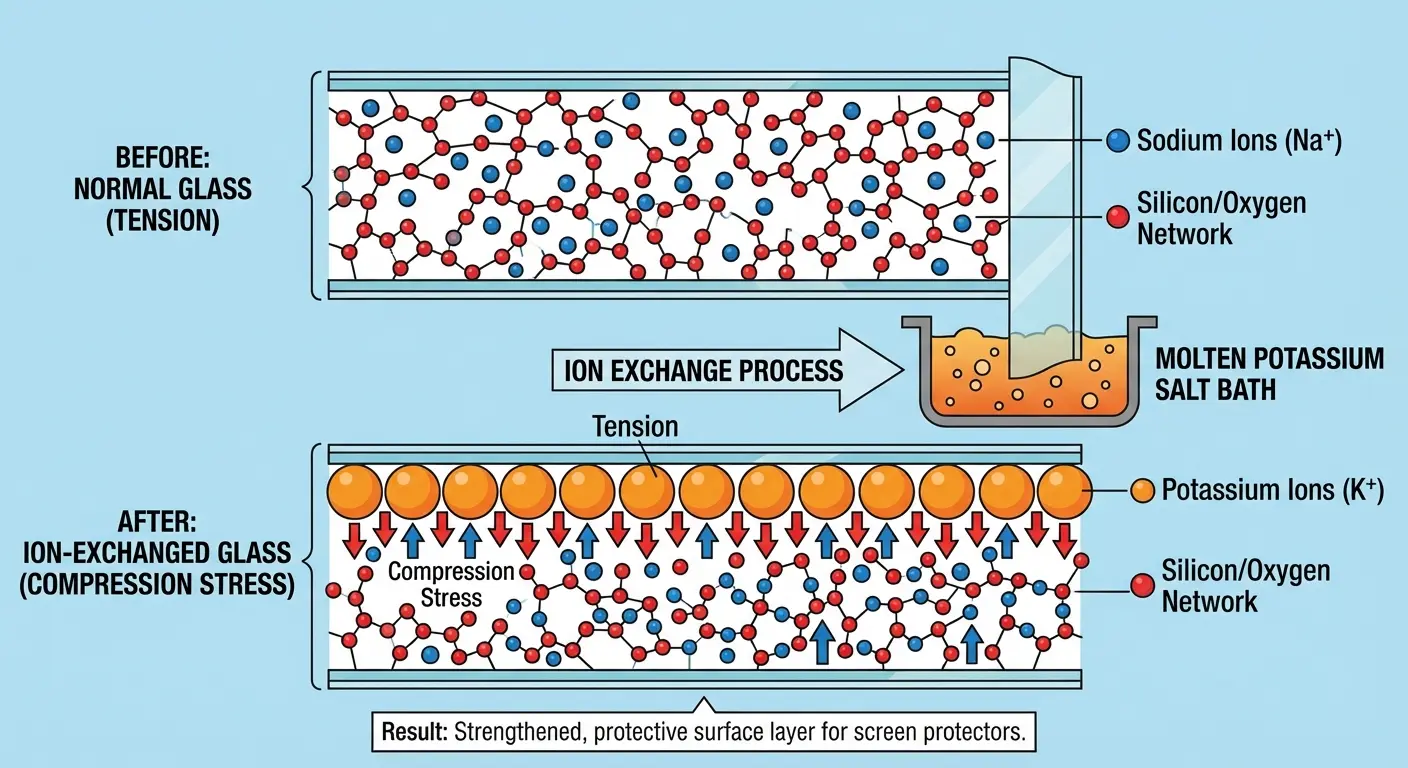
The difference is WHAT glass they tempered and HOW they tempered it. Cheap ones use soda-lime glass (literally window glass) and rush the heat treatment. Good ones use aluminosilicate (the same material as your phone screen) and do proper ion exchange.
You can't tell the difference from the package. That's intentional.
Screen protector marketing loves to throw around terms like "tempered glass" and "9H hardness" without explaining what they mean. It creates an illusion of informed choice while keeping you ignorant of the factors that determine performance.
Material composition matters more than brand recognition. Two cell phone screen protectors can both claim to be tempered glass but perform completely differently based on the quality of the glass, the tempering process, and the coating technology. Without understanding these distinctions, you're choosing based on price and reviews, which is gambling.
Not All Tempered Glass Is Created Equal
The "9H hardness" rating you see everywhere refers to the pencil hardness test, which measures scratch resistance from graphite pencils of varying hardness. It's a useful metric, but it's not a universal standard and it doesn't predict impact resistance. A phone screen protector can rate 9H and still shatter from a moderate drop because hardness and toughness are different properties.
Want to know why cheap "tempered glass" shatters so easily? They skip the ion exchange process. That's where you swap sodium ions for larger potassium ions, creating internal stress that makes glass tough. It's expensive and time-consuming, so budget manufacturers skip it or rush it. You get glass that's technically "tempered" but performs like crap.
Here's what actually matters in screen protector materials:
Cheap glass (soda-lime): Same stuff in windows. Scratches easy, cracks easier. $5-10. You get what you pay for.
Good glass (aluminosilicate): What your actual phone screen is made of. Way tougher. $25-45. Worth it if you have a flat screen.
TPU (plastic): Flexible, so it works on curved screens. Doesn't shatter, but scratches faster than glass. $15-30.
PET film: Basically thick tape. Skip it. $3-8.
Hybrid materials: Glass/polymer combinations that can outperform traditional tempered glass, especially for edge impacts. $30-50.
The rest? Mostly marketing. Ceramic coatings sound fancy but they're brittle.
The Hybrid Material Revolution You Haven't Heard About
Newer materials combine the optical clarity of glass with the flexibility and impact resistance of plastic polymers. These hybrids can outperform traditional tempered glass in specific scenarios, particularly edge impacts where glass tends to crack but flexible materials absorb and distribute force.
Innovation in screen protector materials continues to accelerate globally. Hunan Mingyihu Intelligent Technology Co., Ltd. recently developed ultra-thin flexible glass measuring only 0.03 millimeters thick specifically for foldable screens, using substrate-free AB adhesive bonding technology. That's the kind of material advancement that addresses modern device challenges traditional tempered glass can't solve.
These materials are more expensive to produce, which explains why they appear in premium products but not budget options. The manufacturing process is more complex, requiring precise layering and bonding of different materials. But the performance gains are real, especially for curved screens where rigid glass struggles to maintain edge adhesion.
Material science has evolved beyond the glass-versus-plastic binary. Multilayer constructions, nano-coating technologies, and advanced polymers offer performance characteristics that weren't possible five years ago. The problem is that most consumers don't know these options exist because budget products dominate shelf space and search results.
Installation Shouldn't Be This Hard
If you've watched three YouTube tutorials, cleared your bathroom counter, run a hot shower to settle dust, and STILL ended up with bubbles, that's not on you.
That's a manufacturer who couldn't be bothered to include a $2 alignment tool.
Installation difficulty is a red flag for poor product design. Quality cell phone screen protectors should install easily because they're engineered with alignment tools, forgiving adhesives, and bubble-release technology. When installation is a high-stakes, one-shot process that requires perfect conditions and steady hands, the manufacturer has externalized their engineering challenges onto you.
(Yes, I know I sound paranoid about dust particles. Install one of these things in a normal room and you'll understand.)
The psychological barrier installation creates is real. People delay installing phone screen protectors because they're anxious about screwing it up, which means they're using their phones unprotected. Others settle for poor installation (bubbles, dust, misalignment) because they don't want to waste the protector by removing and trying again. Both outcomes represent design failures.
Why Dust Is Your Enemy
Dust particles create bubbles because they prevent the adhesive from making contact with the screen. Even microscopic particles can cause visible imperfections. That's why installation in a dust-free environment matters, but it's also why good phone screen protectors include solutions rather than instructions to "ensure a dust-free environment."
Premium phone screen protectors include dust removal stickers specifically designed to lift particles from the screen surface. Some include installation frames that cover the screen during the cleaning process, preventing new dust from settling. These aren't luxury add-ons. They're acknowledgments that installation happens in real-world conditions, not laboratory clean rooms.
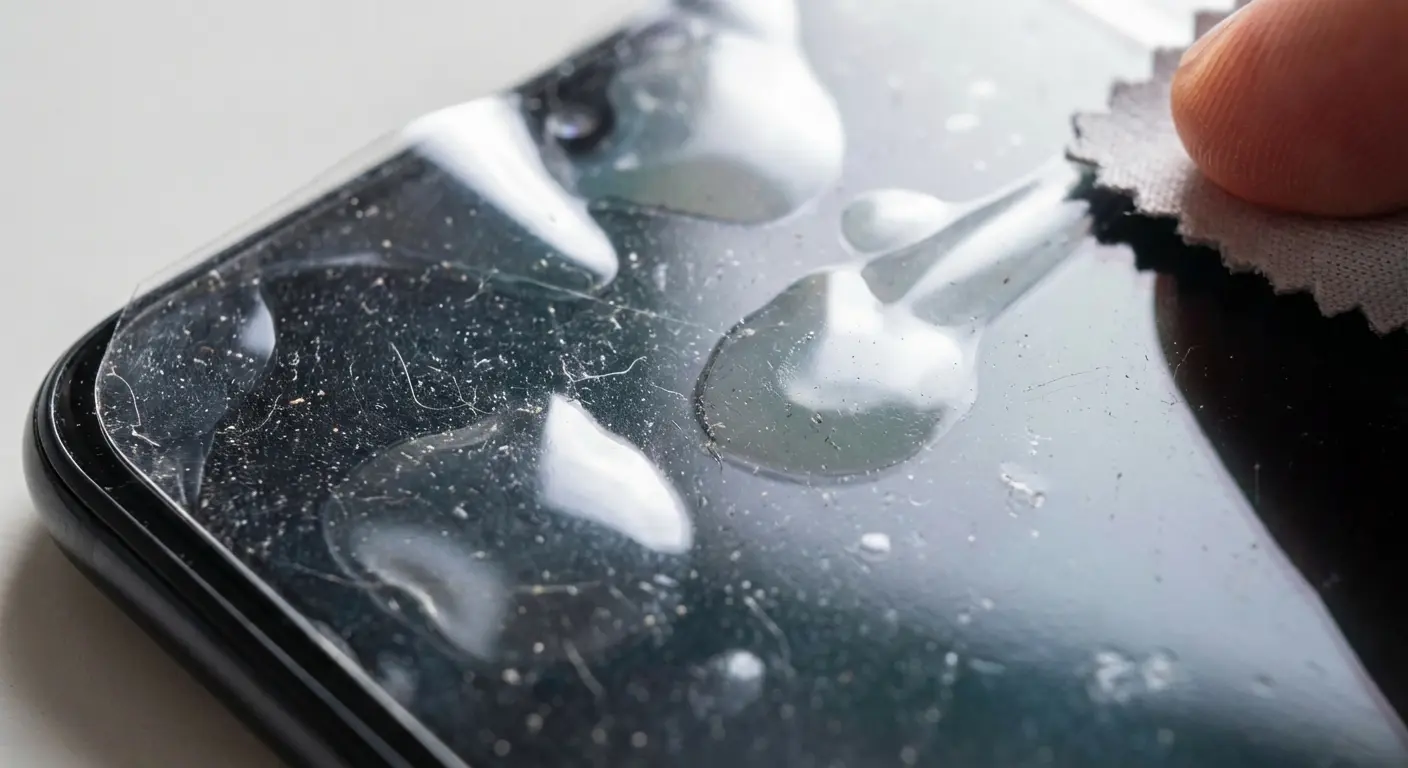
The fact that bathroom steam installation is a widely shared hack proves that standard installation processes are inadequate. People have collectively figured out that running a hot shower creates a temporarily dust-free environment because moisture settles airborne particles. That's resourceful problem-solving, but it shouldn't be necessary.
Alignment Tools Should Be Standard, Not Optional
Aligning a phone screen protector by eye is asking for failure. Even being off by a millimeter means your edges aren't protected properly and you've created lift points where the protector will eventually peel. That's especially critical for devices with curved screens or minimal bezels where there's no margin for error. I also look at blue light screen protectors as a category.
Alignment tools (frames, guides, hinges) ensure the protector lands exactly where it should. They eliminate the guesswork and the hand tremor that causes last-second misalignment. Their absence signals a manufacturer cutting corners because these tools add cost to packaging and production.
Misalignment affects more than aesthetics. If your phone screen protector doesn't cover edge-to-edge, those exposed areas are vulnerable. If it overlaps onto curved edges without proper adhesion, it'll peel. Precise alignment is fundamental to protection, which makes alignment tools essential components of a complete protection system, not optional conveniences.
When Premium Pricing Actually Makes Sense
A $40 phone screen protector seems absurd when you can get a three-pack for $10. That price gap demands justification, and not all premium pricing is justified. Some of it is brand markup or fancy packaging. But some of it reflects genuine engineering differences that affect performance and longevity.
Your phone probably cost $800-1200. You might be financing it over 24 months. In that context, $40 for screen protection isn't excessive, especially when you think about screen replacement costs of $200-400. The math strongly favors investing in quality protection upfront rather than gambling with cheap options and paying exponentially more if they fail.
What You're Actually Paying For
Premium phone screen protector pricing breaks down into several components. Material quality is the foundation: aluminosilicate glass costs more than soda-lime glass, advanced polymers cost more than basic plastics. The oleophobic coating quality varies dramatically. Cheap coatings wear off in weeks while quality coatings last months or years.
Adhesive technology matters more than most people realize. Cheap adhesives are sticky glue that traps bubbles and loses tackiness over time. Quality adhesives use silicone or other advanced compounds that self-heal minor bubbles and maintain adhesion through temperature changes and repeated stress.
Testing and QA add cost but ensure consistency. Premium manufacturers drop-test their products repeatedly, verify touch sensitivity, and test adhesion under various conditions. Budget manufacturers might test a few samples or skip testing entirely, which is why quality varies wildly even within the same product line.
Packaging and installation tools cost money. An alignment frame, cleaning kit, and dust removal stickers might add $5-10 to production costs. Warranty support requires infrastructure and replacement inventory. These costs are real, and they're either built into the price or eliminated to hit a lower price point.
The Warranty Question Everyone Forgets to Ask
Warranty terms reveal manufacturer confidence more honestly than marketing claims. A lifetime warranty (even with conditions) signals that the company expects their product to last and is willing to back that expectation. No warranty means you're assuming all risk.
Different warranty types matter. Replacement-only warranties are better than nothing but not as good as money-back guarantees. Limited warranties might exclude installation defects or normal wear, which significantly reduces their value. Reading warranty terms before purchase tells you what the manufacturer stands behind.
Some American manufacturers are setting higher standards for warranty and quality. ArmorSuit, based in Southern California, offers screen protectors with a lifetime replacement guarantee, using military-grade materials originally developed to protect aircraft and space shuttles. That level of warranty commitment reflects genuine confidence in product durability.
Many cheap phone screen protectors have no warranty at all. If it fails, you're out the money and the time spent installing it. That's fine if it costs $7, less fine when you realize you've spent $30 over time on replacements when a single $40 protector with a warranty would have been cheaper and less hassle.
Universal Fit Is Marketing Speak for "We Cut Corners"
Universal-fit phone screen protectors are compromises by definition. They're designed to work with multiple devices, which means they can't be optimized for any single device. Screen curves, camera cutouts, sensor placement, and edge geometry vary across phone models. Generic protectors can't account for these variations without sacrificing fit or coverage.
Device-specific engineering costs more because it requires creating unique tooling and designs for each phone model. But that investment ensures precise fit, proper coverage, and compatibility with device features. The alternative is hoping a generic solution happens to work well with your specific phone, which is gambling.
"Universal" is marketing speak for "we didn't want to invest in device-specific engineering." Sometimes that gamble pays off, but often it results in poor edge coverage, sensor interference, or compatibility issues with cases.
Edge Coverage Is Where Most Protectors Fail
Curved screens present a unique engineering challenge. Adhesive that works perfectly on flat glass struggles on curves because the physics of adhesion change when you're dealing with three-dimensional surfaces. Cheap phone screen protectors simply don't adhere at the edges, creating lift points that collect dust and eventually peel.
The terms "2.5D" and "3D" get thrown around without explanation. 2.5D refers to screens with slightly curved edges (most modern phones), while 3D indicates more aggressive curves. These distinctions matter because they require different adhesive strategies and material flexibility. A protector designed for flat screens will fail on curved ones.
Edge lift isn't cosmetic. Those lifted edges are vulnerable points where impact force concentrates. During a drop, the protector can't distribute force properly if it's not fully adhered, which means your screen takes more of the impact. Poor edge coverage fundamentally undermines the entire purpose of protection.
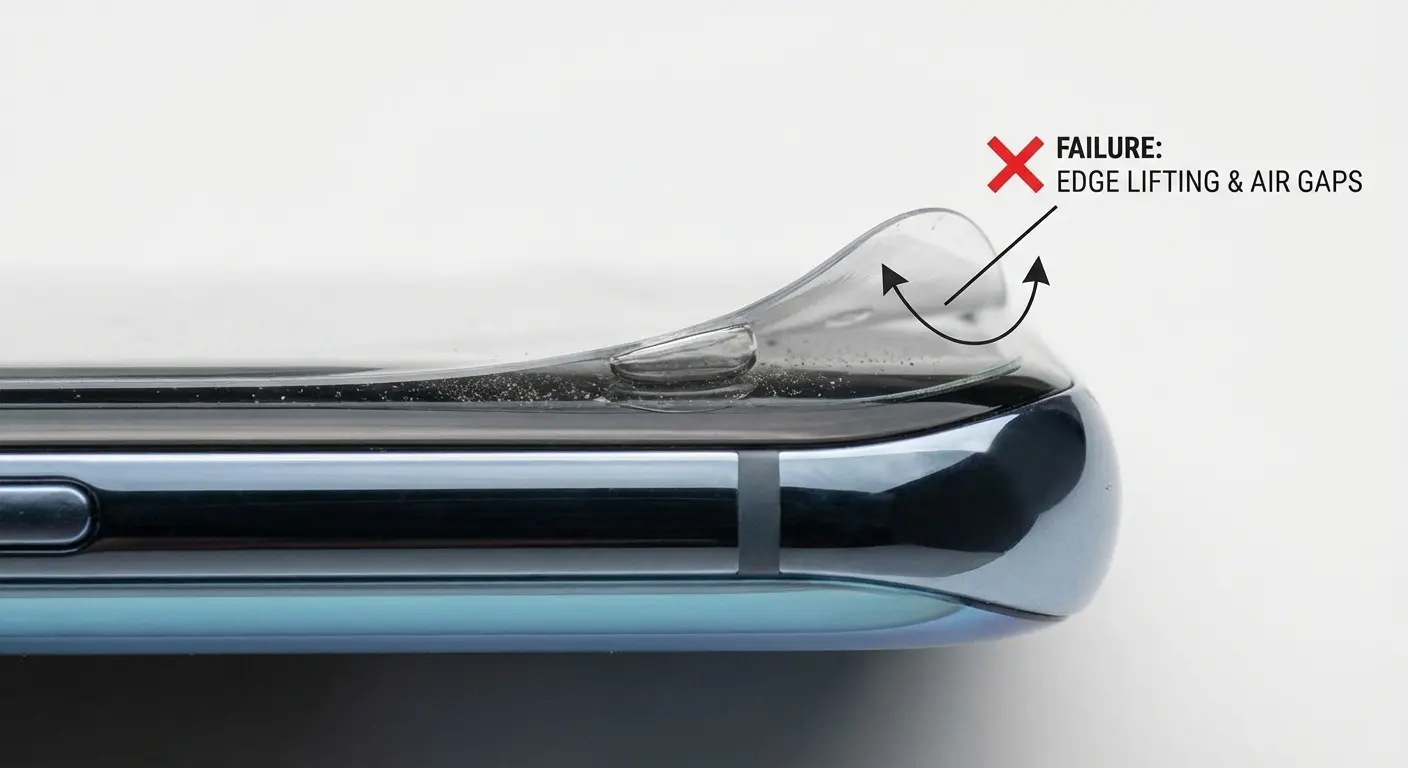
The problem is particularly acute for modern devices. According to repair statistics, over 80% of screen cracks initiate from edge impacts rather than direct center strikes. That makes edge coverage the most critical factor in drop protection, yet it's exactly where universal-fit and budget protectors compromise most.
Sensor Interference You Don't Notice Until It's Too Late
Proximity sensors tell your phone to turn off the screen when you hold it to your ear during calls. Ambient light sensors adjust brightness based on environment. Face ID uses infrared sensors. In-display fingerprint readers use optical or ultrasonic sensors. All of these can be affected by phone screen protectors.
These failures aren't always obvious. Your screen might not turn off consistently during calls, leading to accidental button presses with your cheek. Auto-brightness might behave erratically. Face ID might require multiple attempts. These annoyances seem minor individually, but they degrade the user experience constantly.
Precise cutouts and correct material thickness are critical for maintaining sensor functionality. That requires knowing exactly where sensors are located on each device and engineering around them. Generic phone screen protectors use approximate cutouts based on common layouts, which works until it doesn't. Device-specific engineering eliminates this guesswork.
Your Case and Screen Protector Need to Work Together
You probably bought your case and phone screen protector from different brands, maybe at different times, and hoped they'd work together. Sometimes that works fine. Other times, the case edge pushes against the screen protector, causing lift. Or the protector extends too far and prevents the case from fitting properly.
This compatibility roulette exists because case and screen protector manufacturers don't coordinate. They're designing in isolation, which means conflicts are inevitable. The solution isn't finding the right combination through trial and error. It's choosing products engineered together from the start.
Integrated protection systems eliminate compatibility guesswork. When the same company designs both the case and phone screen protector, they can ensure the components enhance rather than compromise each other. Seems obvious, yet few brands offer this level of coordination.
The Raised Edge Problem
Cases with raised edges (bezels) are critical for screen protection. That raised lip prevents your screen from making contact with surfaces when placed face-down and provides a buffer during drops. But that edge needs to be precisely calibrated to work with phone screen protectors.
If the case edge is too high, it can catch on the phone screen protector during installation or removal, causing peeling. If it's too low, it doesn't provide adequate protection during face-down drops. The tolerance here is millimeters, which is why cases and protectors designed independently often conflict.
Some cases claim to be "screen protector compatible," but that usually means they've left slightly more clearance. It doesn't mean they've been tested with specific protectors or engineered for optimal interaction. True compatibility requires coordinated design, not accommodation.
Think about it: your case bezel rises 0.8mm above the screen surface, but your phone screen protector adds 0.4mm thickness. If the case manufacturer didn't account for protector thickness, that 0.8mm buffer becomes only 0.4mm, which is insufficient for face-down drop protection. Meanwhile, if the case edge presses against the protector perimeter, it creates constant lifting pressure that degrades adhesion over weeks until the protector peels completely.
Why Integrated Protection Systems Outperform Piecemeal Solutions
When case, phone screen protector, and even mounting systems are designed together, each component can be optimized knowing exactly how it interacts with the others. The case edge can be designed to perfectly complement the screen protector thickness. The protector can be sized knowing the exact case dimensions. Mounting systems can account for the total thickness of the protection package.
This coordination maximizes protection through engineering rather than luck. You're not hoping components work together. You're using a system where compatibility is guaranteed because it was designed as a complete solution from the start.
Few brands offer this level of integration because it requires broader product development capabilities. Most companies specialize in either cases or phone screen protectors, not both. The ones that do both often still design them separately. True integration is rare, which is exactly why it's valuable when you find it.
How We Approach Screen Protection at Rokform
Alright, full disclosure time: I work for Rokform. We make cases and mounting systems, and yeah, we make screen protectors too.
Want to know why we started making them? Because customers kept complaining that our cases didn't work with whatever screen protector they'd bought separately. The case edges would push on the protector. The protector would be too thick for the case to fit right. It was a compatibility nightmare.
So we did what seemed obvious: designed them together. Same engineering team, same specs, tested as a complete system. Turns out when you stop treating cases and screen protectors as separate purchases that you hope will work together, all those compatibility problems just disappear.
You've invested in serious protection for your phone. Your case is rugged, your mounting system is solid, but if your phone screen protector keeps letting you down, you're still vulnerable. As the #1 universal phone case and universal phone mount brand, we've seen how fragmented protection fails. Our screen protectors use premium materials with precise edge-to-edge coverage that's tested alongside our cases to ensure they work together, not against each other.
The result is protection that works because every component is designed as part of a complete system. Or don't buy from us. At least now you know what to look for if you're buying elsewhere.
What Happens After the First Crack
A cracked phone screen protector doesn't necessarily mean failure. If your phone screen protector cracks but your screen beneath it is intact, the protector did exactly what it was supposed to do. It sacrificed itself to absorb impact energy that would have otherwise shattered your screen.
The real question isn't whether your phone screen protector will ever crack. It's what happens after it does. Can you still use your phone normally? Is the protector still adhered to the screen, or has it shattered into loose pieces? Does it need immediate replacement, or can it continue providing some protection until you can replace it properly?
This distinction between graceful degradation and catastrophic failure reveals quality differences that aren't apparent until you need the protection. A phone screen protector that maintains integrity after impact is fundamentally different from one that disintegrates on first contact.
Graceful Degradation vs. Catastrophic Failure
Graceful degradation means the phone screen protector cracks in a spiderweb pattern but stays intact and adhered to your screen. You can continue using your phone normally (though you'll want to replace the protector soon). The crack pattern itself shows you where the impact occurred and how the protector distributed that force.
Catastrophic failure means the phone screen protector shatters into pieces that fall away, leaving your screen exposed. That's the worst possible outcome because you've lost protection at the exact moment you've proven you need it. If you drop your phone once, you're likely to drop it again.
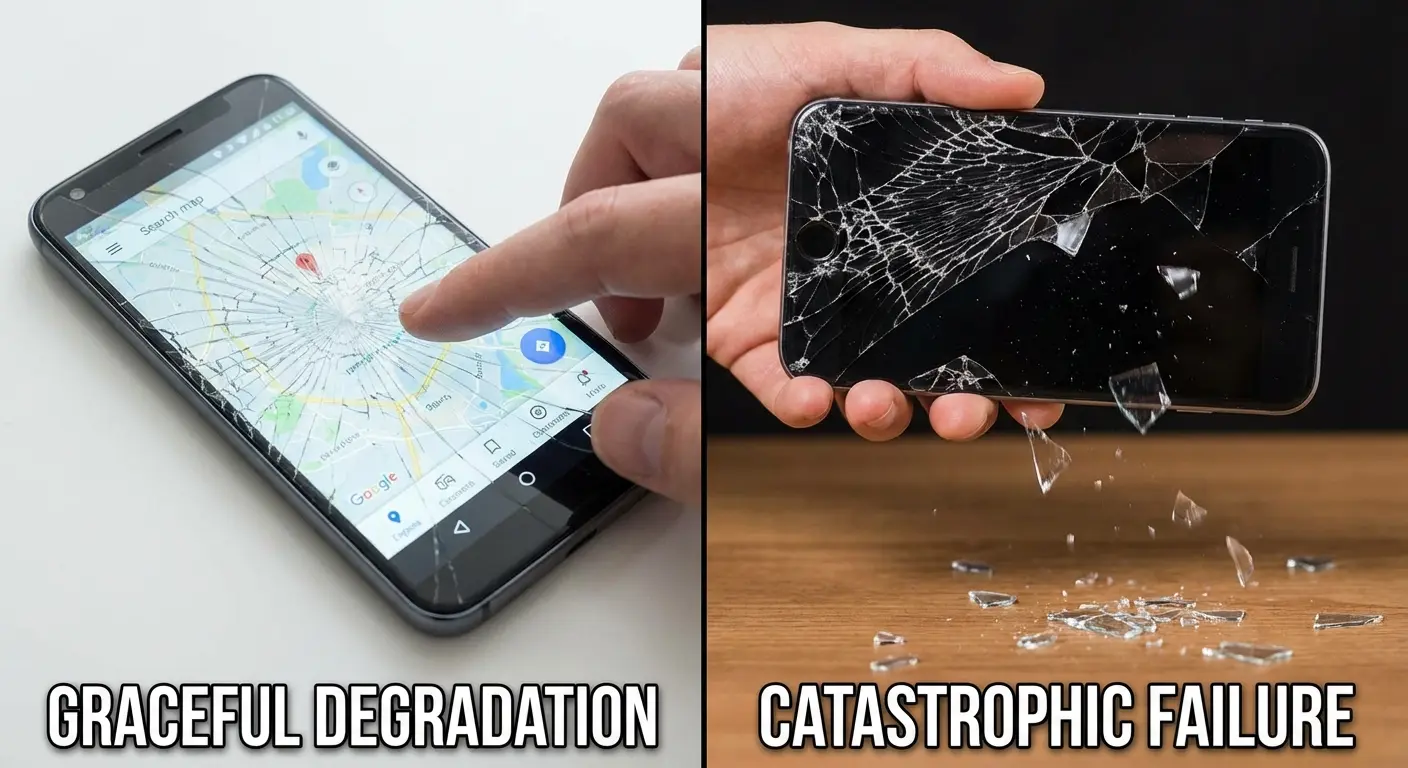
Engineering factors that determine failure mode include adhesive quality (keeps fragments together), material flexibility (allows some give before shattering), and lamination (bonds layers to prevent separation). These aren't features you can evaluate before purchase, which is why warranty an d brand reputation matter. You're trusting that the manufacturer engineered for graceful degradation.
Replacement Readiness
After your phone screen protector cracks, you need to assess whether it requires immediate replacement or can continue functioning temporarily. If it's still fully adhered with no sharp edges or loose pieces, you can probably wait until you have time to replace it properly. If it's shedding fragments or has lifted edges, replace it immediately.
Having a backup phone screen protector on hand makes sense if you depend on your phone for work or can't afford downtime. This isn't paranoia. It's practical planning. The cost of keeping a spare is minimal compared to the risk of operating with a compromised or missing protector.
There's an environmental angle here too. Phone screen protectors are consumable products, but how quickly they're consumed matters. A protector that lasts two years generates less waste than four protectors that last six months each. Investing in quality reduces both financial cost and environmental impact over the device's lifetime.
Stop Accepting Failure as Normal
Look, here's what I want you to take away from this:
Stop accepting failure as normal. If your screen protector scratches after two weeks, that's not "just how they are." If installation requires three attempts and perfect conditions, that's not you being clumsy. If it cracks from a waist-height drop onto carpet, that's not bad luck.
It's a bad product. And you've been conditioned to accept it because replacement is cheap and easy.
Your phone cost $800-1200. You're probably financing it over two years. You use it for hours every single day. In that context, spending $40 on protection that actually works isn't excessive. It's obvious.
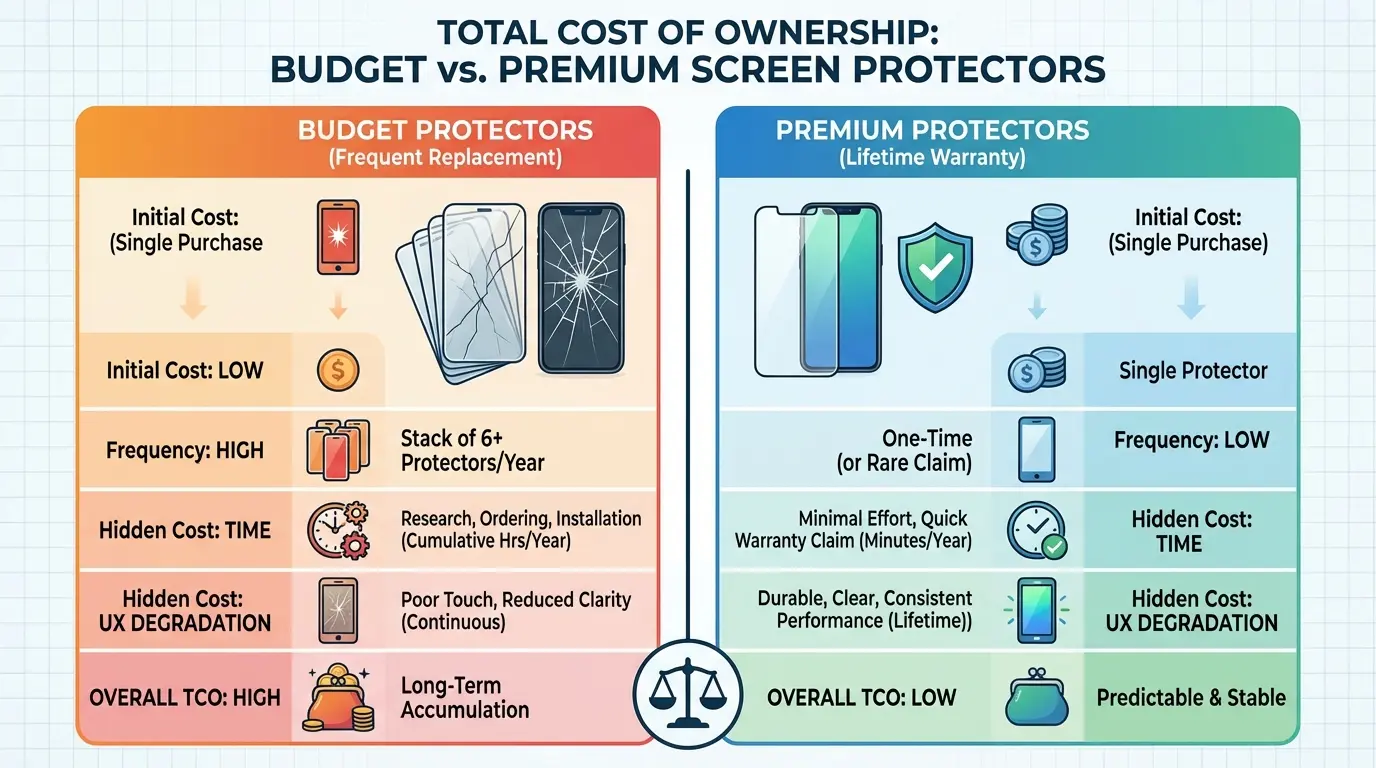
The screen protector industry is worth $50 billion because millions of people buy cheap protectors that fail, then buy cheap replacements that also fail, over and over. Break the cycle. Buy something good once instead of buying garbage four times.
Phone screen protectors deserve the same thought you give to any critical phone accessory. The decision shouldn't default to whatever's cheapest or most convenient. It should be driven by clear assessment of your needs, usage patterns, and the engineering quality of available options.
Your phone is likely your most-used tool. You rely on it for communication, navigation, work, entertainment, and probably a dozen other functions daily. Protecting it properly isn't excessive. It's pragmatic. Settling for inadequate protection because you've normalized low expectations means accepting degraded performance and elevated risk.
Raise your expectations. Demand cell phone screen protectors that protect, not just technically qualify for the category. Expect compatibility with your case, durability beyond the first few weeks, and installation processes that don't require perfect conditions and multiple attempts. These aren't unreasonable standards. They're what quality products should deliver as baseline.
The companies making genuinely good cell phone screen protectors exist, but they're competing in a market flooded with cheap alternatives that have conditioned consumers to expect failure. Breaking that cycle starts with recognizing that protection is worth investing in and that the cost of quality is almost always less than the cost of replacement.
Or keep doing what you're doing. I've got a drawer full of failed screen protectors that proves I'm not judging.

