


Rokform 18x: 8x to 18x zoom, out September.
17 disc golf rangefinders compared on feet-native readouts, target priority modes, and why a basket beats a flagstick as a laser target.
Ball golf spent years engineering its way around a hard problem: a flagstick is a three-quarter-inch pole standing in front of a treeline, and a laser beam struggles to find it. Pin-seeking algorithms exist because of that. So do the reflectors the USGA explicitly permits on flagsticks.
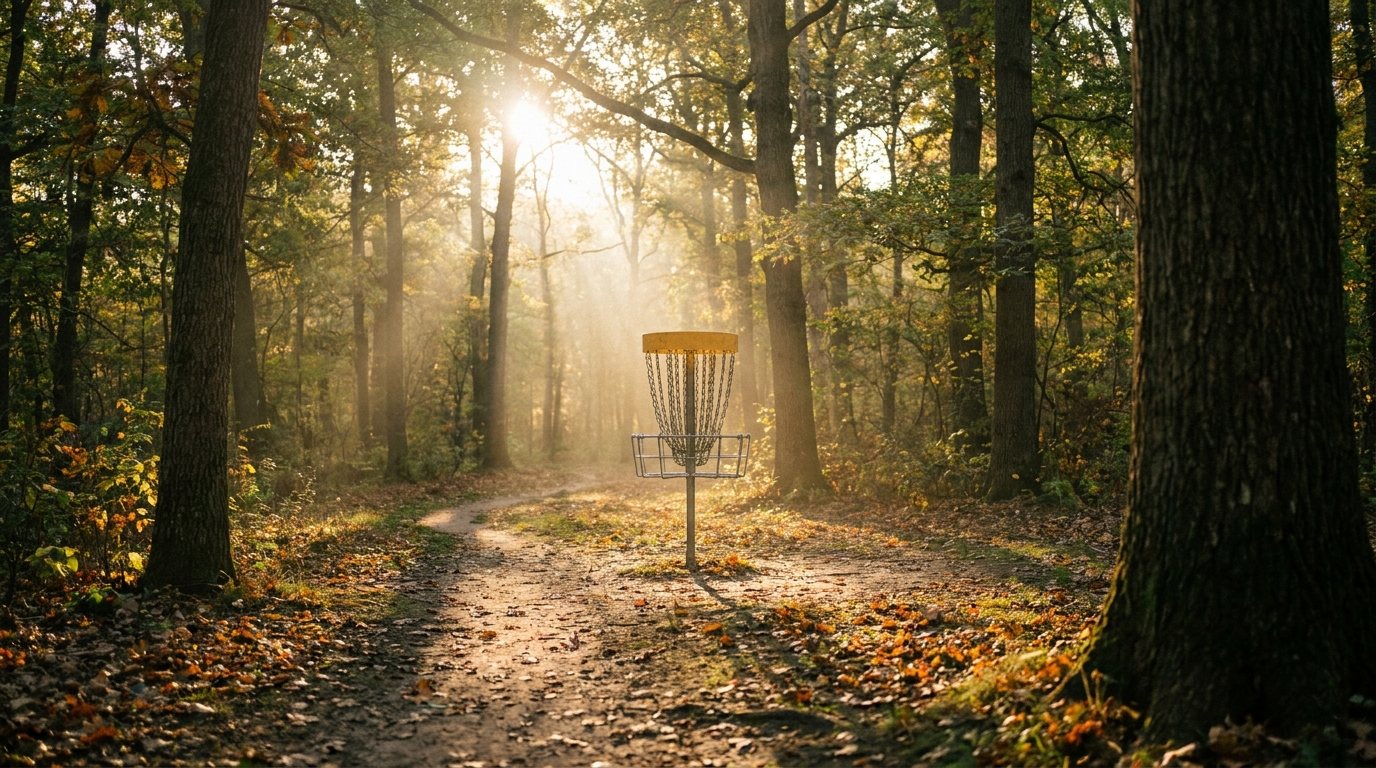
Disc golf never had that problem. A PDGA Championship basket presents a 66 centimetre inside opening, a 51 centimetre target zone, and a minimum of 12 outer and 6 inner chains, all of it metal. That is roughly 13 to 35 times more width than a flagstick, made of a material that returns far more laser energy.
Which means the technology transfers easily and the software does not. I sorted 17 devices by that split: the ones built native for disc golf, the ball golf units disc golfers actually buy, and the ones where the difference genuinely matters.
Table of Contents
- Why A Basket Is An Easier Target Than A Flag
- Built For Disc Golf
- Ball Golf Units That Cross Over
- The Budget End
- What The PDGA Rules Actually Allow
- What Rokform Is Bringing To This In September
- Final Thoughts
TL;DR
- A basket reflects better than a flagstick. Range is never the limiting factor in disc golf.
- Flag lock helps in the open and works against you in the woods, because it reports the nearest return.
- Disc-golf-native units solve that with a closest-or-farthest mode that ball golf models do not offer.
- Units are the real problem. Disc golf runs in feet, most ball golf lasers only offer yards and meters.
- The PDGA allows rangefinders outright, including slope. That is the opposite of the USGA position.
- The Rokform Golf Range Finder 18x lands September 2026 with 8x to 18x magnification and built-in tracking.
Why A Basket Is An Easier Target Than A Flag
Laser rangefinder makers publish tiered maximum ranges precisely because reflectivity dominates the return signal. Bushnell's own disc golf spec sheet lists 2,550 feet to a reflective target against 1,350 feet to a tree, roughly a 1.9 times advantage for anything metallic.
A galvanised steel basket hung with chains sits firmly on the reflective side of that line. A composite flagstick with a cloth flag does not.


The Beam Spot Explains The Rest
Golf rangefinder laser modules run roughly 0.8 to 1.2 milliradians of divergence on pin-seeking designs. At 300 feet that beam is around three and a half inches across. At 500 feet it is closer to six.
That spot completely engulfs a flagstick, so only a fraction of the emitted energy hits the target and the rest scatters into the background. The same spot lands entirely inside a 26 inch basket. Ball golfers need pin-seeking algorithms for a mechanical reason that simply does not apply to a disc golf target.
The One Place A Basket Is Harder
Canopy. Golf greens are open ground and disc golf fairways frequently are not, and this complaint runs back two decades in PDGA discussion archives, where one player noted that a single twig, or even a blade of grass, will reflect the laser.
Flag lock is a first-target priority filter. It reports the nearest object that returns a signal, which is exactly right when the basket is in front of trees and exactly wrong when a branch is in front of the basket. The algorithm ball golf spent years perfecting is the one you want to switch off in the woods, which is the single strongest argument for buying disc-golf-specific hardware.
| Situation | What flag lock does | Verdict |
|---|---|---|
| Basket in the open, trees behind | Reports the basket, ignores the treeline | Helps |
| Basket behind a branch or brush | Reports the branch, ignores the basket | Hurts |
| Basket across open ground | No filtering needed | Neutral |
Built For Disc Golf
Seven devices designed for the sport. What you buy here is feet as the default unit, slope with no tournament lockout, and target-priority modes that let you shoot past brush.
1. Bushnell Edge Disc Golf Laser Rangefinder
$199.95 MSRP with street pricing around $155, 6x magnification, 25mm objective that Bushnell markets as 50% larger and twice as bright for dim conditions. Ranging is listed at 15 to 2,550 feet with accuracy of plus or minus 3 feet, plus Z-Mode for elevation change at the basket.
IPX4, CR2 battery, 6.35 ounces, five year warranty. Two caveats worth knowing. Retailers advertise 900 feet where Bushnell's own sheet says 2,550, which is the usual marketing-max versus practical-max gap. And the PinSeeker claim on some retail listings does not appear on Bushnell's spec sheet at all.
2. MVP Parsec
$174.99 from a disc-golf-native brand, up to 2,600 feet, 6x, target-lock vibration, magnetic mount, rechargeable Li-ion over USB-C. Reviewers count nine modes including linear, height and slope.
Disc Golf Around called it deadly accurate at long and short ranges and singled out distance-compensation mode, where the unit vibrates on lock and then calculates the relative distance accounting for slope. MVP does not publish accuracy, weight or an IP rating, which is a notable omission on the priciest unit in the category.
3. Eagle Seeker 360
$159.95 direct, $139.95 through the Disc Golf Pro Tour shop. 10 feet to 3,280 feet, accuracy of plus or minus one foot, 6x multi-coated optics, feet and yards and meters, flagpole lock and trajectory compensation.
A 750mAh battery over USB-C gives roughly 20,000 measurements per charge, and the cyan bezel exists so you can find it after you put it down in leaf litter. That extreme range far exceeds anything disc golf needs, which reviewers have noted honestly.

4. Disc Store Chain Finder
$119.99 down from $149.99, up to 1,500 feet, plus or minus one foot, 6x. Notable because it renames the feature honestly: this markets a basket lock function rather than borrowing golf's vocabulary.
Every mode displays horizontal distance, elevation change and slope angle together. Voice broadcast, scan mode, manual focus wheel, USB-C, one year replacement warranty. The 1,500 foot ceiling is already generous for the sport.
5. Apex NF-600
$139.99, 10 to 2,000 feet, plus or minus 1.5 feet, 0.1 degree angle precision, 6x with a 7 degree field of view. Feet by default.
The mode list is where it earns its place: slope distance, vertical, horizontal, speed, height, disc golf compensation, and critically closest or farthest priority. That last mode is the answer to the canopy problem, letting you flip the logic and shoot past intervening brush to the basket behind.

6. Rogue Iron Factor
$89.99 MSRP and often around $70, 6.5x24, DG Mode with scan, distance plus vertical height plus angle on one screen. Feet, yards and meters, plus or minus half a metre out to 700, USB-C rechargeable, 5.6 ounces.
The Gadgeteer tested it against both targets and found it spot on to flags on a golf range and only a foot off at most when ranging a basket's top band. That is the closest thing to a published side-by-side comparison in this niche, and it shows no acquisition penalty on baskets. Their only complaint was the absence of a lanyard loop.
7. Apex NP-600
$99.99 and chronically out of stock, 905nm Class 1 laser, feet and yards and meters, eight modes including distance compensation and a 20-reading memory, USB rechargeable. The rechargeable sibling to the NF-600 at a lower price, though retailers do not publish its magnification or maximum range.
Ball Golf Units That Cross Over
Six devices built for ball golf that disc golfers buy anyway. The hardware is identical in every way that matters, and the compromises are all in software.

8. Bushnell Tour V7 Shift
$399.99, 6x, 5 to 1,300 yards. Overkill on range and excellent on optics, with a dual colour OLED and vibration plus a red ring flash on lock.
The problem is units. Yards only, so every read needs a mental multiplication by three, and plus or minus one yard means plus or minus three feet at a scale where disc-golf-native units claim one.
9. Nikon Coolshot 20 GIII
$199.95, 6x, 6 to 800 yards, rainproof at IPX4 equivalent under Nikon's own testing conditions, five year warranty. The longest warranty term in either sport.
800 yards is 2,400 feet, comfortably more than any disc golf hole. Nikon's optics are the best argument here, and the lack of a feet setting is the reason many disc golfers pass.
10. TecTecTec VPRO500
Frequently recommended as the cheap crossover and explicitly flagged by disc golf reviewers as a ball golf design. It works, it is inexpensive, and it will hand you yards.

11. Callaway 300 Pro
Street pricing between roughly $125 and $180, 6X, 5 to 1,000 yards, 300 yard pin lock, and both an audible chirp and a vibrating burst on acquisition. Third parties recommend it for disc golf regularly.
Audible confirmation is arguably more useful in disc golf than ball golf, since you are frequently ranging in low light under canopy where reading a display is harder.
12. Shot Scope Pro L2
$149.99, x6, 700 yards, single button operation, and the simplest device in either sport to use one-handed. 700 yards is 2,100 feet.
Simplicity is the selling point for a walking sport where you are carrying a bag and holding discs. The warranty excludes water damage in writing, which matters more in a sport played in longer grass and wetter conditions, and the same drying advice in our phone water damage repair guide applies to any laser that gets soaked.
13. GOGOGO Sport Vpro GS91W
GOGOGO makes no disc-golf-specific model, and its own disc golf blog points at this multi-purpose unit instead, advertising a 15 to 4,200 foot mode. Worth flagging that the same blog post states rangefinders are generally not permitted in tournaments unless expressly allowed, which is flatly wrong for PDGA play and appears to be ball golf copy pasted onto a disc golf page.
The Budget End
Four options under $100, where the trade is documentation rather than function.
14. Gogogo Sport PocketPin
$55.00 rechargeable, the cheapest credible laser in either sport. Yards, and no disc golf mode, but a real rangefinder at a price that makes the units problem easier to forgive.
15. Gogogo GS03
$79.99. Same reasoning. If you play occasionally and want a number rather than a system, this is the floor.

16. Atlas Disc Golf Supply Scout
$95.00 and sold out at the retailer I could verify. Atlas publishes no specs at all, which is the honest reason it sits here rather than higher.
17. Bushnell Sport 850
$159.99 at Infinite Discs, 850 yards, plus or minus one yard, 6x24, and it measures in feet, which is the whole point. ARC modes, scan at four readings per second, IPX4, CR2, 180 grams.
One oddity: retailer catalogues list this under the same model number Bushnell assigns to the Edge, so these are very likely the same hardware under a renamed line. Buy on price rather than on the name.

What The PDGA Rules Actually Allow
This is where disc golf and ball golf separate completely, and most articles on this topic get it wrong.
The PDGA answers the question directly in its official Rules Q&A: rangefinders are allowed, provided you still throw within the time allowed by the Excessive Time rule. The governing rule, 813.02 Illegal Device, prohibits any device that directly assists in making a throw. Planning one is not covered.
Slope is allowed with no restriction whatsoever. No PDGA rule limits elevation or gradient compensation, which is why disc-golf-native units sell slope as a permanent headline feature rather than something behind a tournament lockout. Ball golf runs the opposite way, with Rule 4.3a(1) listing measuring elevation changes under Not Allowed in every round.
| PDGA | USGA | |
|---|---|---|
| Rangefinder in competition | Allowed by default | Allowed, but a Committee may ban all devices |
| Slope and elevation | Allowed, no restriction | Prohibited |
| Reflectors on the target | Not needed, the target is metal | Explicitly permitted on flagsticks |
| Governing rule | 813.02 plus Q&A | Rule 4.3a(1), MLR G-5 |
One escape hatch exists. Rule 813.02.5 lets a Tournament Director rule a device illegal if it is questioned, which has never been applied to rangefinders but is technically the mechanism by which one could be banned at a specific event.
The contrast with ball golf runs deeper than a rules table suggests. Ball golf had to legislate a reflective aid onto its own target to make lasers work reliably, permitting reflectors on flagsticks above the green surface. Disc golf never needed to, because the target was already a 26 inch metal cage hung with a minimum of eighteen chains. One sport engineered the target to suit the technology and the other got lucky. If you play both, our golf etiquette guide covers the conventions that carry across, and our best golf rangefinders roundup handles the ball golf side properly.

How Much Range You Actually Need
PDGA course design guidelines put a Gold-level par 5 at 1,000 feet and up, with par 3s from 100 to 250 feet depending on tee colour. Most ranging happens between 150 and 500 feet.
Walking eighteen wooded holes is closer to a hike than a round of ball golf, which is worth remembering when you compare weights, and our comfort-focused golf accessories roundup covers the rest of what a walking sport asks for.
Every device in this piece over-delivers. The Eagle Seeker's 3,280 feet and the Bushnell Edge's 2,550 are marketing numbers, not requirements. What matters at disc golf distances is resolution and acquisition, not reach, and at 250 feet the difference between plus or minus one foot and plus or minus three is the spec worth shopping on.
What The Shot Clock Changes
Time pressure is the only real constraint the PDGA puts on rangefinder use, and it deserves more attention than it gets. The Q&A ties rangefinder use directly to the Excessive Time rule, meaning a device that takes three attempts to acquire is costing you against a clock rather than merely testing your patience.
That reframes the acquisition question entirely. In ball golf a slow lock is an annoyance. In sanctioned disc golf it is a scoring risk, which argues for spending on the target-priority modes rather than on maximum range you will never use. Our list of golf accessories every golfer needs makes the same argument about the rest of the bag.
The GPS Alternative
UDisc is effectively the sport's default infrastructure, reporting 2 million users, 21.2 million rounds tracked in 2025 and 17,287 courses across 99 countries. It gives real-time GPS distance to the basket on photographic hole maps, and a Measure Throw function.
The limitation is candid in UDisc's own guidance, which notes that narrowing your location to within 10 metres requires a signal from seven or more satellites and warns that tree cover degrades it. Ten metres is 33 feet against a laser's one to three, on holes averaging 250 to 450 feet. GPS error is roughly 7 to 13% of a typical hole and laser error is under 1%, and the environment where GPS struggles most is exactly the canopy disc golf is played under. Our roundup of GPS golf apps covers the ball golf equivalents.

What Rokform Is Bringing To This In September
The Rokform Golf Range Finder 18x arrives September 2026, and while it is built for ball golf, two features address problems disc golfers know well.
8x to 18x adjustable magnification is a category first, and no other laser rangefinder in either sport offers that range. Dial up to pick a basket out of a cluttered wooded backdrop at distance, dial back for a quick read on a short hole. Nothing in the disc golf list above goes past 6.5x. Flag lock with vibration gives tactile confirmation the moment you lock, which matters under canopy where reading a display is harder, and the 1,200 yard range covers anything either sport can throw at it.
Then the one that fits a walking sport. Apple Find My and Android Find Hub tracking are built in, so a rangefinder set down on a tee pad can be located from your phone. IPX6 handles the wet grass and morning dew that come with early tee times, and MagMax magnetic mounting works with the same system as our top golf cart accessories lineup. Two year warranty, 60 day money back, $499.99.
Reserve yours ahead of the September launch: Rokform Golf Range Finder 18x. Swing hard, make putts.
Final Thoughts
Buy for units and target priority, not for range. Every device here reaches further than any hole you will play, and the two things that genuinely change your experience are whether the number arrives in feet and whether you can tell the laser to ignore the branch in front of the basket.
A disc golf rangefinder built native gives you both. A ball golf unit gives you neither and costs less, and plenty of good players run one happily with mental arithmetic. The honest position, and the one most credible reviewers land on, is that a rangefinder is a rangefinder and the software is the whole difference. Our guide to golf accessories for accuracy covers the crossover kit worth carrying either way.

