


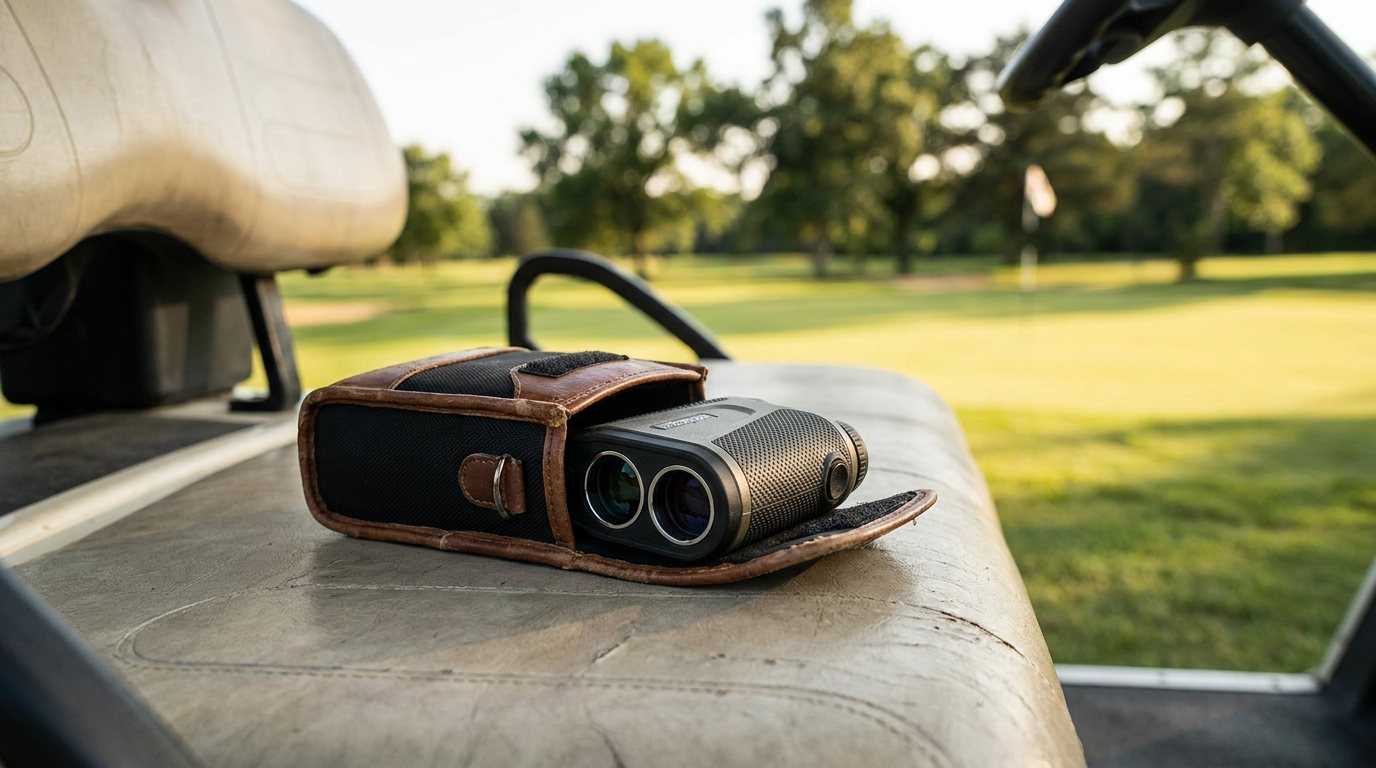
Rokform 18x ships with a case. September.
17 golf rangefinder cases ranked, plus the drop-damage warranty exclusion that every single major brand quietly shares.
Your rangefinder came with a case. Almost all of them do, across every price tier, and that fact quietly undermines most articles written on this subject.
Here is the argument that actually holds. I read the warranty terms for every major rangefinder brand, and not one of them covers drop or impact damage. Bushnell excludes accidental damage. Garmin excludes abuse, misuse and accident. Nikon voids for negligence and accident. Shot Scope excludes accidental damage outright. Precision Pro scopes coverage to how the device was built.
A $600 device with a two year warranty that would not pay out if you drop it on a cart path is a device whose only real protection is the thing you carry it in. So this is not a list of accessories. It is a list of the seventeen ways to keep a warranty exclusion from becoming your problem.
Table of Contents
- What Your Warranty Will Not Cover
- Replacement Cases From The Original Brand
- Magnetic Cases That Add Cart Mounting
- Hard Shell And Premium Aftermarket
- Silicone Skins And Tracker-Ready Covers
- The Loss Problem Nobody Publishes Numbers On
- What Rokform Is Bringing To This In September
- Final Thoughts
TL;DR
- Every rangefinder ships with a case. The question is upgrading or replacing, not whether you need one.
- No major brand covers drop or impact damage under warranty. Every single one excludes it.
- Bushnell excludes water damage too, on devices it markets as water resistant.
- Magnetic cases and skins are the real upgrade, because they add cart mounting to a device that lacks it.
- Precision Pro sells a 30% replacement discount for a lost rangefinder, which tells you how often it happens.
- The Rokform Golf Range Finder 18x ships September 2026 with a carrying case and Find My tracking built in.
What Your Warranty Will Not Cover
Read these five clauses together and the case stops looking optional.
| Brand | Warranty term | What is excluded |
|---|---|---|
| Bushnell | 2 years on lasers | Accidental damage, including water damage, negligent use, misuse, transport damage |
| Garmin | 1 year | Failures due to abuse, misuse, accident, unauthorised repair |
| Nikon | 5 years | Misuse, abuse, abnormal use, negligence, alteration, accident |
| Shot Scope | 2 years | Accidental damage, misuse, neglect, and separately water, flood and fire |
| Precision Pro | 3 years | Scoped to manufacturing: display, optics, electronics, button feel, magnet |
Bushnell is the one worth pausing on. It publishes IPX6 and IPX7 ratings across its laser line and then excludes water damage in the warranty, which means the rating describes what the device survives rather than what the company will pay for.


What Actually Kills Rangefinders
Impact, not water. The one durability complaint surfacing in manufacturer review sections is mechanical, with one owner reporting a single minor drop knocked a unit 50 yards out of calibration.
That is the failure a case prevents and the warranty ignores. Optical alignment inside a rangefinder is the fragile part, and a device that still powers on after a drop can be confidently wrong, which is worse than one that is obviously broken. Our roundup of golf accessories for accuracy covers the rest of the kit where precision depends on nothing having been knocked.
Nikon Quietly Removed The Best Safety Net
Nikon previously ran a no-fault warranty on rangefinders, replacing units regardless of cause. That programme has ended, documented across owner forums, leaving the five year term with a standard exclusion list.
Five years is still the longest in the category. It just no longer means what it used to mean.
Replacement Cases From The Original Brand
Five options where the model-specific fit matters more than the material.
1. Bushnell Replacement Carrying Case, Tour Hybrid and Tour V7
$14.99, zip closure with a carabiner, model-specific. Bushnell publishes neither material nor water resistance, which is a strange omission on a protective product.
The carabiner is the useful part, attaching to a bag rather than a cart. Sibling versions exist for the A1-Slope at $12.99 to $14.99.
2. Bushnell Replacement Carrying Case, Pro X3
$14.99 and frequently out of stock. Fits the Pro X3 and Pro X3+, ships with a carabiner.
The fact that Bushnell sells replacement cases as standalone products at all is the tell. Nobody stocks a spare part for something that does not get lost.

3. Garmin Carrying Case, Approach Z82
$39.99 MSRP, model-specific, carabiner clip for a belt or bag. The most expensive OEM replacement here by a wide margin, and availability through authorised dealers has been patchy.
4. Precision Pro Laser Rangefinder Carrying Case
$19.99, hard shell, and semi-universal rather than model-locked. Precision Pro markets it as fitting the NX9 Slope, NX10 Slope and Titan Series, and describes it as one size fits most rangefinder models.
The hard shell is the point. Most OEM cases are padded fabric, which handles abrasion and does nothing for impact.
5. Shot Scope Laser Carry Case
$19.99, water-resistant material, zip closure with an elastic quick-access toggle, and Shot Scope lasers only. Availability has been poor.
The quick-access toggle is a genuinely good idea, because a case you have to fully unzip forty times a round is a case that ends up staying open in the bag.

Magnetic Cases That Add Cart Mounting
Four products that upgrade rather than replace, turning a case into a mount.
6. Bushnell BITE Magnetic Skin, A1-Slope
$24.99, a magnetic skin rather than a case, protecting the device and adding cart-bar mounting through Bushnell's BITE magnet. Model-specific to the A1-Slope.
This is the pattern worth understanding. The skin stays on the device, so protection and mounting are the same object and there is nothing to unzip.
7. TecTecTec Magnetic Leather Sleeve, ULT-S and ULT-S Pro
$49.99, vegetable-tanned leather with an integrated magnet, model-specific. The most expensive protective product in this list and the only one made of real leather.
A sleeve mounts straight to a cart bar. The trade against a zip case is abrasion protection in exchange for speed.

8. TecTecTec Magnet Sleeve
$19.99, neoprene stretch with two magnets. One important limitation: it only fits rangefinders without side buttons, which rules out most of the current market and all of the slope-switch models.
9. Blue Tees MagHub Magnetic Bag Clip
$24.98, a steel-cored magnetic pad that attaches to a golf bag and gives any magnet-equipped rangefinder somewhere to land. Pairs with devices that already have magnets built in rather than adding one.
Stripebird sells a direct competitor, the Golf Hub for Magnets at $24.98, a manganese steel plate in liquid silicone that clamps to most bag cuffs with no tools. Neither works with 14-way divider bags. Worth reading beside our breakdown of golf cart phone holders if you are building the whole setup.
Hard Shell And Premium Aftermarket
Four options where you are buying impact protection or aesthetics rather than function.

10. Blue Tees Player+ Hard Shell Carrying Case
$39.98, moulded leatherette with suede lining, padded handle and a magnetic lock closure. The magnetic closure is meaningfully faster than a zip when you are ranging every hole.
11. Blue Tees Rangefinder Hard Case
$29.28, leatherette moulded shell, suede lining, magnetic lock, fitted to the Series 3 Max+ and Series 4 Ultra. The cheaper sibling and the better value if you own either device.

12. Stitch Golf Console
$98, felt-lined with YKK zippers, an elastic strap closure and an aluminium carabiner. Fits most rangefinders.
Nobody needs a $98 rangefinder case. Some people want one, and the build quality is real. Worth saying plainly rather than pretending it is a performance purchase.
13. Jones Golf Bags Rangefinder Pouch
$38 standard, $42 for the heritage colourways, fourteen options. Jones publishes no material, closure or attachment details at all, which is the honest reason it sits here rather than higher.
Silicone Skins And Tracker-Ready Covers
Four covers that stay on the device rather than storing it.
14. TecTecTec Protective Silicone Case, ULT-S and ULT-S Pro
$19.99, silicone with precision cutouts and a non-slip grip, model-specific. A skin solves the actual failure mode better than a case does, because it is on the device at the moment you drop it.

15. TecTecTec Silicone Sleeve, KLYR
$19.99, shock absorbing and magnet-compatible so it does not block a built-in cart magnet. TecTecTec runs the widest silicone range in the category, with versions for the ULTX and VPRO500 at the same price.
16. TecTecTec Premium Hard Shell Case, KLYR
$19.99 and it ships with a magnetic ball marker, which is the kind of small thing that decides a purchase between two identical products.
17. Spigen Rangefinder Wrap with AirTag
$29.99, universal, with a dedicated AirTag slot, and currently sold out alongside the rest of Spigen's golf line. The concept matters more than the availability, because a case that makes the device findable addresses the failure nobody insures against.
The Loss Problem Nobody Publishes Numbers On
No survey, industry report or insurance dataset quantifies how often golfers lose rangefinders. I looked hard and the honest answer is that the data does not exist.
What exists is revealed preference, and it is loud. Precision Pro builds lost rangefinder protection into its standing guarantee, offering 30% off a replacement if you lose it. Manufacturers do not productise a problem that is not happening. Spigen designed an AirTag slot into a rangefinder wrap. Bushnell, Precision Pro, Shot Scope and Blue Tees all sell replacement cases as standalone products, which only makes sense if the originals disappear.

Replacement Cases Are A Product Category
Bushnell, Precision Pro, Shot Scope and Blue Tees all sell replacement cases as standalone SKUs between roughly $13 and $40. That is not an accessory line, it is a repeat-purchase line, and it only exists because the originals go missing.
Worth factoring into a buying decision. A model-specific OEM case ties you to a $15 replacement every time one disappears, where a universal hard shell or a silicone skin survives a device upgrade. If you change rangefinders every few seasons, buy universal. Our holiday gift guide for golfers covers the accessories that actually get used rather than stored.
Why The Cart Is The Culprit
A magnetically mounted rangefinder spends four hours on a cart rail and then you walk away from the cart. That is the entire mechanism, and it is the reason a magnet is simultaneously the best convenience feature and the biggest loss risk in the category.
Caddie HQ states plainly that the number one way players lose expensive magnetically mounted rangefinders is by forgetting them on the rental cart. Treat that as informed opinion rather than data, because no numbers back it. A magnet keeps the device where you can reach it and removes the one cue that would remind you to pick it up, which is your hand. Our golf etiquette guide covers the end-of-round habits that solve most of this for free.

Choosing Between A Case And A Skin
Ask when the damage happens. A case protects the device in the bag between rounds and in transit. A silicone skin protects it during the four hours it is out of the bag, which is when you drop things.
| Protection type | Best against | Weakness |
|---|---|---|
| Zip fabric case | Abrasion, dust, bag transit | Slow, and off the device when you drop it |
| Hard shell case | Crush damage in transit | Bulk, and same timing problem |
| Silicone skin | Drops during play | Nothing for bag storage or dust |
| Magnetic skin or sleeve | Drops plus adds cart mounting | Model-specific, blocks some buttons |
| Tracker-ready wrap | Loss | No impact protection on its own |
The honest recommendation is a skin for play and the original case for storage, which costs about $20 and covers both. The same logic drives our thinking on why you need a golf phone case, where the device you carry every round is the one that meets the cart path. Our list of golf accessories every golfer needs puts that in context with the rest of the bag.
One Thing No Case Solves
Optical misalignment after an impact is silent. A rangefinder that has been knocked hard still powers on, still locks a pin, still returns a confident number, and that number can be wrong by enough to cost you a club.
Nothing in a warranty covers it and nothing on a spec sheet warns you about it. The only practical defence is a periodic sanity check: range a known distance, a 150 yard marker or a measured practice hole, and see whether the device agrees with it. Do that once a season and after any hard drop. It takes thirty seconds and it is the only quality-control step available to you, because no brand offers recalibration as a service.
What Rokform Is Bringing To This In September
The Rokform Golf Range Finder 18x arrives September 2026 and ships with a carrying case, a microfibre lens cloth, a USB-C charging cable and a quick start guide in the box.
The more interesting part is what makes the case less load-bearing. Apple Find My and Android Find Hub tracking are built in, so the loss problem that the whole aftermarket has been improvising around with AirTag slots is solved at the device level. Left it on a cart at the turn? Locate it from your phone in seconds. Nothing else in this category can do that.
MagMax magnetic mounting snaps it to cart rails and any MagMax surface without needing a magnetic sleeve bolted on afterwards, and IPX6 covers dew, rain delays and humid rounds. 8x to 18x adjustable magnification is a category first, flag lock with vibration confirms the pin the moment you lock it, and the tournament-legal slope toggle covers practice and competition on one device. Two year warranty, 60 day money back, $499.99. Our top golf cart accessories lineup runs on the same MagMax system.
Reserve yours ahead of the September launch: Rokform Golf Range Finder 18x. Swing hard, make putts.
Final Thoughts
Buy the case for the drop, not for the rain. Water ratings are printed on the box and impact protection is not, yet impact is the failure every warranty in this category specifically refuses to cover.
Then decide honestly whether you want protection or mounting, because the products that do both well are model-specific and the universal ones compromise. A golf rangefinder case costing $20 protects a device costing thirty times that against the one thing nobody will reimburse you for, which makes it the highest-return purchase in your bag. Our most common golf mistakes piece covers the errors that cost more than a broken rangefinder ever will.

