


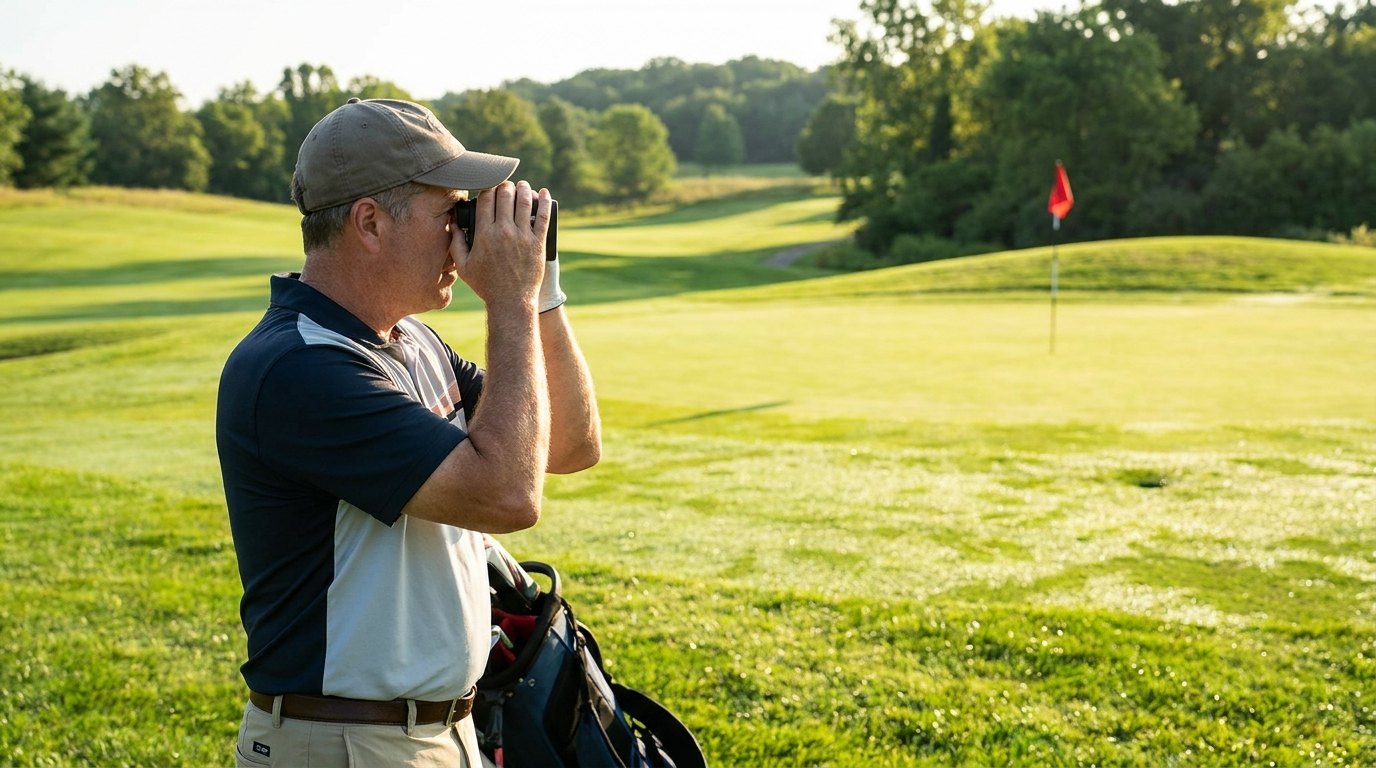
Stated tolerance is about one yard. Real course reads are not. Here is every error source in a rangefinder read, ranked by what it costs your scorecard.
Rokform Golf Range Finder 18x, coming soon.
Pick up almost any laser sold to golfers and the box promises roughly a yard. Bushnell publishes "Accurate to +/- 1 yard" for the Pro X3+ across a 5 to 1,300 yard measurement span in the Bushnell Pro X3+ user manual, and the rest of the category echoes it. Then you read one flag three times from the same spot and collect three different numbers. Golf rangefinder accuracy is not a single figure on a box. It is a chain, and the laser is its strongest link. I have watched far more yardage vanish into bad target selection than into any timing circuit, so that is where this piece spends its time. The gap between published golf rangefinder accuracy and Saturday morning reality is almost entirely fixable, and almost entirely yours.

Table of Contents
- TL;DR
- What "Plus or Minus One Yard" Is Actually Measuring
- The Error Sources, Ranked by What They Cost You
- How to Test Your Own Device in Fifteen Minutes
- Laser Versus GPS When You Compare Them Honestly
- Buy for the Whole Error Chain, Not the Tolerance Line
- Holding a Steady Read on a Distant Flag
- Final Thoughts
TL;DR
- Published tolerance describes a ranging engine on a clean target under controlled conditions, not a golfer swaying in wind on a side slope.
- The beam leaves as a cone wide enough at 200 yards to cover the flagstick and the trees behind it.
- Hand shake at high power costs two to fifteen yards on the number you accept, and bracing removes most of it.
- How accurate are golf rangefinders next to your swing? Your carry spread with one club dwarfs the device tolerance.
- Better golf rangefinder accuracy on the course comes from technique and targeting first, hardware second.
What "Plus or Minus One Yard" Is Actually Measuring
A published tolerance is a statement about the ranging engine, describing how precisely a unit converts round trip time into distance given a cooperative target, enough returned light, and a stable aim point. None of the three is guaranteed on a golf course, and two depend on whoever holds the device.
Device error and system error are different quantities. One is what a manufacturer tests and publishes. The other lands on your scorecard, and it includes you. Only the first appears on the box, which is why the same one yard figure repeats across nearly every unit in a roundup of the best golf rangefinders of the year, and why it tells you so little.
Half a yard is the claim at the top of the market now. Mileseey's GenePro G1 publishes plus or minus 0.5 yard and took Best Overall Rangefinder of 2026 on July 2, 2026 with a 96 percent optics score, per MyGolfSpy's award coverage (MyGolfSpy). One yard is the entry fee for a golf laser rangefinder, not a selling point.
The Timing Problem Behind Every Reading
The device fires an infrared pulse, times the round trip, and converts that time into a distance. The nanosecond arithmetic behind the conversion sits in how a golf rangefinder works. The part that matters to a scorecard is that a one yard tolerance is a demand made on a timing circuit, and that demand was met years ago. Rangefinder accuracy at the circuit level stopped being the constraint long before you bought anything.

Why Tolerance Widens the Farther You Shoot
Most golfers assume one tolerance figure holds everywhere. Plenty of spec sheets say otherwise. Nikon publishes a banded tolerance for the COOLSHOT 50i of plus or minus 1 yard under 100 yards, plus or minus 2 yards from 100 to 1,000 yards, and plus or minus 0.5 percent beyond, alongside a 905 nm laser and a 6 to 1,200 yard span, per the Nikon COOLSHOT 50i specifications. That wavelength is Nikon's own, published for Nikon's units.
Returned energy falls off with distance, the beam footprint grows, the atmosphere interferes more, and the timing window stretches, so the bands widen. How accurate are golf rangefinders at the yardages that decide your score? Better than the headline suggests, because approach shots live in the tightest band, the quiet good news inside every tiered golf rangefinder accuracy spec.
| Device | Published tolerance | Stated range | What the fine print adds |
|---|---|---|---|
| Bushnell Pro X3+ | Plus or minus 1 yard | 5 to 1,300 yards | One flat figure across the span |
| Nikon COOLSHOT 50i | 1 yard under 100 yd, 2 yards to 1,000 yd, 0.5 percent beyond | 6 to 1,200 yards | Banded, not flat |
| Nikon COOLSHOT PROIII Stabilized | 0.75 yard under 700 yd, 1.25 yards to 1,000 yd, 1.75 yards beyond | Long range | Tightest band here |
| Garmin Approach Z10 | Within 1 yard | Up to 350 yards | Shorter span, compact body |
| Mileseey GenePro G1 | Plus or minus 0.5 yard | Manufacturer stated | Claims 0.1 second measuring speed |
Sources: the Nikon COOLSHOT PROIII Stabilized announcement, the Mileseey GenePro G1 product specifications and the Garmin Approach Z10 press release.
The Error Sources, Ranked by What They Cost You
Ranking by yards moved beats ranking by how technical each source sounds. It helps to be clear on what a golf rangefinder does for your decision making first, because golf rangefinder accuracy only matters to the extent it changes a club.
| Error source | Typical cost to the number you play | Who controls it | Fastest fix |
|---|---|---|---|
| Your own club distance spread | Ten yards and up | You | A range session with real carry data |
| Beam landed on the wrong target | Five to thirty yards | You | Confirm the lock, then read again |
| Slope interpretation and elevation | Five to twenty yards | Shared | Learn your own elevation adjustments |
| Hand shake at high magnification | Two to fifteen yards | You | Brace, exhale, fire on the pause |
| Dirty glass, low light, rain | Failed reads more than wrong ones | Shared | Microfiber cloth and a second read |
| Cold battery and temperature swings | Slow or failed locks | You | Charge before the round, warm the unit |
| The published device tolerance | One yard or less | The manufacturer | Nothing. Already the smallest term |
Your Own Distance Spread Is Bigger Than Any Device Error
A golfer hits ten eight irons in a monitor bay and records carries of 148, 152, 155, 157, 157, 158, 159, 161, 162 and 164 yards. Sixteen yards of spread, a club and a half on the ten yards per club scale this piece uses throughout. The average is 157.3, and four of the ten landed within two yards of it.
Strike quality moves the ball, and so do lie, wind, temperature and a quickened pulse on the first tee. A device erring by a yard adds a rounding error to a decision already carrying double digit swing variance. That spread is the honest answer to whether you need a rangefinder. The job of a good golf rangefinder is not shaving a yard off the measurement, it is deleting distance from your list of guesses.
What the Beam Hit Is Not Always What You Aimed At
The laser leaves the unit as a cone. Spot size grows with distance according to divergence, so a beam running roughly 1 milliradian measures about 0.2 yards across at 200 yards, close to seven inches. The Equipment Rules cap a flagstick at three quarters of an inch in diameter. Both the pin and a trunk forty yards behind the green fit inside that beam.
Take that 200 yard back pin. First target logic reports the nearest return and hands you 200. The identical aim point returns 240 without it, a forty yard error, four clubs, in the same confident digits. Nikon states it plainly for its own units: first target priority displays the distance of the closest subject when subjects overlap. A flag lock rangefinder adds a second layer, telling you through vibration or a visual ring that the return it kept was the thin one. Golf rangefinder accuracy at the moment of decision is mostly a targeting question.

The Numbers That Give You Away
A read that comes back long almost always caught the backdrop, and a short one caught a mound, a ridge or a branch in front. Take three reads. If one disagrees with the other two by more than a couple of yards, that odd number is a targeting failure, and the pair that agree is the pair to trust.
Slope Is Perfect Trigonometry and Still Not the Whole Answer
The geometry is exact. Horizontal distance equals line of sight multiplied by the cosine of the inclination angle, and elevation change equals line of sight multiplied by the sine. Playing distance adds elevation gain uphill and subtracts it downhill.
The worked example on a 6 degree uphill par three is run in full inside how a golf rangefinder works. Accuracy is the part that concerns us here: the horizontal number comes back marginally shorter than the raw read while the number you play lands about a club and a half longer, because elevation gain overwhelms the cosine shrink. The device was never wrong by an inch.
No manufacturer publishes its full compensation algorithm. Arccos put a Smart Laser Rangefinder on sale in late October 2025 whose plays like figure folds wind, slope, temperature, humidity and altitude into one number, with a tournament mode that switches the algorithm off, reported by Golf Digest (Golf Digest). Two devices on one flag can produce different numbers and both be defensible. I treat golf rangefinder slope output as a strong recommendation, never a prediction of where the ball stops.

Slope Off Does Not Mean Slope Ignored
Competition removes the feature, not the hill. Tour and committee restrictions on slope, elevation and contour displays are set out in the USGA rangefinder rules, and amateur committees layer their own local terms on top.
Bushnell announced the Tour V7 Shift on January 20, 2026 with Slope First display logic that puts the compensated number first on screen, covered in MyGolfSpy's launch report (MyGolfSpy). That design makes the toggle easy to forget, and a golfer who has only played the compensated number is helpless the first time it goes off. Read the raw yardage, judge the elevation by eye, apply your own adjustment, then check against the golf rangefinder slope figure in casual rounds until the two agree.
Hand Shake Multiplies With Magnification
Eighteen power triples the size of a distant flag against six power and triples the movement of the reticle with it, which is worth two to fifteen yards on the number you accept. The optics behind that tradeoff belong to how a rangefinder works. Six power is forgiving. Push higher and the reticle drifts across the flag, the collar, the bunker face and back, and the device reports whatever sat under the crosshair when the pulse fired. Nothing malfunctioned. You asked a different question than the one you meant.
Bracing, breathing and confirming cost nothing and fix most of it. A flag lock rangefinder refuses to confirm until it has the thin target, so wait for the vibration instead of accepting the first digits on screen. Most of this lives inside the wider habit of how to use a rangefinder properly.
The steady read routine:
- Stand still and settle your feet before the unit comes up.
- Brace both arms against your ribs, a cart rail, or a bag strap.
- Find the flag at the lowest magnification that shows it clearly.
- Exhale, and fire at the bottom of the breath when the reticle is quietest.
- Wait for the lock confirmation before accepting the number.
- Read a second time. Matching numbers finish it. A mismatch means a third.
Glass, Rain, Cold and Reflectivity Change What Comes Back
Smeared glass, a fogged eyepiece, low sun down the target line, or heavy rain between you and the pin all cut the returned signal. The symptom is rarely a wrong number. It is a slow lock, a failed read, or a lock on the wrong surface. Reflectivity matters too: a prism equipped flag sends back far more light than wet grass or a dark tree line, which is why one device feels sharp on one hole and sluggish on the next. A soft image is its own diagnosis, and why your rangefinder looks blurry usually comes down to two adjustments most golfers never touch.
Cold belongs in the same category. A weakening cell on a cold morning degrades lock behavior before any warning icon appears, and a unit carried from a cold car to a warm first tee fogs internal surfaces no cloth reaches. Neither pushes the number off by yards. Both cost you the second read that would have caught a targeting error, which is where the yards actually go. Charge the night before and keep the device in a pocket.
How to Test Your Own Device in Fifteen Minutes
Auditing golf rangefinder accuracy takes three fixed references and a phone note. Stamped sprinkler heads work, and so do range markers. You are measuring two things: repeatability, how tightly your reads cluster, and bias, how far that cluster sits from truth. Repeatability matters more, because a consistent offset can be worked around and scatter cannot.
The fifteen minute accuracy audit:
- Pick three fixed references at roughly 75, 150 and 225 yards.
- Take five reads at each and write every number down.
- Subtract the lowest read from the highest at each station to get your spread.
- Compare the middle of each cluster to the reference number to get your bias.
- Repeat one station braced and one freehand to isolate hand shake.
- Repeat one station with a freshly cleaned lens.
- Log the date so next season has a baseline.

What a Failed Test Actually Means
A tight cluster on the correct number means the device is fine. A tight cluster on the wrong number means the reference is mismarked or the unit has drifted. Wide scatter points at technique, glass or a dying battery long before the laser.
One caveat about rangefinder calibration: consumer golf lasers ship with no user adjustment for distance offset. No menu fixes a real fault, so rangefinder calibration here means verification, not correction. Confirm rangefinder accuracy against marks you trust, and repeated failures on those marks are a warranty conversation.
Laser Versus GPS When You Compare Them Honestly
A laser measures the exact object you point it at, which is why it owns the flag, carries over hazards, and anything with a defined edge. Satellite positioning needs neither line of sight nor a steady hand, and inherits whatever error lives in the map and the pin position.
The research is kinder to satellites than most golfers assume. A peer reviewed validation of 1,267 tracked shots reports mean bias of a yard or under against a laser and tape measure control, and separately reports inter unit reliability, one unit against a second of the same model, of 3 yards or less for one shot tracking system and 2 yards or less for the other, published in the International Journal of Golf Science. Useful numbers, still short of what a golf laser rangefinder delivers on the shot that matters. Satellites earn their place on blind shots, layups, and front, middle and back numbers when the pin is out of sight. Golf rangefinder accuracy and satellite accuracy answer different questions, and the full laser rangefinder versus GPS comparison goes deeper.
Buy for the Whole Error Chain, Not the Tolerance Line
Two devices with identical published tolerance can perform very differently in the same hands. Optics quality settles whether you can pick the pin out of flat light, and confirmation feedback settles whether you know which target you got. Speed to lock decides whether you take a second read or wave the group through.
Weigh those before comparing rangefinder accuracy figures that are effectively identical. Golf rangefinder accuracy on a spec sheet has been solved for years, and our golf rangefinder buying guide breaks the rest down feature by feature.
Holding a Steady Read on a Distant Flag
Two failures cost real yards, and both sit near the top of the ranking above. You cannot confirm which surface the beam kept, and you cannot put enough power on a far flagstick before your own hands start walking the reticle off it. The Rokform Golf Range Finder 18x was built against those two.
Adjustable 8x to 18x magnification lets you set the power to the shot. Dial up for a back pin on a par five, and dial down to 8x on a short approach, where a wider, quieter picture cuts the hand shake cost instead of multiplying it. Flag lock with vibration settles the other failure: the unit tells you through your hand that it held the thin return rather than the tree line forty yards behind the green, the difference between a 200 yard read and a 240 yard read on the same aim point.
The Rokform Golf Range Finder 18x arrives in September. A golf laser rangefinder whose power you choose per shot takes the largest correctable term out of the chain and hands you a number you can commit a club to.
Final Thoughts
The published tolerance is real, and the engineering behind it is impressive. It answers a narrow question. The number you play comes out of a chain that starts with where the beam landed, runs through how steady you were and how you read the hill, and ends with how consistently you strike a golf ball. Fix that chain in order of cost, largest first.
How accurate are golf rangefinders once all of that is accounted for? Accurate enough that distance should be the one variable you never wonder about. Real golf rangefinder accuracy is not a number on a box, it is the quiet confidence of standing over the ball with the club already chosen.

