


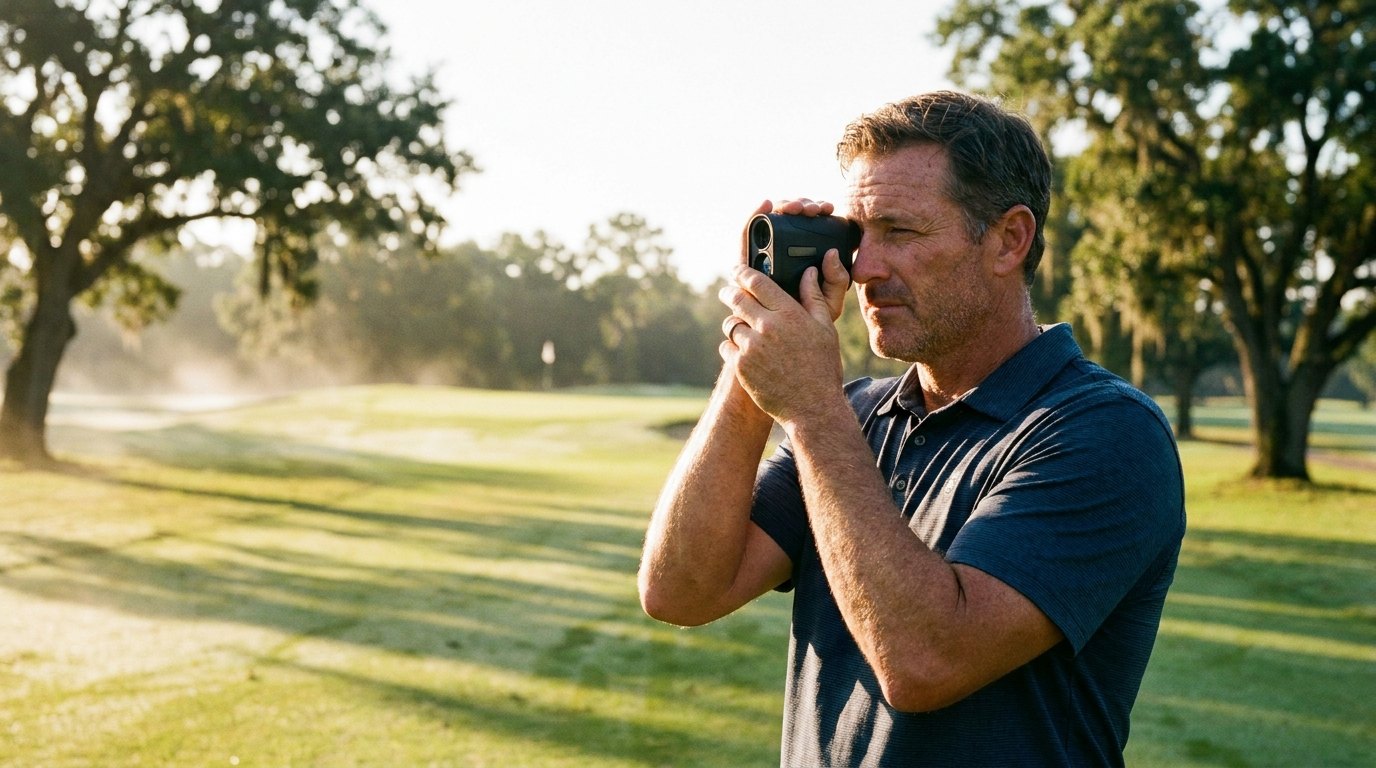
The button is easy. Holding a magnified optic steady on a flagstick 180 yards out is not. Here is the technique, step by step.
The Rokform Golf Range Finder 18x is coming soon.
Most manuals tell you to point and press, four seconds of a much longer skill. The USGA's pace framework allows 45 seconds per shot and puts the average round at 4 hours 30 minutes, a new high the association attributes to delay accumulating through the day rather than to devices. Your read has to fit inside that 45 seconds without borrowing from anybody else's. Learning how to use a golf rangefinder means holding a magnified optic still on a three quarter inch flagstick while three people wait, then knowing whether the number was the pin or the pines behind it. A golf rangefinder removes one variable, and only if the read repeats. Everything below on how to use a golf rangefinder assumes you own one and still do not trust it.

Table of Contents
- Why Your Hands Are the Weakest Part of the System
- Setting Up Before You Reach the First Tee
- The Nine Step Sequence for a Read You Can Repeat
- Where to Aim, and What to Read Besides the Pin
- Reading Wind and Elevation Into the Number You Just Got
- The Rules That Govern the Toggle
- Cart, Ball, or Behind It: Where to Take the Read
- Habits That Turn a Lucky Read Into a Repeatable One
- A Faster Read Without a Rushed One
- Final Thoughts
TL;DR
- Brace before you press. Two hands and a third contact point beat one hand at arm's length.
- Exhale halfway and hold. The reticle is quietest there.
- Frame the flag first, then sweep across the stick instead of stabbing.
- Wait for the buzz, then shoot again and make the device agree with itself.
- Read the back of the green and shoot on somebody else's time.
- Slope off once there is a card in your pocket. Guides on how to use a rangefinder skip that one, and it costs strokes.
Why Your Hands Are the Weakest Part of the System
Magnification amplifies hand tremor along with the target, and how a rangefinder measures distance covers the optics behind that. The coaching version is shorter: your hands are the only part of the system you can change while standing over the ball. A hand drifting half a degree walks the reticle onto whatever stands behind the pin.
Bracing is the fix, and nobody enjoys hearing it. Grip the unit with both hands, pull your elbows in against your ribs, and set your feet at shoulder width. Then the upgrade most golfers skip. A third contact point removes an axis of movement, and one is almost always within reach: a cart rail, the top of a stand bag, your own knee if you crouch. Every unbraced read you take with a golf rangefinder is a read you will take twice, which makes the one handed standing read the least efficient habit in golf. Nikon agrees with the diagnosis and builds optical stabilization into its golf laser rangefinder line rather than selling you more magnification.
The Difference Between Box Range and Flag Range
Headline yardage gets measured against large or reflective targets, and flag pickup is a fraction of it. Reading a spec sheet is its own skill, and what to look for when buying starts with separating headline range from flag range.
| Unit | Optics | Published range | Flag figure | Lock confirmation |
|---|---|---|---|---|
| Bushnell Pro X3+ LINK | 7x, 28mm | 5 to 1,300 yards | Within a yard past 600 yards | PinSeeker with Visual JOLT |
| Nikon COOLSHOT PROIII | 6x, 21mm | 8 to 1,200 yards | Not published | Dual Locked On Quake |
| Precision Pro NX10 | Not published | 5 to 999 yards | 400 yard flag pickup | Tournament legal toggle |
Any premium golf laser rangefinder publishes both figures. Trust the box number and you will try to lock a flag the device was never going to hold.
Setting Up Before You Reach the First Tee
Almost everything that goes wrong at 7:40am was decided in the parking lot. No manual on how to use a rangefinder puts that ten minutes first, and knowing how to use a golf rangefinder starts there rather than on the third green with a dead cell. This routine previews the job if you are still deciding whether you need one at all.
Pre round setup checklist:
- Power on and check the display against the light you will play in.
- Check the cell. CR2 3V lithium is the standard, so carry a spare.
- Wipe both lenses with the microfiber cloth, never a shirt tail.
- Set the slope switch for the round you are playing, then say the state out loud.
- Shoot a known range marker and check the number against what the marker claims.
- Tell your group you shoot on their swing, not after it.
A golf rangefinder calibrated against a known marker gives you a baseline for the rest of the day.
The Lens Is the Most Common Point of Failure
Dew, breath fog and rain beading cause more failed reads than any hardware fault. Condensation is only one culprit, and why the view goes blurry covers dioptre and eye relief. IP ratings come from IEC 60529: IPX4 for spray, IPX6 for strong jets, IPX7 for 30 minute immersion.

Picture a 7:10am tee time in late September. Two holes read fine, then the unit stops locking and keeps returning the tree line. Dew has beaded on the objective and your breath has fogged the eyepiece. Two passes with the microfiber and the next read buzzes on the flag. Move both wipes to the start of every hole.
The Nine Step Sequence for a Read You Can Repeat
This is coaching, not research. Nobody has published a study measuring lock rates against bracing or breathing, so build it as a routine rather than citing it as a finding. I know nine steps reads as fussy written down. Six seconds is what the order actually costs once your hands own it. The honest answer to how to use a golf rangefinder is nine habits, not one button.
- Brace. Both hands, a third contact point, feet set.
- Breathe. Exhale roughly halfway, then hold.
- Frame first. Find the flag before your finger touches anything.
- Scan, do not stab. Sweep slowly across the flagstick and back.
- Wait for confirmation. Vibration, a flashing ring, or both.
- Re shoot. Two reads inside a yard is a confirmed number.
- Cross check. A sprinkler head, a 150 marker, or a GPS yardage.
- Shoot on someone else's time, while a partner is hitting.
- Read the front and back too. The pin number says nothing about depth.
Step seven is where a second source earns its place, and laser and GPS side by side explains what each is good at. Type "how to use a rangefinder golf" into a search bar and you get a page about buttons instead.
What a Failed Lock Is Telling You
A unit that will not confirm is reporting a condition, not malfunctioning. Wet glass, a flag standing against a dark tree line, and an unsupported grip account for almost all of it, and each has a fix you can run without leaving your ball.
Run this in order when a lock fails:
- Wipe both lenses, objective first.
- Re brace, and find a contact point you did not use the first time.
- Exhale halfway and hold before the next press.
- Widen the sweep and slow it down.
- Move two steps so the flag sits against green or sky.
- Shoot the front edge instead, since a bunker lip is a far bigger target than a stick.
A flag lock rangefinder that refuses to buzz has told you something true about the conditions or your grip. Nothing on that list costs more than the walk to your ball.
What the Confirmation Systems Actually Verify
The buzz is the entire point, and it is also narrower than golfers assume.
Bushnell pairs a red ring flash with vibration in PinSeeker with Visual JOLT, Nikon uses Dual Locked On Quake, and the Garmin Approach Z10 Flag Finder delivers both signals at lock. Every golf laser rangefinder in this class is confirming one thing: the unit has acquired the nearest small target inside your sweep. A flag lock rangefinder cannot confirm that the small target was the flagstick. So a number with no confirmation has been checked against nothing, and a confirmed number pulled from a lazy sweep can still belong to a rake, a cart post or the first row of pines. Published tolerance is not course tolerance either, and how accurate these devices are breaks down the gap.

Practicing the Sequence Somewhere It Does Not Count
The first tee is the worst place to learn the order. Shoot the 150 marker on the range between swings. Shoot a flag on the practice green from forty yards, then from a hundred, until framing the stick stops taking a full second of searching. Sit in a parked cart and shoot from the rail so that brace is familiar before you need it with a group waiting.
Two things get faster with repetition, and neither is the device. Finding the flag gets faster, and so does the decision to take a second look instead of walking off with a number you half believe. Those seconds are the whole cost for anyone still learning how to use a rangefinder.
Where to Aim, and What to Read Besides the Pin
Aim at the flagstick, not the fabric, which moves in any breeze, and not the pin top. Low on the stick is the steadiest target on the green. Knowing where to aim golf rangefinder optics separates a confirmed number from a lucky one, and aiming at the right target covers the rest.
Then widen it. Shot Scope's approach data shows the amateur miss runs short, with 19.00% of approaches finishing short-right and 17.40% short-left, against 6.20% long-right and 8.00% long-left. Golfers club down to a pin number and come up short of a green they never measured. Anyone learning how to use a golf rangefinder should treat the pin as one of three numbers.
Front, Pin, Back: Turning One Number Into a Window
Three numbers fit inside the time budget for one. Shoot the front edge while the group walks in, then the pin, then the collar behind. Where to aim golf rangefinder beams for that third read is the part people get wrong: the back edge, not the tree line above it.

The gap tells you which miss survives. Twelve yards of green behind the flag turns an aggressive club into a sensible one. Four yards, with sand waiting, turns it into a bogey.
Reading Wind and Elevation Into the Number You Just Got
The laser gives you a straight line. The ball does not fly one. Elevation comes first of the two adjustments that sit between the read and the club, because elevation is the one you can measure. Wind is judgment.
Uphill plays longer, downhill shorter, and a slope enabled unit does that arithmetic when the round permits. The golf rangefinder slope function earns its money on unfamiliar courses, where your eye has no reference for a green thirty feet above you. Read wind at the flag rather than at your feet, because the ball spends its life at treetop height.
When Slope Mode Earns Its Keep and When It Has to Come Off
Slope belongs in practice rounds and course scouting. The switch goes off the moment a card is involved. External toggles exist so the state reads from outside the housing, and premium units lock the switch so an official can check it without handling the device. Make that switch step zero if you are working out how to use a rangefinder golf competitions permit. Owning a golf rangefinder slope feature has never been the problem. Leaving it on is.
The Rules That Govern the Toggle
Rule 4.3a(1) lets you take distance and direction from a device and stops you measuring elevation change or taking a club recommendation from one, and the rules on distance devices sets out the wording and the penalty structure in full. Distance devices are allowed under the base Rules, and Model Local Rule G-5 is what a Committee adopts to prohibit them, the reverse of how most golfers describe it. Learning how to use a golf rangefinder in competition is mostly learning which features to switch off.
The PGA TOUR allowed distance-measuring devices at the RBC Heritage on April 15, 2025 as part of a speed-of-play test, with slope, elevation, wind, course mapping and club selection disabled and distance the only permitted output, per PGA TOUR.
What Professional Competition Tells the Rest of Us
That disabled list is a fair checklist for any amateur playing in something that counts. Tour policy for 2026 still keeps devices off the PGA TOUR itself while permitting them with slope disabled on its developmental tours, and what the Rules actually say carries the detail. Distance is information the Rules permit. A recommended club is not.
Cart, Ball, or Behind It: Where to Take the Read
Position decides accuracy and pace together. The cart hands you a brace and a head start, though the number comes from a spot you are not standing on, fine on a long approach and wrong inside 120 yards. You get the true line and the flag against the green from behind the ball.
| Situation | Shoot from | Brace against |
|---|---|---|
| Tee box, par 3 | Behind the markers | Your bag, upright |
| Long approach, 170 and out | The cart, before you walk in | Cart rail, forearms flat |
| Short approach, inside 120 | At the ball | Your lead knee, crouched |

I build my whole routine around cart position, because a golf rangefinder braced on a seat beats the same unit held at arm's length, and that is most of what how to use a golf rangefinder efficiently comes down to.
Sequencing Is What Makes All of This Invisible
Pace is the real constraint on technique, not accuracy. Tour data puts a number on what the discipline is worth: shots from the fairway ran 5.1 seconds faster and shots from the rough 4.9 seconds faster with devices in play, and roughly 75% of players supported permanent use when the Tour published its findings on June 25, 2025. Those are professionals working with caddies and a 40 second standard, so read the figures as a ceiling rather than a promise for your Saturday fourball.
Sequencing buys the time, not hurrying. Shoot while someone else is over the ball and take your number on the walk in. Your allowance starts when it is your turn, and a read taken before then costs the group nothing at all.
The Cart Rail Brace
Forearms flat on the rail, shoulders dropped, unit resting on the back of your hand rather than on metal. That last detail matters, because a running cart pushes vibration into the optic.
Habits That Turn a Lucky Read Into a Repeatable One
Owning a rangefinder and using one well are separated by a few dull habits: the same grip and breath every time, and the same confirmation requirement on the holes where you are in a hurry. Everything about how to use a golf rangefinder well collapses into one word, repeatable. We are not making the device smarter here. We are making your relationship with the number consistent.
Calibrating the Number Against Your Real Carry
A confirmed 158 only helps if you know what your seven iron carries on a normal swing. Take the unit to the range, shoot the 150 marker, and attach honest carry numbers to each club.
Here is the failure it prevents. A golfer confirms 158 twice, pulls the seven iron he hits 158 on his best day, and finishes twenty feet short. The read was right, the club was wrong, and his repeatable carry is 148. Gapping gaps surface as chronic short misses, and no technique with a golf rangefinder fixes a club chart built on memory.
A Faster Read Without a Rushed One
One problem has run through this page. You need a number you can repeat, and you need it inside your own turn, without three people watching you take a third look. Both halves come down to what your hands are doing in the six seconds before you press. The Rokform Golf Range Finder 18x was designed against that window, and it arrives in September 2026.
MagMax magnetic mounting handles the first half. The unit snaps onto a cart rail and stays there, so the third contact point this article keeps asking for is already built before you lift it to your eye, and the read starts from a fixed platform instead of two unsupported arms. Flag lock with vibration handles the second. The buzz arrives through your fingers the moment the unit acquires the stick, which is what stops the re shoot from becoming a habit you cannot afford at 45 seconds a shot.
Neither spec swings the club. Both remove a reason to take the read twice while your group waits on the tee.
Final Thoughts
The button was never the hard part of how to use a golf rangefinder. Everything that makes a read trustworthy happens in the seconds around it: the bracing, the exhale, the sweep, the buzz, and the second read that agrees with the first. Build those five into a routine and the number stops being a suggestion.
What is left is a distance you believe, a club you chose on purpose, and a swing. That last one is still yours, which is either good news or bad.

