


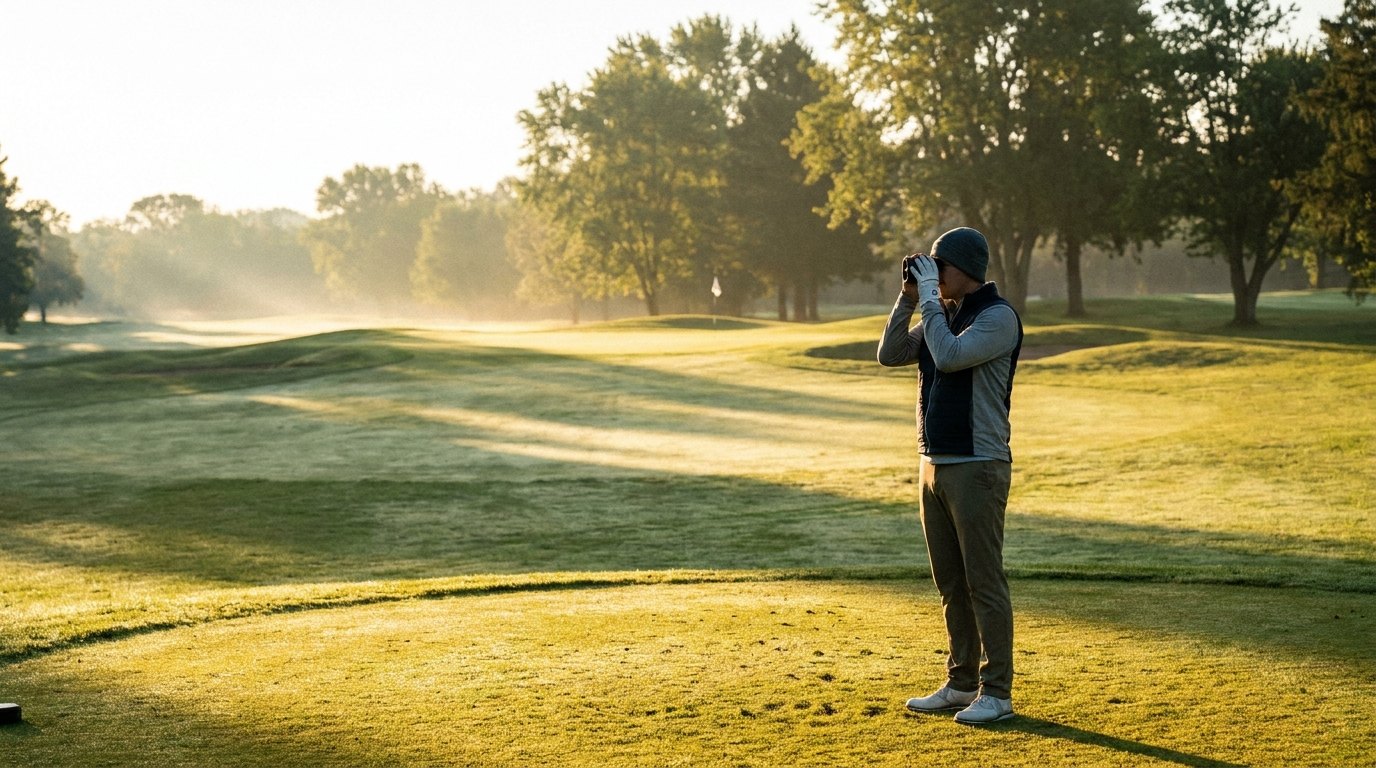
The physics behind every yardage: an invisible pulse, sub nanosecond timing, and the rule that decides which return is the flagstick.
The Rokform Golf Range Finder 18x is coming soon.
Ask how does a golf rangefinder work and most answers stop at "it shoots a laser at the flag." True, and useless. The interesting part happens in the 915 nanoseconds after your thumb hits the button. Light travels at exactly 299,792,458 metres per second, roughly one foot every nanosecond according to the defined speed of light, so a 150 yard round trip is over before you finish blinking. The device catches several reflections in that sliver of time, not one, and decides which of them you meant. You need to know what a golf rangefinder does with the light it sends out before you can trust a number.

Table of Contents
Everything below answers one question: how does a golf rangefinder work?
- What Actually Leaves the Front of the Device
- The Clock Is the Instrument, Not the Laser
- Why the Beam Comes Home More Than Once
- How First Target Priority Picks the Flag
- The Buzz That Tells You It Locked
- What Slope Mode Is Actually Calculating
- Why Magnification Decides Whether You Lock
- Inside the Eyepiece: Optics, Reticle and Display
- How to Stop Losing the Flag Against the Background
- Final Thoughts
TL;DR
- A laser diode fires a short, invisible infrared pulse at whatever sits behind the reticle.
- A photodiode catches the reflection and a timing circuit solves d = c × t ÷ 2. Divide by two because the pulse makes the trip twice.
- Light needs about 6.1 nanoseconds per yard, round trip.
- So how does a golf rangefinder work to a yard? Its clock resolves about six nanoseconds.
- The beam spreads. Flag, green, bunker face and tree line all send returns home.
- First target priority reports the closest valid return. Vibration then confirms a stable acquisition, never that the stable thing was a flag.
- Slope is trigonometry layered on the raw read by an internal inclinometer.
- Magnification improves aiming and lock reliability, nothing else. Accuracy belongs to the clock, and marketing copy blurs those two in a way that costs golfers money.
- Short version of how do laser rangefinders work: a clock, a spreading beam, a decision rule.
What Actually Leaves the Front of the Device
A laser diode sits behind the objective lens and fires a short, low power pulse of infrared light along the line your reticle is pointing. Nothing lights up. No dot lands on the flagstick, and that invisibility causes nearly every complaint golfers have about strange readings.
Hold the button instead of tapping it and the diode fires repeatedly, dozens of pulses across the second or two you spend sweeping, each pulse its own measurement.
Infrared, Not a Visible Dot
The emitted light sits outside the band your eyes respond to, so aiming is inference, never confirmation. Two golfers on the same spot, aiming at the same pin, can come away eleven yards apart because one drifted a fraction of a degree low and caught the false front.
What Manufacturers Publish About the Laser Itself
Specifics belong to the spec sheet in front of you, not to the category. Nikon publishes a 905 nm wavelength, an IEC 60825-1 Class 1M classification and FDA Class I in the published COOLSHOT 50i specifications. Bushnell goes a different way. The Pro X3+ user manual states "CLASS 1 CONSUMER LASER PRODUCT" under EN 50689:2021 and publishes no wavelength at all. Anyone claiming every golf laser rangefinder runs the same wavelength at the same safety class is guessing.
Still weighing whether you need a rangefinder? Knowing how do laser rangefinders work will not tell you whether you want one. It tells you what you are buying.
The Clock Is the Instrument, Not the Laser
The laser is the easy part. Diodes are cheap and reliable. The hard part, the one deciding whether you keep a device five years, is the timing circuit.
Every time of flight rangefinder solves the same equation: distance equals the speed of light multiplied by the measured interval, divided by two. The formula for laser rangefinders is written exactly that way: d = c · t ÷ 2. Dividing by two is the part people skip. Your pulse covers the target distance twice, outbound and home, so the raw interval describes double the number you care about.
The Numbers Behind d = c × t ÷ 2
Light needs roughly 2.03 nanoseconds per foot, 6.1 nanoseconds per yard, and 6.67 nanoseconds per metre, round trip. Those three numbers carry the entire measurement, and every time of flight rangefinder has to slice a sub microsecond interval finely enough for a yard to register.
| Line of sight distance | Round trip travel | Round trip time | Time window for 1 yard of error |
|---|---|---|---|
| 100 yards | 200 yards | about 610 ns | about 6.1 ns |
| 150 yards | 300 yards | about 915 ns | about 6.1 ns |
| 1,200 yards | 2,400 yards | about 7,320 ns | about 6.1 ns |
Why Sub Nanosecond Timing Decides the Number
The right hand column never changes. A stated tolerance of one yard means resolving about six nanoseconds whether you are reading a wedge or a driver, and half a yard means about three. Wikipedia's entry on the method states the requirement plainly: very accurate sub nanosecond timing circuitry.
Glass quality has nothing to do with that. Neither does magnification. A golf rangefinder reads within a yard because its clock is good. A published tolerance and a real world spread are two separate measurements, and how accurate rangefinders really are covers the gap.

Why the Beam Comes Home More Than Once
Lasers spread. A beam leaving the objective a few millimetres wide arrives at 200 yards considerably wider than a flagstick, and the spread is measurable: one milliradian of divergence widens a beam by one metre for every 1,000 metres travelled, with rangefinding modules commonly sitting anywhere from half a milliradian to several, according to this laser rangefinding module divergence guide.
Your outgoing pulse does not hit the pin. It hits the pin, the green around it, the collar, whatever bunker face is in the frame, and the tree line behind, and every one of those surfaces sends light back. That is the single most useful fact about how do rangefinders work, and the answer to how does a golf rangefinder work sits in what happens next.

The Returns Are Ordered in Time
Nearer surfaces come home first. A flag at 168 yards returns roughly 98 nanoseconds ahead of a tree line at 184 yards. Sixteen yards of separation becomes about a hundred nanoseconds inside the receiver, sixteen times the 6.1 nanoseconds a yard costs round trip, and that ordering is what the processor works with.
Weak Return, Strong Return
A thin fibreglass pin reflects a small fraction of what foliage reflects, so the nearest return is often the faintest. Any golf laser rangefinder weighs arrival time against signal strength, because a device reporting the strongest return would hand you the tree line.
How First Target Priority Picks the Flag
The closest valid return inside the beam is the one that gets reported. That is the entire rule behind the setting. Nikon puts it plainly: "When measuring overlapping subjects, the distance of the closest subject is displayed," which the company calls useful when golfing for measuring the distance to a flagstick on a green with woods in the background.
Distance target priority does the opposite and reports the farthest return. The setting is correct when your target sits behind foreground clutter and wrong for almost every approach shot you will hit. Bushnell brands its first target logic PinSeeker, described in the Pro X3+ manual as allowing easy flag acquisition without inadvertently getting distances to background targets.
| What you are aiming at | What else is in the beam | Mode that works | What the wrong mode gives you |
|---|---|---|---|
| Flag on an open green | Tree line 20 yards behind | First target | The tree line, so you play a club too long |
| Flag with a bunker short | Bunker lip 15 yards nearer | First target, aimed high on the pin | The bunker lip, so you come up short |
| Back edge of a green | Fringe and pin in front | Distance target | The pin, not the back edge |
Mode selection is part of using a rangefinder on course without second guessing yourself. A 210 yard par 3, pin in the front third, pines twelve yards off the back. First target priority returns 208 and the golfer hits a hybrid. Distance target priority returns 222 from the same aim and the golfer sails a three wood over the green. Two clubs of difference, one menu setting.
When the Nearest Return Is Not the Flag
Most of what golfers call a malfunction is this. A branch, a sprinkler head or a mound nearer than the pin and inside the beam gets reported faithfully, because the mode has no concept of what a flagstick is. It knows which return arrived first. So how does a golf rangefinder work out which one is the pin? It does not. You do, by aiming somewhere clean and confirming the number repeats.
The Buzz That Tells You It Locked
Confirmation feedback exists because you cannot see the beam. Vibration is your golf rangefinder reporting that the return it chose stayed consistent across a burst of pulses instead of appearing once and vanishing. Bushnell pairs JOLT vibration with a red ring, and Nikon's stabilized line repeats a visual confirmation.
What the buzz does not promise matters as much. Lock onto a tree trunk and you get an identical vibration.
Scanning Is How You Earn the Lock
The clean lock routine, six steps:
- Set target priority to first before the round, not halfway up the fairway.
- Brace your elbows against your ribs, or rest the unit on a cart rail.
- Start the reticle on the sky above the pin.
- Hold the button and sweep down through the flag and past it.
- Wait for the vibration and for the number to repeat before you accept it.
- If readings jump more than a few yards between sweeps, reset your stance instead of averaging in your head.
Sweeping is not impatience. It gives the processor multiple chances to catch the small, faint return from the pin among the stronger ones behind it. Every published accuracy figure assumes that catch happened: Garmin announced the Approach Z10 on July 21, 2026, a $299.99 compact laser with 6x magnification, rated to 350 yards and accurate within one yard, according to the Garmin newsroom, Garmin. That yard describes the timing circuit, not the object your reticle was sitting on when the beam left. Answering how do golf rangefinders work always comes back to which return the device chose.
What Slope Mode Is Actually Calculating
Golf rangefinder slope readings are trigonometry stacked on the raw measurement. No second laser. An internal inclinometer measures the angle between your line of sight and horizontal, and the processor runs two functions on the distance it already has.
Call the line of sight distance L and the inclination angle θ. Horizontal distance is L × cos θ. Elevation change is L × sin θ. Playing distance is roughly horizontal distance plus the climb going uphill, minus the drop going downhill. Bushnell describes its output as angle compensated range based upon distance and slope, Garmin brands elevation adjusted yardage as PlaysLike, and none of them publish the algorithm. The compensated number is a manufacturer's model. The geometry underneath is physics, which is where how does a golf rangefinder work stops being a spec question.
A 150 Yard Read Uphill, Worked Out
Take 150 yards at six degrees of climb. Horizontal distance comes back at roughly 149.2 yards, so the flat correction is under a yard and effectively meaningless. The elevation term is 15.7 yards, pushing the playing number to about 165. That gap is a smooth eight iron against a hard nine, and why golf rangefinder slope modes exist at all.

Slope Off for Competition
Compensated numbers are barred from most competitive play, which is why a lockable toggle matters and why the rules on distance devices is worth reading before you enter an event. Satellite systems handle elevation on a different basis entirely, compared side by side in laser against satellite distance.
Why Magnification Decides Whether You Lock
Optical power never touches the timing circuit, so it cannot make a number more accurate. What it does is make the flagstick large enough in the eyepiece to hold the reticle on it for the length of the measurement. That decides whether you get the pin or the pines once the target sits past 200 yards.
The Tremor Problem
Magnification multiplies hand tremor by the same factor it multiplies the image. A half degree wobble in your hands becomes five degrees of image movement at 10x, according to research on image stabilization physics in handheld optics. Drift off the pin mid burst and the processor reports the green or the tree line with total confidence. Stabilization exists for that reason. Nikon introduced the COOLSHOT PROIII STABILIZED on January 22, 2025, publishing ±0.75 yard under 700 yards and a display resolving in 0.1 second, down from 0.3 second, per Nikon's product announcement, Nikon.
Field of View Is the Hidden Cost
Higher power narrows the field of view, which slows down finding the pin in the first place. Short approach, big pin, low power finds it faster. Long par 5, small pin, high power is the only realistic way to place the reticle. Fixed magnification forces a golf rangefinder to compromise on one end of that range. That trade is most of how do rangefinders work as a design problem, laid out spec by spec in our golf rangefinder buying guide. Anyone asking how do golf rangefinders work at 300 yards is really asking about lock reliability.
Inside the Eyepiece: Optics, Reticle and Display
An objective lens gathers light, an internal lens train delivers an upright image, and a display overlays the reticle and yardage on top. Exit pupil governs brightness at your eye, eye relief governs comfort and whether the thing works over glasses. Nikon lists 3.7 mm and 17 mm on the COOLSHOT 50i, Bushnell 3.7 mm and 15 mm on the Pro X3+.
The Dioptre Ring Fixes Your Eye, Not the Distance
Rotating the eyepiece sets where the internal display and reticle come to focus for your eye specifically. It has no connection to the laser, the clock or the number. Bushnell publishes ±3.5 dioptre adjustment and instructs users directly: if the display icons and numbers are blurry, rotate the eyepiece until they focus. Nikon publishes ±3 dioptre on the COOLSHOT 50i.
Reset the eyepiece in four steps:
- Point the device at a plain bright surface such as the sky, not at a target.
- Look through the eyepiece and ignore the scenery entirely.
- Rotate the ring in either direction until the reticle and display numbers snap into crisp focus.
- Note the position so you can return to it after somebody borrows it.
Buy a used unit and the display can look smeared at every distance while the yardages check out against course markers. The previous owner set the dioptre for their eye, and thirty seconds on the ring fixes what gets diagnosed as a broken screen. A soft image has a short list of causes, walked through in why your rangefinder looks blurry. Knowing how do laser rangefinders work saves you from returning healthy hardware.

How to Stop Losing the Flag Against the Background
The whole answer to how does a golf rangefinder work ends at one moment: the device is choosing between returns, and the flag is the faintest thing in the beam. Hold the reticle on the pin for the length of the burst and the choice goes your way. Let it drift onto the tree line and the number that comes back belongs to the trees. Every golf laser rangefinder faces that choice. What differs is how much help you get holding the pin still.
The Rokform Golf Range Finder 18x arrives in September 2026 and attacks that moment from two directions. Its 8x to 18x adjustable magnification puts a 220 yard pin far enough into the eyepiece that a half degree of hand movement no longer walks the reticle off it, and dialling back to 8x widens the field of view for fast reads on short approaches, so neither end of the course forces a compromise. Its 1,200 yard range keeps a usable return on the display when the flag is not the only thing you need measured, from a blind carry to a range marker. Rokform also fitted Apple Find My and Android Find Hub tracking, and describes the 18x as the first golf range finder a phone can locate.
Final Thoughts
Ask how does a golf rangefinder work one more time and the answer fits in a sentence: a clock counting nanoseconds, a beam wider than the flag, and a rule choosing which return to report.
Do two things before your next round. Confirm target priority is set to first, and reset the dioptre for your own eye. Then take three reads at a marked 150 yard plate and watch how tightly they group, because a golf rangefinder holding within a yard of itself is telling you the clock is fine and any strange number came from what you aimed at. Ten minutes on the range buys that for the season.

