


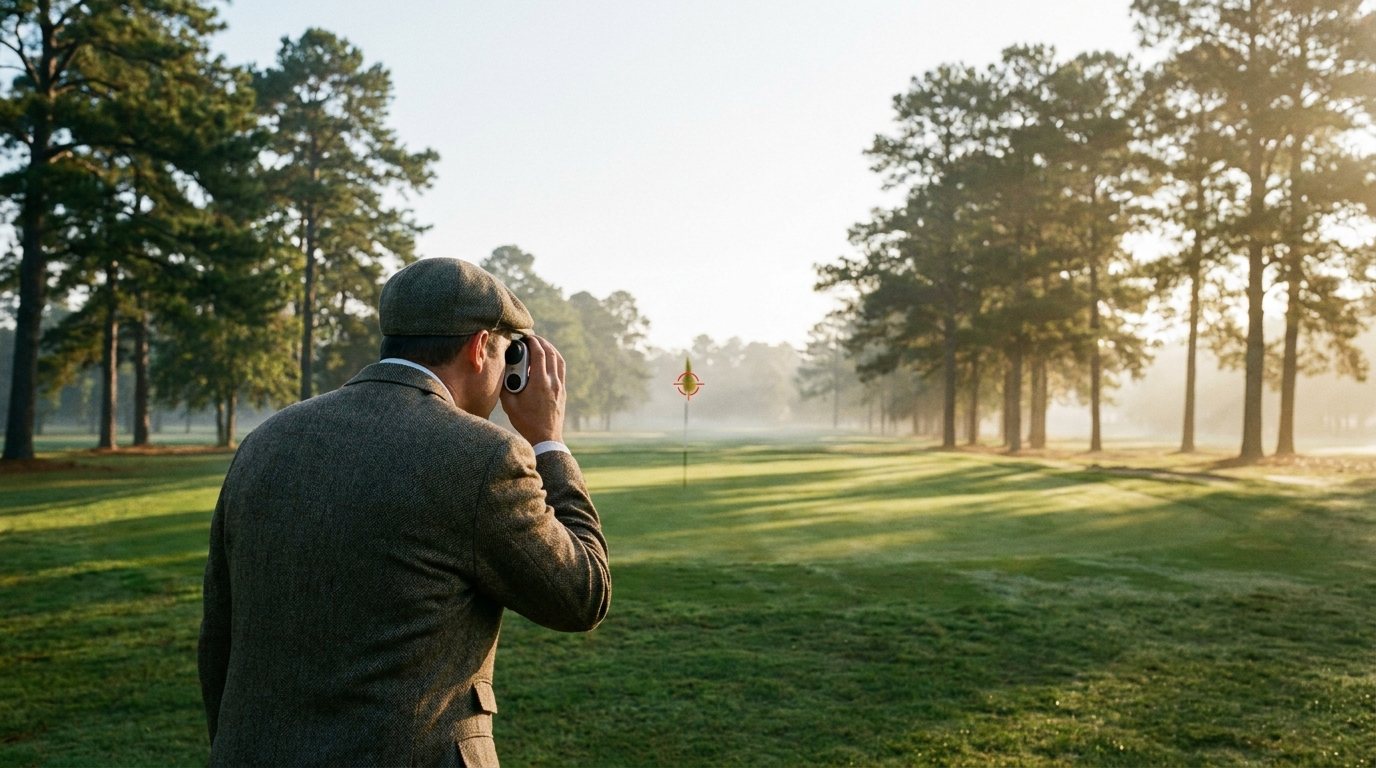
Rokform Golf Range Finder 18x: flag lock, September.
17 flag lock golf rangefinders sorted by how each one confirms the pin, plus the advertised-range spec nobody prints on the box.
Buying guides for this category sort by price or by brand, and both choices hide the thing that changes your round. Every rangefinder on this page confirms the pin differently. Some buzz your palm. Some flash a ring around the number. Two of them beep at you. And a few give you almost nothing until you lower the device and squint at a readout you already half-doubt.
A July 2026 Shot Scope survey found that 51% of golfers now use a laser rangefinder and 41% carry both a laser and a GPS unit, with 88% checking a device on every hole. That is a lot of trust placed in a number, and the confirmation signal is what earns that trust or quietly erodes it. So I sorted all 17 by how they tell you the lock happened. I also pulled advertised max range against real flag lock range for every model where both figures exist, and the gap is wider than the category likes to admit.
Table of Contents
- Why Flag Lock Confirmation Matters More Than Range
- Flag Lock You Feel Before You See It
- Flag Lock That Shows Up On The Display
- Flag Lock You Can Actually Hear
- Flag Lock Under Two Hundred Dollars
- The Spec Nobody Prints On The Box
- What Rokform Is Bringing To This In September
- Final Thoughts
TL;DR
- Flag lock is three different confirmation systems, not one feature, and each fails in its own way.
- Bushnell is the only brand pairing vibration with a red ring flash around the yardage, across the Tour V6 Shift, Tour V7 Shift and Pro X3+.
- Nikon and Leupold confirm with light and sound instead of haptics, which suits gloved hands better than most people expect.
- Advertised range and flag lock range are different numbers. A golf rangefinder with flag lock claiming 1,200 yards may only hold a flagstick at 150.
- An external slope switch beats a menu setting once you play anything competitive.
- The Rokform Golf Range Finder 18x arrives September 2026 with 8x to 18x adjustable magnification, flag lock with vibration, and Apple Find My tracking built in.
Why Flag Lock Confirmation Matters More Than Range
Your laser hits whatever is closest or whatever is biggest, and a flagstick is neither. It is a thin pole standing in front of a treeline that returns far more energy than the stick does. Pin seeking algorithms filter that return so the device reports the flag instead of the oak behind it.
The confirmation signal is the part most buyers skim, and it is the part you interact with roughly 40 times a round. A device that locks correctly but tells you badly is still a device you will second-guess on the tee, which is the same reason we wrote about how to aim in golf the correct way. A yardage you don't trust changes your alignment before it ever changes your club.

The Three Ways A Rangefinder Says "I Found It"
Haptic confirmation vibrates the housing. Visual confirmation lights an icon, flashes a ring, or freezes the number on screen. Audible confirmation chirps.
Each one has a failure mode worth knowing before you spend. Vibration disappears under thick winter gloves or a weak motor. Visual confirmation asks you to read while holding steady, which is the exact moment your hands are least cooperative. Audible confirmation works when your fingers are numb and never asks your eye to leave the target, though everyone within 20 feet hears it.
| Confirmation Type | How It Signals | Where It Works Best | Where It Falls Down |
|---|---|---|---|
| Vibration | Haptic pulse through the housing | Cold mornings, quiet groups | Thick gloves, weak motors |
| Visual | Ring flash, icon, or frozen readout | Bright light with a good display | Requires a steady hold while reading |
| Audible | Chirp or beep on acquisition | Gloved hands, low light | Quiet greens, courses that frown on it |
Why A Pin Seeking Algorithm Is Not The Same As A Flag Lock Signal
Two separate systems get conflated constantly. The algorithm decides which return to report. The signal tells you it happened.
Leupold splits these into named parts, with one system filtering out false readings from bushes and trees while Prism Lock handles reflector-equipped flagsticks. Nikon runs First Target Priority to report the nearest overlapping target. That split explains why two devices with identical "flag lock" bullet points behave nothing alike at 180 yards into a wooded backdrop. Any laser rangefinder golf buyer comparing spec sheets is really comparing two different things at once, and only one of them shows up in the marketing.

Flag Lock You Feel Before You See It
Six devices where a pulse in your palm does the confirming. This is the most common implementation and the easiest to get wrong, because a weak motor produces a buzz you cannot feel through a glove.
I ranked these by how convincing the pulse actually is, not by what it costs.

1. Bushnell Tour V6 Shift
PinSeeker with Visual JOLT leads a haptic category because Bushnell doubles up. The red ring flashes around the yardage readout at the same instant the unit vibrates, so confirmation reaches you whether or not you feel anything.
Specs land at 6x magnification, 5 to 1,300 yards, roughly 500 yards to a flag, IPX6, and a physical Slope Switch on the left side. Around $399.99. Reviewers describe acquisition as consistently reliable, and the reason is placement: the ring sits around the number rather than over the target, so your eye never leaves the stick.
2. Precision Pro NX10
Target Acquisition Technology paired with Pulse Vibrations, and no visual or audible backup whatsoever. You get 6x, a 999-yard measuring range with flag lock rated to 400 yards, an external slope switch, and pricing that swings between $279.99 direct and $199.99 at discount retailers.
The wide circular reticle is the real selling point here. Testers report locking on without needing to be precise about the hold, which matters more than it sounds if your hands shake on a cold first tee. A good golf rangefinder with flag lock should forgive an imperfect grip.
3. Shot Scope Pro L2
Target lock vibration, 6x, and the shortest max range in this entire piece at 700 yards. Nobody is ranging 700 yards, so I struggle to call that a flaw.
Two design decisions stand out instead. The yardage stays on screen an extra couple of seconds after the lock so you can confirm what you read before it vanishes, and the slope switch is a deliberately oversized tab your playing partners can see from a few feet away. At $149.99 it pairs naturally with the rest of the kit we cover in our roundup of golf accessories for accuracy.
4. Blue Tees Series 3 Max+
Advanced Flag Lock with Pulse Vibration, 6x, 900 yards, IPX4, USB-C rechargeable, a magnetic strip cart mount, $199.98.
Here I have to be straight with you. MyGolfSpy found the pin seeker struggles badly with a backdrop behind the flag, and testers needed five or six attempts past roughly 150 to 200 yards before they trusted a number. The vibration motor fires fine every time. The algorithm feeding it is the weak link, which is exactly the distinction this whole piece is built around.

5. Callaway LS Slope
P.A.T. pin lock rated to 250 yards, Pulse Confirmation vibration, 6x, 800 yards max, roughly $199.95. Slope toggles off for tournament play.
That conservative 250-yard pin lock rating is the honest number in a category full of inflated ones, and I would rather buy the device that undersells.
6. TecTecTec ULT-X
Target Lock Technology, vibration only, 6x, 1,000 yards with flag lock rated to 450, and a sliding faceplate that exposes a yellow stripe when slope is live. $249.99.
The catch is the workflow, not the hardware. This is not a point-and-click lock. You hold the power button and sweep across the flag until it buzzes, and independent testing timed full readings at seven to ten seconds, with a two-second boot before you can range at all. Anyone shopping for a golf rangefinder with slope and quick reads should weigh that carefully, because a golf rangefinder with slope you have to wrestle costs you the pace you bought it to save.
Flag Lock That Shows Up On The Display
Four devices where the screen does the talking. Visual confirmation asks more of you, since you have to hold steady and read, and it survives gloves, cold hands, and the moment a weak vibration motor gives you nothing at all.
The USGA's 2026 rules update introduced stronger pace of play enforcement, with recommended shot time limits of 40 seconds for the first player to hit and 30 seconds for everyone after, according to Birdie Report's breakdown of the 2026 USGA rule changes. A device that takes three attempts to confirm now costs you more than patience.
7. Bushnell Tour V7 Shift
Bushnell's own copy is blunt: a red ring flashes as JOLT vibrates. The V7 adds a dual-color red and green OLED that separates actual yardage from the slope-adjusted number on screen simultaneously, so you see both without toggling.
6x, 5 to 1,300 yards, 5 to 500 to a flag, IPX6, Slope Switch, $399.99. Reviewers call it the fastest unit Bushnell has built, with the number appearing the instant you release the button.
8. Bushnell Pro X3+
7x, 1,300 yards, 600-plus yards to the flag, IPX7 fully waterproof, $599.99.
The Pro X3+ earns its place on display engineering. A side button toggles between a bright red readout and a crisp black one across four brightness steps, so the red ring lock cue stays legible in flat overcast light and in direct sun. The slope switch adds a locking latch and a hood that exposes a red band marked "slope" three times, meaning an opponent can verify your setting without having to ask. That is a genuinely tournament legal rangefinder design rather than a claim on a box, and we go deeper on the full field in our guide to the best golf rangefinders if you want the wider comparison.

9. Garmin Approach Z82
Garmin never branded its lock, but the manual is specific about what happens: the device vibrates, a flag icon appears, the distance arc turns yellow, and the hole view map transitions to a close-up of the green.
Confirmation arrives with spatial context instead of a bare number, which tells you whether you are short of the green or already past the front edge. 6x with image stabilization, 5.5 to 450 yards, accuracy within 10 inches of the flag, IPX7, $599.99. Tournament Mode disables PlaysLike and PinPointer and shows a solid blue LED on top of the unit.
10. Voice Caddie SL3
Pin Tracer is a trademarked mode you engage by holding the power button rather than an automatic behavior, and it exists for flags with trees behind them. Vibration plus dual-color OLED confirmation, 6X, 1,000 yards, $599.99 direct.
One finding is worth knowing before you buy. Breaking Eighty found the separate GPS Pin Assist feature actively degraded acquisition, and switching it off solved the problem entirely. A feature that fights your flag lock is worse than no feature.

Flag Lock You Can Actually Hear
Three devices confirm with sound, making this the smallest group and the most misunderstood. An audible chirp reaches you through gloves, through cold, and without asking your eye to leave the target.
The tradeoff is social. Everyone nearby hears it too.
11. Nikon Coolshot ProII Stabilized
DUAL LOCKED ON ECHO with First Target Priority. The LOCKED ON sign lights green alongside an electronic tone, and this model carries no vibration at all.
6x, 8 to 1,200 yards, waterproof to one meter for ten minutes, roughly $299.97 marked down from $449.99. Stabilization cuts hand shake by around 80%, and that is what holds the beam on a distant pin long enough to acquire it. Nikon frames the entire system around one specific scenario: measuring a flagstick with woods behind it. Pin lock on this unit is a function of steadiness first and algorithm second.
12. Leupold GX-5c
Three named systems doing three separate jobs. Flag Lock identifies the pin, a second filtering layer eliminates false readings from bushes and trees, and Prism Lock beeps only when it detects a reflector-equipped flagstick from 30 yards out.
That last one is the most specific confirmation in this whole piece. The tone means "that was the pin," not "something ranged," which is a meaningfully different promise. 6x, 800 yards reflective and 450 to a pin flag, and you can disable the beep in the menu if your group objects. Anyone who values a definite pin lock over a probable one should look hard at this.

13. Callaway 300 Pro
P.A.T. Pin Acquisition Technology with Birdie Technology handling the audible side, and it is the only unit here confirming with both a chirp and a vibrating burst.
6x, 5 to 1,000 yards with pin lock effective to 300, an external slope on/off switch, and water and fog resistance with no published IP rating. MSRP sits at $299.99, though street pricing has slid to somewhere between $99.99 and $169.99, which usually signals end-of-life inventory. Grab it at that price and keep expectations calibrated, the same reason we keep a running list of the golf accessories every golfer needs rather than chasing one gadget at a time.
Flag Lock Under Two Hundred Dollars
Four devices proving flag lock stopped being a premium feature a while ago. Every one of these vibrates on acquisition and carries an external slope switch.
What you give up is documented water resistance, verified optics claims, and honest range figures.
14. MILESEEY PF260 Tour
350-yard flag lock with vibration, 6X, 1,100 yards max, IP54, a magnetic mount, $169.99.
MILESEEY publishes two separate timing figures, 0.3 seconds for general measuring and 0.8 seconds for a flag lock, and that is a level of candor the category almost never offers. The slope switch pairs with a green LED so slope state stays externally visible to anyone who asks.
15. REDTIGER GolfVue Series 1
7X, 1,200 yards, accurate to half a yard, IP54, a magnetic stripe with an included belt clip, $109.99.
Flag lock sits inside a six-mode selector rather than functioning as the default golf behavior, so you have to be in the right mode before it does anything for you. REDTIGER is also unusually direct about its own limits, stating outright that the IP54 rating is not suited to rainy or foggy rounds. Worth reading next to our breakdown of golf cart phone holders if you are building out the cart setup properly.
16. WOSPORTS L14
350-yard target lock with pulse vibration, 7X, 5 to 1,500 yards, external slope switch, built-in magnets, $129.99.
WOSPORTS does something the premium brands should copy immediately. It publishes target lock distance separately from max range across the entire product line, right down to the $69.99 model. Every unit in the range also ships with an external switch, so a golf rangefinder with slope and pin lock vibration costs well under a hundred dollars here, and a golf rangefinder with slope and pin lock vibration at that price would have been unthinkable three years ago.
17. Pinned Golf Prism+
Pinned Lock Vibration, 7x, 1,200 yards, N52 magnets that stick to any cart, $199.99 down from $259.99.
Acquisition is quick, though Breaking Eighty called the haptic underwhelming, and the slope reading hands you an adjusted number without showing how much slope it applied. Water resistance is listed as IPX54 by Pinned and IPX6 by B&H. That kind of conflict on a published spec should make you cautious about the ones you cannot check.

The Spec Nobody Prints On The Box
Advertised max range and flag lock range are two different numbers, and every manufacturer leads with the flattering one. National Club Golfer's testing of a unit advertising up to 1,200 yards measured reliable flagpole lock at 150 yards, extending to 250 with the flag unfurled.
The physics behind the gap are simple enough. A flagstick returns a fraction of the laser energy a treeline or a clubhouse wall does, so pin acquisition ceilings land far below hard target ceilings. Here is what that looks like across the models publishing both figures, and buying any golf rangefinder with flag lock without checking this column is how people end up disappointed at 190 yards.

| Model | Advertised Max Range | Published Flag Lock Range | Gap |
|---|---|---|---|
| WOSPORTS L14 | 1,500 yd | 350 yd | 1,150 yd |
| Bushnell Tour V7 Shift | 1,300 yd | 500 yd | 800 yd |
| MILESEEY PF260 Tour | 1,100 yd | 350 yd | 750 yd |
| Bushnell Pro X3+ | 1,300 yd | 600 yd | 700 yd |
| Callaway 300 Pro | 1,000 yd | 300 yd | 700 yd |
| Precision Pro NX10 | 999 yd | 400 yd | 599 yd |
| TecTecTec ULT-X | 1,000 yd | 450 yd | 550 yd |
| Callaway LS Slope | 800 yd | 250 yd | 550 yd |
The Slope Switch Question Your Playing Partners Care About
Tournament legality comes down to one thing: whether slope can be verified from the outside.
Bushnell, Precision Pro, Shot Scope, Callaway, Arccos, MILESEEY, REDTIGER and WOSPORTS all use an external mechanical switch. Blue Tees Captain Pro requires a three-second button hold. Voice Caddie SL3 buries the toggle in a touchscreen. Garmin and Nikon substitute indicator lights. A switch someone can see beats a setting you have to swear to, and that matters more than people expect once you read through our golf etiquette guide.

What Rokform Is Bringing To This In September
Every device above solves one part of this and leaves another part open. The Rokform Golf Range Finder 18x arrives September 2026 and closes the gaps I kept running into while building this list.
8x to 18x adjustable magnification is a category first, and no other golf laser rangefinder offers that range. Zoom in on the flag on a long par 5, dial back for a quick read on a short approach. Flag lock with vibration gives you tactile confirmation the moment you lock the pin, so there is no guessing whether you got the flag or the bunker behind it. The 1,200-yard range reads anything visible on the course. A tournament-legal slope toggle covers practice rounds and competition on one device, and IPX6 handles dew, rain delays and humid summer rounds.
Then there is the feature nobody else in this piece has. Apple Find My and Android Find Hub tracking are built in, so a $500 rangefinder never gets left on a tee box or lost in a cart again. MagMax magnetic mounting snaps it to cart rails and any MagMax surface, and if you already run our mounts, that same system carries over from our top golf cart accessories lineup. Two-year warranty, 60-day money back, $499.99.
Reserve yours ahead of the September launch: Rokform Golf Range Finder 18x. Swing hard, make putts.
Final Thoughts
Three filters clear most of this category in about 90 seconds. Pick the confirmation method that matches how you actually play, check the flag lock range instead of the headline range, then confirm whether slope is externally verifiable.
Everything else is preference. The best golf rangefinder with flag lock for you is the one whose signal you stop questioning by the third hole, because the number on that screen only helps if you believe it, and belief is what the confirmation signal is really selling. If the yardage keeps coming back right while the score keeps coming back wrong, our piece on the most common golf mistakes is the more useful read.

