


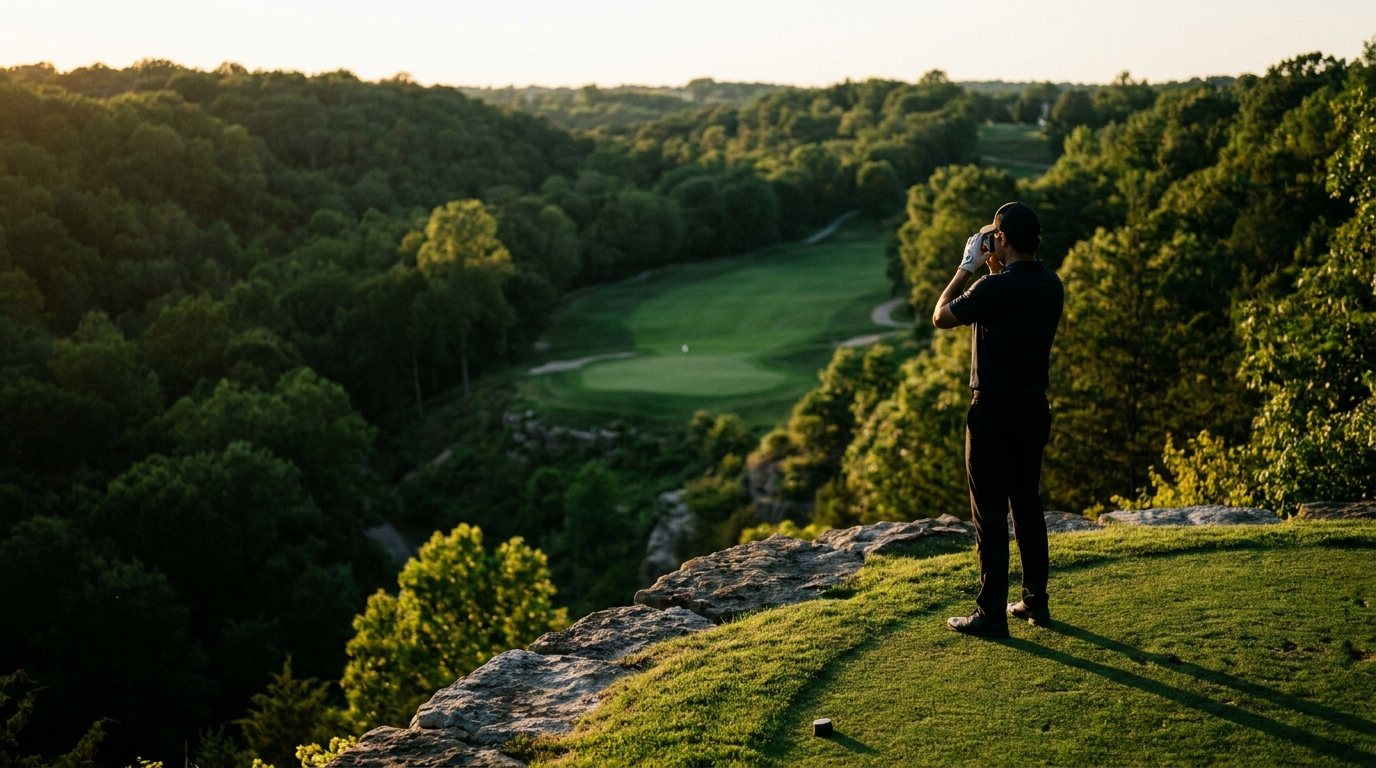
Rokform 18x: tournament-legal slope, September.
18 golf rangefinders with slope, sorted by what each algorithm actually knows and whether anyone can prove yours is switched off.
Every device on this page will hand you a "plays like" yardage. Not one of them will tell you how accurate that yardage is.
That sounds like an accusation. It is arithmetic. I read the spec sheet and the manual for all 18, and every single brand publishes a tolerance for the distance it measures, something like plus or minus one yard. Zero of them publish a tolerance for the distance it predicts. The slope number arrives with no error bars, no validation method, and no statement of whose swing the model assumes.
Arccos data covering 3.5 million shots, reported by MyGolfSpy, found that half of all rangefinder reads are off the real number by 10 yards or more and one in five are off by 20. Worth reading with a raised eyebrow, since Arccos sells a rangefinder. Worth reading anyway, because the same dataset breaks down what drives the adjustment: sustained wind 35.7%, gusts 28.2%, slope 19.9%, temperature 12.4%, altitude 2.6%, humidity 1.1%. Slope is under a fifth of the correction your shot actually needs.
So I sorted these by what each algorithm knows about, then by whether your playing partners can see the switch.
Table of Contents
- What Slope Is Doing, And What The Rules Say About It
- Slope That Is Only Trigonometry
- Slope That Factors More Than The Hill
- Slope You Can Prove Is Switched Off
- Slope Under Two Hundred Dollars
- The Tolerance Nobody Publishes
- What Rokform Is Bringing To This In September
- Final Thoughts
TL;DR
- Measuring elevation change is banned by Rule 4.3a(1) in every round, not only in competition. Most golfers have this backwards.
- Carrying a slope-capable device with slope switched off is legal. The Rule governs use, not what is in your bag.
- Five brands disclose what their slope math factors in, and all five disclose different variable sets.
- Nobody publishes an accuracy tolerance for the adjusted number. Everybody publishes one for the raw number.
- WOSPORTS inverts the colour convention: red showing means slope is OFF. Every other brand does the opposite.
- The Rokform Golf Range Finder 18x lands September 2026 with a tournament-legal slope toggle and 8x to 18x adjustable magnification.
What Slope Is Doing, And What The Rules Say About It
Slope takes the straight-line distance to the flag, measures the angle of incline or decline, and returns a longer number uphill or a shorter one downhill. That much is universal.
What golfers get wrong is when it is allowed. Rule 4.3a(1) lists "measuring elevation changes" under Not Allowed, full stop, with no reference to competition. The prohibition applies to your Saturday fourball exactly as it applies to a club championship. Model Local Rule G-5 is a separate and much blunter instrument that bans electronic distance devices entirely, not a rule that permits the non-slope ones.

Carrying Slope Is Not The Same As Using It
The preamble to Rule 4.3 settles this in one sentence: the Rule "only concerns how equipment is used. It does not limit the equipment that a player may have with them during a round."
A slope-capable device with slope switched off is therefore legal. That was not always true. The old regime banned slope-capable units outright, and a 2014 USGA flowchart saying exactly that is still floating around, which is why half the arguments on the first tee go the way they do. The 2019 modernization ended it. A first breach costs you the general penalty, two strokes in stroke play or loss of hole in match play, and a second breach is disqualification.
The 2026 PGA TOUR distance-measuring device regulation uses the same use-based test, stating that features "such as measuring elevation or slope, wind speed, club selection advice or personal data input must not be used during competition." Committees can still write something stricter, so read the hard card before you assume. Our golf etiquette guide covers the rest of the on-course conventions worth knowing.
The Part That Should Bother You
Five brands publish what their slope calculation factors in, and no two of them match.
Nikon's ID Technology is literally horizontal distance plus or minus height, which Nikon frames as "a guide" rather than a prediction. Bushnell's Elements layers air pressure and temperature on top. Leupold's True Golf Range uses temperature and altitude. Garmin's PlaysLike is geometry alone unless you pair it with another Garmin device. Voice Caddie's V-Algorithm throws out physics entirely and applies more than ten years of PGA and LPGA club distances and trajectories.
Five different functions describing the same hill. They cannot all be returning the same answer.

Slope That Is Only Trigonometry
Six devices where the adjusted number comes from the angle and nothing else. No temperature, no pressure, no altitude, no ball flight model.
I want to be clear that this is not a criticism. Pure trigonometry is honest about being trigonometry.
1. Nikon Coolshot ProII Stabilized
ID Technology, described by Nikon as horizontal distance plus or minus height, presented as a guide to how far you should hit it. 6x, 8 to 1,200 yards, and the most granular accuracy spec in the category: plus or minus 0.75 yards under 700, 1.25 out to 1,000, 1.75 beyond that.
Stabilization cuts hand shake by roughly 80%. Tournament state shows as a green Actual Distance Indicator blinking while the power is on. Nikon has archived this model in favour of the Coolshot ProIII Stabilized, so treat the ProII as clearance stock rather than a current purchase.
2. Garmin Approach Z82
PlaysLike accounts for elevation change and displays the elevation difference alongside the laser distance and the adjusted number. Paired with a compatible Garmin device it will also pull wind and weather, though the laser alone does not sense either.
6x with image stabilization, 5.5 to 450 yards, IPX7, $599.99. Tournament Mode is a software setting rather than a switch, and the tell is a solid blue LED on the top deck that disables PlaysLike and PinPointer together. Garmin publishes no accuracy tolerance at all, for either number.

3. Shot Scope Pro L2
Elevation only, x6, 700 yards, plus or minus one yard on measurement, $149.99. The slope switch slides on the side and the rule is simple: green visible means slope is on.
Shot Scope's own materials describe the adjusted distance as sitting beneath the main reading rather than replacing it, which is the behaviour you want. Seeing both numbers is how you build a sense of when to trust the adjustment.
4. Blue Tees Series 3 Max+
Distance, slope-adjusted distance and slope angle appear as three separate display elements, which is more transparency than several units three times the price manage. 6x, 900 yards, $199.98, and pushing the switch right selects tournament mode with red exposed.
The pin seeking is the weak point rather than the slope. MyGolfSpy found it needing five or six attempts past roughly 150 to 200 yards against a backdrop.

5. Callaway 300 Pro
Adjusted distance bottom-left, angle of incline bottom-right, both visible at once. The side switch shows green for slope on and red for slope off, which is the clearest colour convention here.
6X, 5 to 1,000 yards, 300 yard pin lock, IPX3 weather resistant, one year warranty through IZZO. MSRP is $299.99 with street pricing down around $125 to $180.
6. Vortex Blade Slope
The best documented toggle of any device in this piece. Hold Menu for roughly two seconds, select Slope, press Measure. External green LEDs illuminate while slope is live, and Vortex states plainly that with the LEDs off the unit is tournament legal.
6x, up to 1,400 yards reflective, 350 yards to a flag, $249.99 street. Line of sight sits on top with the adjusted number underneath and a signed inclination angle, positive uphill and negative downhill. The lifetime unconditional VIP warranty is the other reason it keeps appearing in these lists.
Slope That Factors More Than The Hill
Four devices whose adjusted number is trying to model something beyond geometry. Every one of them is making assumptions it does not publish, and the assumptions differ wildly.

7. Bushnell Pro X3+ LINK
Elements mode adds air pressure and temperature to the slope calculation, on the reasoning that a ball travels farther through thinner air. 7x, 1,300 yards, 600-plus to the flag, IPX7, plus or minus one yard on the measured distance, $599.99.
The slope switch is the only genuinely locking mechanism in this roundup. A side latch has to be pulled before the switch moves, which exists specifically to stop an accidental engagement mid-round, and an orange strip is exposed when slope is live. Elements sits on a separate Mode button layered on top of slope, so you can run slope without it.
8. Leupold GX-5c
True Golf Range computes from line of sight distance, incline or decline, current temperature and altitude. 6x, 800 yards reflective, 450 to a pin flag, discounted heavily to $149.99.
Two things to weigh. Club Selector is bundled to TGR, so switching slope off also removes the club recommendation, which is what the Rules require anyway. And this is the only device here with no external slope indicator at all. Your playing partners cannot verify your setting without taking the unit off you.

9. Arccos Smart Laser Rangefinder
The widest environmental model in the category: slope, wind speed, gusts, wind direction, temperature, humidity and altitude, plus AI Strategy club and target recommendations. 6.1x, 5 to 999 yards, IP44, $299.99 including the first year of membership and roughly $199.99 a year after.
Colour logic runs opposite to most: the switch toggled to black is Tournament Mode on, green showing means the adjustments are live. Arccos frames Tournament Mode as Rule 4.3 compliance because it disables slope and the weather layers together.
10. Voice Caddie SL3
V-Algorithm does not model physics. It applies more than ten years of accumulated PGA and LPGA club distances and trajectories to produce the adjusted number, which means the reference swing is a tour professional's rather than yours.
6X, 1,000 yards, plus or minus one yard measured, $599.99. Slope toggles through a touchscreen menu, and while the manual lists a Slope Off display light as a body component, Voice Caddie never publishes its colour or position. A golf rangefinder with slope buried two taps into a touchscreen is harder to audit than a switch.
Slope You Can Prove Is Switched Off
Four devices chosen for one quality: a playing partner standing beside you can read your slope setting without touching the device. That matters more than any spec on a card once money or a trophy is involved.

11. Bushnell Tour V7 Shift
Slide the switch left for slope and an orange indicator band appears, with a second row added to the display carrying the grade percentage and the compensated range. 6x, 5 to 1,300 yards, 500 to a flag, IPX6, $399.99.
The dual colour OLED shows the actual and adjusted numbers at once. Reviewers call it the fastest unit Bushnell has built.
12. Precision Pro NX10
Flip the external switch and green appears. 6x, 5 to 999 yards, 400 yard flag lock, three year warranty, $279.99.
Precision Pro publishes no accuracy tolerance whatsoever, for the raw distance or the adjusted one, which is a gap two brands in this piece share. The wide circular reticle and the forgiving hold are what people buy it for.

13. TecTecTec ULT-X
A sliding attached faceplate rather than a switch, with yellow showing for slope and black for non-slope. Physically obvious from several feet away, and harder to nudge by accident than a slider.
6x, 1,000 yards, 450 yard flag lock, $249.99, currently out of stock direct. Acquisition asks you to hold the button and sweep across the flag until it buzzes, and independent testing timed full readings at seven to ten seconds.
14. WOSPORTS L14
Read this one carefully, because WOSPORTS runs the convention backwards. Red showing on the switch means slope compensation is closed, in other words off. Black showing means slope is on. Every other brand here uses a visible colour to mean slope is live.
7X, 5 to 1,500 yards, 350 yard target lock, two year warranty, $129.99, with the angle in degrees and the compensation distance both on screen. Good hardware, and a colour scheme that will get misread by anyone used to a Bushnell.
Slope Under Two Hundred Dollars
Four devices proving the switch is no longer a premium feature. What thins out at this price is documentation, not function.
15. MILESEEY PF260 Tour
$169.99, 6X, 1,100 yards, 350 yard flag lock, IP54, magnetic mount, with a green indicator that lights when slope is active. MILESEEY publishes acquisition timings of 0.3 seconds for general measuring and 0.8 for a flag lock, which is candour the category rarely offers.
16. Callaway LS Slope
$199.95, 6x, 800 yards, P.A.T. pin lock rated to 250 yards with Pulse Confirmation, and slope that toggles off for tournament play. The conservative 250 yard pin lock rating is the honest number in a category full of inflated ones.
Callaway publishes no water resistance figure at all for this model, which is a strange omission given the sibling 300 Pro manual carries one.
17. Pinned Golf Prism+
$199.99 down from $259.99, 7x, 1,200 yards, N52 magnets that grab any cart rail. Acquisition is quick and the haptic is soft.
The slope reading gives you an adjusted number without showing how much slope it applied, and Pinned publishes neither the switch mechanism nor an indicator colour on its own site. An adjusted number you cannot decompose is a number you cannot sanity check.
18. REDTIGER GolfVue Series 1
$109.99, 7X, 1,200 yards, accurate to half a yard, IP54 that REDTIGER itself says is unsuited to rainy or foggy rounds. Flag lock sits inside a six mode selector rather than being the default golf behaviour.
The slope switch is referenced in the marketing without the mechanism or the indicator being documented anywhere on REDTIGER's own domain. At this price that is the trade you are making.

The Tolerance Nobody Publishes
Here is the whole problem in one comparison. Nikon will tell you its measured distance is accurate to plus or minus 0.75 yards under 700, 1.25 out to 1,000 and 1.75 beyond. That is a company willing to be held to a number.
Ask the same company, or any of the other seventeen, what the tolerance is on the slope-adjusted figure and you get silence. No error bars. No test protocol. No statement of the ball speed, launch angle or spin rate the model assumes. Leupold's marketing mentions accuracy within a tenth of a yard, which sits oddly beside its own manual putting ranging accuracy at half a yard, and reads as display resolution rather than predictive agreement.
| Brand | Slope feature | What it factors in | Tolerance published for the adjusted number |
|---|---|---|---|
| Nikon | ID Technology | Horizontal distance and height only | None |
| Garmin | PlaysLike | Elevation change only, unless paired | None |
| Bushnell | Slope with Elements | Angle, air pressure, temperature | None |
| Leupold | True Golf Range | Angle, temperature, altitude | None |
| Arccos | Plays Like | Angle, wind, gusts, temperature, humidity, altitude | None |
| Voice Caddie | V-Algorithm | Tour professional club distances and trajectories | None |
No independent publication has ever put two of these on the same tee and printed both adjusted numbers side by side. That test would settle the question in an afternoon, and its absence is the most interesting fact in this whole category.
How To Read The Switch On Someone Else's Device
Colour conventions are not standardised, which turns a simple courtesy check into a small quiz. Worth knowing before you accuse anybody of anything.
| Model | Mechanism | Slope is ON when |
|---|---|---|
| Bushnell Tour V7 Shift, Pro X3+ | Sliding switch, latched on X3+ | Orange band exposed |
| Precision Pro NX10 | External switch | Green showing |
| Shot Scope Pro L2 | Sliding switch | Green visible |
| Callaway 300 Pro | Side switch | Green showing, red means off |
| Vortex Blade Slope | Menu hold, 2 seconds | External green LEDs lit |
| TecTecTec ULT-X | Sliding faceplate | Yellow showing |
| Garmin Approach Z82 | Software menu | Blue LED off, blue LED on means tournament mode |
| WOSPORTS L14 | External switch | Black showing, red means off |
| Arccos Smart Laser | Side toggle | Green showing, black means tournament mode |
| Leupold GX-5c | Software menu | No external indication at all |
Anyone who plays competitively should weight this heavily. Our piece on the most common golf mistakes covers the errors that cost more strokes than a yardage ever will, and the best golf rangefinders guide widens the field beyond slope.

What To Do With The Adjusted Number
Treat it as one input rather than an instruction. The Arccos breakdown puts slope at under 20% of the total adjustment a shot needs, with wind doing more than three times the work, so a plays-like number that ignores wind is solving the smaller half of your problem.
Learn your own gap distances first, because the adjusted yardage means nothing without a club you trust at that number. Our breakdown of types of golf clubs is the place to start, and aiming correctly matters more than the last two yards of any calculation. A GPS app running alongside gives you the front and back numbers a laser cannot.
What Rokform Is Bringing To This In September
The Rokform Golf Range Finder 18x arrives September 2026 with a tournament-legal slope toggle: slope on for practice, slope off for competition, one device covering every round rather than two devices covering one each.
8x to 18x adjustable magnification is a category first, and no other golf laser rangefinder offers that range. Zoom in on the flag on a long par 5, dial back for a quick read on a short approach. Flag lock with vibration confirms the pin the moment you lock it, so there is no guessing whether you got the flag or the bunker behind it. The 1,200 yard range reads anything visible on the course, and IPX6 covers dew, rain delays and humid summer rounds.
Then the feature nothing else in this list has. Apple Find My and Android Find Hub tracking are built in, so a $500 rangefinder never gets left on a tee box or lost in a cart. MagMax magnetic mounting snaps it to cart rails and any MagMax surface, carrying over from our top golf cart accessories lineup. Two year warranty, 60 day money back, $499.99.
Reserve yours ahead of the September launch: Rokform Golf Range Finder 18x. Swing hard, make putts.
Final Thoughts
Buy the switch, not the algorithm. Every golf rangefinder with slope here measures distance to a published tolerance and predicts a plays-like number to no published tolerance at all, so the part you can actually verify is the hardware: how the toggle works, whether it locks, and whether the person you are playing against can read it from where they stand.
Then use the adjusted number the way a caddie would use a hunch. It is directionally right, it is doing less of the work than you think, and it has no idea what the wind is doing. The best golf rangefinder with slope is the one whose number you learn to calibrate against your own results over a season, which is a slower answer than a spec sheet gives you and a considerably more useful one. Our roundup of golf accessories for accuracy covers what else earns its place in the bag.

