


My buddy Jake bought a used Yamaha MT-07 last spring for $6,200. Solid deal, right? By October, he'd spent another $4,800. Insurance destroyed him ($2,400), gear he didn't budget for ($1,100), maintenance he wasn't expecting ($800), and mods he swore he wouldn't buy ($500). Jake's not an idiot. This is just what motorcycle ownership costs when nobody warns you what's coming.
The sticker price is a lie. Not because dealers are dishonest, but because the real cost of riding hides in a dozen places you won't think about until you're already committed. Most riders grossly underestimate what they'll actually spend, and it shows when they bail after one expensive season.
I'm breaking down the expenses that catch new and experienced riders off guard, and how to budget for a hobby that can either stay affordable or turn into a money pit depending on your approach. Understanding how much does a motorcycle cost beyond the initial purchase separates riders who enjoy years of affordable riding from those who quit after realizing they can't sustain it financially.
Table of Contents
The Sticker Price Breakdown: What You're Actually Paying For
Financing Traps That Keep You Paying Long After You Should
Insurance Costs Nobody Warns You About
Gear Investment Beyond the Helmet
Maintenance Intervals That Add Up Faster Than You Think
Modification Creep and the Upgrade Cycle
Storage and Security Expenses Most Riders Overlook
Seasonal Costs and Riding Downtime
The True Cost of Dropping Your Bike
Resale Value and Depreciation Reality
TL;DR
Motorcycle prices range from $4,000 for used beginner bikes to $45,000+ for premium models, but the purchase price represents only 40-60% of true first-year ownership costs
Insurance alone can cost new riders $2,000-$5,000 annually (yes, really, I've checked the quotes three times)
You need gear before your first ride. Budget $800-$1,500 minimum, and no, your regular jacket doesn't count
Maintenance costs hit harder and faster than car ownership, with major services every 3,000-6,000 miles
Financing terms trap buyers into 60-72 month loans with interest that can double the bike's actual cost
Modification spending averages $2,000-$8,000 for most riders within the first two years (you'll do it too, trust me)
Storage, security, and seasonal prep add another $500-$2,000 annually in expenses people forget about
Depreciation eats 20-30% of your bike's value in year one, more for certain brands and models
The Sticker Price Breakdown: What You're Actually Paying For
The advertised price on any motorcycle is just a starting point. Walk into a dealership with a budget based on MSRP and you'll quickly discover that motorcycle prices include layers of fees, charges, and add-ons that inflate your final cost by 15-25% before you sign anything.
I need to explain what drives costs across different bike categories, why certain models hold value better than others, and the hidden dealer fees that turn a $10,000 bike into a $12,500 out-the-door reality. The gap between what manufacturers advertise and what you'll actually pay creates the first budget shock for most buyers.
Motorcycle Category |
Price Range (New) |
Price Range (Used) |
Typical Engine Size |
Best For |
|---|---|---|---|---|
Entry-Level |
$4,000-$8,000 |
$2,500-$5,000 |
Under 500cc |
New riders, commuting, learning basics |
Mid-Range |
$8,000-$15,000 |
$5,000-$10,000 |
600-900cc |
Experienced riders, weekend trips, versatile use |
Premium/Specialty |
$15,000-$25,000 |
$10,000-$18,000 |
900cc-1300cc |
Advanced riders, long tours, specific purposes |
Luxury/Performance |
$25,000-$45,000+ |
$18,000-$35,000 |
1000cc+ |
Track use, premium features, collector models |
Entry-Level Bikes and the Beginner Tax
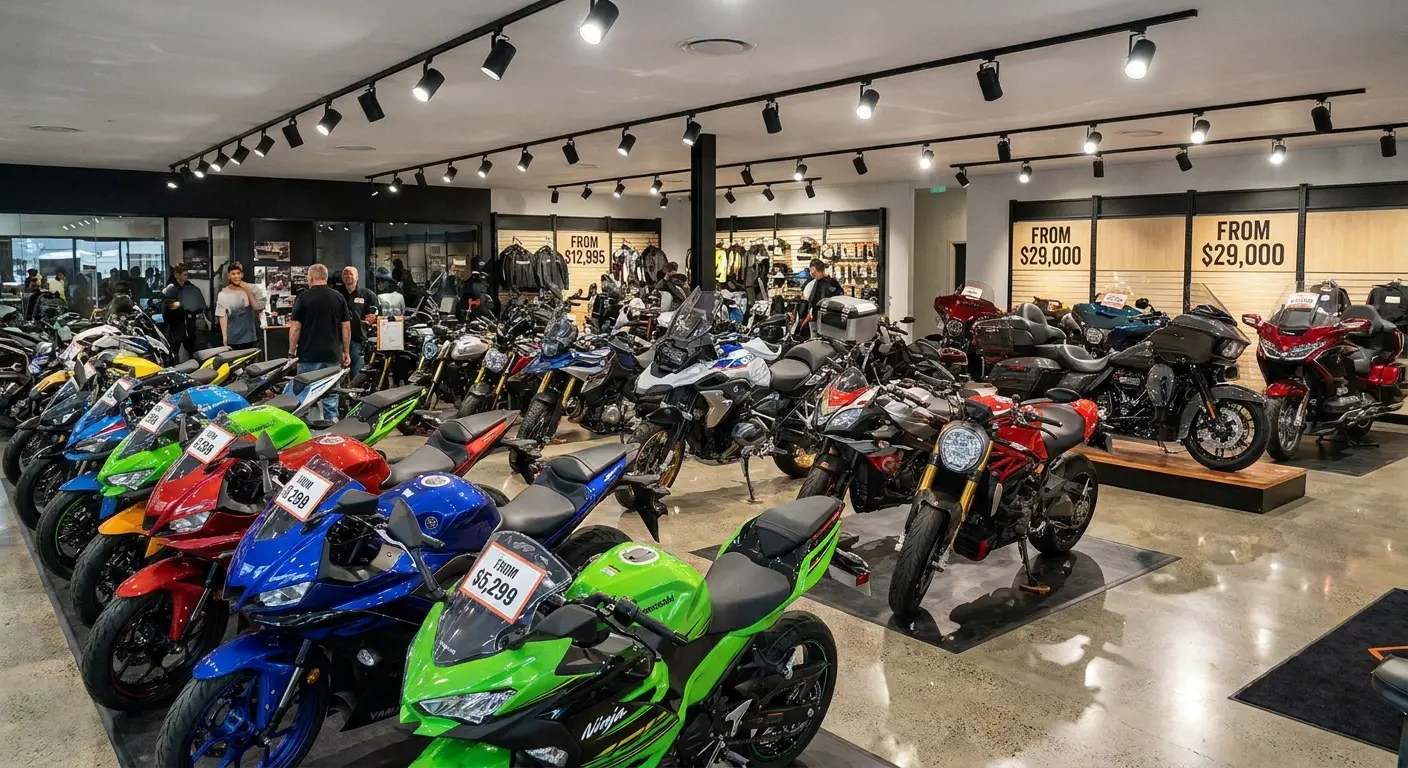
Starter motorcycles run between $4,000-$8,000 new. You're looking at models under 500cc, often from Japanese manufacturers who've perfected the formula for reliable, forgiving machines. A new Kawasaki Ninja 400 lists around $5,300 MSRP, but walk into a dealership and you'll face another $800-$1,200 in fees before you touch the throttle.
Used entry bikes drop that range to $2,500-$5,000, but you inherit someone else's maintenance history or lack thereof. The beginner tax isn't in the bike's price. It's in the insurance premiums that follow (which I'll get to later), and the inevitable first-bike mistakes that cost money to fix.
When researching your options, knowing the total ownership costs helps you make smarter decisions about which motorcycle is right for you from the start. How much is a motorcycle going to cost you over three years matters way more than what you pay today.
Mid-Range Motorcycles Where Most Riders Actually Land
This $8,000-$15,000 range houses the bikes most riders actually want after their first season. We're talking 600-900cc sport bikes, middleweight cruisers, and versatile standards that handle commuting and weekend trips equally well.
A Yamaha MT-09 runs about $9,800 MSRP, while a Harley-Davidson Sportster Iron 883 starts around $9,500. The pricing here reflects better components, more sophisticated electronics, and stronger resale value. You're paying for ABS, traction control, and fuel injection systems that actually work consistently.
Dealer fees still apply, usually $700-$1,000, plus destination charges around $400-$600 depending on where the bike ships from. These motorcycle prices feel more manageable than premium options but still require careful budgeting when you factor in everything beyond the sticker.
Premium and Specialty Machines
Prices explode once you enter adventure bikes, large-displacement cruisers, and high-performance sport bikes. A BMW R 1250 GS starts at $18,000 but easily climbs to $25,000 with the packages most riders actually need. Ducati Panigales begin around $17,500 and top $40,000 for racing variants.
You're not just buying more engine. You're paying for advanced suspension systems, premium brakes, lightweight materials, and electronics packages that include multiple riding modes, cornering ABS, and quickshifters.
These bikes also demand higher maintenance costs and specialized service, factors that multiply your ownership expenses beyond the purchase price. The price of a motorcycle in this category reflects engineering sophistication that requires expensive expertise to maintain properly.
The Dealer Fee Maze
Here's where it gets frustrating.
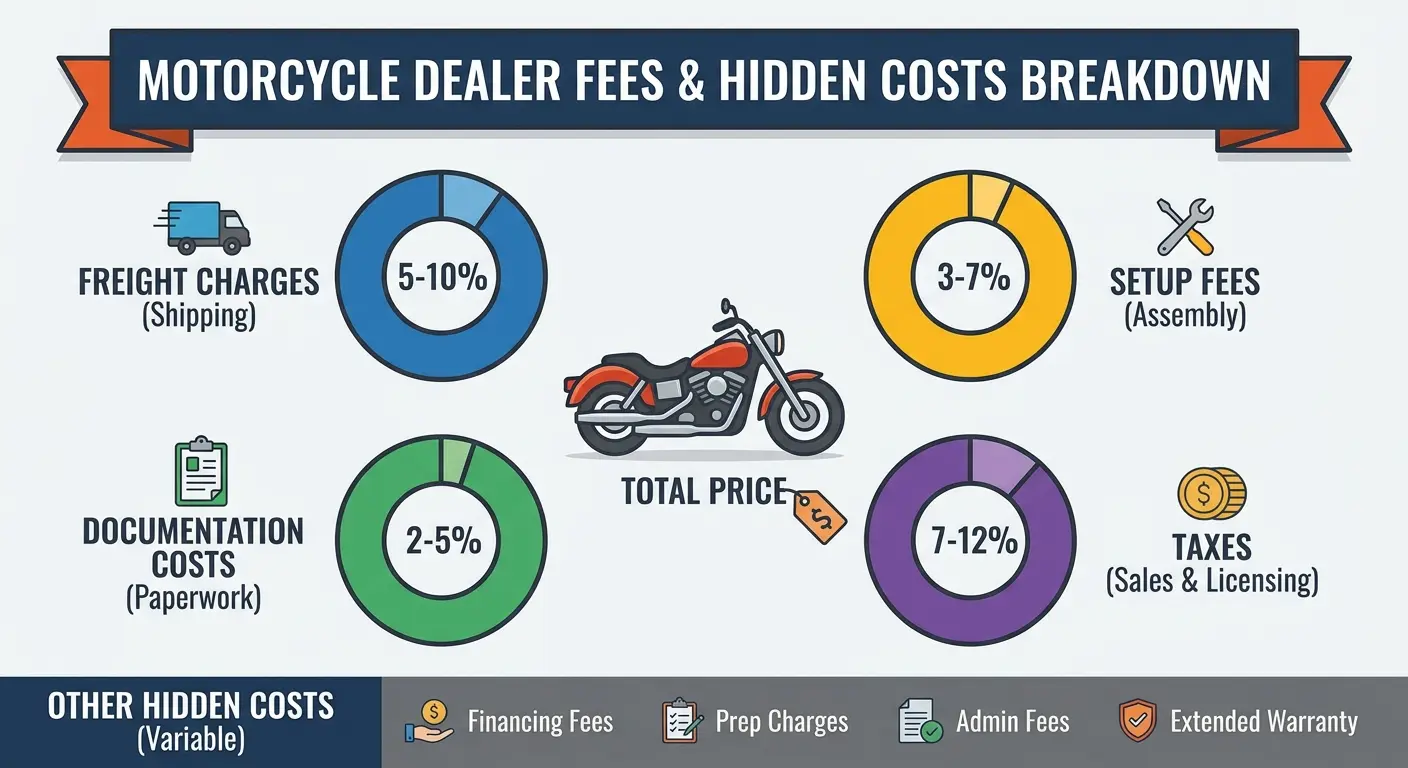
Freight and setup fees aren't negotiable at most dealerships, running $400-$800 regardless of bike price. Documentation fees vary by state but average $200-$500. Some dealers add "market adjustments" on popular models, inflating motorcycle prices by $1,000-$3,000 above MSRP.
Walk into a dealership to buy a $10,000 Yamaha MT-07. The salesperson quotes you the MSRP, but your actual out-the-door price becomes $11,450: $10,000 base price, $495 freight, $399 setup, $295 documentation fee, $75 title fee, and $186 in taxes. That's a 14.5% increase over the advertised price before you even discuss financing or extended warranties.
Extended warranties get pushed hard, costing $800-$2,000 depending on coverage length and bike value. Most aren't worth it for reliable Japanese bikes, but European models with expensive parts might justify the expense.
Dealer prep fees supposedly cover assembly and inspection, but you're often paying $300-$600 for work that takes a technician 30 minutes. These charges add up quickly and explain why the bike you thought cost $10,000 actually requires $11,500-$12,000 to take home.
Financing Traps That Keep You Paying Long After You Should
The monthly payment sounds reasonable until you calculate what that bike actually costs over the full loan term. Motorcycle financing differs significantly from auto loans, and the terms often work against buyers who focus on monthly payments instead of total cost.
Figuring out how much does a motorcycle cost when you finance requires looking beyond the sticker price to the interest you'll pay over 3-6 years. A $10,000 bike can easily cost $16,000 by the time you own it outright, and being upside-down on a motorcycle loan happens faster and more severely than with cars.
Loan Term |
Monthly Payment (on $12,000 at 7.5%) |
Total Interest Paid |
Total Amount Paid |
Equity After Year 1 |
|---|---|---|---|---|
36 months |
$373 |
$1,428 |
$13,428 |
$2,676 |
48 months |
$291 |
$1,968 |
$13,968 |
$1,836 |
60 months |
$240 |
$2,400 |
$14,400 |
$1,440 |
72 months |
$207 |
$2,904 |
$14,904 |
$1,188 |
Interest Rates That Don't Match Auto Loans
Motorcycle loans carry higher interest rates than car financing, usually 4-10% for buyers with good credit. Rates jump to 12-18% for subprime borrowers, which includes many young riders buying their first bike.
A $12,000 motorcycle financed at 7.5% over 60 months costs you $14,400 total, with $2,400 going straight to interest. That's money you'll never see again, pure cost added to your ownership expenses.
Promotional 0% APR deals exist but require excellent credit and usually apply only to specific models the manufacturer wants to move. These offers also come with shorter terms (24-36 months), making monthly payments higher than most buyers can comfortably afford.
Loan Terms That Extend Beyond the Bike's Useful Life
Dealerships push 60-72 month terms to lower monthly payments and close sales. A $15,000 bike at $250/month sounds manageable until you realize you're still making payments in year five when the bike needs its third major service and is worth half what you paid.
Shorter 36-month terms hurt monthly cash flow but save thousands in interest and prevent you from owing more than the bike's worth. A $10,000 loan at 6% costs $304/month over 36 months versus $193/month over 60 months, but the shorter term saves $830 in interest and builds equity faster.
How much do motorcycles cost over the life of a loan depends heavily on the term you choose. I've seen riders trapped in 72-month loans who want to upgrade after three years but can't because they owe more than the bike's worth.
The Upside-Down Trap
Motorcycles depreciate faster than cars, losing 20-30% of their value in year one. Finance a $12,000 bike with $1,000 down and you owe $11,000 immediately. After one year of payments on a 60-month loan, you've paid down maybe $1,800 in principal. Your bike is now worth $8,500, but you still owe $9,200.
You're underwater.
Here's a real example: You finance a $14,000 Kawasaki Z900 with $2,000 down at 8% over 60 months. Your monthly payment is $243. After 18 months of payments, you've paid $4,374 total but only reduced your principal by $2,100. You still owe $9,900. The bike's market value has dropped to $9,100. You're $800 upside-down, and that gap widens if you want to trade up because you're still in the steepest part of the depreciation curve.
This matters when you want to upgrade, get injured, or need to sell unexpectedly. You can't trade up without rolling negative equity into your next loan, compounding the problem. Gap insurance costs $300-$500 and covers the difference if the bike gets totaled, but it doesn't help if you simply want out of the loan.
Insurance Costs Nobody Warns You About
Insurance expenses shock new riders and drain budgets faster than any other ownership cost. The premiums you'll pay depend on factors most people don't consider until after they've bought the bike, and by then it's too late to make a different choice.
Why does motorcycle insurance cost more than most people expect? Insurance companies view motorcycles as high-risk vehicles, and they price accordingly. Your age, riding experience, location, and bike choice all multiply together to create premiums that can exceed your monthly bike payment.
Age and Experience Penalties
Under 25 with no motorcycle endorsement yet? You're paying $3,000-$5,000 annually for full coverage on a sport bike. Insurance companies view young riders on fast bikes as near-guaranteed claims, and they price accordingly.
Even a modest 650cc bike can cost $1,500-$2,500 to insure for new riders under
25. The motorcycle prices you researched don't include this reality, and it catches people off guard when they get their first quote.
Rates drop significantly after 25, and again after 30, assuming you maintain a clean record. Taking an MSF safety course knocks 10-15% off premiums at most insurers. Riding for three years without claims can cut your rates in half, but those first years hurt financially.
Getting familiar with the best motorcycle insurance options available helps you compare coverage and find policies that balance protection with affordability. Shopping around saves money, but your fundamental risk profile still determines your base rate.
Bike Choice Multiplies Your Premium
Sport bikes cost 2-3 times more to insure than cruisers or standards with similar engine sizes. A Yamaha YZF-R6 might cost $4,000/year to insure for a 23-year-old, while a Yamaha MT-07 (similar performance, different style) runs $1,800.
Insurance companies track theft rates and claim frequencies by model, and sport bikes top both lists. Cruisers and touring bikes carry lower premiums because the average rider is older and less likely to ride aggressively. Adventure bikes fall somewhere in the middle.
Engine size matters less than bike category for insurance purposes, which catches new riders off guard when their 600cc sport bike costs more to insure than their friend's 1200cc cruiser.
Coverage Types and Deductibles
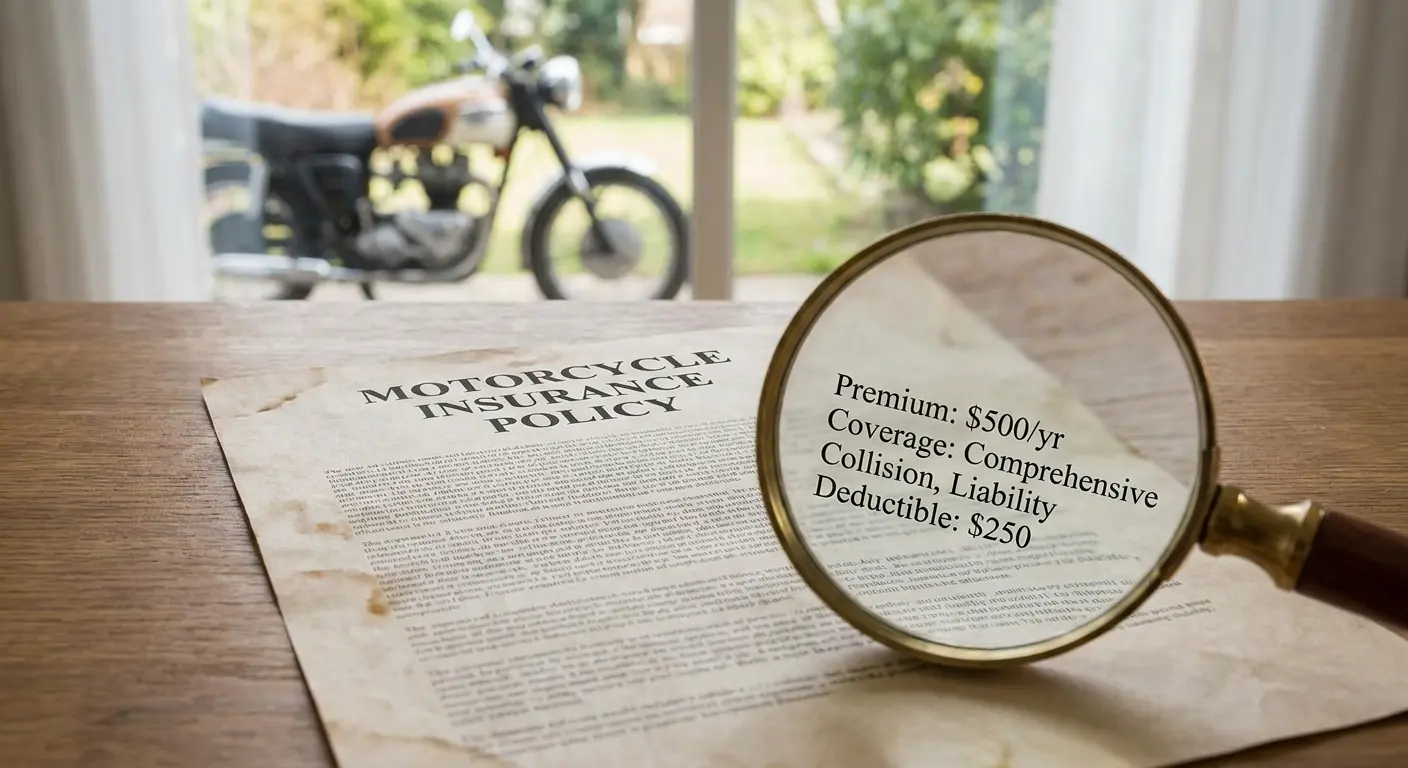
Liability-only coverage (required in most states) runs $300-$800 annually depending on your location and limits. This covers damage you cause to others but leaves you holding the bill if you wreck your bike.
Comprehensive and collision coverage adds $800-$3,000 to your premium, depending on the bike's value and your deductible choice. A $500 deductible costs significantly more in premiums than a $1,000 deductible, but it also means less out-of-pocket expense when you file a claim.
Most riders should carry full coverage on bikes worth more than $5,000 and drop it once the bike's value falls below $3,000. Medical payments coverage and uninsured motorist protection add another $200-$400 but provide crucial protection in serious accidents.
Gear Investment Beyond the Helmet
You need gear before your first ride. Quality gear costs significantly more than most new riders budget for initially, and you can't legally or safely ride without proper equipment.
The seasonal gear additions pile up quickly. Summer mesh gear keeps you cool but offers less abrasion resistance. Winter gear adds insulated layers, waterproof shells, and heated components that can run $500-$1,000 for a complete setup.
First Ride Gear Checklist (Minimum Safety Requirements)
DOT or Snell-approved full-face helmet ($150-$400)
Motorcycle jacket with CE-rated armor at shoulders, elbows, and back ($150-$300)
Full-fingered gloves with palm sliders and knuckle protection ($50-$100)
Riding pants with knee and hip armor or reinforced motorcycle jeans ($100-$200)
Over-the-ankle boots with non-slip soles and ankle protection ($120-$250)
Rain gear or waterproof layer ($100-$200)
High-visibility vest or reflective elements ($20-$40)
Total Minimum Investment: $690-$1,490
The Minimum Safe Gear Package
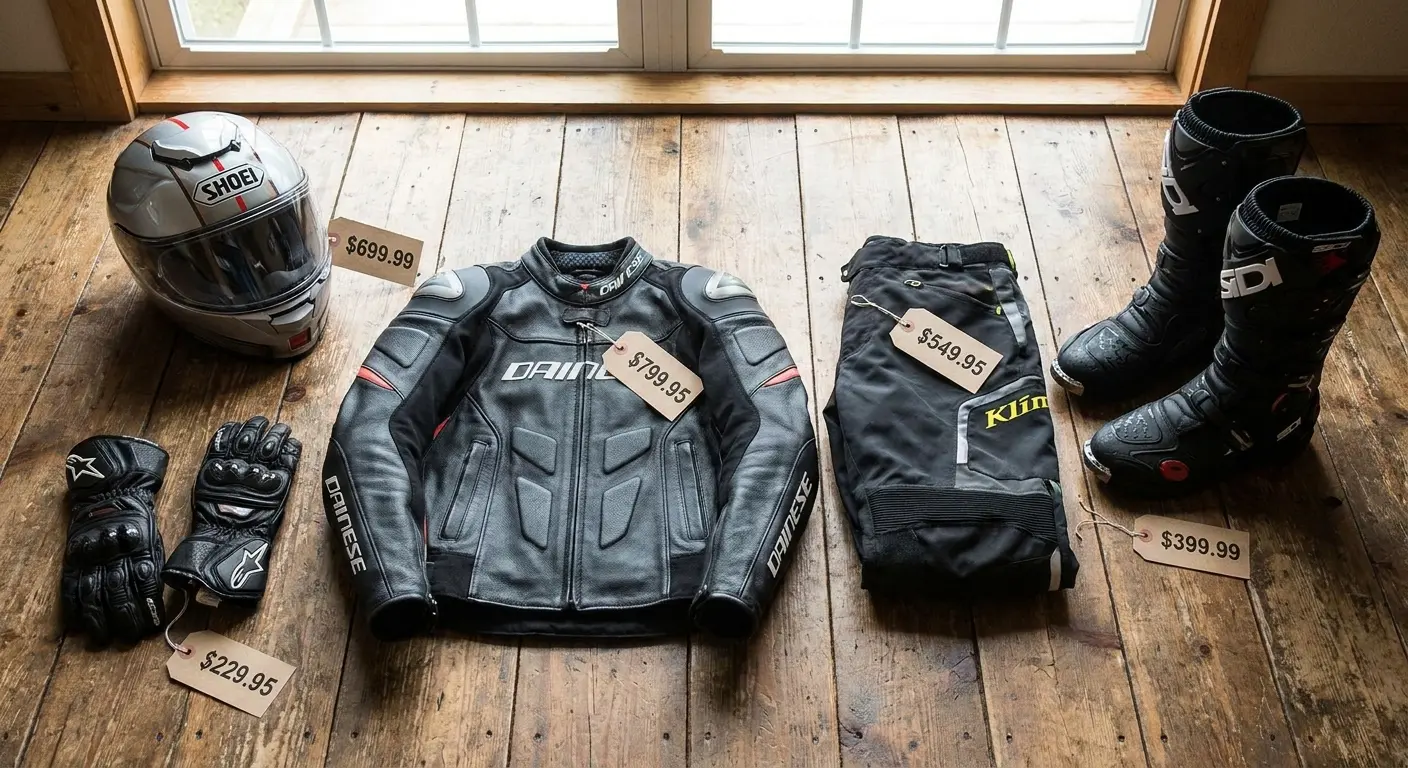
You need a DOT-approved helmet ($150-$400 for quality options), a motorcycle jacket with armor ($150-$300), gloves ($50-$100), riding pants or reinforced jeans ($100-$200), and boots that cover your ankles ($120-$250). That's $570-$1,250 minimum before you ride legally and safely.
Cheap gear exists, but a $60 helmet and $40 jacket won't protect you adequately in a slide. You can start with budget gear and upgrade over time, but you're still looking at $400-$500 for gear that meets basic safety standards. Most experienced riders recommend spending more upfront because cheap gear wears out quickly and offers minimal protection when you actually need it.
Weather-Specific Additions
Summer mesh gear keeps you cool but offers less abrasion resistance. Winter gear adds insulated layers, waterproof shells, and heated components that can run $500-$1,000 for a complete setup. Rain gear alone costs $100-$300 for quality waterproof jackets and pants that don't soak through after 20 minutes.
Cold-weather riders need heated grips ($80-$150 installed), heated jacket liners ($150-$300), or full heated gear systems ($400-$600). You're building multiple wardrobes for different conditions, and most riders accumulate $1,500-$2,500 in gear over their first two years of riding.
The Upgrade Cycle
Your first helmet might be a $180 HJC. Two years later, you're eyeing a $450 Shoei because you've logged enough miles to appreciate better ventilation, reduced noise, and improved comfort. Your initial $120 boots get replaced with $280 Sidi boots that actually protect your ankles and don't leave your feet aching after long rides.
This upgrade pattern repeats across every gear category as you figure out what matters through experience. Budget for gear replacement every 3-5 years even without crashes, because materials degrade, safety standards improve, and your preferences evolve as you ride more.
Maintenance Intervals That Add Up Faster Than You Think
Maintenance schedules and costs catch new motorcycle owners unprepared. Bikes demand more frequent attention than cars despite lower annual mileage, and the service intervals arrive faster than most people expect.
How much does a used motorcycle cost to maintain? Often more than a newer bike because deferred maintenance compounds quickly. I'm covering routine service intervals, parts costs, labor rates, and the differences between doing your own work versus paying a shop.
Oil Changes and Routine Service
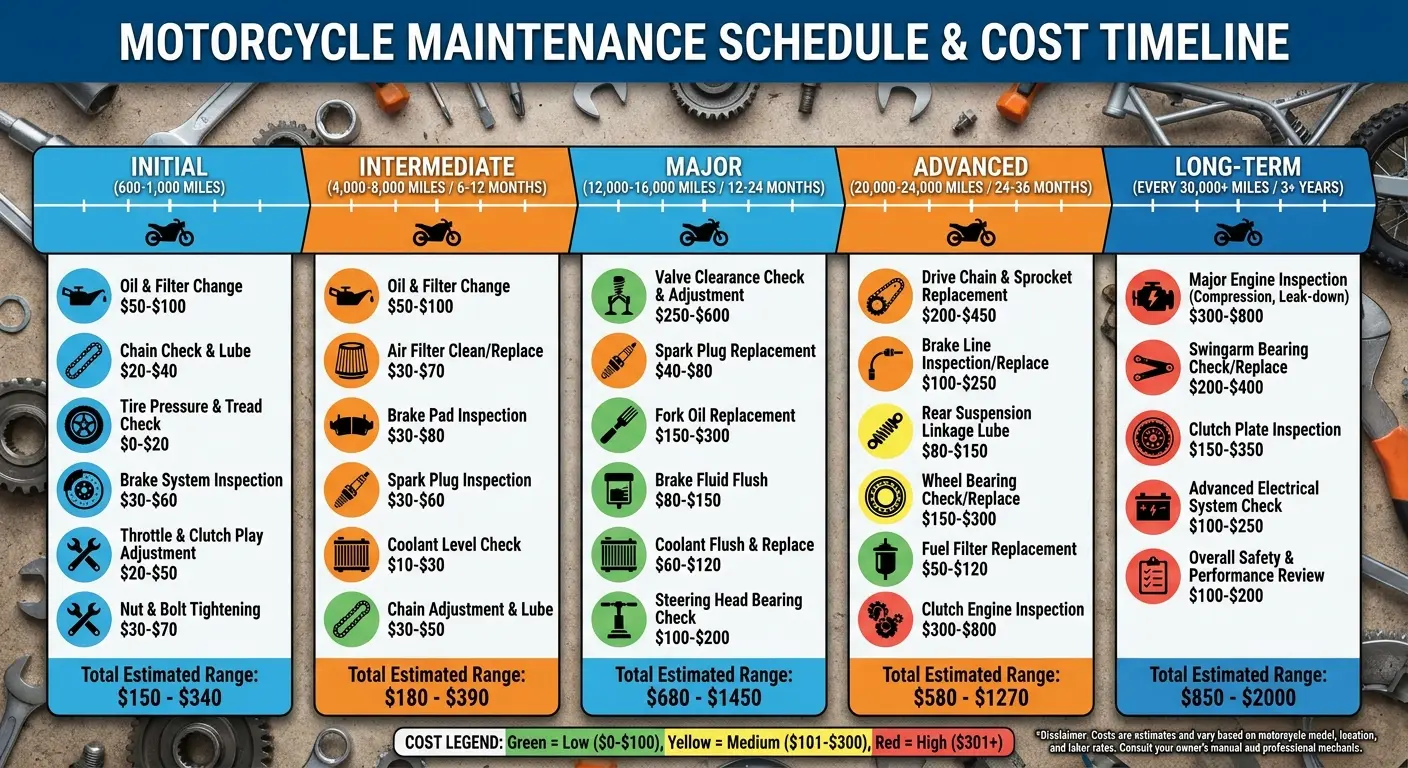
Motorcycles need oil changes every 3,000-6,000 miles depending on the bike and oil type. A basic oil change costs $60-$100 at a shop, $30-$50 if you do it yourself. You're changing oil 2-4 times per riding season for most people, adding $120-$400 annually just for this one item.
Air filter replacement every 6,000-12,000 miles runs $30-$80 for parts, $80-$150 if a shop does it. Spark plugs need replacement every 8,000-16,000 miles at $60-$200 depending on the bike.
Valve adjustments hit every 12,000-24,000 miles and cost $300-$800 in labor alone because it's time-intensive work requiring engine disassembly. This service alone can equal several months of bike payments, and it's non-negotiable for engine longevity.
Tires Wear Faster Than You Expect
Sport bike tires last 5,000-8,000 miles if you're lucky. Touring tires stretch to 10,000-15,000 miles. A set of quality tires costs $250-$400, plus $80-$150 for mounting and balancing. You're replacing tires every season or two depending on how much you ride, making this a $300-$550 annual expense for most riders.
Tire choice affects both cost and longevity. Cheap tires save $100 upfront but wear out 30% faster and offer less grip when you need it. Premium tires cost more but deliver better performance and often last longer, making them cheaper per mile despite the higher initial price.
Chain Maintenance and Replacement
Chain-driven bikes (most sport bikes and standards) need chain cleaning and lubrication every 300-600 miles. A good chain cleaning kit costs $30-$50, and quality chain lube runs $12-$20 per can. You'll go through 3-4 cans per season at $50-$80 annually.
Chain and sprocket replacement hits every 15,000-25,000 miles at $250-$400 for parts plus $150-$300 for labor if you don't do it yourself. Shaft-drive bikes (many cruisers and touring bikes) eliminate this maintenance but require periodic fluid changes that cost $80-$150.
Regular upkeep is essential, and following a comprehensive motorcycle maintenance guide helps you stay on top of service intervals and avoid costly repairs.
Brake Service and Fluid Changes
Brake pads last 10,000-20,000 miles depending on riding style and pad quality. Front pads cost $40-$80, rears run $30-$60. Labor adds $100-$200 if you're not doing the work yourself. Brake fluid needs changing every two years at $60-$120 for both front and rear systems.
Brake rotor replacement becomes necessary every 20,000-40,000 miles or when they wear below minimum thickness. Rotors cost $100-$250 each, and most bikes have two front rotors and one rear. That's a $300-$750 expense when it hits, usually without much warning beyond measuring rotor thickness during routine service.
Annual Maintenance Budget Template
Basic Annual Maintenance (10,000 miles/year)
Oil changes (3x): $180-$300
Chain maintenance supplies: $50-$80
Tire replacement: $330-$550
Brake fluid change (every 2 years): $30-$60
Air filter: $30-$80
Coolant flush (every 2-3 years): $27-$50
Annual Total: $647-$1,120
Major Service Items (as needed)
Valve adjustment (12,000-24,000 miles): $300-$800
Chain/sprocket replacement (15,000-25,000 miles): $400-$700
Brake pad replacement (10,000-20,000 miles): $140-$280
Fork seal replacement (20,000-30,000 miles): $200-$400
Battery replacement (3-4 years): $80-$200
Add 20-30% buffer for unexpected repairs and wear items
Modification Creep and the Upgrade Cycle
Here's the thing about modifications: the stock bike rarely stays stock for long. Modification spending hits most riders after purchasing a motorcycle, and the costs accumulate faster than people anticipate. I'm detailing common upgrades, their costs, and why how much do motorcycles cost includes thousands in modifications most riders can't resist.
Exhaust Systems and the Sound Trap
Stock exhausts sound muted and often weigh more than aftermarket options. A quality slip-on exhaust costs $400-$800 and saves 8-15 pounds while adding sound and minor performance gains. Full exhaust systems run $800-$2,000 and require ECU tuning (another $300-$500) to run properly.
The sound improvement feels worth it until you realize you've spent $1,200 for 3-5 horsepower and noise that annoys your neighbors. Most riders do it anyway because the stock exhaust feels compromised once you hear what the bike can sound like.
And yes, you'll buy the exhaust. Everyone does. You're not special.
Performance Upgrades That Multiply
ECU flashing or aftermarket fuel controllers cost $300-$600 and unlock power that manufacturers restricted for emissions compliance. Air filters upgrade for $60-$150 and pair with exhaust changes for better airflow.
Suspension upgrades start at $500 for springs and revalving, climb to $2,000-$4,000 for complete cartridge kits or electronic suspension systems. Brake upgrades tempt riders who want better stopping power. Braided steel lines cost $100-$200 and improve lever feel. Aftermarket calipers and master cylinders run $500-$1,500 depending on brand.
You're chasing marginal improvements that feel significant but rarely transform the bike's actual performance on public roads.
Comfort and Convenience Additions
Aftermarket seats cost $300-$600 and make long rides tolerable instead of painful. Tank bags run $80-$200, saddlebags cost $200-$600, and tail bags add another $100-$250.
Phone mounts range from $30 for basic options to $100+ for systems that actually secure your device during aggressive riding. I've seen too many riders lose phones to cheap mounts that can't handle vibration or rough roads. A quality mounting system protects your navigation, communication, and emergency contact device without adding bulk or requiring constant readjustment.
Rokform's motorcycle mounts use strong magnetic systems and durable cases designed specifically for the vibration and impact that motorcycles generate. When you're relying on your phone for GPS navigation through unfamiliar territory or need quick access to emergency contacts, a secure mount isn't optional.
Windscreens cost $100-$400 depending on size and adjustability. Heated grips add $80-$150 installed. Frame sliders run $100-$200 and potentially save thousands in fairings if you drop the bike. USB charging ports cost $30-$60 plus installation time.
The Aesthetic Modification Spiral
Tank pads, frame protectors, and colored accessories start small at $20-$50 per item but accumulate quickly. Custom paint jobs run $1,500-$5,000 depending on complexity. Aftermarket fairings for sport bikes cost $500-$1,500 for quality pieces, more for carbon fiber.
Wheel upgrades tempt riders with lighter weight and better looks at $1,500-$3,000 for a complete set. Custom lighting adds $100-$500 depending on how elaborate you get. Rearsets (adjustable foot controls) cost $300-$800 and change riding position slightly while looking more aggressive.
Most riders spend $2,000-$8,000 on modifications within two years of ownership. Some restrain themselves to practical upgrades, others chase every improvement they see on forums and social media. The modifications rarely add resale value equivalent to what you spent, making them pure ownership costs rather than investments.
Storage and Security Expenses Most Riders Overlook
The ongoing costs of
keeping a motorcycle safe and maintained when you're not riding it add up quickly. Storage solutions, security systems, and the expenses associated with protecting your investment from theft and weather damage hit renters and homeowners differently, but everyone pays something.
Parking and Garage Costs
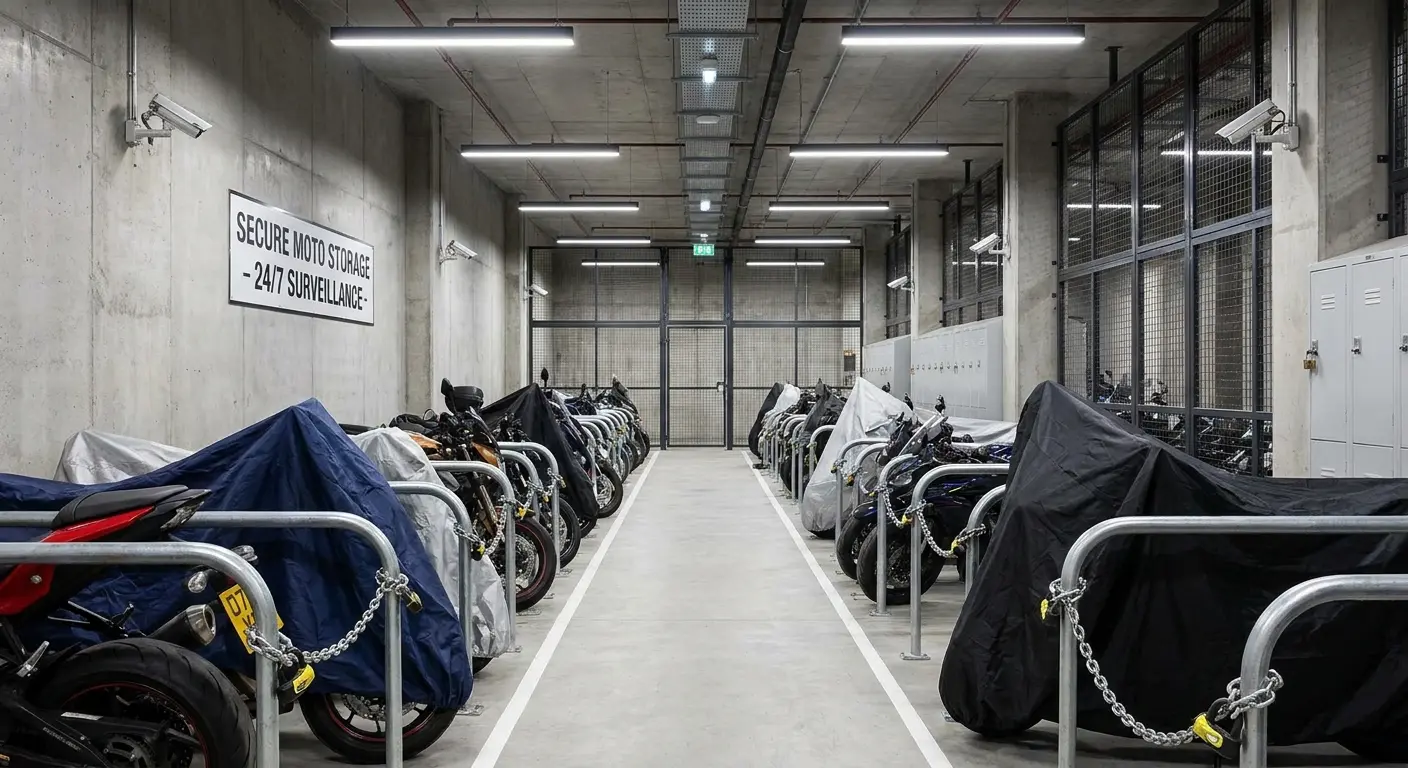
Apartment dwellers face monthly parking fees of $50-$200 for covered motorcycle parking in urban areas. Uncovered parking might be free but exposes your bike to weather and theft. Renting garage space separately costs $100-$300 monthly in cities where demand exceeds supply.
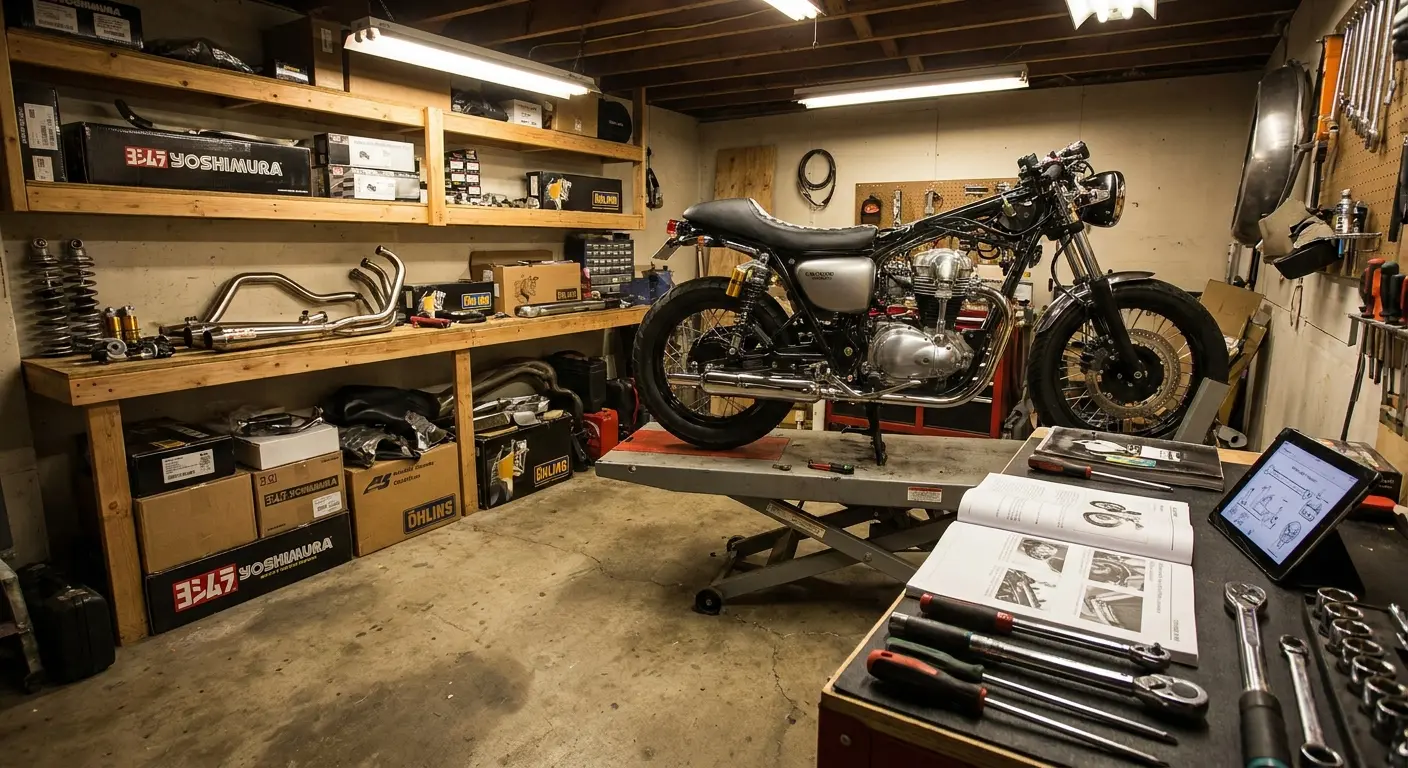
Homeowners need to account for garage space value and organization systems. Motorcycle lifts cost $400-$1,200 and let you store bikes vertically or perform maintenance more easily. Wall-mounted storage systems for gear and parts run $200-$600 depending on size and quality.
Security Systems and Theft Prevention
Disc locks cost $40-$150 and prevent the front wheel from rolling. Chain locks run $80-$200 for quality hardened steel options that resist cutting. Alarm systems add $100-$300 and alert you to tampering, though effectiveness varies by location and how quickly you can respond.
GPS trackers cost $100-$300 plus monthly subscription fees of $10-$25 for tracking service. They help recover stolen bikes but don't prevent theft. Comprehensive insurance covers theft, but you're still out your deductible ($500-$1,000 usually) and face potential premium increases after a claim.
Motorcycle covers protect from weather and prying eyes at $50-$150 for quality options. They also advertise that something worth stealing sits underneath, making them a mixed security measure. Garage storage remains the best protection but isn't available to everyone.
Winterization and Seasonal Storage
Riders in cold climates face winterization costs every fall. Battery tenders cost $40-$80 and prevent dead batteries during storage months. Fuel stabilizer runs $10-$15 per bottle. Oil changes before storage add another $60-$100 to prepare the bike properly.
Climate-controlled storage facilities charge $75-$200 monthly during winter months. That's $450-$1,200 annually just to keep your bike safe while you can't ride it. Some riders skip professional storage and winterize at home, but they still face the cost of space and proper preparation to prevent damage during months of inactivity.
A rider in Minneapolis stores his Suzuki GSX-R750 from November through March. He pays $120/month for heated storage ($600 total), plus $80 for a battery tender, $15 for fuel stabilizer, and $75 for a pre-storage oil change. Spring prep includes another oil change ($75), fresh coolant ($45), and new brake fluid ($65). His seasonal storage and prep costs total $955 annually for a bike he can only ride seven months out of the year.
Seasonal Costs and Riding Downtime
Expenses tied to seasonal riding patterns and the reality that motorcycles sit unused for significant portions of the year in many regions create hidden costs. Registration renewal fees, the cost of maintaining a vehicle you can't use year-round, and the financial impact of riding season preparation all factor into true ownership expenses.
Registration and Licensing Fees
Motorcycle registration costs $30-$200 annually depending on your state and bike value. Some states charge based on engine displacement or vehicle age. Motorcycle endorsement fees run $15-$50 for the initial license, then renewal fees every 4-8 years depending on state requirements.
Inspection fees in states that require them add $10-$40 annually. Emissions testing applies in some areas at $20-$50 per test. These costs hit regardless of how much you actually ride, making them fixed expenses that increase your per-mile cost if you're a casual rider.
The Cost Per Riding Day Reality
Northern riders get 6-8 months of viable riding weather. Your $12,000 bike sits unused for 4-6 months while you still pay insurance (some companies offer seasonal policies that reduce winter costs), storage, and depreciation. If you ride 100 days per year, your daily cost just for bike ownership before gas and maintenance is $120+ when you factor in all annual expenses.
Year-round riders in warm climates spread costs across 300+ riding days, dropping daily ownership costs to $40-$50. This geographic reality makes motorcycle ownership significantly more expensive in cold-weather states on a per-use basis, though total annual costs might be similar once you account for higher insurance rates in densely populated warm-weather areas.
Spring Preparation Expenses
Every spring requires fresh fluids, tire inspection, brake checks, and general recommissioning after winter storage. Budget $200-$400 for spring service if you're paying a shop, $80-$150 if you do it yourself. Tires often need replacement after sitting, especially if you didn't properly prepare the bike before storage.
Battery replacement hits every 3-4 years at $80-$200 depending on type and quality. Coolant flushes every 2-3 years cost $80-$150. These services cluster around season starts, creating expense spikes that catch riders off guard when they're eager to get back on the road.
The True Cost of Dropping Your Bike
Know what nobody tells you about drops and accidents? They're inevitable for most riders, and the financial impact of each incident adds to your total ownership cost. Repair costs for common damage types, the decision between insurance claims and out-of-pocket repairs, and why even minor drops can cost thousands to fix properly all matter when budgeting realistically.
Parking Lot Drops and Low-Speed Damage
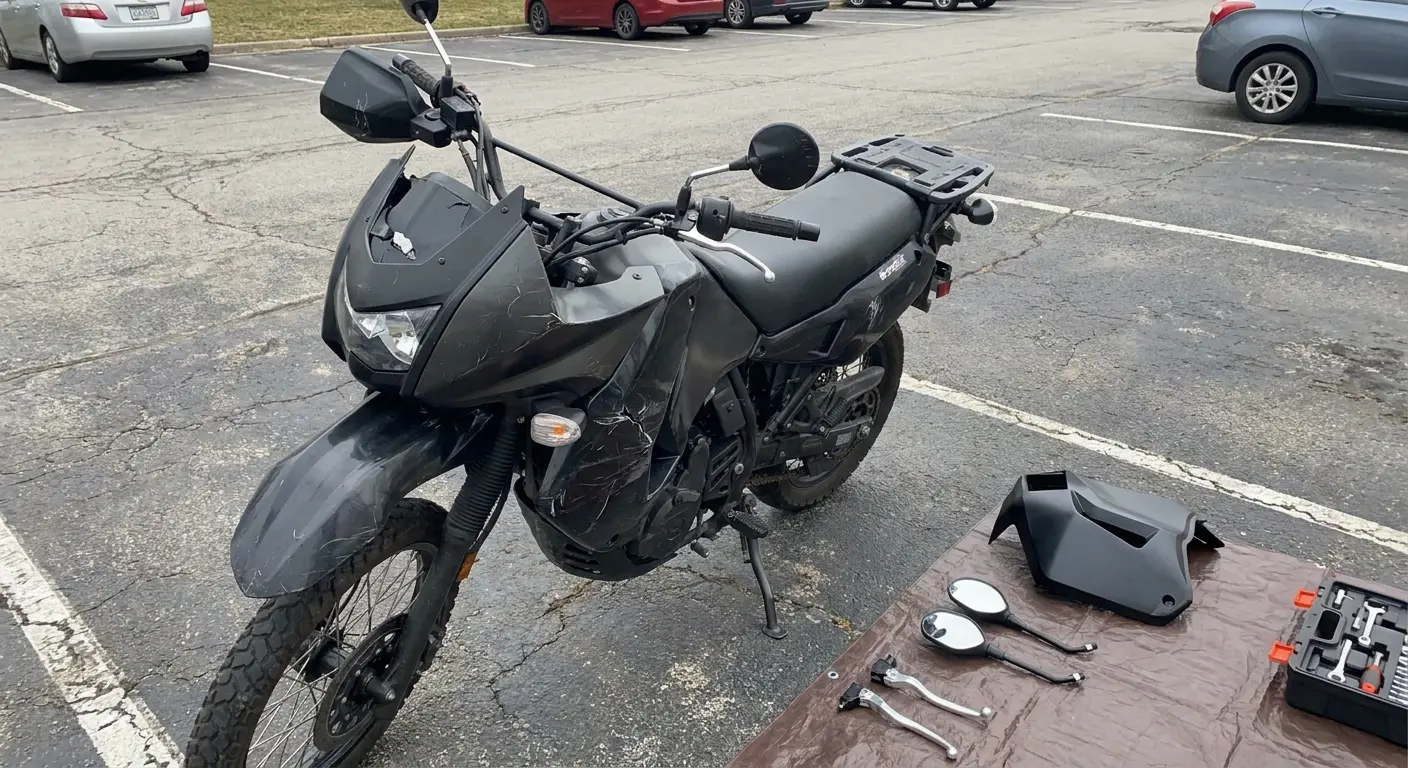
Dropping your bike at a standstill breaks levers, scratches fairings, and potentially damages bar ends, mirrors, and frame sliders if installed. Replacing a clutch lever costs $30-$80 for the part, brake levers run $40-$100. Mirrors cost $50-$150 each depending on the bike.
Fairings represent the expensive damage. A single scratched fairing panel costs $200-$600 to replace on sport bikes, more for premium brands. Paint matching adds another $150-$300 per panel. A simple parking lot tip-over can easily cost $800-$1,500 to repair properly if fairings get scratched.
Frame sliders potentially prevent fairing damage but cost $100-$200 to install. They work best on naked bikes where there's nothing to break. On fully-faired bikes, they sometimes cause more damage by catching and flipping the bike rather than letting it slide.
Crash Damage and Repair Decisions
Real crashes multiply costs exponentially. Forks bend at $400-$800 per leg to replace. Wheels crack at $300-$800 each. Fairings total $1,500-$4,000 for a complete set on sport bikes. Handlebars, controls, and foot pegs add another $300-$600. Engine case damage requires $500-$2,000 in parts and labor to repair properly.
Your deductible determines whether you file an insurance claim. Damage under $1,000 often makes sense to pay out-of-pocket to avoid potential premium increases. Damage over $3,000 usually justifies a claim despite the insurance hit. The gray area between $1,000-$3,000 requires calculating whether the repair cost exceeds what you'll pay in increased premiums over the next 3-5 years.
Hidden Damage and Safety Concerns
Frame damage from crashes might not be visible but affects handling and safety. Professional frame straightening costs $500-$1,500 if possible, but many frames can't be repaired safely. Suspension damage shows up gradually through poor handling rather than obvious visual damage.
Buying used bikes with accident history saves money upfront but potentially costs more long-term through handling issues and decreased resale value. Carfax-style reports for motorcycles exist but aren't comprehensive. You're often trusting the seller's honesty about crash history and repair quality.
Resale Value and Depreciation Reality
Motorcycles lose value over time, and getting a handle on the factors that accelerate or slow depreciation helps you make smarter purchase decisions. Resale values by bike type, the impact of mileage and modifications, and why some bikes hold value while others become nearly worthless within five years all factor into how much money does a motorcycle cost over your ownership period.
First-Year Depreciation Hits Hardest
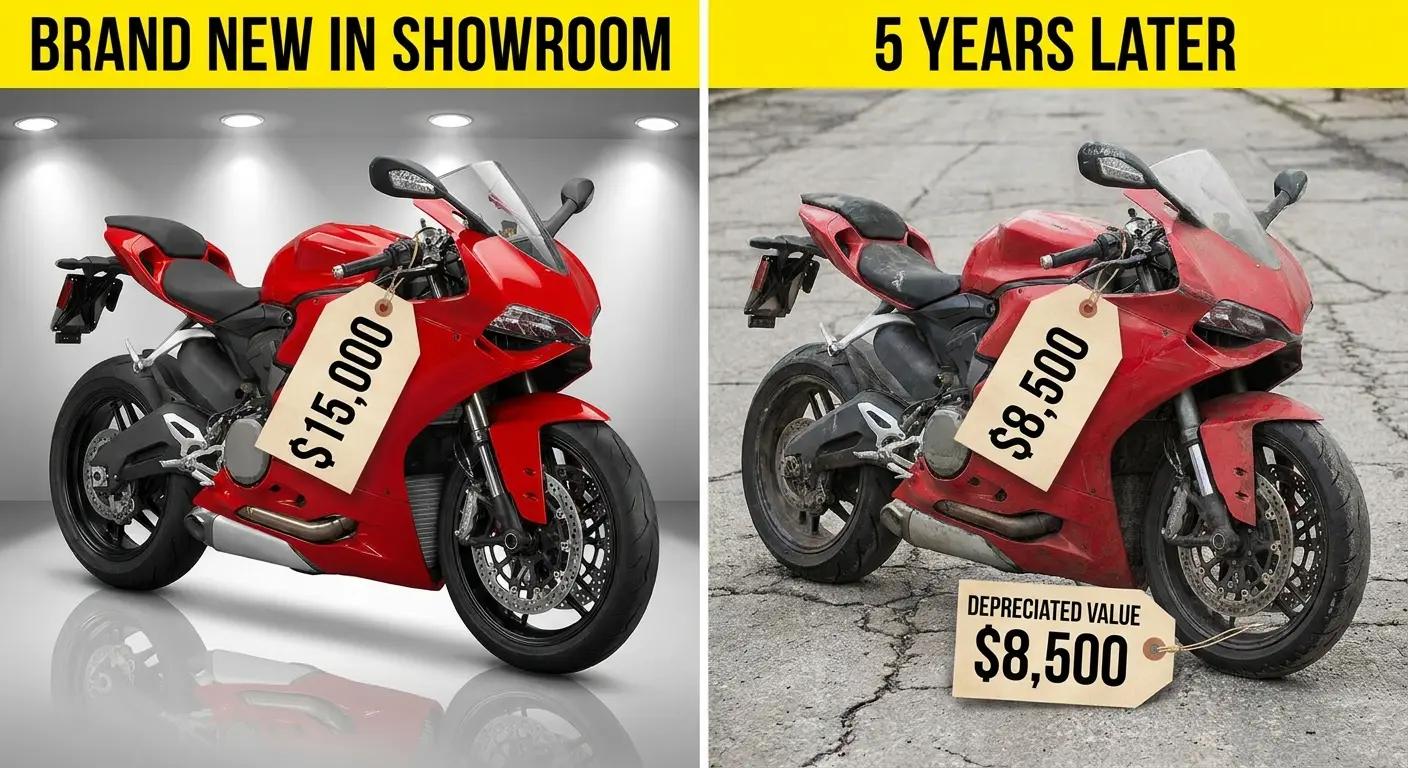
New motorcycles lose 20-30% of their value the moment you ride them off the lot. A $12,000 bike is worth $8,400-$9,600 after one year regardless of mileage or condition. This $2,400-$3,600 loss represents your biggest single ownership cost in year one, exceeding insurance, maintenance, and gear combined for many riders.
Premium brands depreciate slower, around 15-20% in year one. A $25,000 BMW or Ducati loses $3,750-$5,000 but still commands strong resale prices because the used market for these bikes stays active. Japanese bikes in the mid-range ($8,000-$15,000) depreciate fastest because new models appear annually with minimal changes, making last year's bike less desirable.
Mileage Impact on Resale Value
Motorcycles with under 10,000 miles sell for 80-90% of their age-adjusted value. Miles between 10,000-20,000 drop value to 70-80%. Over 30,000 miles and you're looking at 50-60% of age-adjusted value unless the bike is particularly desirable or well-maintained.
Sport bikes suffer worse mileage penalties than touring bikes or cruisers. A sport bike with 25,000 miles raises questions about how hard it was ridden and whether expensive services were completed. A touring bike with 50,000 miles is barely broken in if properly maintained. This perception gap affects resale values significantly across categories.
Modifications and Resale Reality
Modifications rarely return their cost at resale. You might recover 30-50% of modification expenses if the upgrades are desirable and well-executed. Many modifications actually hurt resale value by limiting your buyer pool to people who want exactly what you built.
Stock bikes sell faster and for more money than heavily modified examples. Buyers worry about how modifications were installed, whether the bike was tuned properly, and what other changes might have been made that aren't immediately visible. Keeping stock parts to reinstall before selling helps, but you've still spent time and money on modifications that don't increase the bike's value.
Brand and Model Depreciation Patterns
Harley-Davidson cruisers hold value better than most brands, depreciating 15-20% in year one and stabilizing around 50-60% of original value after five years. Japanese sport bikes lose 30-40% in year one and bottom out at 30-40% of original value after five years.
Limited edition models and discontinued bikes sometimes appreciate if demand exceeds supply, but this is rare. Most motorcycles are depreciating assets that cost you money every year you own them. Getting your head around this helps frame ownership decisions around how much you'll lose when you eventually sell rather than focusing only on purchase price.
When you factor in depreciation, insurance, maintenance, gear, and modifications, motorcycle prices tell only a fraction of the ownership story. A $10,000 bike easily costs $15,000-$20,000 over three years of ownership, and that's before major repairs or accidents enter the equation.
Final Thoughts
The purchase price of a motorcycle tells you almost nothing about what ownership will actually cost. I've seen riders buy $6,000 used bikes and spend $12,000 over three years between insurance, gear, maintenance, and modifications. I've also seen riders buy $20,000 new bikes and keep total ownership costs reasonable through smart insurance choices, DIY maintenance, and resisting modification temptation.
Your actual costs depend on your age, location, bike choice, and riding habits more than the sticker price. A 35-year-old buying a used Suzuki V-Strom and doing their own maintenance might spend $3,000 annually all-in. A 22-year-old financing a new Yamaha R6 could easily spend $8,000-$10,000 per year when you account for everything I've covered.
Budget for total ownership costs from day one. Calculate insurance quotes before you fall in love with a specific bike. Factor in gear, maintenance, and the modifications you know you'll want eventually (because you will). The bike itself is just the entry fee to a hobby that demands ongoing investment.
Protecting your investment starts with quality accessories, and exploring the best motorcycle accessories ensures you're equipped for safe, enjoyable riding without overspending on unnecessary items. From secure phone mounting systems to practical storage solutions, the right accessories enhance your riding experience without breaking your budget.
The riders who enjoy motorcycling long-term are the ones who budget realistically and don't let ownership costs spiral out of control. The ones who quit after a season or two usually underestimated expenses and found themselves financially stretched by a hobby that should have been enjoyable. Know what you're getting into financially, and motorcycling becomes sustainable instead of a brief expensive experiment.

