


Table of Contents
The Misplaced Anxiety Around Screen Damage
What Screen Protectors Actually Protect Against (And What They Don't)
The Real Cost of a Cracked Screen Isn't What You Think
Tempered Glass vs. Film: The Debate That Misses the Point
Installation Anxiety and Why It Matters More Than Material Choice
The Edge Coverage Problem Nobody Talks About
Screen Protectors and Resale Value: A Complicated Relationship
Touch Sensitivity: When Protection Becomes Interference
The Case Compatibility Trap
Why Your Screen Protector Strategy Should Start With Your Phone Case
Final Thoughts
You've spent more time worrying about dropping your iPhone face-down than thinking about the thousand other ways your screen actually degrades. I know I have.
The entire screen protector industry built itself around one fear: that spiderweb crack that renders your phone unusable in an instant. But after years of designing phone protection, we keep seeing the same pattern.
Catastrophic screen failure is rarely how phones die.
Most iPhones don't meet their end in a dramatic parking lot drop. They fade slowly, through accumulated scratches that make reading in sunlight impossible, through oleophobic coating degradation that turns every swipe into a smudgy mess, through edge chips that spread gradually until Face ID stops working reliably.
ESR's analysis shows the iPhone 17 series has a 25% greater smash expectation than the iPhone 16 series and other variants (according to industry analysis from ESR), yet most buyers still focus exclusively on impact protection while ignoring the daily degradation that affects their phone experience.
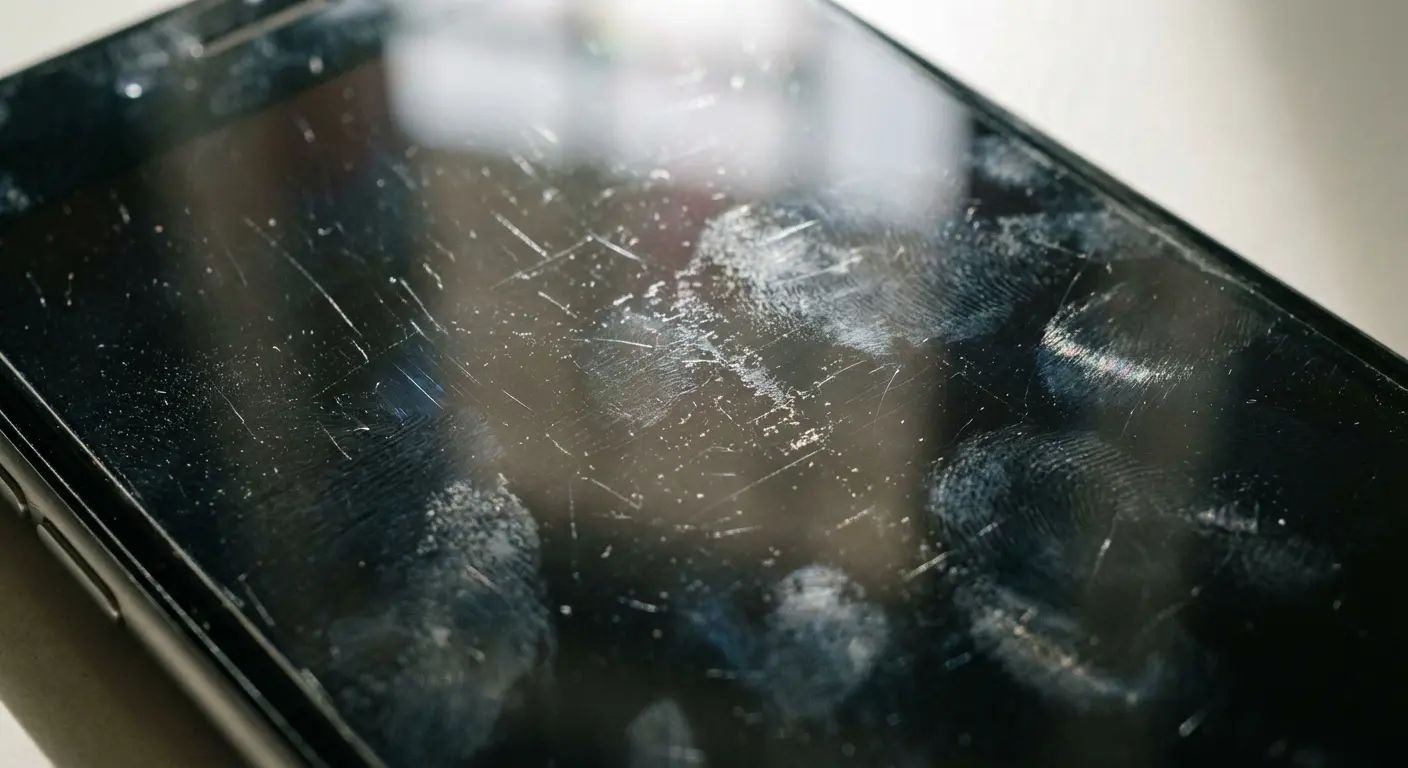
The screen protector conversation gets dominated by impact resistance specs and drop height certifications. Those numbers feel concrete, measurable, scientific. They give you something to compare when you're standing in the Target phone accessories aisle trying to justify spending $40 on a piece of glass.
Those specs don't tell you how the protector feels six months from now when the coating's worn off and your thumb catches on every swipe. Whether it'll interfere with the magnetic alignment you didn't know you needed until your car mount stops gripping properly. If the edge adhesive will start peeling after the first time you slip your phone into a tight pocket.
Protection isn't binary.
Your screen degrades along a spectrum, and most of that degradation happens in ways that don't photograph well for warranty claims but absolutely affect how you use your phone every single day.
Ever see someone using a phone with a cracked screen? Did it shatter yesterday, or have they been living with it for three months? Most screen damage doesn't demand immediate attention. It just makes every interaction slightly worse until you finally get around to dealing with it.
The industry conditioned us to fear dramatic failure while ignoring incremental degradation. We obsess over drop ratings while our screens slowly become less responsive, less clear, less pleasant to use. The iPhone screen protectors we choose reflect this misplaced anxiety, optimized for preventing a disaster that might never happen while doing nothing about the slow decline that definitely will.
What Screen Protectors Actually Protect Against (And What They Don't)
The Scratch Resistance Illusion
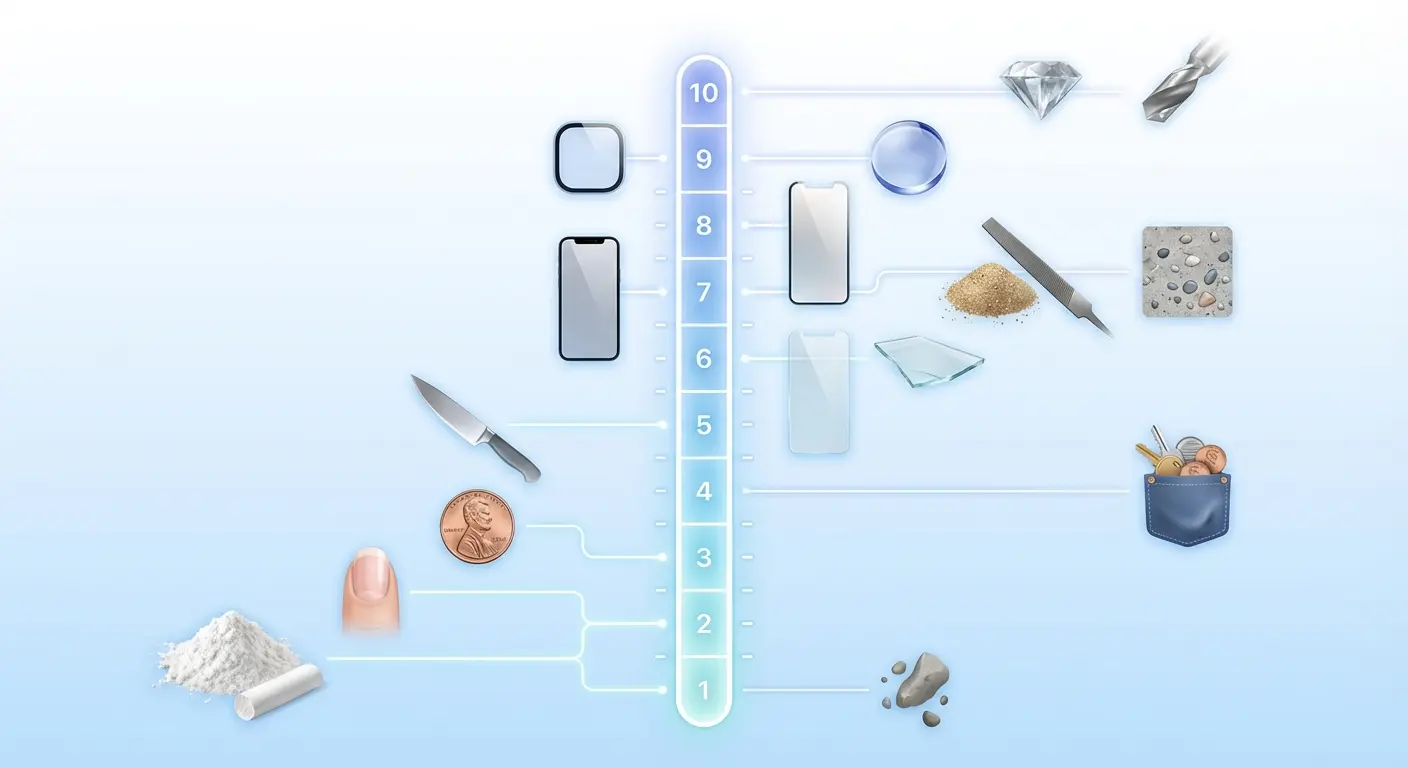
Ceramic Shield on newer iPhones already rates around 6.5 on the Mohs hardness scale. Most tempered glass screen protectors? They're sitting right around 6 to 7. You're adding a layer that's marginally harder than what Apple already engineered, and in some cases, you're adding a softer layer that scratches more easily than the screen it's supposed to protect.
The 9H rating you see plastered across product listings refers to pencil hardness, not Mohs hardness. Completely different scale that measures coating durability, not scratch resistance. It's the difference between protection against damage and protection against marketing-driven anxiety.
Keys won't scratch your iPhone screen. Neither will coins. The metal in your pocket rates lower on the hardness scale than your screen does.
Sand particles? That's what will scratch it. Quartz rates at 7 on the Mohs scale. Metal shavings if you work in certain environments. The tiny glass particles that end up in some pockets and bags.
A screen protector can absolutely help with those specific threats. But if you're buying one because you're worried about your keys, you're solving a problem that doesn't exist while potentially creating new ones.
Material |
Mohs Hardness |
Will this actually scratch your screen? |
|---|---|---|
Keys (brass/nickel) |
3.5-4 |
No |
Coins (copper/nickel) |
3-3.5 |
No |
Ceramic Shield |
6.5 |
This IS your screen |
Standard tempered glass protector |
6-7 |
Barely harder than your screen |
Sand/quartz particles |
7 |
Yes - this is the actual problem |
Metal shavings (steel) |
4-4.5 |
No |
Glass fragments |
5.5-7 |
Maybe, depending on type |
*I've tested this with actual sand from the beach. It sucks.
Look, I've tested dozens of protectors, and the truth is uncomfortable: the best protection for scratch resistance is one that addresses your specific environment. Work in construction? You need protection from airborne particles. Office job where your phone lives on a desk? You probably don't need any additional scratch protection beyond what Apple already built in.
Impact Protection Reality
When your iPhone hits concrete, the screen protector isn't absorbing impact. Physics doesn't work that way with a rigid material that's already bonded to another rigid surface. What tempered glass can do is sacrifice itself by cracking first, potentially preventing the crack from transferring to the screen below.
Sometimes.
The protection comes from how the impact force gets distributed around the edges. That's case territory. If your case doesn't have a raised bezel that extends beyond your screen protector, you're relying on perfect face-up landings. Those don't happen often.
I've seen iPhones survive six-foot drops onto concrete without a screen protector. I've also seen protected screens shatter from two-foot drops onto tile. The variables (angle, surface hardness, existing stress points in the glass) matter more than whether you've got an extra layer of tempered glass installed.
My friend who does graphic design dropped her iPhone 16 Pro in a parking lot. Waist height, landed corner-first. The $45 screen protector shattered completely. Screen underneath? Perfect. She was thrilled, obviously. Bought the same protector again.
Two weeks later she drops it in her kitchen from like two feet onto tile, and this time both the protector AND the screen crack. She's still pissed about it, and honestly, I don't know what to tell her. Sometimes it works, sometimes it doesn't. The variables matter more than the protector.
I'm not saying don't use screen protectors. I'm saying building your protection strategy around them alone leaves you vulnerable in the ways that matter.
The Real Cost of a Cracked Screen Isn't What You Think
You can replace an iPhone screen for $200 to $350, depending on the model. That's the number everyone focuses on when deciding whether a $30 screen protector is worth it. Simple cost-benefit analysis, right?
But you're not calculating the three months you'll use that cracked screen before you schedule the repair. You're not factoring in the client meeting where you pulled out your phone to show a presentation and saw them glance at your shattered screen. Or the family moment you didn't photograph because you've started unconsciously avoiding your phone's camera when the screen is messed up.
Cracked screens change behavior in subtle ways. You stop using Apple Pay because the broken glass catches on your thumb. You avoid watching videos because the cracks catch the light at certain angles. You become more hesitant with every interaction, treating your phone as if it's even more fragile now than it was before the damage. I also answer whether iPhones need screen protectors at all.
The real cost is the degraded experience multiplied by every interaction until you finally get it fixed. For most people, that's thousands of compromised phone uses. Death by a thousand inconveniences.
Here's the uncomfortable truth: if you're the kind of person who'll live with a cracked screen for months, you're probably also the kind of person who'll live with a scratched, hazy screen protector for months. The protection is only valuable if you maintain it, and most people don't.
I've watched people use phones with screen protectors so scratched and degraded that they would've been better off with a naked screen. The protector became the problem it was supposed to prevent (a barrier between the user and a clear, responsive display).
Let's do the actual math here:
Screen protector: $30
Replacement when it gets scratched: $30
Another replacement: $30
Total over two years: around $90
Screen repair without AppleCare+: $279
Screen repair with AppleCare+: $29
If you're going to crack your screen once in two years, the protector saves you money. If you're going to crack it twice, get AppleCare+. If you're not going to crack it at all (most people), you wasted $90.
Tempered Glass vs. Film: The Debate That Misses the Point
Get this: the tempered glass segment accounts for 58.1% of the privacy screen protectors market in 2025 (according to market research from Coherent Market Insights), dominating over PET film and TPU alternatives. Not because it offers superior protection, but because consumers associate the rigid, glass-like feel with premium quality and better protection, regardless of their actual usage needs.
The tempered glass versus film debate has become phone protection's version of iOS versus Android. People have chosen sides, dug trenches, and will defend their choice with the passion usually reserved for sports teams.
You know what almost never factors into these debates? How you actually use your phone.
Tempered glass feels like your actual screen. That's the whole point. The tactile feedback, the smoothness, the way your thumb glides during typing... it's all nearly the same as using a naked screen. Film protectors feel like you're touching plastic wrap, and no amount of "self-healing" marketing will change that.
For some people, that difference is trivial. For others, it's a constant low-grade annoyance that affects typing speed, swipe accuracy, and overall satisfaction with a device they touch hundreds of times per day.
Film protectors are thinner, more flexible, and can cover curved edges more effectively. They also scratch more easily and can develop a hazy appearance over time that tempered glass doesn't. The "self-healing" properties some film protectors advertise? They work on minor surface scratches, not the deeper gouges you actually care about.
Maybe I'm oversensitive to this because I type fast, but the feel matters more than drop protection specs.
Feature |
Tempered Glass |
Film (PET/TPU) |
What Actually Matters |
|---|---|---|---|
Tactile feel |
Nearly identical to naked screen |
Noticeably different texture |
High - you touch your phone hundreds of times daily |
Edge coverage |
Limited on curved screens |
Excellent, flexible application |
Medium - depends on case compatibility |
Scratch visibility |
Shows deep scratches clearly |
Can develop hazy appearance over time |
High - affects daily viewing |
Impact sacrifice |
Cracks to absorb impact |
Absorbs impact through flexibility |
Low - case design matters way more |
Self-healing |
None |
Minor surface scratches only |
Low - doesn't work on meaningful damage |
Installation difficulty |
High - one-shot alignment |
More forgiving, repositionable |
High - affects whether you'll actually use it |
Typical price range |
$15-50 |
$8-25 |
Medium - only matters if you replace regularly |
The Installation Permanence Problem
Tempered glass installations feel permanent. You get one shot at alignment, and if there's a bubble or a speck of dust underneath, you'll see it every time you use your phone. That permanence creates anxiety during installation and regret afterward if it's not perfect.
Film protectors feel temporary even when they're properly installed. They're thin enough that your brain categorizes them as less serious, more replaceable. This perception leads to better long-term protection because people are more willing to replace a film protector when it gets scratched up.
Weird thing is, the material that feels more premium and permanent often results in people living with compromised protection longer because the psychological barrier to removal and replacement is higher.
I've seen people keep cracked tempered glass protectors on their phones for months because removing it feels wasteful. They spent $40 on it. They went through the installation process. Taking it off means admitting they need to do it all over again.
Full disclosure: I currently have a screen protector with a bubble in it. It's been there for six weeks. I keep meaning to fix it.
Installation Anxiety and Why It Matters More Than Material Choice
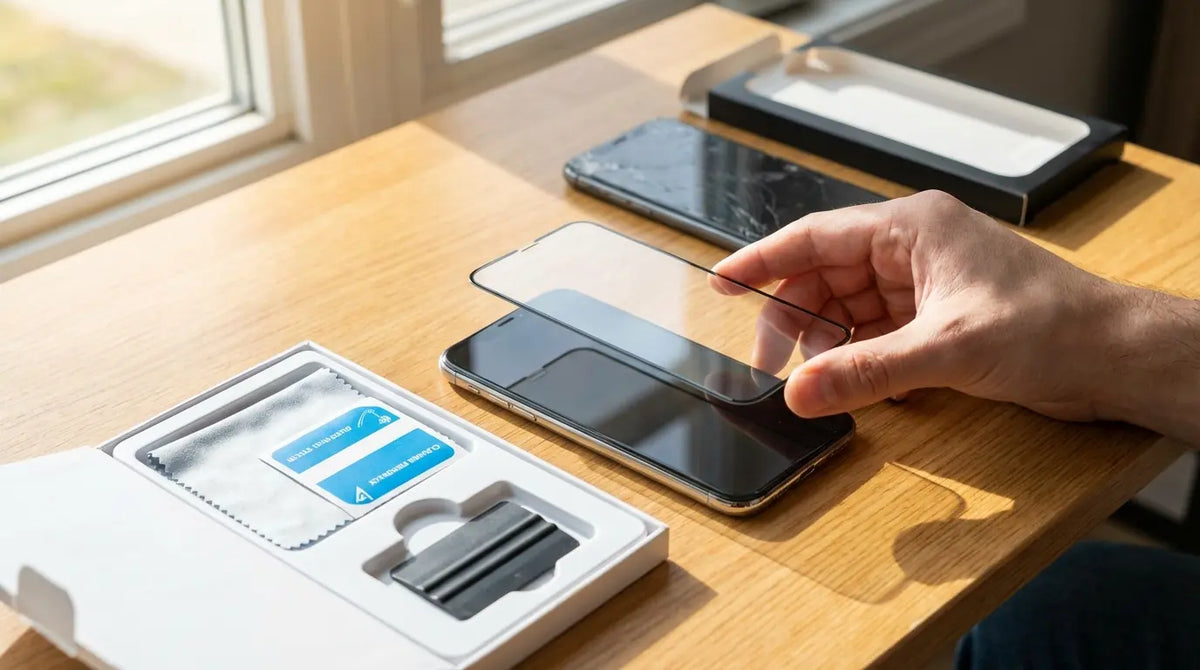
You've watched the installation video three times. You've cleaned your screen with the included alcohol wipe. You've positioned the protector perfectly, aligned it with the speaker cutout, and slowly lowered it onto the screen.
There's a bubble. And another. And a piece of dust that definitely wasn't there five seconds ago.
This is where the whole thing falls apart. Not because the protector isn't strong enough or the material isn't premium enough, but because installation demands a level of precision and environmental control that most people can't achieve in their living room.
The screen protector industry treated installation as a user problem rather than a design problem. They include installation frames and alignment stickers and act as if that solves the fundamental issue: you're trying to bond two perfectly flat surfaces together without trapping anything between them, in an environment full of dust particles, pet hair, and air currents.
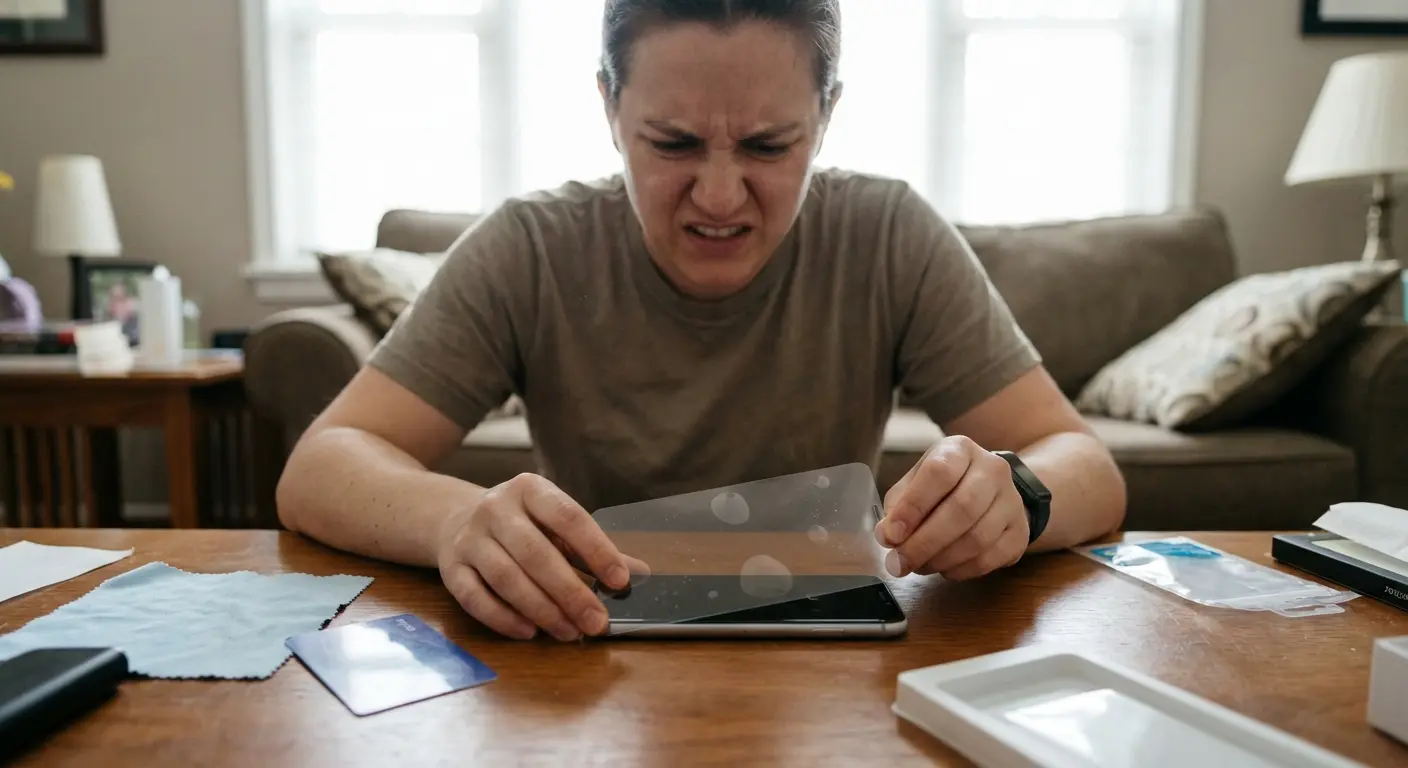
Professional installation services exist because this is genuinely difficult. But most people don't want to drive to a mall kiosk and wait for someone else to install a screen protector. They want to do it themselves, immediately, after unboxing their new phone or receiving their protector in the mail.
Before you install: pick a room with no fans running, clean a flat surface, wash your hands, maybe run a hot shower to kill the dust (yeah, really), and have everything ready - wipes, stickers, alignment frame, whatever came in the box.
The bathroom steam method (running hot water in your shower to create a humid environment that weighs down dust particles) works, but it's absurd that this folk wisdom is more effective than the official installation instructions included with $50 iPhone screen protectors.
Why Perfect Installation Is Overrated
A screen protector with a small edge bubble still protects your screen. A protector that's aligned 1mm off-center still prevents scratches. The perfectionism that causes people to remove and reinstall protectors multiple times often does more damage (through repeated adhesive exposure and handling) than living with a minor imperfection.
You need to know which installation flaws matter. A bubble over the Face ID sensor? That matters. A bubble in the corner that doesn't affect the display or touch sensitivity? That's cosmetic. Slight misalignment that leaves 1mm of exposed screen on one side? Probably fine if your case covers it. Misalignment that blocks the speaker or front camera? That's a redo.
A software developer spent 45 minutes installing and reinstalling a $40 tempered glass protector, trying to eliminate a single small bubble near the bottom corner. On the third attempt, he finally got it perfect but introduced a hair-thin crack along the edge from handling it too much. He ended up ordering a replacement and installing it with two small bubbles that he decided to live with.
Six months later, he couldn't remember which corner the bubbles were in. They'd never affected his use of the phone once.
The quest for perfect installation has caused more people to give up on screen protection entirely than any other factor.
Sometimes good enough is good enough.
The Edge Coverage Problem Nobody Talks About
Astropad tested the iPhone 17's anti-reflective Ceramic Shield 2 and found that regular glass screen protectors increase screen reflectance from 2.1% to 4.6% (according to testing by Astropad on the iPhone 17). You're canceling out Apple's anti-reflective tech. This happens because the AR coating needs direct contact with air to work through destructive interference. Place any standard protector on top and you've created a new problem while trying to solve an old one.
Modern iPhones have curved edges. Not dramatically curved, but enough that applying a flat piece of glass or film creates a tension point where the protector wants to lift away from the screen. Manufacturers have three options: make the protector smaller than the screen (leaving edges exposed), use only edge adhesive (creating the halo effect), or try to force full adhesive coverage (leading to eventual peeling).
None of these solutions are good. They're all compromises that create different problems depending on how you use your phone and what case you pair it with.
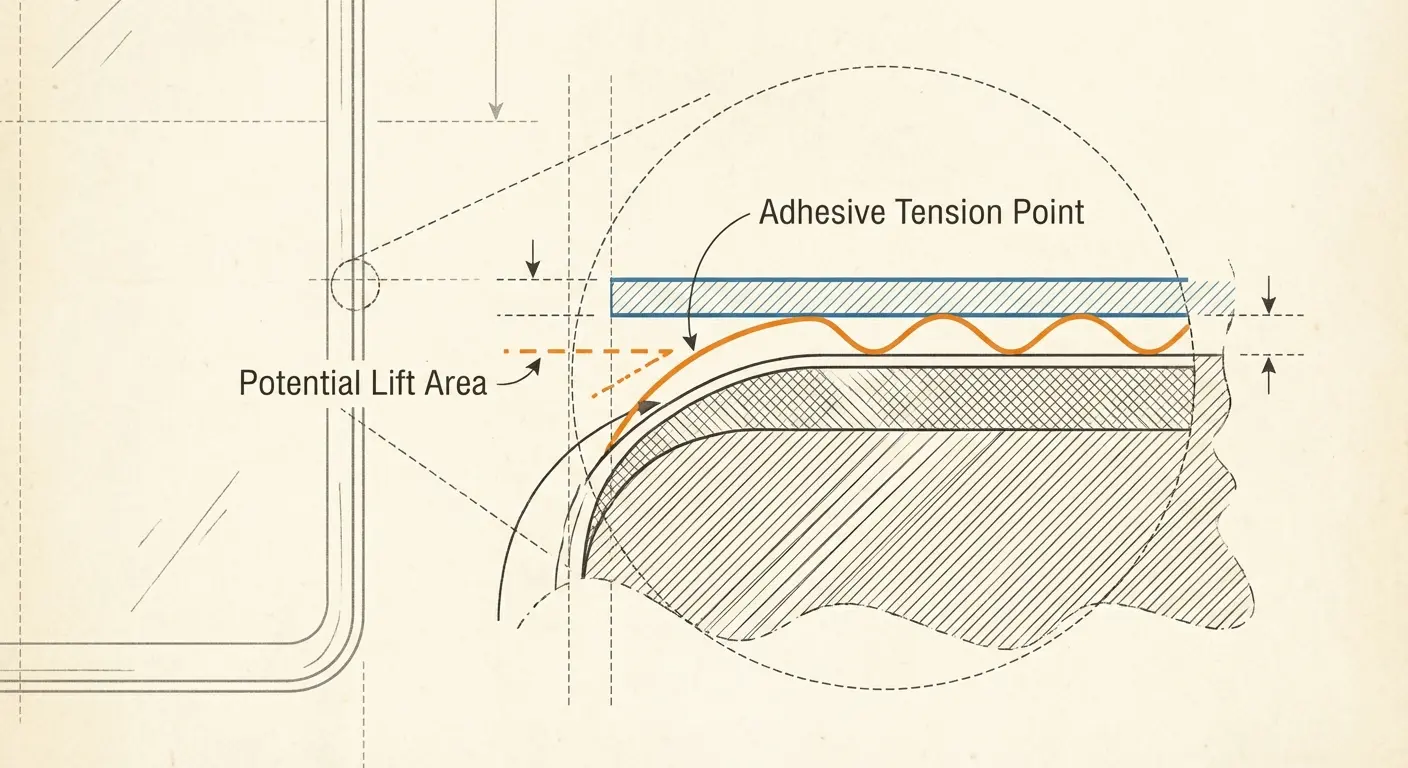
"Full coverage" sounds complete, right? Like you're protecting the whole screen. What it actually means: the protector extends closer to the edges, which means it's more likely to conflict with your case, more prone to lifting, and more susceptible to edge impacts that cause the entire protector to crack.
You've probably seen it: a phone with a perfectly intact screen underneath a shattered screen protector that cracked from an edge impact. The protector did its job by sacrificing itself, sure, but now you're using your phone with a spiderweb of cracks obscuring your display until you get around to replacing it.
The Case Compatibility Gamble
You bought a screen protector designed for your iPhone model. You bought a case designed for your iPhone model. Both products should work together perfectly, right?
Your case might create just enough pressure on the screen protector edges to cause lifting within a week. Or the case lip might not extend far enough to protect the protector edges, leaving them vulnerable to the exact edge impacts you're trying to prevent.
Your case manufacturer and screen protector manufacturer never tested their products together. You're the beta tester, and you won't know if it works until you've already bought both.
OtterBox Defender cases are notorious for this with full-adhesive protectors. Spigen cases usually work fine. Apple's own cases? Hit or miss depending on the protector thickness.
Screen Protectors and Resale Value: A Complicated Relationship
The logic seems airtight: protect your screen, maintain resale value, sell your phone for more when you upgrade.
Except the resale market doesn't quite work that way.
Buyers evaluating a used iPhone care about screen condition, yes. But they also care about touch responsiveness, display clarity, and whether there's adhesive residue around the edges from a removed screen protector. A phone with a pristine screen that has subtle glue marks from protector removal can sell for less than a phone with minor scratches but no residue.
You're protecting your screen for a future sale that might happen in two years. During those two years, you're potentially compromising your daily experience with reduced touch sensitivity, visual clarity issues, or the constant awareness that your screen doesn't feel quite right.
The math only works if the improved resale value exceeds both the cost of the protector and the accumulated frustration of using it. For many people, that equation doesn't balance.
Or here's a thought: are you actually going to sell this phone? Most people keep phones until they're worth like $150 trade-in regardless of condition.
When Protection Becomes Preservation
Some people treat their iPhones like investment vehicles, obsessing over maintaining mint condition for maximum resale value. They keep screen protectors on even when they're scratched and hazy. They avoid using certain features that might cause wear. They're sacrificing the user experience they paid for in order to preserve value for the next owner.
This makes sense if you're flipping phones frequently or if resale value genuinely matters to your financial situation. For most people, though, it's a false economy. You're degrading your experience with a $1,000+ device to potentially increase resale value by $50 to $100.
Your iPhone is a tool you use dozens or hundreds of times per day. Optimizing for resale value at the expense of daily satisfaction is like buying a sports car and never driving it above 45 mph to preserve the engine.
Touch Sensitivity: When Protection Becomes Interference
Your iPhone's touch sensitivity is calibrated for the exact thickness and properties of its screen. Adding any layer changes that equation. Sometimes the difference is imperceptible. Sometimes it's the reason you've started missing letters when typing or why your edge swipes don't register consistently.
Screen protector manufacturers will tell you their products don't affect sensitivity. They're technically correct in that the protector doesn't block touch input. But they're practically wrong because adding thickness (even 0.3mm) changes how your finger pressure translates through the layers to the touch sensors.
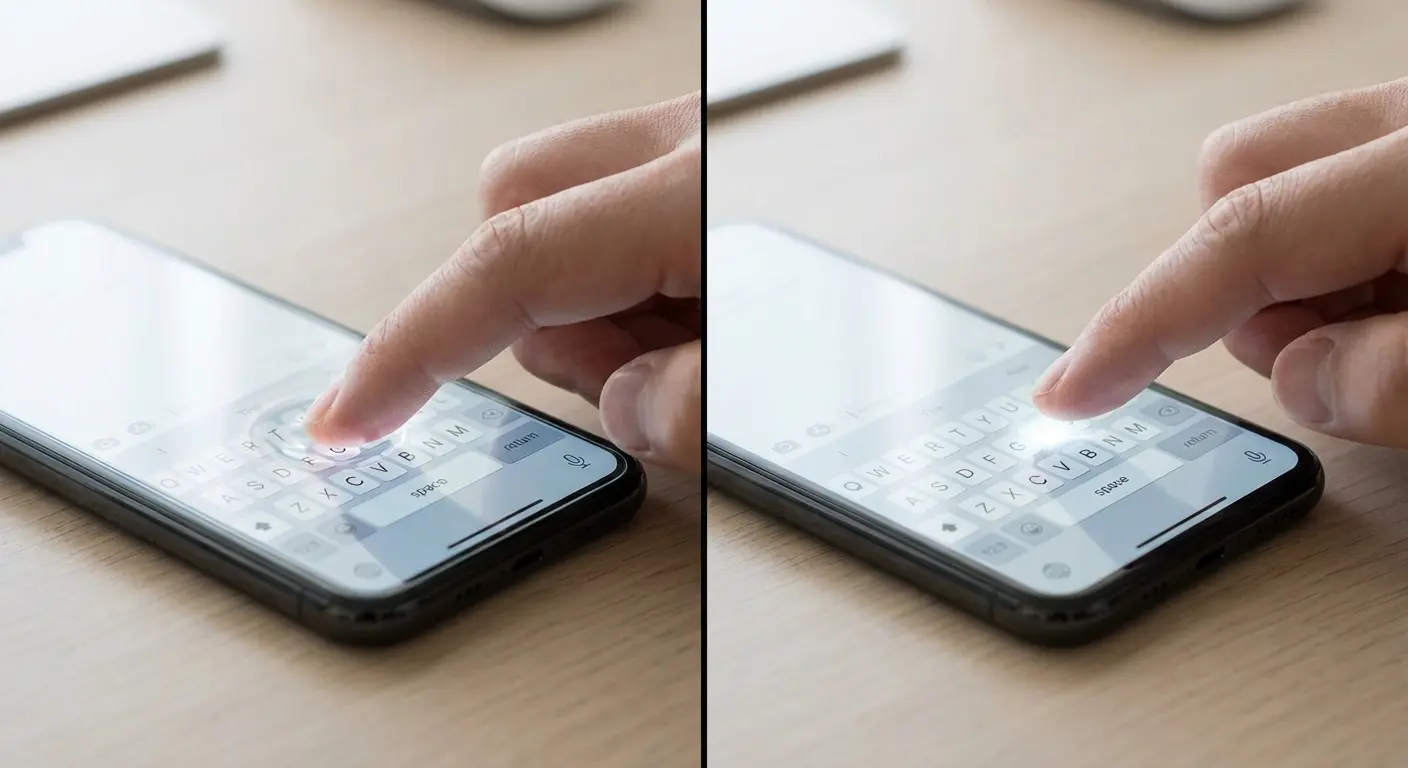
You might not notice it immediately. The degradation is subtle enough that your brain adapts, adjusting your typing pressure and swipe gestures unconsciously. You don't realize you've adapted until you remove the protector and suddenly your phone feels more responsive than it has in months.
Try these: Type a long paragraph and count missed letters. Swipe from the left edge ten times - how many fail? Pull down Control Center from the top-right corner repeatedly. If you're struggling with three or more of these tests, your screen protector is the problem.
The Gesture Recognition Problem
Edge swipes to go back, swiping up to close apps, pulling down Control Center from the corner... these gestures rely on precise touch recognition at the screen edges. Screen protectors that don't extend fully to the edges create a dead zone. Protectors that do extend fully often have edge adhesive issues that affect touch sensitivity in those exact areas.
You've experienced it: swiping to go back in an app and nothing happening. Trying again with more pressure. Eventually tapping the back button because the gesture isn't reliable. That's not iOS being buggy. That's your screen protector interfering with edge touch detection.
Some people never notice because they don't use gesture navigation heavily. Others find it infuriating because it affects their primary interaction method dozens of times per day. Your sensitivity to this issue depends entirely on your usage patterns, which is why reviews are so inconsistent about whether a particular protector affects touch sensitivity.
Finding a good screen protector for iPhone means understanding which compromises you can tolerate and which ones will drive you crazy within a week.
The Case Compatibility Trap
Most people buy their screen protector and case separately, at different times, sometimes from different retailers. They treat them as independent protection decisions.
This is backwards.
Your case determines what kind of screen protector you need or whether you need one at all. A case with a substantial raised bezel provides more impact protection for your screen than any protector material. A case with minimal bezel makes a screen protector essential but also limits which protectors will fit properly.
The screen protector industry doesn't want you thinking this way because it means you might decide you don't need their product. Case manufacturers don't emphasize it because they assume you'll buy a screen protector regardless. You're left figuring out compatibility through trial and error.
Users increasingly adopt anti-glare and matte screen protectors (particularly after experiencing Apple's nano-texture displays on iPad Pro). These specialty protectors often have different thickness profiles and edge designs than standard glass, creating even more potential conflicts with cases that were designed and tested with basic tempered glass in mind.
Why Your Protection Strategy Should Start With Your Lifestyle
You don't need the same protection setup as someone whose usage patterns are completely different from yours. The construction worker who handles their phone with gloved hands needs different protection than the office worker whose phone lives on a desk most of the day. The person who mounts their phone in their car for navigation needs different considerations than the person who uses it primarily for photography.
Screen protector recommendations rarely account for these differences. They optimize for a generic user who doesn't exist, leaving you to figure out whether the advice applies to your situation.
Think about where your phone actually gets damaged. Is it in your pocket with your keys (which won't scratch it anyway)? Is it on hard surfaces where it might slide off? Is it in environments with sand or metal particles? Is it being mounted and unmounted from car holders or bike mounts?
I know someone who kept cracking screen protectors on her iPhone 14 Pro despite never dropping her phone. The culprit? She was constantly mounting and unmounting her phone from a tripod adapter, and the twisting motion created stress points at the protector edges. Once she switched to a thinner film protector with more flexibility, the problem disappeared. Her risk wasn't impact damage, it was repetitive mechanical stress from her specific use case, something no product review or spec sheet addressed.
Your risk factors should determine your protection strategy, not the fear-based marketing that assumes everyone's phone is constantly seconds away from catastrophic failure.
If you're a parent, your phone will get grabbed by sticky hands. If you run with your phone, it's getting sweaty. If you live in Arizona, temperature swings will destroy adhesive. If you're me, you'll drop your phone on your face while reading in bed at least once a month. (Or is that just me?)
Why Your Screen Protector Strategy Should Start With Your Phone Case
Market research says smartphones account for 89.7% of screen protector applications in 2025 (according to research from Coherent Market Insights). Which means people are buying screen protectors for tablets, laptops, smartwatches maybe? Doesn't matter. Point is, we're all doing this, yet most users still purchase these accessories as afterthoughts rather than as part of an integrated protection strategy.
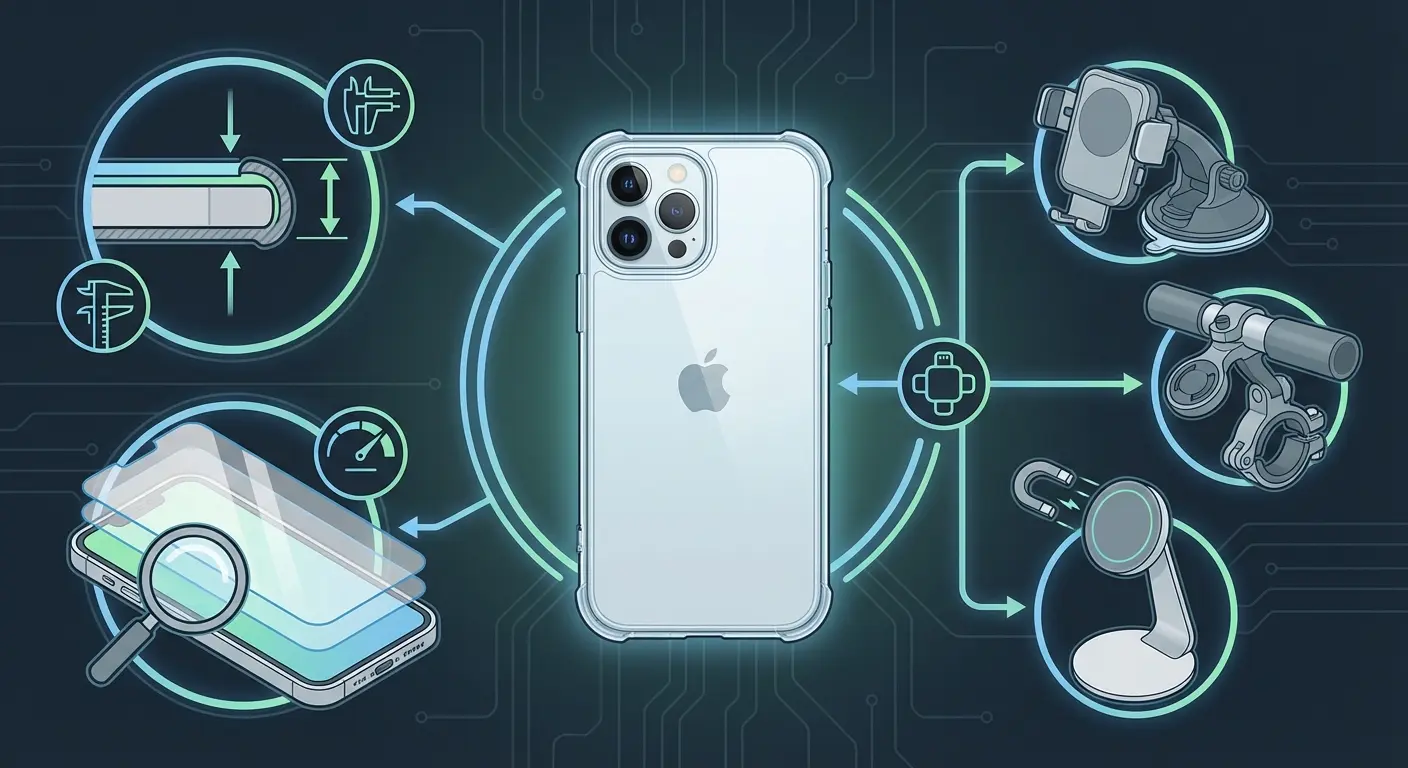
Magnetic mounting systems changed the phone protection equation. If you're using MagSafe or other magnetic mounts, you need to consider how your screen protector affects magnetic alignment and holding strength. Some protectors add enough thickness to weaken magnetic connection. Others interfere with precise positioning, which matters when you're trying to align your phone for navigation while driving.
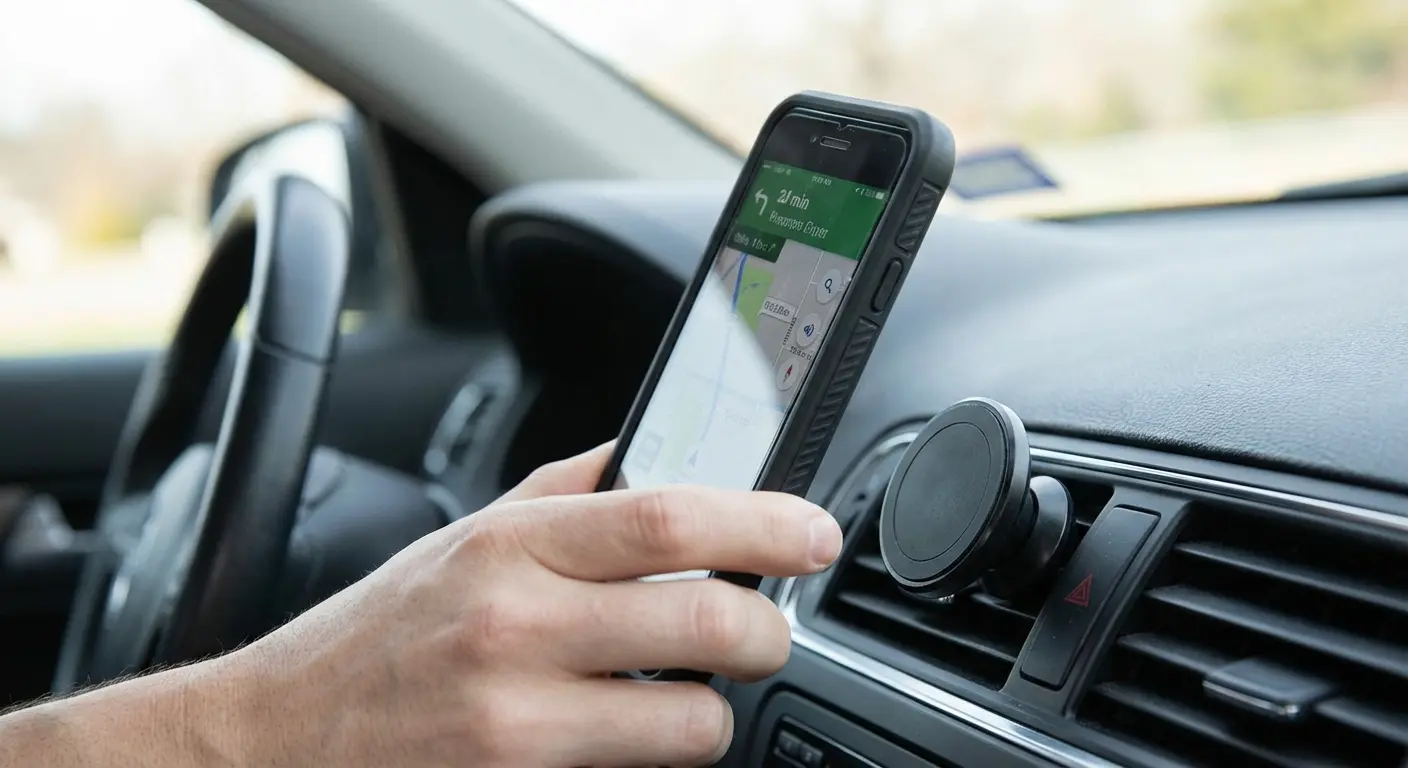
This is where the traditional screen protector buying process completely breaks down. You're making decisions based on drop protection specs and scratch resistance when the determining factor should be whether the protector works with your mounting system.
Full disclosure: I work with Rokform, so take this section with appropriate skepticism. But the reason I work with them is because they actually thought about this integration problem instead of just making another screen protector and calling it a day.
Rokform's RokLock™ twist-lock mounting system provides secure attachment that doesn't rely on magnetic alignment tolerances that screen protectors might affect. If you're using magnetic mounts and finding that your screen protector is creating connection issues, you're solving the wrong problem. The issue isn't the protector, it's that you're using a mounting system that's sensitive to thickness variations.
Rokform screen protectors are designed specifically to work within their protection ecosystem, ensuring that your case, protector, and mount function together rather than fighting each other. When you're choosing a screen protector, compatibility with your entire setup matters more than any individual spec. Many users discover that a Zagg screen protector or other premium brand can still create compatibility issues if it wasn't designed with their specific case and mounting system in mind.
The protection strategy that works starts with understanding how you use your phone in real life, choosing a case that supports that usage, and then selecting a screen protector (if you need one at all) that complements rather than compromises your setup.
Final Thoughts
Look, most people don't need screen protectors. If you've got a case with a decent lip and you're not working in a sandstorm, your screen is probably fine.
But if you do need one, stop optimizing for hypothetical disasters and start thinking about how you actually use your phone.
Screen protectors aren't inherently good or bad. They're tools that solve specific problems for specific users. The issue is that we've been sold a universal solution to a problem that isn't universal.
Your screen might not need protection from impacts if your case provides adequate bezel coverage. It might not need protection from scratches if you're not exposing it to the materials that cause scratches. It might not need protection at all if you're planning to upgrade in a year and don't care about minor wear.
Or it might need protection because you work in an environment with abrasive particles. Because you have kids who handle your phone with sticky fingers. Because you've dropped enough phones to know that your personal drop rate is higher than average.

I'm telling you screen protectors are mostly unnecessary. I also have one on my phone right now. I can't fully explain this. It's like insurance - you know you probably don't need it, but the anxiety of not having it is worse than the minor inconvenience of having it.
The $40 tempered glass protector that feels perfect but doesn't work with your car mount? That's not protection, that's just expensive anxiety. The film protector that feels weird but actually stays on and works with your setup? That's the one you'll actually use.
Before you buy your next screen protector, ask yourself what you're protecting against. Not what the marketing says you should worry about, but what has actually damaged your phones in the past. Consider how the protector will affect your daily experience, not just how it might save you from a hypothetical future disaster.
And if you're spending more time worrying about perfect installation than you spend thinking about whether you need it at all, you've already lost.
Good enough is good enough.
My actual recommendation: Buy a good case (Spigen Rugged Armor is like $15), skip the screen protector, use your phone normally. If you scratch the screen, you scratch it. You'll survive. If this advice is wrong for you, you'll know within a week and you can add a protector then.
Or don't listen to me. Get the $50 tempered glass protector and the installation kit and spend an hour making it perfect. You'll feel better about it, even if you didn't need it. Sometimes peace of mind is worth the money.
Just don't be the person using a phone with a scratched, hazy protector that makes your screen worse than if you'd gone naked.
That's not protection. That's just sad.

