


TL;DR
Look, here's all you need to know: phone grips fail because companies design them for holding your phone, not for how you actually live with it all day. Magnetic attachment isn't just convenient - it's the only way to keep wireless charging, use different mounts, and adapt when your needs change. And removability? That matters way more than grip strength, but nobody wants to admit it.
Why Most Phone Grips Miss the Point Entirely
Every phone grip ad shows the same thing: someone holding their phone confidently while hiking, or taking a selfie at a concert, or texting one-handed on a busy street.
Nobody shows you trying to prop your phone on your desk for a Zoom call while your PopSocket makes it wobble. Or struggling to get your phone onto your wireless charger because there's a giant ring in the way. Or realizing your grip doesn't fit your new car mount.
That's the actual problem. Grips are designed for the 10 minutes a day you're actively holding your phone, not the other 23 hours and 50 minutes.
Think about the last time you fumbled with your phone. Was it because you couldn't hold it securely, or because you were trying to prop it up during a video call? Were you struggling with grip strength, or were you annoyed that you couldn't attach it to your car mount without removing the bulky ring on the back?
The phone grip industry has backed itself into a corner. Manufacturers compete on adhesive strength and ring durability while completely ignoring the fact that your needs change every couple hours. I tested a bunch of magnetic grips. The Benks ArmorPop (link here if you want specs: Benks ArmorPop specifications) is ridiculously light at 22 grams and only 3.9mm thin. So the industry knows how to design accessories that don't turn your phone into a brick. They're just solving for the wrong priorities.
The Context-Switching Problem
Your phone moves through completely different modes during any given day. Morning alarm and news browsing, propped up on your nightstand. Commute navigation, mounted in your car. Desk work with occasional video calls, standing upright for notifications. Lunch scrolling, one-handed. Gym session, secure pocket storage. Evening content consumption, landscape viewing on the couch.
Count how many of those scenarios benefit from a permanent grip ring. Now count how many are actively made worse by one.
My friend Sarah uses her phone in like six completely different ways every day. Morning: propped on the bathroom counter (YouTube news, don't judge). Commute: car mount for GPS. Work: standing on her desk so she can see Slack pings without picking it up. Lunch: one-handed scrolling while eating a salad. Gym: shoved in an armband. Evening: landscape mode on the couch for Netflix.
Her PopSocket is great for exactly one of those scenarios. Guess which one she optimized for? The one she actually uses least - one-handed holding.
Most grips force you to choose a primary use case and accept compromises everywhere else. You optimize for security and sacrifice mountability. You prioritize one-handed texting and give up wireless charging. You get a slim profile but lose the kickstand functionality.
This isn't a grip problem. It's companies not understanding how people actually use their phones.
What "Secure Hold" Actually Means
We need to talk about what companies are hiding behind fancy marketing. They conflate two totally different things: preventing accidental drops and enabling confident one-handed use.
A textured case prevents drops. You don't need a grip for that. What you need a grip for is reaching the top-left corner of your screen without performing finger gymnastics, responding to texts while carrying grocery bags, or taking photos without that paranoid two-hand death grip.
The question isn't whether your grip prevents drops. It's whether your grip enables actions you'd otherwise avoid or perform awkwardly.
Can you comfortably swipe down your notification shade with one hand? Can you type a quick message while holding your coffee? Can you snap a photo at an odd angle without fear?
Those capabilities matter more than adhesive strength ratings or weight capacity specs. But they're harder to photograph for product pages, so the industry ignores them. A grip should expand what you can do with your device, not just protect it from falling. The difference between these two approaches defines whether you'll use your grip daily or remove it within a week.
The Hidden Cost of Single-Use Accessories
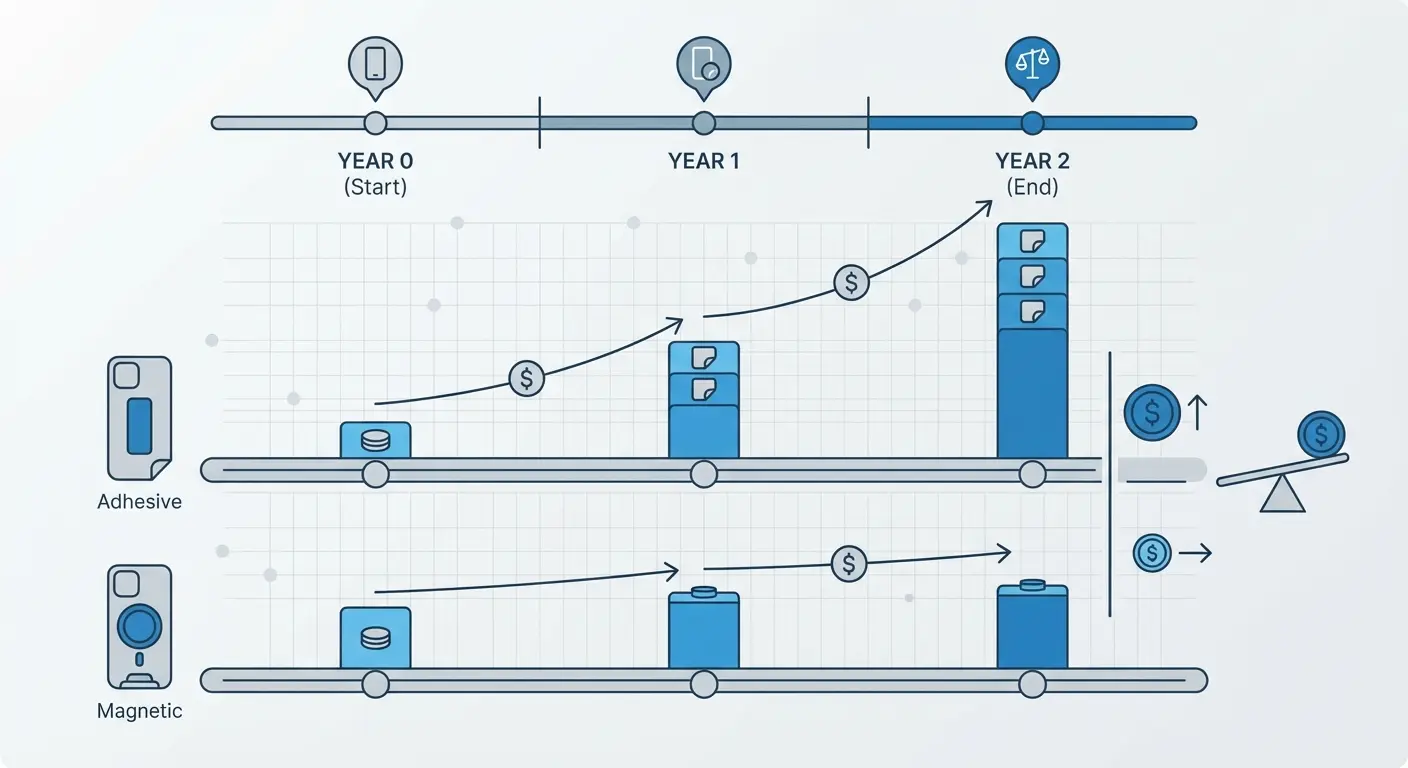
You know what kills me? People think adhesive grips are cheap because they cost $12. Then they spend $30 getting adhesive residue off their phone before trading it in. Or they destroy the grip switching cases. Or they buy a wireless charger they can't actually use.
That $12 grip costs way more than $12. You just pay for it later.
Cost Type |
Adhesive Grip |
Magnetic Grip |
|---|---|---|
Initial Purchase |
$8-$25 |
$25-$45 |
Replacement Cycle |
Every 6-9 months |
Only when lost/damaged |
Case Switching |
Must rebuy or destroy grip |
Moves between cases freely |
Wireless Charging Access |
Blocked (requires removal) |
Full compatibility maintained |
Trade-In Value Impact |
-$20 to -$50 (adhesive residue) |
No impact |
Total 2-Year Cost |
$75-$150+ |
$25-$45 |
The Replacement Cycle Nobody Mentions
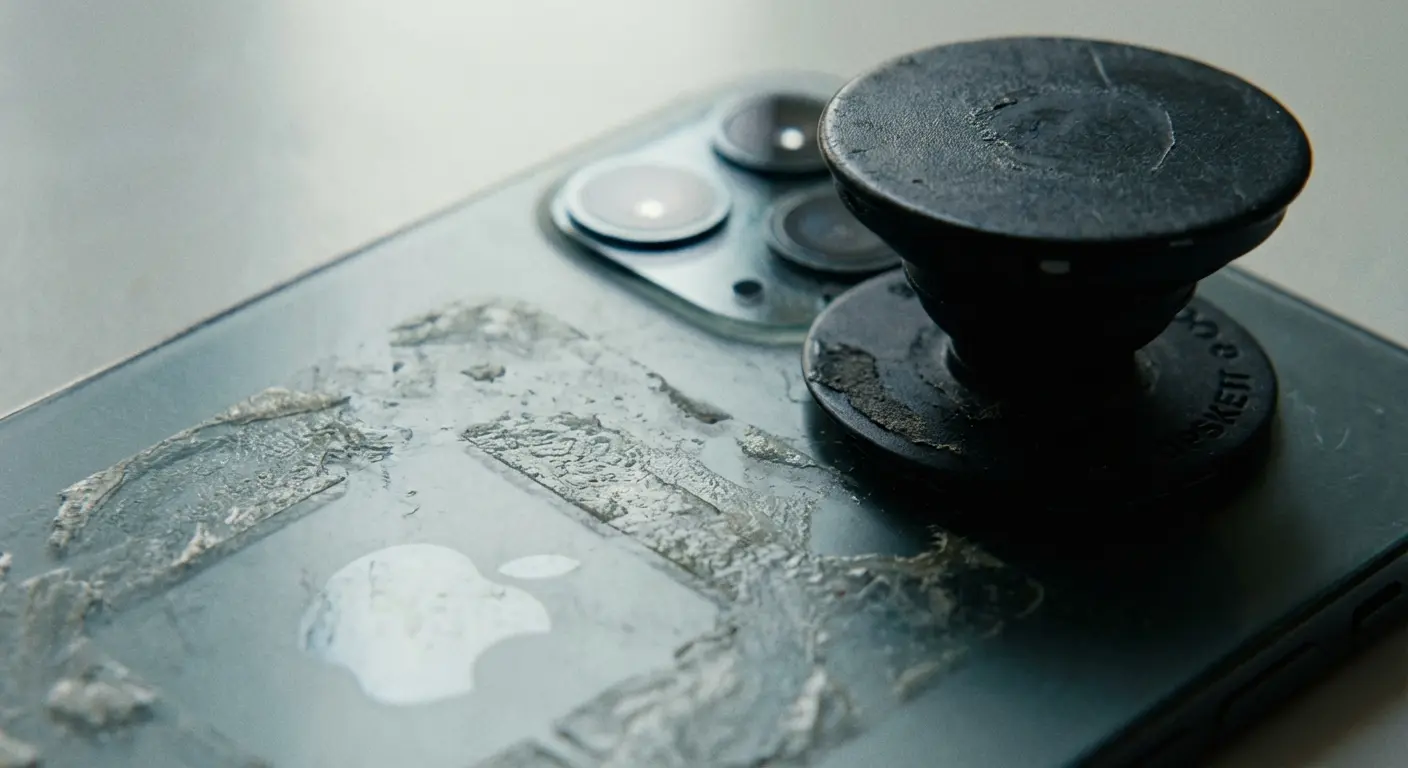
Phone grips wear out. The adhesive weakens, especially in heat or cold. The ring mechanism loosens. The finish scratches or discolors. The entire unit becomes gross after six months of daily hand contact and pocket lint accumulation.
I bought one of those $8 PopSockets from Target. Fell off in my car in July heat within three weeks. The adhesive just gave up.
Replacing a traditional grip means removing the old one (potentially damaging your case or phone), cleaning off residual adhesive, and hoping the new one adheres as well as the first. You're not buying one grip. You're buying into a replacement cycle that most users don't anticipate.
Magnetic solutions eliminate this friction entirely, but only if you're willing to accept a different set of trade-offs. The upfront cost is higher, but the long-term economics favor removable systems by a significant margin.
The Compatibility Tax
Your current grip probably works great with your current phone and your current case and your current car mount. Change any one of those variables and you're starting over.
Got a new phone with a different size or camera layout? Your grip position might now block the lens or sit awkwardly off-center. Switched to a thinner case? The grip might not adhere properly to the textured surface. Bought a new car with a different mount system? Your grip ring might not fit the attachment mechanism.
James bought that $30 grip from Amazon (you know, the one with 50,000 reviews that are definitely not fake) for his iPhone 13 Pro, carefully positioning it to avoid the camera bump. When he upgraded to the iPhone 15 Pro Max nine months later, the camera module had moved and grown larger. His perfectly-positioned grip now partially blocked the ultra-wide lens. He faced three options: use the grip in a suboptimal position and accept compromised photos, spend another $25 on a new grip, or go without. He chose to go without, effectively wasting his original investment.
These aren't edge cases. These are predictable scenarios that most users encounter within 12 to 18 months of buying a grip.
Permanent accessories create fragility in your entire phone ecosystem. You're not just committed to the grip. You're committed to maintaining every compatible component around it. A magnetic grip breaks this cycle by creating a standardized interface that survives phone upgrades, case changes, and mounting system evolution.
What Your Grip Says About How You Actually Use Your Phone
You probably bought your current grip based on how you thought you'd use your phone, not how you actually use it. Most people do.
We imagine ourselves as careful, intentional phone users. We picture typing messages, taking photos, maybe watching videos. We don't picture the awkward positions, the rushed moments, the environmental factors that define our daily interaction patterns.
Track your phone usage for one full day. Ask yourself: do you charge wirelessly? Do you switch cases? Do you use car mounts? Do you prop your phone up to watch content hands-free? Do you need it slim enough for tight pockets?
Your highest-frequency activities should drive your grip choice, not the marketing claims you see online.
The Consumption vs. Creation Split
How much time do you spend creating content (typing, photographing, recording) versus consuming it (reading, watching, scrolling)?
For most users, it's an 80/20 split favoring consumption. Yet most grips optimize for creation scenarios: secure camera grip, stable typing position, confident one-handed texting.
If you're spending 80% of your phone time watching videos, reading articles, or scrolling social feeds, you don't need a better grip. You need a better kickstand. Anyone who wants it to double as a stand should read my phone grip and stand guide.
This seems obvious once stated, but look at the grip market. Count how many products lead with "secure hold" versus "versatile viewing angles." The ratio is completely inverted from actual usage patterns. A magnetic grip with integrated stand functionality addresses this mismatch, but you'll notice most manufacturers still prioritize grip strength over viewing versatility.

Stationary vs. Mobile Usage
Where's your phone when you're using it? In your hand while walking? Propped on a desk? Mounted in your car? Lying flat on a table?
Traditional grips assume your phone is always in your hand. They're optimized for that single context. But phone usage has evolved. We're increasingly using our phones as auxiliary displays, hands-free communication devices, and navigation screens.
A grip that excels at handheld use but can't prop your phone up or attach to a mount is solving yesterday's problem. Your phone spends more time out of your hand than in it. Your accessories should reflect that reality.
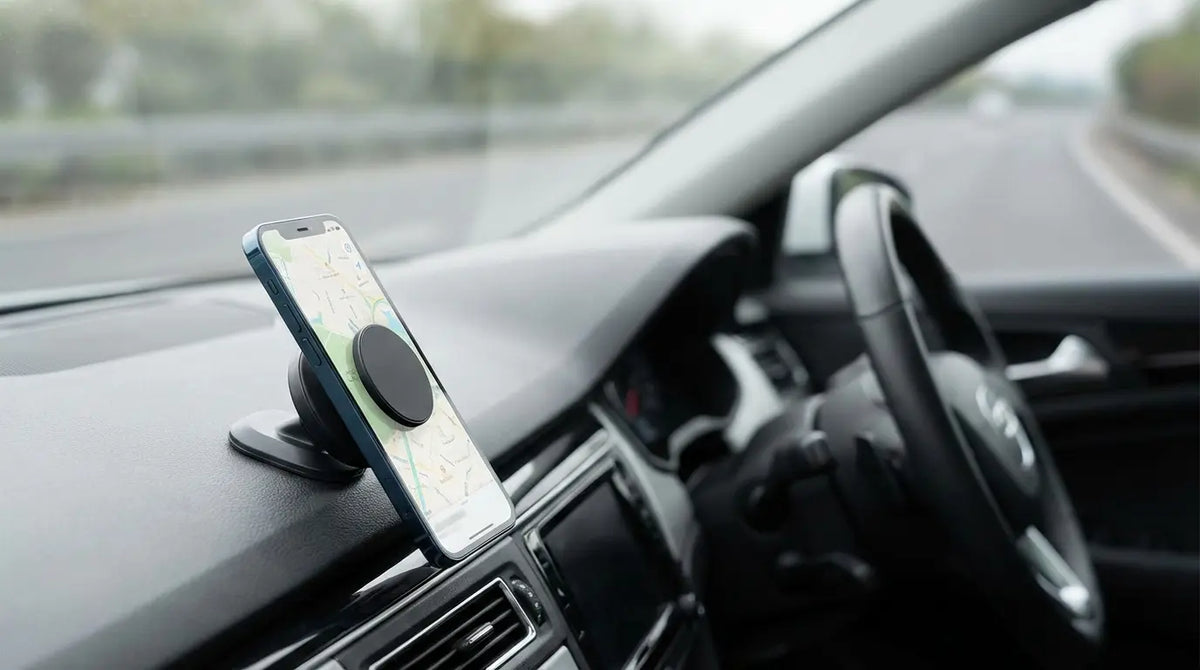
When you're looking at the best car phone mounts, consider how your grip integrates with your mounting ecosystem rather than treating them as separate purchases. The friction between incompatible accessories costs you time and frustration every single day.
The Magnetic Advantage Nobody Talks About
Magnetic grips get marketed on convenience. Snap on, snap off, no adhesive residue. That's the pitch.
That's also the least interesting thing about magnetic attachment.
Okay, here's the actual benefit of magnetic grips, and it's not the thing companies advertise.
It's not about easy removal. It's about turning your phone into something modular instead of a fixed thing.
Once you've got a magnetic connection point, your phone can be a handheld device, then a car navigation screen, then a bedside alarm clock, then a video call display. All without removing cases or swapping accessories or doing that thing where you try to stick your phone to a mount and it won't quite catch and you're adjusting it while driving which is definitely safe.
But only if your grip doesn't screw up the magnetic array or add so much bulk that other magnetic stuff won't stick.
The Ecosystem Effect
MagSafe (and MagSafe-compatible systems) transformed phones from isolated devices into modular components. Your phone can move between different roles seamlessly. All without removing cases or swapping accessories.
This only works if your grip doesn't block the magnetic array or add so much bulk that other magnetic accessories can't connect properly.
Most magnetic grips fail this test. They add a magnetic attachment point but eliminate the native MagSafe functionality. You're trading one ecosystem for another, not expanding your options.
The best options maintain full MagSafe compatibility while adding their own attachment capabilities. That's harder to engineer, which is why it's rarer (and more expensive). But it's the only configuration that delivers on the ecosystem promise.
Grip Feature |
Ecosystem Benefit |
Compatibility Requirement |
|---|---|---|
Magnetic attachment |
Works with magnetic car mounts, desk stands, bike mounts |
Minimum 4-6 lbs pull force |
MagSafe passthrough |
Maintains wireless charging, MagSafe wallet compatibility |
Maximum 5mm added thickness |
Kickstand functionality |
Hands-free content viewing at multiple angles |
Supports both portrait and landscape |
Removability |
Switch between slim carry and full functionality |
No adhesive residue, instant reattachment |
Universal case compatibility |
Works across phone upgrades and case changes |
Magnetic ring adapter included |
Removability as a Feature, Not a Compromise
I used to think permanent attachment was better. More secure, more reliable. Then I ruined a $50 case trying to remove a grip. Now I think differently.
Traditional grips treat permanent attachment as a virtue. They brag about adhesive strength and long-term bonding. Removability is framed as a weakness, something that magnetic grips accept as a necessary trade-off.
This is backwards.
Removability is the feature. Permanent attachment is the compromise.
Think about every scenario where you need your phone without the grip. Wireless charging. Slim pocket storage. Cleaning. Photography without the grip visible in reflections. Swapping between users who prefer different grip positions.
You've probably worked around these limitations so many times you've stopped noticing them. You charge overnight with a cable instead of a wireless pad. You've accepted the bulk in your pocket. You clean around the grip instead of under it. You've normalized the compromises.
Magnetic attachment eliminates all of this friction. Your grip is there when you need it and gone when you don't. No residue, no damage, no permanent commitment. Understanding what is MagSafe and the best accessories helps you evaluate whether a magnetic grip truly integrates with Apple's ecosystem or merely mimics it.
A grip that maintains full ecosystem compatibility gives you options instead of forcing choices. You can use wireless charging at your desk, mount your phone in your car, prop it up for video calls, and still have secure one-handed grip when you need it. That's the promise of magnetic systems, but only a handful of products deliver on it.
When Removability Becomes Non-Negotiable
Some users can tolerate permanent grips. Others can't. The difference usually comes down to context variability and device sharing patterns.
You need a removable grip if you answer "yes" to two or more of these:
Do you use 3+ different mounting systems daily (car, desk, kitchen, gym)? Do you have wireless chargers in multiple locations you use daily? Do you switch phone cases monthly or seasonally? Does your phone appear in professional settings where aesthetics matter? Do multiple people use your phone with different grip preferences? Do you take photos where the grip would be visible in reflections or selfies? Do you regularly need your phone to fit in slim pockets or small clutches? Do you change phones annually and want to transfer accessories?
The Multi-Mount User
You've got a mount in your car. Another on your desk. Maybe one in the kitchen for recipe viewing and one in the gym for workout tracking. You're constantly moving your phone between different mounting systems throughout the day.
Permanent grips create friction at every transition point. You need to verify compatibility with each mount, adjust for different attachment mechanisms, and work around grips that block mounting surfaces or interfere with adjustability.
Magnetic systems solve this instantly. One magnetic attachment point works with every magnetic mount. Your phone moves seamlessly between car, desk, kitchen, and gym without adapters or compatibility checks.
This isn't a minor convenience. It's the difference between using your mounting ecosystem and gradually abandoning it because the friction isn't worth the benefit. A magnetic grip becomes the universal interface that makes your entire accessory collection work together instead of competing for space on your device.
The Wireless Charging Household
If you've invested in wireless charging pads (nightstand, desk, car), a grip that blocks Qi charging is a non-starter. You're forced to choose between grip functionality and charging convenience.
Most users choose charging and either skip the grip entirely or constantly remove and reattach it. Both options defeat the purpose.
High-quality magnetic options use N52 magnets for secure attachment (Benks ArmorPop magnetic specifications), ensuring your device stays firmly attached during everyday use without compromising your ability to charge wirelessly when needed. The best solutions maintain MagSafe compatibility and preserve wireless charging.
The Case Swapper
Maybe you rotate between a rugged case for weekends and a slim case for professional settings. Maybe you change cases seasonally or based on outfit coordination. Maybe you just like options.
Permanent grips lock you into one case. Switching means destroying your grip or accepting incompatibility.
Magnetic grips move between cases (assuming both cases have magnetic compatibility). You maintain grip functionality across your entire case collection without buying multiple grips or dealing with adhesive removal. The flexibility compounds over time - what starts as a minor convenience becomes a significant cost savings and frustration reducer across months of use.
Design Friction: Why Aesthetics Still Matter More Than We Admit
Nobody wants to admit they're avoiding a useful accessory because it looks bad. We frame it as preferring minimalism or appreciating our phone's original design. We're embarrassed to walk around with something ugly attached to our expensive device.
This is completely valid.
Your phone is one of the most-used, most-visible objects you own. It's in your hand during meetings, on the table during meals, visible in every photo and video you appear in. Aesthetics matter.
The Premium Device Paradox
You dropped $800+ on a phone partly because it looks good. Apple spent millions making it thin and sleek and premium-feeling.
Then you slapped a bulky case on it and stuck a bright pink PopSocket on the back.
I'm not judging. I did the same thing. But let's acknowledge the weirdness of paying for design and then covering it up.
Consider the difference between two users with identical iPhone 15 Pros. User A has a bulky clear case with a bright pink PopSocket and visible adhesive ring. User B has a slim aramid fiber case with a low-profile magnetic grip in matching black. Both get the same functional benefits - secure grip, kickstand capability, drop protection. But User B's setup looks intentional and premium, while User A's looks improvised. In professional settings, during client meetings, or in social situations where first impressions matter, that difference affects how others perceive the user's attention to detail and design sensibility.
Most grips ignore this tension entirely. They're designed for function with aesthetics as an afterthought. The result is products that work well but look aftermarket rather than integrated.
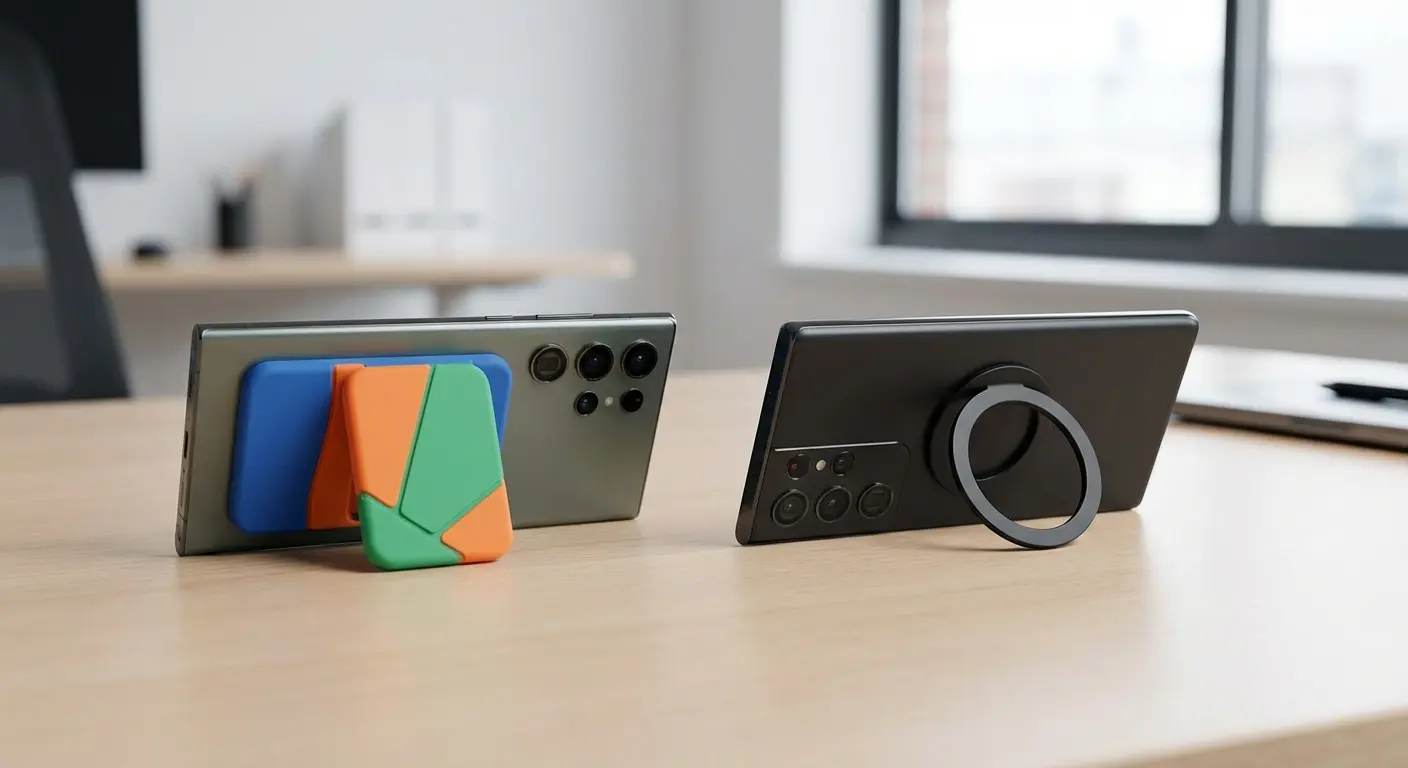
Better grips treat design as a core requirement, not a bonus feature. They use materials that complement premium phones rather than cheapening them. They minimize visual bulk while maintaining functionality. They look intentional rather than improvised. A magnetic grip that respects your phone's design language becomes invisible in the best way - you stop thinking about it as an accessory and start experiencing it as an integrated feature.
The Social Signaling Factor
Like it or not, our phone accessories communicate things about us. A rugged case with a carabiner clip signals different priorities than a slim leather case. A cartoon character PopSocket sends a different message than a minimalist metal ring.
This isn't vanity. It's awareness that the objects we carry participate in social signaling whether we intend them to or not.
You might skip a grip entirely not because you don't need the functionality, but because the available options don't align with how you want to present yourself. That's a design problem, not a user problem.
Grips that respect this reality succeed with design-conscious users who otherwise avoid the category entirely. They deliver functionality without forcing aesthetic compromise.
The MagSafe Ecosystem Trap (And How to Avoid It)
MagSafe promised a unified accessory ecosystem. What we got is a fragmented landscape of varying compatibility levels, inconsistent magnetic strength, and confusing terminology. Premium magnetic grips maintain full MagSafe compatibility while supporting both vertical and horizontal stand orientations (Benks ArmorPop multi-angle functionality), perfect for video watching, calls, and desk use, but many cheaper alternatives sacrifice these capabilities for cost savings.
You need to understand the distinctions before you invest in accessories.
Compatible vs. Certified
"MagSafe compatible" means the accessory uses magnets arranged in the right pattern to attach to MagSafe surfaces. It doesn't mean it meets Apple's specifications for magnetic strength, charging efficiency, or alignment precision.
"MagSafe certified" means the accessory has been tested and approved by Apple. It meets specific performance standards and won't void your warranty.
Most magnetic grip products are compatible but not certified. They'll attach to your phone, but they might not hold as securely, might interfere with charging speeds, or might add enough thickness that other MagSafe accessories can't connect properly.
Don't buy the no-name magnetic grips on Amazon with the suspiciously perfect 4.8-star ratings. The magnets are weak. Ask me how I know.
Before buying any grip, verify the magnetic strength rating (measured in gauss or pull force), the added thickness (measured in millimeters), and whether it maintains full charging speeds. Most product pages omit this information entirely.
The Stacking Problem
The MagSafe ecosystem theoretically allows you to stack compatible accessories. Grip plus wallet. Grip plus charger. Grip plus mount.
In real life, stacking rarely works as advertised. Each layer of accessories weakens the magnetic connection and adds bulk. By the time you've added a case, a grip, and a wallet, the magnetic hold is marginal at best.
You're forced to choose your primary accessory and accept that others won't work reliably. This defeats the entire purpose of a modular ecosystem.
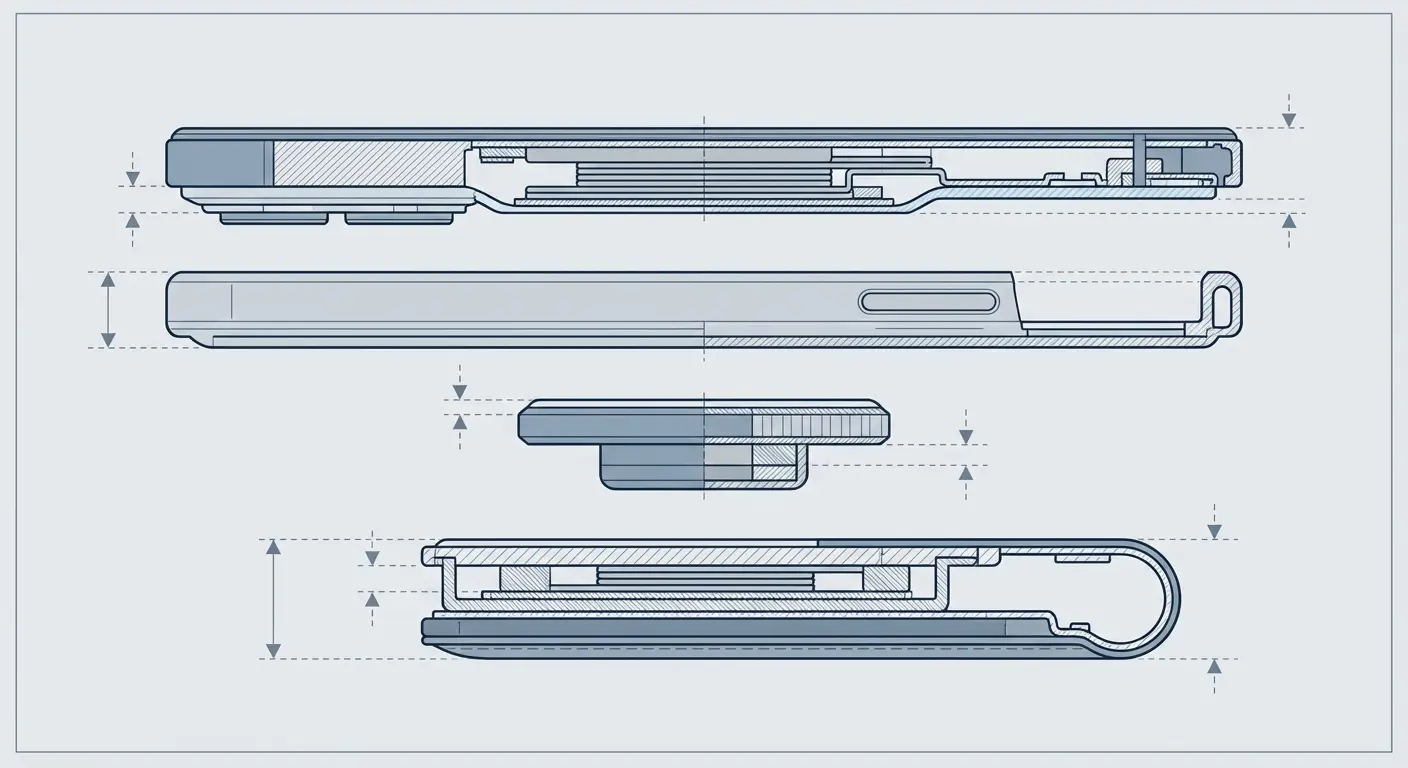
The solution is grips designed specifically for stacking compatibility. They use stronger magnets to compensate for the distance created by additional layers, and they're thin enough that other accessories can still connect. These are harder to find and cost more, but they're the only option if you want ecosystem flexibility rather than theoretical compatibility.
Case Compatibility Complications
Not all phone cases support MagSafe, even if your phone does. Some cases are too thick for the magnetic connection to work. Others use materials that interfere with magnetic fields. Some have textures or coatings that prevent secure attachment.
If you're using a non-MagSafe case, you need a grip that either adheres to the case directly or comes with its own magnetic adapter ring. The adapter ring sticks to your case and provides a magnetic surface for MagSafe accessories.
This works, but it adds another layer of thickness and another potential failure point. The adapter might not adhere well to textured cases. It might not align perfectly with your phone's charging coil, reducing charging efficiency.
You need to map out your entire accessory stack (phone, case, grip, mounts, chargers) and verify compatibility at each layer before committing to any single component. The ecosystem only works if every piece is designed to work together.
When Adhesive Actually Makes Sense
Look, I've been trashing adhesive grips this whole time. But let's be honest.
If you never wireless charge, never use car mounts, and never switch cases, adhesive is fine. It's cheaper and slimmer. Stop letting people tell you magnetic is always better.
The problem is most people don't fit that profile. But if you do? Save your money. Get the $12 PopSocket and call it a day.
What You Should Actually Do
You're probably experiencing at least one of these frustrations right now: your grip blocks your wireless charger, or it doesn't work with your new car mount, or it's too bulky for your pocket, or you can't prop your phone at the angle you need for video calls.
Look, I've tried a lot of these things. Most of them sucked in at least one important way.
The one I actually kept using is Rokform's Magnetic Sport Ring With Stand. Not because it's perfect - nothing is - but because it's the first one that didn't make me choose between wireless charging and actually being able to mount my phone in my car.
It's magnetic (so it comes off when I need it slim), has a kickstand that doesn't feel like it'll break in a week, and works with their whole mounting system. Which sounds like marketing BS, but it actually matters when you've got mounts in your car, on your bike, wherever.
It costs more than the $15 Amazon specials. But I'm not buying my fifth grip this year, so it's probably cheaper in the long run. Your call.
For cyclists who need secure mounting without permanent attachments, the best phone mount for bikes demonstrates how magnetic systems excel in high-vibration environments where adhesive grips fail.
A Few Things That Actually Matter
Ignore the marketing fluff. Focus on measurable specs that predict real-world performance:
Magnetic pull force. Anything under 3 pounds is marginal. You want 4 to 6 pounds for confident attachment that won't detach unexpectedly.
Ring rotation mechanism. Ball bearing systems last longer and stay smoother than friction-based rotation. If the product page doesn't specify, assume it's friction-based.
Material composition. Zinc alloy and stainless steel hold up better than plastic. Silicone contact surfaces resist wear better than bare metal or hard plastic.
Thickness added to phone. Under 5mm is ideal for maintaining pocket portability and accessory compatibility. Over 8mm starts creating real bulk issues.
Temperature tolerance. If you live somewhere with temperature extremes (car interiors in summer, outdoor use in winter), verify the grip is rated for those conditions. Adhesives fail in heat, and some plastics become brittle in cold.
These specs predict how your grip will perform six months from now, not just how it feels in the store.
The Versatility Test
Before buying any magnetic grip, run through this mental checklist:
Can you remove it without tools or damage? Can you reposition it if your initial placement was wrong? Does it work with your car mount? Does it interfere with wireless charging? Can you prop your phone in both portrait and landscape orientations? Does it fit in your pocket without catching on fabric? Can you lay your phone flat on a table without wobbling?
If you answer "no" to more than one of these questions, you're accepting significant compromises. Make sure those compromises align with your usage patterns, not your imagined ones.
Look, Here's the Bottom Line
Your phone grip should make your life easier, not give you new problems to solve.
If you're constantly working around your grip - removing it to charge, struggling with car mounts, dealing with bulk in your pocket - you bought the wrong grip.
Magnetic isn't perfect. It costs more upfront. But it's the only system I've found that doesn't lock you into one way of using your phone.
I said earlier that magnetic is always better. That's not quite right. If you never use wireless charging or car mounts, adhesive is fine. But who doesn't use those things in 2024?
Will MagSafe be the standard in five years? No idea. Probably not. Tech companies love changing standards. But right now, it's the best option for people who use their phones in more than one context per day.
That's it. That's the whole argument.
Now go fix your phone setup. Or don't. I'm not your dad.

