



Table of Contents
Why We Talk About Repair Shops Instead of Prevention
What Makes a Phone Repair Shop Actually Worth It
The Real Price Tag: What That Estimate Doesn't Tell You
Those Certificates on the Wall? Yeah, About That...
Where Do These Parts Actually Come From?
Turnaround Time Promises vs. Reality
Warranty Fine Print That Actually Matters
Data Security During Repairs: The Part Everyone Ignores
When DIY Kits Make Sense (and When They Really Don't)
The Prevention Mindset: Why Protection Beats Repair Every Time
How Rokform Eliminates the Repair Shop Equation
TL;DR
Most people research repair shops after their phone's already broken. Backwards.
Certifications don't mean much. Experience does. Ask how long the actual tech has been doing this.
"OEM equivalent" parts = not actually equivalent.
Nobody thinks about data security until it's too late.
Real talk: A $60 case beats a $200 repair every time.
Why We Talk About Repair Shops Instead of Prevention
Let me guess. You're here because your phone's already toast. Cracked screen? Dead charging port? Took an unplanned bath?
Yeah, I've been there too.
The immediate need feels urgent, and you want to know which phone repair shop won't make things worse or drain your wallet. Fair enough.
But here's what nobody says out loud: the entire repair shop industry exists because we've normalized phone damage as inevitable. The conversation should start way before you're Googling "phone repair near me" at 9 PM on a Tuesday.
The numbers are actually insane. Americans break two smartphone screens every second, feeding an industry that has grown to approximately $4 billion in the US alone as of 2023. That's not a sign of inevitable fragility. It's evidence we've collectively dropped the ball on protection.

The repair shop market has grown into a multi-billion dollar industry not because phones are inherently fragile (though they are), but because we've accepted a cycle: buy phone, use phone without adequate protection, damage phone, repair phone, repeat.
Every phone repair shop you pass reinforces this cycle. Their entire business model depends on your phone breaking.
Because that's how they make money.
Look, I'm not here to shame you for needing a repair. Sometimes damage happens despite your best efforts. What I want to examine is why the default conversation focuses on finding the best repair option rather than eliminating the need for repair entirely. This is the part that clicked for me.
What Makes a Phone Repair Shop Actually Worth It
Here's what's messed up about online reviews: a shop with 500 five-star reviews might be excellent at customer service (friendly staff, clean waiting area, free coffee) while being mediocre at actual repairs. You need to dig deeper than star ratings.
Consumer behavior reveals this disconnect clearly. Online reviews are the #1 factor for 60% of people choosing a repair shop, yet those reviews often emphasize atmosphere and friendliness over technical outcomes. Meanwhile, 33% of consumers prefer third-party repair shops over manufacturer-authorized centers due to price, making cost the deciding factor rather than expertise or parts quality.
We're spending billions annually fixing problems based on who has the nicest waiting room.
Specialization tells you more than broad capabilities ever will. A shop that repairs everything from iPhones to gaming consoles to laptops is spreading expertise thin. When they've seen your exact problem dozens or hundreds of times, they know the quirks, the common failure points, and the workarounds that generic repair guides don't mention.
Before you hand over your phone, ask:
Does the person actually touching my phone know what they're doing? (Not the owner, the actual tech)
Where are the parts from? Push for a real answer.
What's the warranty, and can I get it in writing?
Is the part in stock RIGHT NOW?
What's your data security policy?
Do you have liability insurance?
What happens if the repair creates new problems?
That's it. If they dodge any of these, leave.
How Long Has This Person Been Doing This?
How long has the person touching your phone been doing this work? Not how long the shop has been open, but how long your specific technician has been repairing phones.
There's a shop near my office that's been there since 2015. Nice logo, clean space. Guy who fixed my phone last year? Started three months ago. Meanwhile, there's this hole-in-the-wall place run by this dude who used to work at the Apple Store for a decade.
Guess which one I trust with my phone?
A shop opened in 2015 might have 90% staff turnover, meaning your repair is handled by someone three months into the job. You have every right to ask about technician experience. Shops that employ skilled, long-term technicians will proudly tell you. Shops that rotate through inexperienced workers will deflect or give vague answers about "trained professionals."
Red flag. Huge red flag.
Consider two repair shops side by side. Shop A has been open for eight years and prominently displays its founding date. When you ask about the technician, they mention he's been with them for six months after completing a two-week training program.
Shop B opened two years ago, but the owner-technician has been repairing phones for twelve years, previously working at an Apple Authorized Service Provider. Shop B's technician has diagnosed and repaired thousands more devices despite the business being newer. The shop's age means nothing compared to the technician's hands-on experience.
Where Do These Parts Actually Come From?
Watch them squirm when you ask this.
Where do their replacement parts come from? This question makes many repair shops uncomfortable, which is exactly why you need to ask it. The parts supply chain for phone repairs is murky at best, fraudulent at worst.
Most shops would prefer you don't think too hard about whether that replacement screen came from Apple's factory, a third-party manufacturer in Shenzhen, or was pulled from another broken phone. The economics of repair pricing depend on using cheaper parts while charging prices that imply OEM quality.
The complexity of parts sourcing continues to evolve with technology. TBK recently launched the TBK-958ZE UV Laser Screen Disassembly Machine, a tool that can separate broken LCD screens in approximately 2 minutes and handle back glass removal in 4 to 8 minutes. While this technology speeds up repairs significantly, it also enables more efficient harvesting of components from broken phones, feeding the refurbished parts market with pieces of unknown quality and history.
What seems like a technological advancement for repair efficiency simultaneously expands the gray market problem, making it even harder to trace parts provenance.
The Real Price Tag: What That Estimate Doesn't Tell You
That $79 screen replacement estimate rarely ends up being $79. You need to understand the full cost structure before committing to any repair.
Diagnostic fees might be separate from repair costs. Some shops waive the diagnostic fee if you proceed with the repair, others don't. That's $30 to $50 you might not have budgeted for. Ask explicitly whether the quoted price includes diagnosis or if that's an additional charge.
Repair Type |
Typical Price Range |
Common Hidden Costs |
Total Realistic Cost |
|---|---|---|---|
Screen Replacement |
$79 - $200 |
Diagnostic fee ($30-50), adhesive resealing ($15-25), parts price increase if ordering required |
$124 - $275 |
Battery Replacement |
$49 - $89 |
Diagnostic fee ($30-50), adhesive strips ($10), recalibration service ($20) |
$89 - $169 |
Charging Port Repair |
$60 - $120 |
Diagnostic fee ($30-50), cleaning service ($15-30), connector replacement if cleaning fails ($40-60) |
$105 - $260 |
Water Damage Assessment |
$0 - $50 |
Full disassembly/cleaning ($80-150), component replacement (varies), reassembly ($40-60) |
$120 - $310 |
Camera Replacement |
$80 - $150 |
Diagnostic fee ($30-50), calibration software ($25-40), protective lens ($10-20) |
$145 - $260 |
Parts availability affects pricing more than shops admit during initial quotes. They might quote you a price based on having the part in stock, but if they need to order it, that price can change.
Supply chain disruptions have made parts pricing volatile. A screen that cost the shop $40 last month might cost $60 this month, and they'll pass that increase to you.
The "While We're In Here" Trap
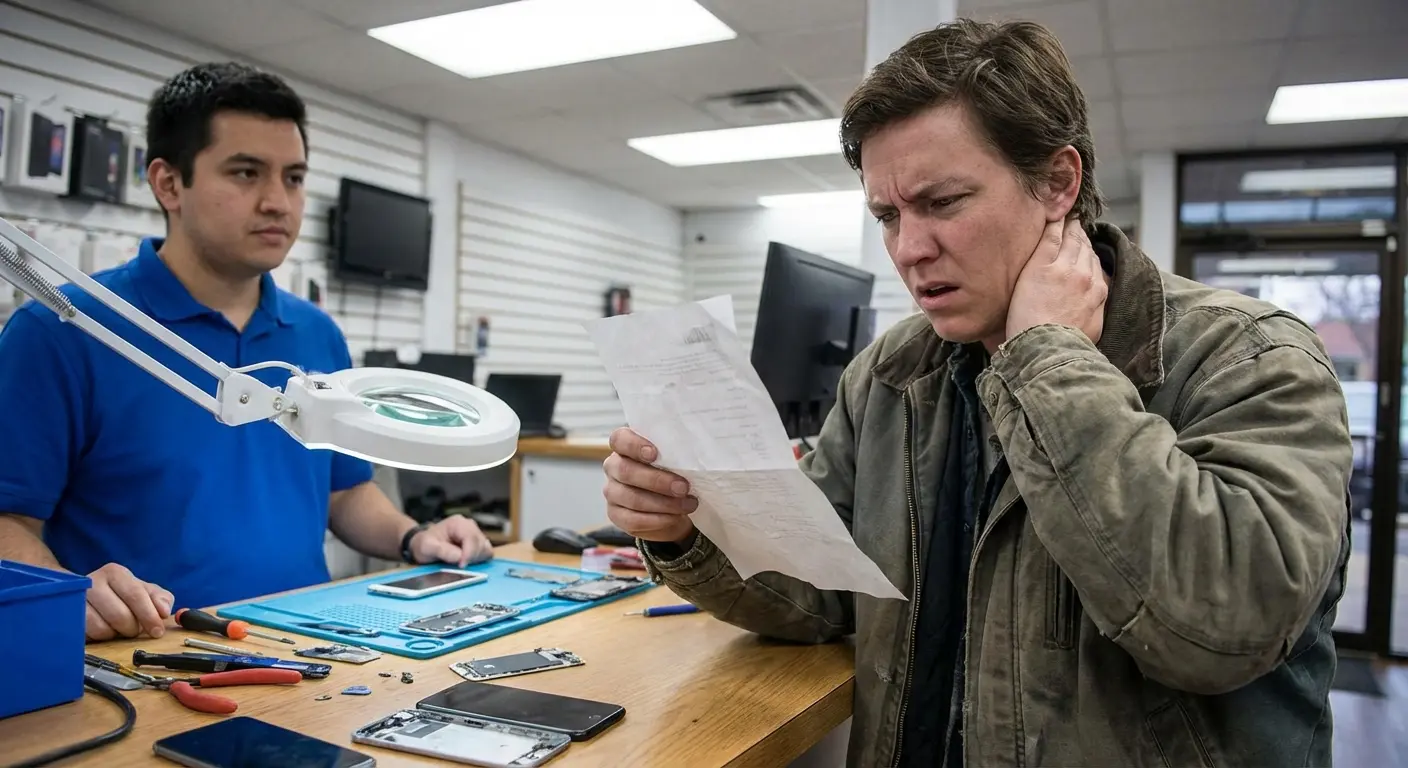
Repair shops make money on volume and upgrades. Once they have your phone opened, they'll often "discover" additional issues. Some of these are legitimate (water damage isn't always visible externally), but others are questionable recommendations designed to increase ticket size.
Battery replacement is the most common upsell. "While we're in here, your battery health is at 82%, we should replace it." Maybe you should, maybe you shouldn't. Ask for specific diagnostics data, not just a percentage. iOS shows battery health in settings; Android users can check with apps. Compare their assessment to what your phone reports.
So this actually happened to my friend Jake. Brings in his Pixel for a screen fix, quoted $149. Tech opens it up and suddenly there's "water damage" from who-knows-when. Maybe real, maybe BS. Either way, they're recommending $383 in work for a phone that was working fine except for the crack.
Jake paid it. I would've walked.
Those Certificates on the Wall? Yeah, About That...
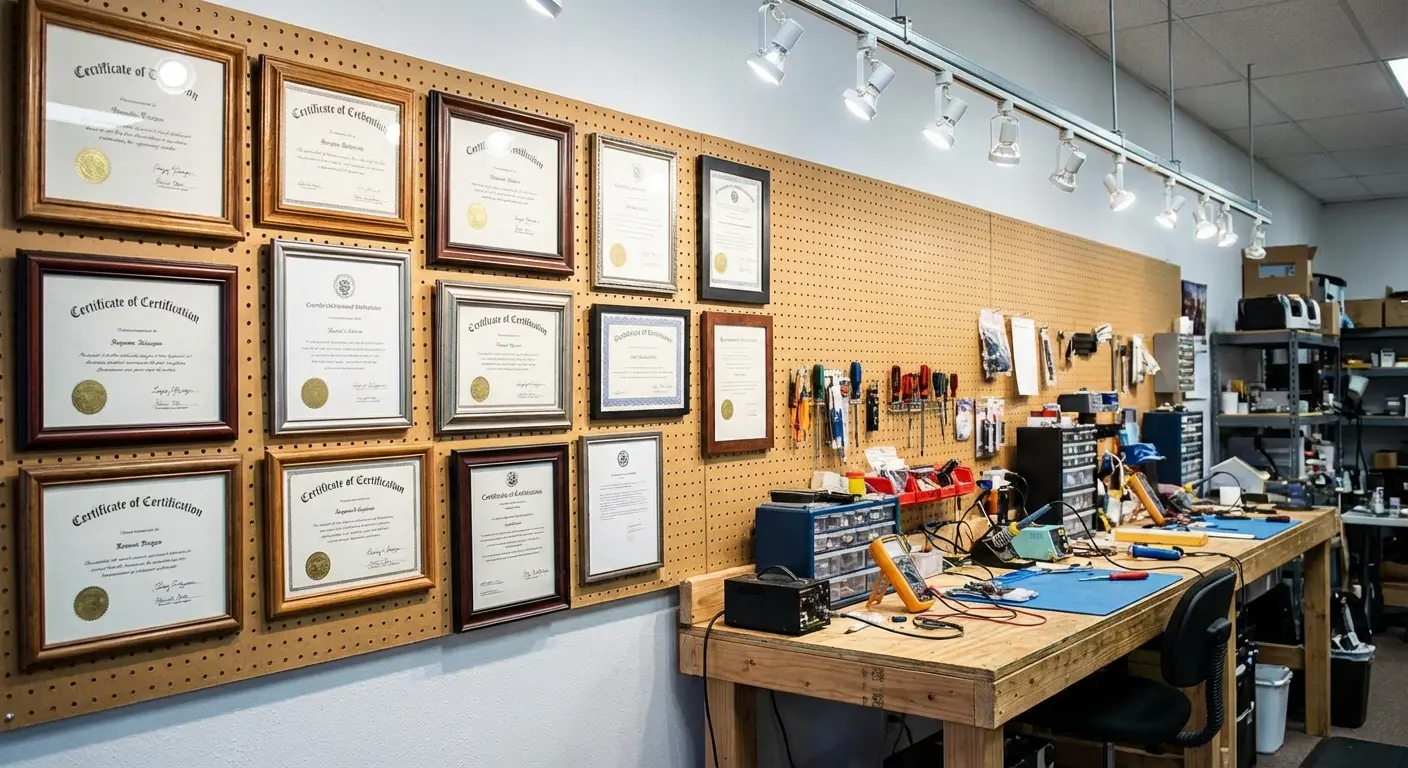
Walk into most repair shops and you'll see a wall of certificates. Apple Certified, Samsung Authorized, CompTIA A+ certified, and various other credentials. These look impressive. Some mean something, most don't mean as much as you'd think.
Apple's certification programs are rigorous, but here's what they don't mention: being an Apple Authorized Service Provider means the shop agrees to use only Apple parts and follow Apple procedures. That's great if you care about warranty stuff, but it often means higher prices.
An independent shop with experienced technicians might deliver identical quality at 40% lower cost, they just can't use the Apple Authorized label.
What Those Certifications Actually Test
Most repair certifications test knowledge of procedures and safety protocols, not hands-on repair skill. You can pass these tests without ever having successfully repaired a phone. Both matter, but they're not the same thing.
Tenure and volume tell you more than certificates. A technician who's completed 2,000 screen replacements has developed muscle memory, problem-solving instincts, and pattern recognition that no certification can provide. Ask about repair volume, not just credentials.
Okay, I said earlier that certifications don't matter much, but micro-soldering certification actually does mean something. That one's legit. If you need board-level repair work, that certification matters. For basic screen replacements? Not so much.
Certification Type |
What It Tests |
What It Doesn't Test |
Value Indicator |
|---|---|---|---|
Apple Certified Technician |
Apple-specific procedures, safety protocols, parts identification |
Hands-on repair speed, problem-solving under pressure, non-Apple device knowledge |
High for warranty work, moderate for out-of-warranty repairs |
Samsung Authorized |
Samsung repair procedures, diagnostic software use, parts sourcing protocols |
Actual repair skill, cross-brand expertise, complex troubleshooting |
Moderate; mainly ensures parts authenticity |
CompTIA A+ |
General computer hardware knowledge, basic troubleshooting theory, safety standards |
Mobile-specific repair techniques, micro-soldering, modern smartphone architecture |
Low for phone repairs; better for general electronics |
Micro-Soldering Certification |
Board-level component replacement, precision soldering techniques, microscope use |
Screen replacement, battery work, general assembly/disassembly |
High for complex repairs; irrelevant for basic repairs |
iFixit Pro Certified |
Proper tool use, repair methodology, component identification |
Speed, efficiency, real-world problem-solving |
Moderate; shows commitment to learning but not necessarily experience |
Where Do These Parts Actually Come From?
OEM (Original Equipment Manufacturer) parts are what came in your phone from the factory. OEM equivalent, OEM quality, OEM grade, or aftermarket parts are not the same thing, despite repair shops using these terms interchangeably.
Pop quiz: What does "OEM equivalent" actually mean?
The answer is whatever the repair shop wants it to mean.
The gray market for phone parts is massive. Refurbished parts pulled from broken phones, factory seconds that didn't pass quality control, and outright counterfeits all flow through supply chains. Your repair shop might not even know which category their parts fall into.
Their supplier says "OEM quality" and they take it at face value because the price is right.
Why This Actually Matters
Aftermarket screens often have inferior touch sensitivity, color accuracy, or brightness compared to original parts. You might not notice immediately, but over weeks you'll realize scrolling feels less responsive or outdoor visibility is worse.
Aftermarket batteries frequently have inflated capacity ratings. That "3,200 mAh" replacement might deliver 2,400 mAh, giving you worse battery life than your degraded original.
Cameras are particularly problematic. Replacing a camera module with a non-OEM part can affect photo quality in ways that aren't obvious in the repair shop's lighting but become apparent in real-world use. Low-light performance suffers, autofocus slows down, and color processing changes.
This makes me irrationally angry, honestly. You're paying for a repair that makes your phone worse than it was before it broke.
Turnaround Time Promises vs. Reality
"We'll have it ready in an hour" sounds great until hour three rolls around and they're still working on it. Repair time estimates are based on ideal conditions: the part is in stock, the repair goes smoothly, no other customers are ahead of you, and no complications arise.
Complications happen frequently.
Screws strip, connectors break, adhesive doesn't release cleanly, or the replacement part arrives defective. Each of these adds time.
A one-hour screen replacement can become a four-hour ordeal, and shops often won't communicate these delays proactively. You're left wondering whether to wait or leave and come back.

The Parts Ordering Wild Card
Many shops don't stock every part for every phone model. They'll accept your repair, then order the part, which might take two to five business days. They should tell you this upfront, but many don't because they don't want to lose the sale to a competitor who has the part in stock.
Ask directly: "Do you have this specific part in stock right now, or will you need to order it?" Don't accept vague answers. If they need to order it, ask for the supplier's estimated delivery time and add two days to whatever they tell you.
Customer drops off a Google Pixel 7 Pro at 10 AM for a camera replacement, promised "ready by 2 PM." The shop quoted based on having the part, but when the technician opens their inventory system, they discover their supplier marked it as backordered yesterday.
They order from a secondary supplier with "same-day delivery," which means delivery by end of business day (5 PM). The part arrives at 4:30 PM, but the technician who started the job left at 3 PM, and the evening technician has three other repairs ahead of it. The customer finally gets their phone at 11 AM the next day. Twenty-five hours instead of four.
The shop never called to update the timeline because "we thought we'd still get it done that day." This scenario plays out daily across thousands of repair shops.
Warranty Fine Print That Actually Matters
Repair warranties sound reassuring until you need to use them. "90-day warranty on parts and labor" seems straightforward, but the exclusions often swallow the coverage.
Water damage voids almost every repair warranty, even if the water damage occurs after the repair and is unrelated to the repair work. Drop your phone in water six weeks after a screen replacement? Your screen warranty is void. The logic is that water can affect components throughout the phone, so they can't guarantee the repair anymore.
Physical damage exclusions are similarly broad. Any new crack, dent, or scratch can be grounds for warranty denial, even if it's nowhere near the repair site.
You replaced your charging port, then dropped your phone and cracked the back glass? They might refuse warranty coverage on a subsequent charging port failure, claiming the impact could have affected internal components.
What Good Warranties Actually Cover
Workmanship guarantees should cover defects in the repair itself: adhesive that fails, parts that were damaged during installation, or reassembly issues. Parts warranties should cover defects in the replacement part: a screen that develops dead pixels, a battery that swells, or a camera that stops focusing.
Get warranty terms in writing before the repair starts. Verbal promises mean nothing when you return with a problem. The written warranty should specify exactly what's covered, what's excluded, and what documentation you need to provide for warranty claims.
Look, I made a template for this, but honestly? Just ask them to write down what's covered and what's not. If they won't, that tells you everything.
Data Security During Repairs: The Part Everyone Ignores
You're handing your phone (containing your email, banking apps, photos, messages, and passwords) to a stranger. Most people worry about whether the repair will work correctly. Almost nobody worries about what happens to their data during the repair.
Technicians need your passcode to test functionality after repair. That passcode gives them access to everything unless you've taken specific precautions. They can browse photos, read messages, access apps, and even install software that maintains access after you get your phone back.
Look, am I being paranoid about the data security thing? Probably a little. But also, have you seen the news?
Modern smartphones now include built-in protection for this exact scenario. Android's Repair Mode (available on Pixel and Samsung phones running Android 14 or later) creates a sandboxed, temporary profile that allows technicians to test all phone functionality without accessing your personal files, apps, or data. The feature requires at least 2GB of available storage and creates a separate partition that protects your information while still enabling full device testing.
Even the technician cannot switch back to normal mode without your PIN or password. This represents a significant advancement in repair security, though it's only available on select devices and requires users to know about and activate it before handing over their phones.
Protection Steps Most People Skip
Back up your phone completely before any repair. If something goes wrong (data loss happens, despite shops' promises), you're covered.
Enable "Find My iPhone" or Android's equivalent tracking. If your phone disappears from the repair shop, you can track it.
Remove biometric authentication temporarily. Disable Face ID, Touch ID, or fingerprint unlock. Use only a passcode, and change it to a temporary one you don't use elsewhere. After you get your phone back and verify everything works, change the passcode again.
Sign out of sensitive apps before the repair: banking apps, email, password managers, and anything containing financial or personal information. Yes, this is annoying. It's also the only way to ensure a technician can't access these accounts while your phone is in their possession.
Honestly, most people won't do this. It's a pain. But if you care about your data...
When DIY Kits Make Sense (and When They Really Don't)
YouTube makes phone repair look straightforward. Order a $25 screen replacement kit from Amazon, watch a 12-minute video, and save $150 compared to a repair shop. Sometimes this works.
Often it doesn't.
Battery replacements are the most DIY-friendly repair for most people. The process is relatively forgiving, the parts are standardized, and the risk of creating additional damage is lower than other repairs.
Screen replacements are technically possible but much riskier. Damaging connectors, cracking the replacement screen during installation, or failing to properly seal the phone afterward are common DIY mistakes.
The True Cost of DIY Failure
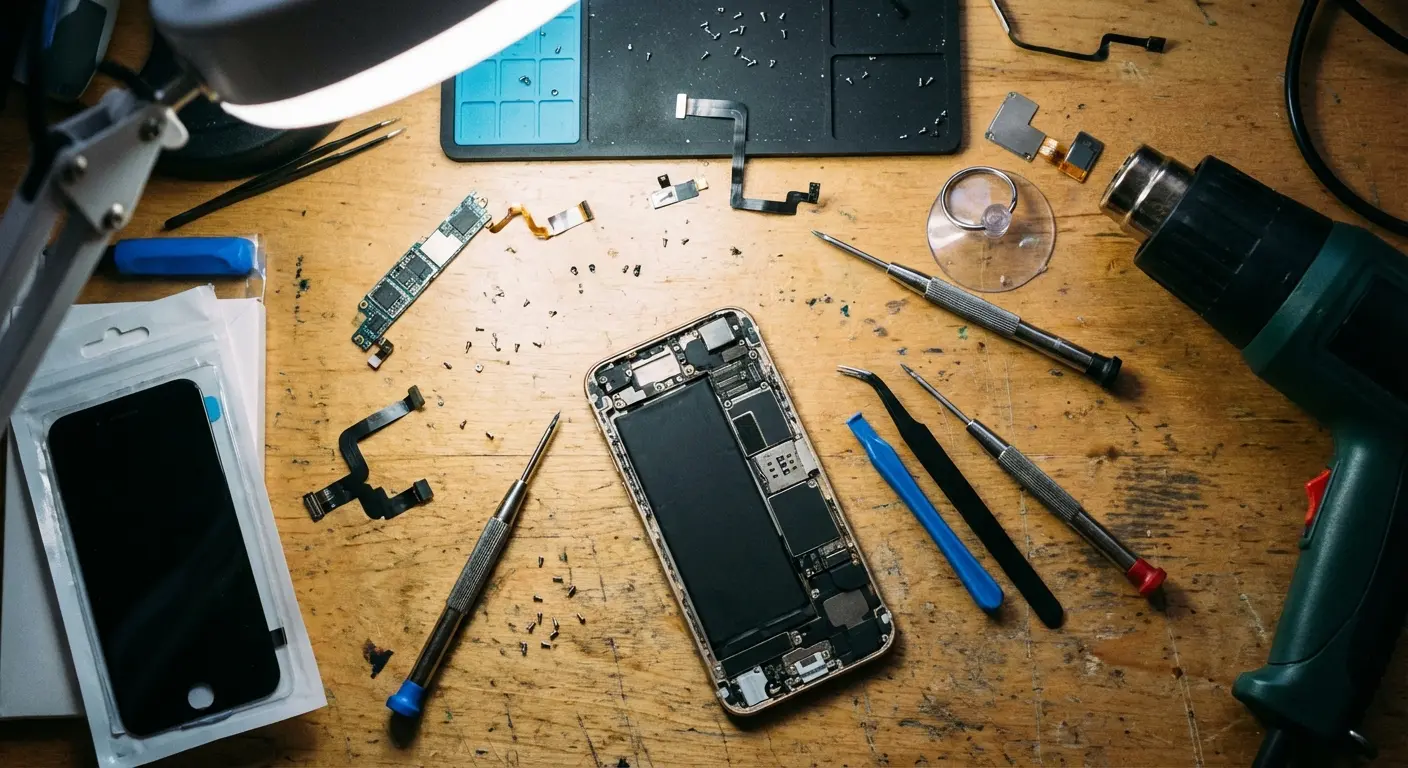
You attempt a screen replacement, damage a connector in the process, and now your phone needs both a screen and a connector repair. You've spent $25 on parts you can't use and created a more expensive repair problem.
I learned this the hard way, and I'm still annoyed about it.
Repair shops charge more to fix phones that customers have already attempted to repair themselves because they need to undo your work before they can do their work.
Waterproofing is nearly impossible to restore with DIY repairs. Phones use precise adhesive seals that require specific tools and techniques to replicate. Your DIY repair might work perfectly but leave your phone vulnerable to water damage it would have survived with the original seal intact.
The Prevention Mindset: Why Protection Beats Repair Every Time
Okay, enough about repair shops.
Here's where we stop talking about finding the best repair option and start talking about why you shouldn't need them. Every repair, no matter how well executed, leaves your phone slightly worse than it was. Aftermarket parts aren't quite as good as originals, adhesive seals aren't quite as precise, and there's always some risk of additional damage during the repair process.
Check out these numbers. 50% of consumers would rather repair a phone than buy a new one if the cost is under $150, yet the average smartphone repair costs between $100 and $300 depending on the model. More tellingly, cracked screens account for 62% of the mobile repair market. Damage that's almost entirely preventable with proper protection.
We're spending billions annually fixing problems that shouldn't exist in the first place.
The average smartphone user spends $157 per year on repairs and $89 on insurance deductibles, according to industry data. That's $246 annually to fix a problem that adequate protection could prevent. Over a typical three-year phone ownership period, you're spending $738 on repairs and deductibles.
The Compounding Cost of Downtime
Money is only part of the equation. How much is your time worth?
The hours spent researching repair shops, driving to and from the shop, waiting for repairs, and dealing with data backup and restoration add up quickly. Most repairs require at least three hours of your time when you factor in all these activities.
Productivity loss during phone downtime has real costs. If your phone is your primary work device (and for many people, it is), being without it for even a day affects your ability to respond to emails, take calls, access documents, or use work apps. That impact might not show up on a repair invoice, but it's very real.
How Rokform Eliminates the Repair Shop Equation
Alright, cards on the table. I work for Rokform, so yeah, I'm about to tell you our cases solve this whole problem. But before you roll your eyes, hear me out, because the math actually checks out.
We build phone cases that make repair shops irrelevant for the vast majority of damage scenarios. That's not marketing speak, that's engineering reality.
Our cases are built to military drop test standards (MIL-STD-810G 516.6), which means they survive 4-foot drops onto concrete repeatedly without transmitting damage to your phone. This isn't about surviving one lucky drop. It's about consistent, reliable protection across hundreds of potential impacts throughout your phone's life.
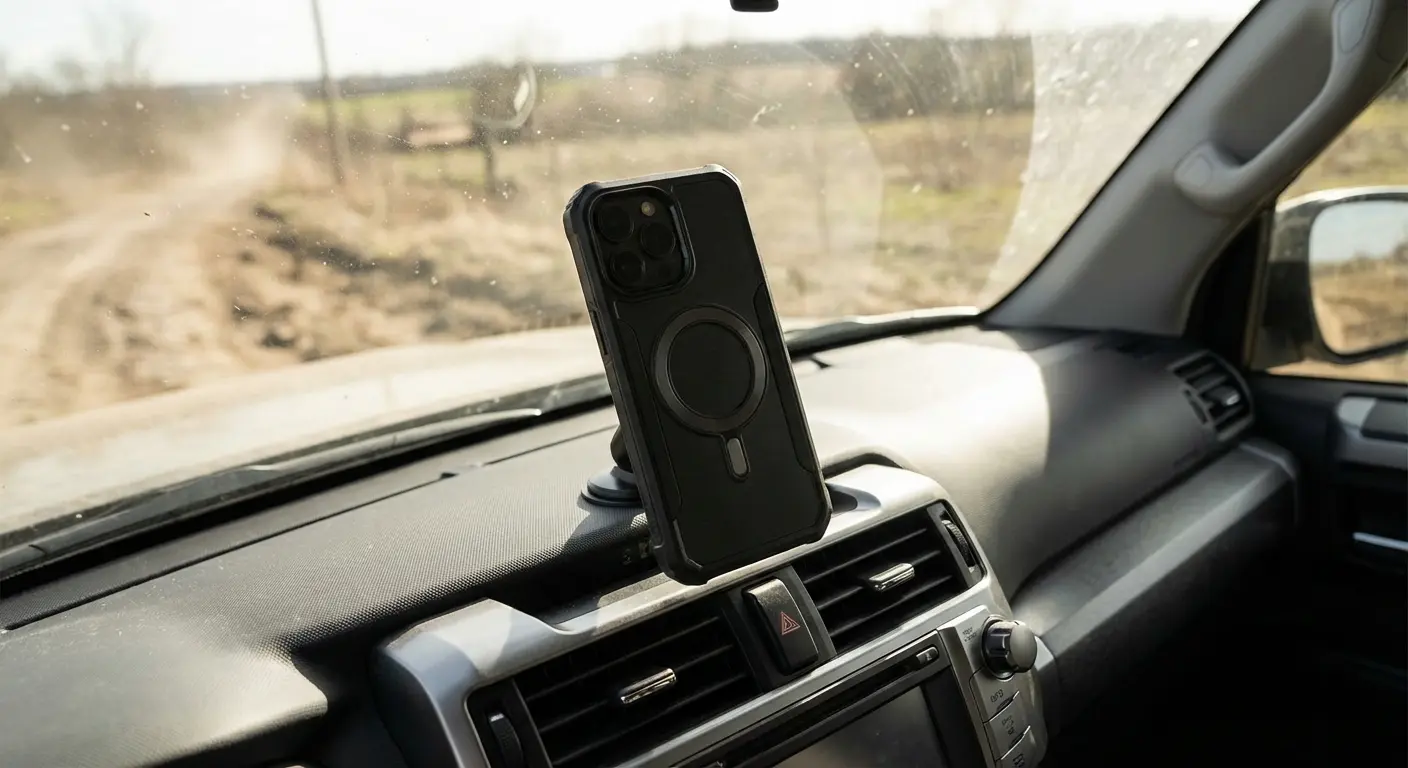
The magnetic mounting system we've developed isn't just about convenience (though mounting your phone in your car, on your bike, or at your desk without fumbling with clips matters). It's about reducing the drop incidents that send people to repair shops in the first place. Your phone stays secured where you put it instead of sliding off surfaces or falling during one-handed mounting attempts.
The Actual Math on Protection Investment
A Rokform case costs between $50 and $80 depending on your phone model and features. That single purchase eliminates the $246 annual average repair and insurance costs we mentioned earlier.
Even if you replace your case when you upgrade phones every two years, you're spending $160 over four years compared to $984 on repairs and deductibles during that same period.
You avoid the data security risks of handing your phone to repair technicians. You skip the downtime and productivity loss. You never deal with aftermarket parts that don't quite match original quality.
The protection investment pays for itself the first time it prevents a cracked screen, and every subsequent save is pure value.
What makes Rokform the #1 choice for phone protection? We've engineered our cases with raised bezels that protect your screen and camera lenses from surface contact, reinforced corners that absorb impact energy, and polycarbonate and TPU construction that distributes shock across the entire case structure. Our RokLock™ twist-lock mounting system provides security that friction mounts and magnetic-only systems can't match. Your phone won't detach during aggressive mountain biking, off-roading, or high-speed cornering.
Check out our full lineup of protective cases designed specifically for your iPhone model. We've engineered solutions for the iPhone 17 and every recent model, because protection should never be an afterthought.
Final Thoughts
Phone repair shops exist because we've normalized phone damage. We shouldn't have.
Every repair shop you pass is a monument to our collective failure to protect our devices. That sounds dramatic, but it's true. We're spending billions fixing problems that shouldn't exist.
Look, repair shops aren't evil. But they're also not your friend. They exist because we keep breaking our phones, and we keep breaking our phones because we treat protection like it's optional.
It's not.
I'm not saying you'll never need a repair. Batteries die, ports fail, weird stuff happens. But if you're budgeting for screen replacements like they're inevitable? You're doing this wrong.
Your phone is likely your most-used piece of technology. It contains your digital life, supports your productivity, and represents a significant financial investment.
Treating its protection as an afterthought makes no sense.
Spend $60 on a case that actually works, or spend $200+ every time you drop your phone. Your call. But stop acting surprised when the thing you didn't protect breaks.

