


Table of Contents
The Hidden Physics Working Against Your Suction Grip
What Manufacturers Won't Tell You About Surface Compatibility
Temperature's Silent Role in Grip Failure
Why Suction Cups Lose Their Hold (And It's Not Just Dust)
The Altitude Problem Nobody Talks About
Humidity's Double-Edged Effect on Adhesion
Material Science: Why Your Phone Case Matters More Than You Think
The Lifespan Reality of Suction Technology
Maintenance Myths That Actually Accelerate Failure
When Suction Grips Make Sense (And When They Don't)
A Better Approach to Phone Security
TL;DR
Suction cups fail because physics. Temperature, altitude, and humidity all work against them. They wear out in months, not years. And that maintenance advice? Mostly makes it worse. Use magnets instead.
The Hidden Physics Working Against Your Suction Grip
You know that satisfying thwack when you stick a suction cup to your windshield? Feels solid, right?
Yeah, it's lying to you.
This isn't about you doing it wrong. Suction cups are fighting physics, and physics is undefeated. The phone grips market is worth $822 million and growing, with the global market valued at USD 822.1 million in 2023 and projected to grow at a CAGR of 8.5% between 2023 and 2030. Which means millions of people are buying these things without knowing they're fundamentally flawed. Great.
Atmospheric Pressure Is Your Only Safety Net
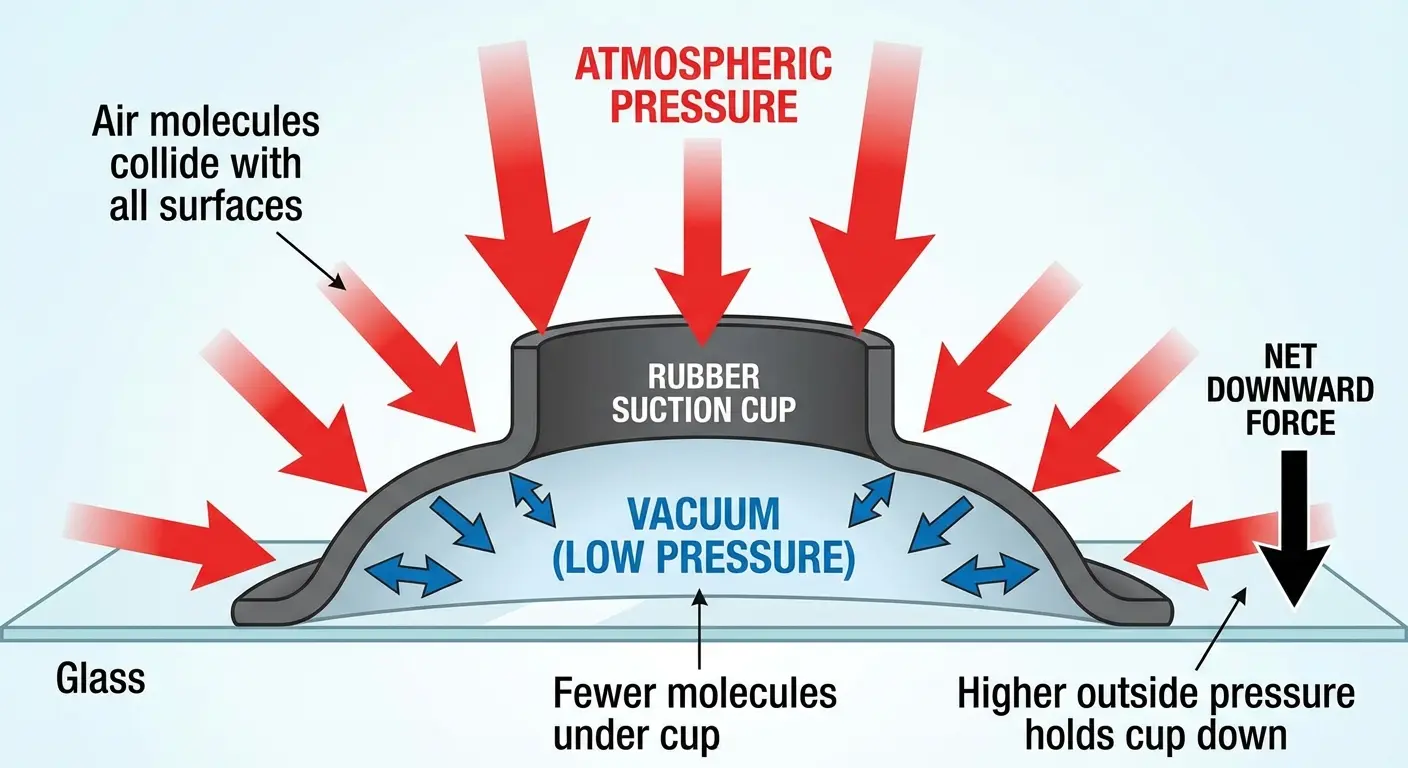
Suction cups don't actually suck onto surfaces. They create a vacuum, and the air around you does the work. At sea level, that's about 14.7 PSI pushing down.
You're basically trusting the atmosphere to hold your $1,000 phone.
In a lab? Sure, this works great. Perfect surface, perfect temperature, perfect everything. Your car at 6 AM on a January morning? Not a lab.
The Micro-Leak Problem
Every suction cup is engaged in a slow-motion race against air infiltration.
Even microscopic imperfections in the seal allow air molecules to gradually equalize the pressure. This happens whether you're aware of it or not, whether the surface looks clean or not, whether the cup appears intact or not. The rate of failure varies, but the outcome doesn't.
They all fail eventually. The question isn't if, but when, and whether your phone is attached when it happens.
What Manufacturers Won't Tell You About Surface Compatibility
Look at any suction cup package. It's always stuck to gleaming glass or polished metal, right? Those aren't aspirational images. Those are literally the only surfaces where these things work anywhere near how they're supposed to.
Most phone cases? The very products designed to protect your device? They actively work against suction. The evolution of suction-based phone accessories continues trying to fix this. In November 2025, Joyroom released a magnetic suction cup mount featuring 18 individual suction cups, each 7.5mm in diameter, designed to provide stronger grip on slick surfaces. While this represents an engineering improvement over traditional single-cup designs, it still faces the same basic surface compatibility problems that plague all suction-based systems.
The compatibility problem runs deeper than "clean your surface" advice suggests.
Texture at the Microscopic Level
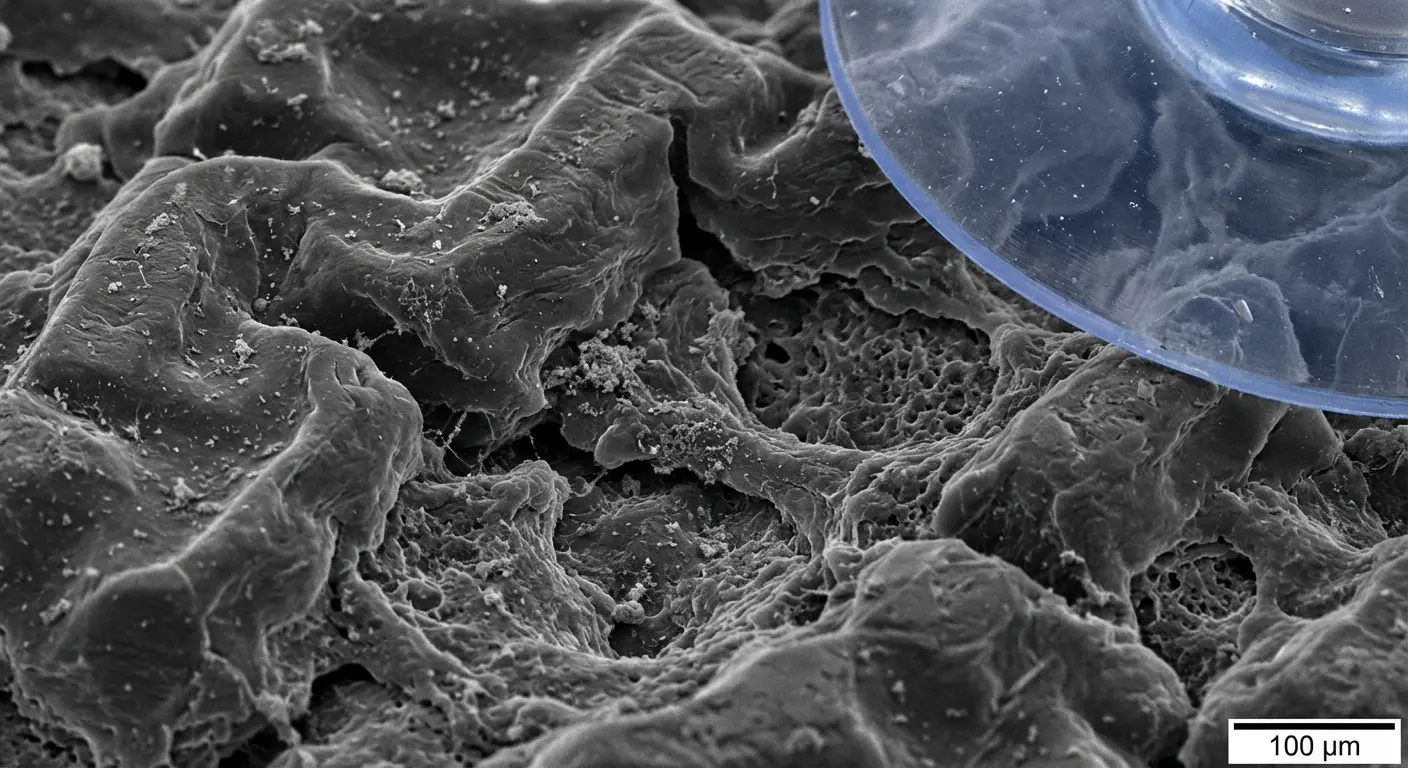
Your phone case might look smooth, but at the scale where suction seals form, it's a canyon system.
Protective cases are engineered for grip, which means intentional texture. That texture creates countless tiny channels where air can infiltrate the seal. Manufacturers test their products on non-porous, perfectly smooth surfaces. You're using yours on textured polycarbonate, silicone with anti-slip coatings, or leather with natural grain variation.
The performance gap between lab and real-world conditions isn't small. It's catastrophic.
Surface Type |
Microscopic Smoothness |
Suction Compatibility |
Typical Seal Duration |
|---|---|---|---|
Bare glass (phone back) |
Excellent |
High |
6-8 hours |
Polished metal |
Excellent |
High |
5-7 hours |
Hard plastic case (glossy) |
Good |
Moderate |
2-4 hours |
Silicone case |
Poor |
Low |
15-45 minutes |
Textured/grip case |
Very Poor |
Very Low |
5-20 minutes |
Leather/fabric case |
Poor |
Incompatible |
Immediate failure |
These are best-case scenarios. Your mileage will definitely vary, and probably not in a good way.
The Coating Conundrum
Modern phone cases come with oleophobic coatings (to resist fingerprints), antimicrobial treatments, and UV-resistant layers. Each coating adds another barrier between the suction cup and a real seal.
These treatments are designed to repel substances. Which includes the suction cup material itself.
You can clean these surfaces obsessively, but you can't remove the chemical properties that prevent adhesion. The case is doing exactly what it was designed to do, which happens to be incompatible with what the suction grip needs to function.
Temperature's Silent Role in Grip Failure
Temperature affects suction grips in two distinct ways, and both are working against you simultaneously.
First, the suction cup material itself expands and contracts with temperature changes. Second, temperature affects the air pressure differential that creates the suction effect in the first place. Car mounts face the most extreme version of this challenge. We're talking temperature swings of 60+ degrees within hours.
For drivers dealing with temperature-related mounting failures, understanding the best car phone mounts that address these environmental challenges can make the difference between reliable navigation and constant readjustment.
Material Expansion Rates
Suction cups are typically made from silicone, rubber, or thermoplastic elastomers. All of these materials expand and contract with temperature.
This wouldn't matter if the expansion were uniform, but it's not. The outer edge of the suction cup (where the seal forms) experiences different thermal conditions than the center.
This creates microscopic gaps in the seal, allowing air infiltration.
Picture this: You stick your mount on in your warm living room. Works great. Then you walk out to your car that's been sitting outside all night, 28 degrees, frozen solid. That suction cup just went from soft rubber to hockey puck.
You start driving, turn on the heat, and within 20 minutes the dashboard area reaches 85 degrees. The suction cup has now experienced a 57-degree temperature swing in less than half an hour. The material expanded rapidly, the seal geometry changed, and microscopic air channels formed.
One pothole later, your phone's in the footwell. Good luck finding it without pulling over.
The Car Dashboard Effect
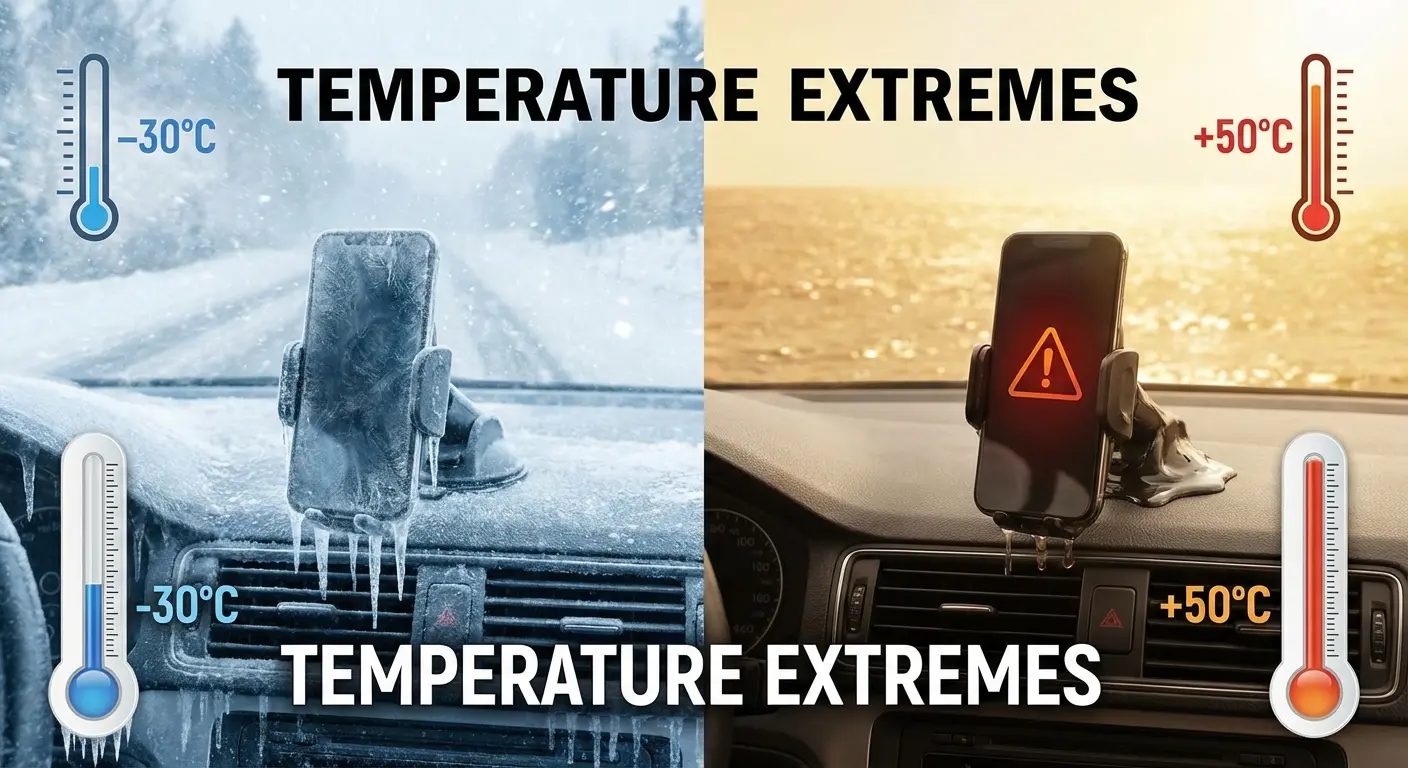
Your car's interior can reach 150 degrees on a summer day. That same interior might drop to 20 degrees on a winter night.
The suction cup you mounted this morning will have completely different material properties by afternoon. We've seen countless reports of phones dropping during commutes, and the pattern is clear: failures cluster around temperature extremes. Your morning commute in a cold car, your afternoon drive after the vehicle's been sitting in the sun.
The grip didn't suddenly become defective. The environment changed in ways that made sealing impossible.
Cold Weather Stiffening
Below 40 degrees, most suction cup materials lose flexibility. The material becomes rigid, unable to conform to minor surface irregularities that it could accommodate at room temperature.
This stiffening effect is temporary (the material recovers when warmed), but it's catastrophic for seal integrity while it lasts.
You'll notice this if you try to apply a phone suction grip in cold conditions. It doesn't press down with the same satisfying compliance. That's the material telling you it can't form a seal.
Why Suction Cups Lose Their Hold (And It's Not Just Dust)
The standard advice for maintaining suction grips focuses almost entirely on cleanliness: wipe the surface, clean the cup, remove dust and oils.
This advice isn't wrong, but it's incomplete to the point of being misleading.
Contamination is one factor among many, and often not the primary cause of failure. Material degradation, UV exposure, and mechanical stress gradually destroy effectiveness, even when you're following all the maintenance recommendations perfectly.
Material Fatigue Accumulation
Every time you attach and remove a suction grip, you're introducing microscopic tears in the material.
The flexing required to create and break the seal stresses the elastomer at the molecular level. These stress points accumulate. After 50 cycles, the material has measurably less elasticity than when new. After 200 cycles, the degradation becomes visible under magnification.
After 500 cycles, the cup may look intact but has lost significant sealing capability.
You're not doing anything wrong. You're using the product as intended, and the intended use destroys it gradually.
My friend drives for Uber. She's on her third suction mount this year because she actually uses it, you know, attaching and removing it like you're supposed to. She does this 4-5 times a day. Three months in, the mount that used to last her whole shift? Now she's fixing it every 45 minutes. She's basically a phone mount babysitter at this point.
The suction cup looks fine. No visible cracks or deformation. But the accumulated molecular-level stress has destroyed its sealing capability. She assumes the mounting surface has gotten dirty, but cleaning makes no difference.
The material itself has failed.
UV Degradation You Can't See
Ultraviolet radiation breaks down the polymer chains in suction cup materials. This happens fastest in direct sunlight (a car mount scenario) but occurs even in indirect light.
The degradation begins at the surface and works inward.
The visible signs (discoloration, surface cracking) appear late in the degradation process. By the time you notice UV damage, the material has already lost substantial holding power. The cup that looks fine but keeps failing probably has UV damage that hasn't manifested visually yet.
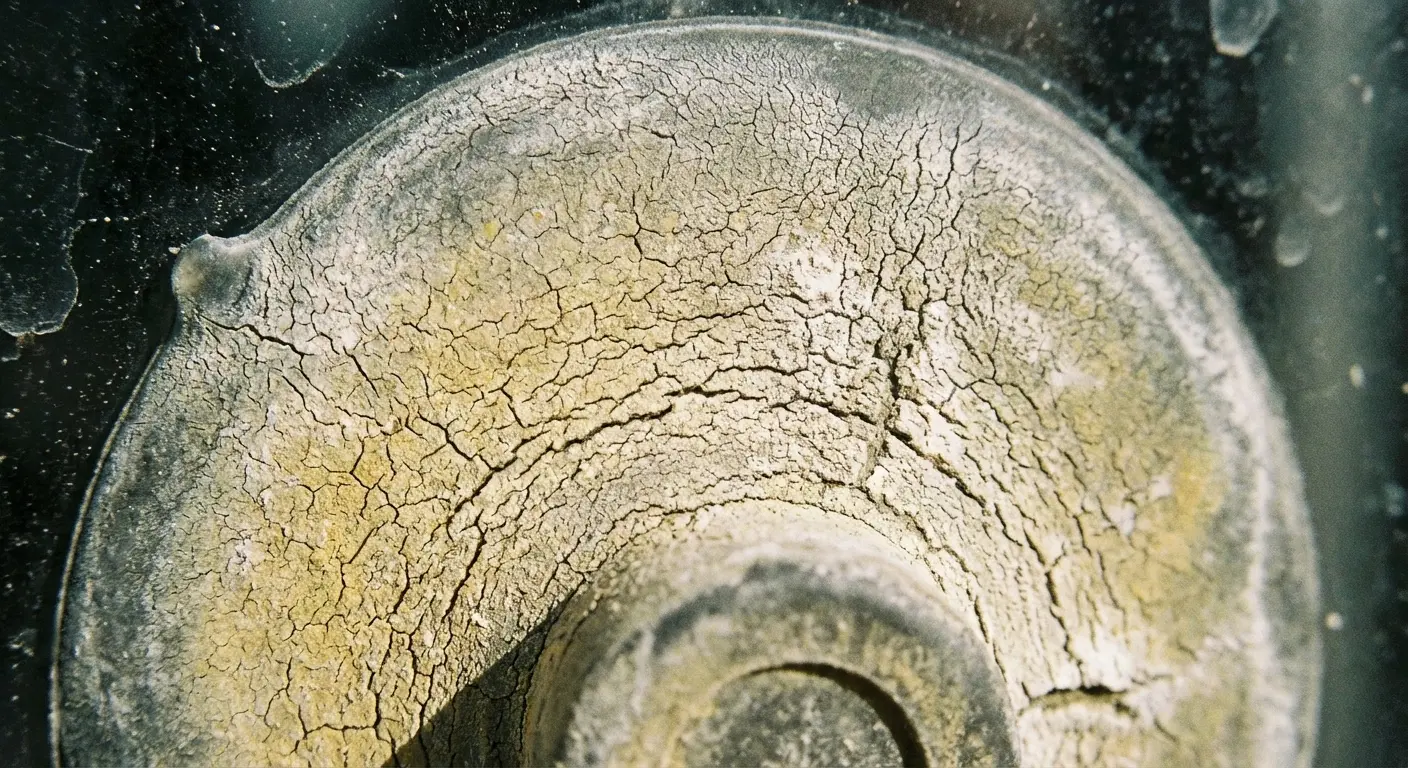
Plasticizer Migration
Many suction cups contain plasticizers to maintain flexibility. Over time, these plasticizers migrate out of the material, especially when exposed to heat.
The cup becomes harder and less compliant. This process is irreversible.
You'll notice this as a subtle change in how the cup feels. It doesn't press down quite as easily. It doesn't conform to surfaces the way it used to. That's not dirt or damage you can clean away. That's the fundamental material composition changing.
The Altitude Problem Nobody Talks About
Atmospheric pressure decreases with altitude, and since atmospheric pressure is what makes suction grips work, elevation directly impacts holding power.
This isn't a minor effect.
At 5,000 feet, atmospheric pressure is roughly 17% lower than at sea level, which means your suction grip has 17% less holding force. For people living in or traveling to elevated areas, suction technology becomes progressively less reliable, yet this limitation is almost never mentioned in product specifications or user guidance.
The Pressure Drop Curve
Sea level? 14.7 PSI. Drive up to the mountains, say, 10,000 feet, and you're down to about 10 PSI.
That's a third of your holding force just... gone.
A suction cup with a 1-square-inch contact area has roughly 14.7 pounds of holding force at sea level. That same cup at 10,000 feet has about 10 pounds of force. The phone weighs the same, but the force holding it decreased by nearly a third.
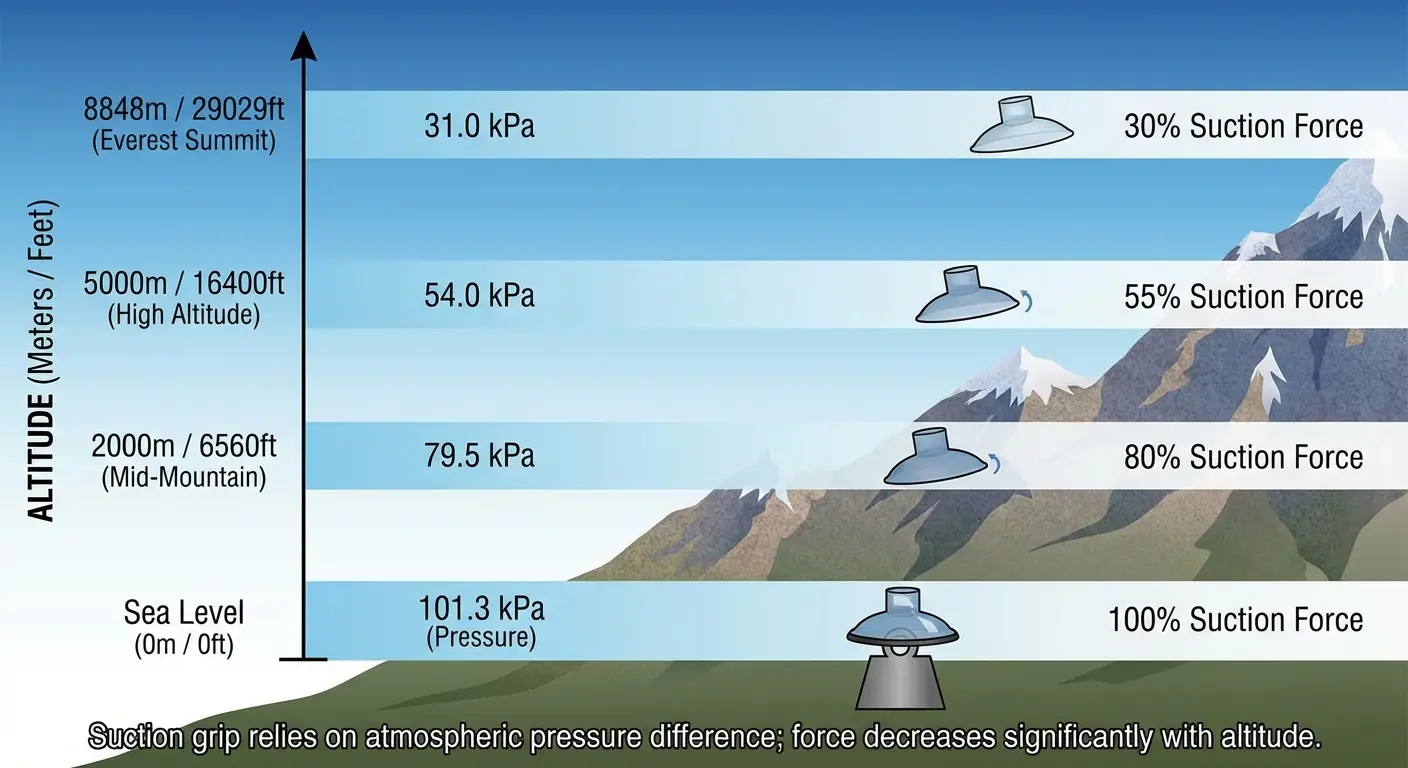
Altitude |
Atmospheric Pressure |
Holding Force (1 sq in cup) |
% Reduction from Sea Level |
|---|---|---|---|
Sea level |
14.7 PSI |
14.7 lbs |
0% |
2,500 ft |
13.4 PSI |
13.4 lbs |
9% |
5,000 ft |
12.2 PSI |
12.2 lbs |
17% |
7,500 ft |
11.1 PSI |
11.1 lbs |
24% |
10,000 ft |
10.1 PSI |
10.1 lbs |
31% |
14,000 ft |
8.6 PSI |
8.6 lbs |
42% |
Altitude Changes During Travel
And before you think "I don't live in the mountains, I'm fine." You're not.
Highway mountain passes, flights (cabin pressure typically equals 6,000-8,000 feet), and even tall buildings create pressure variations that affect suction performance. We've documented failure patterns that correlate precisely with elevation changes during road trips.
The grip that worked fine in coastal areas fails repeatedly in mountain regions. Users assume they're doing something wrong or the surface is different. Usually, it's physics responding to altitude.
Pressure Equalization Speed
When you drive up a mountain, the atmospheric pressure outside your car drops gradually. The air trapped in your suction cup's vacuum space doesn't immediately equalize.
It takes time for air to infiltrate and match the new pressure.
During this equalization period, the pressure differential (and therefore holding force) is even lower than the steady-state altitude effect would predict. Quick elevation changes create the worst conditions for suction grip performance. The technology can't adapt fast enough to maintain consistent holding power.
Humidity's Double-Edged Effect on Adhesion
Humidity affects suction grips in contradictory ways depending on the level.
Moderate humidity can improve seal formation by making surfaces slightly more compliant and filling microscopic gaps with water molecules. Excessive humidity introduces moisture that acts as a lubricant, preventing adhesion. Very low humidity causes static charge buildup and makes materials more brittle.
Why does your suction grip perform differently across seasons or in different climates? The "optimal" humidity range for suction technology is narrower than most environments provide.
The Goldilocks Zone
Suction cups perform best at 40-60% relative humidity.
Below 30%, materials become less flexible and static electricity can interfere with seal formation. Above 70%, moisture begins to act as a contaminant rather than an aid.
Most indoor environments fall within this range, which is why suction grips often work acceptably in homes and offices. Cars, however, regularly exceed these bounds. A closed car in summer humidity can reach 90%+ relative humidity. Winter heating systems can drop interior humidity below 20%.
Condensation as a Failure Trigger
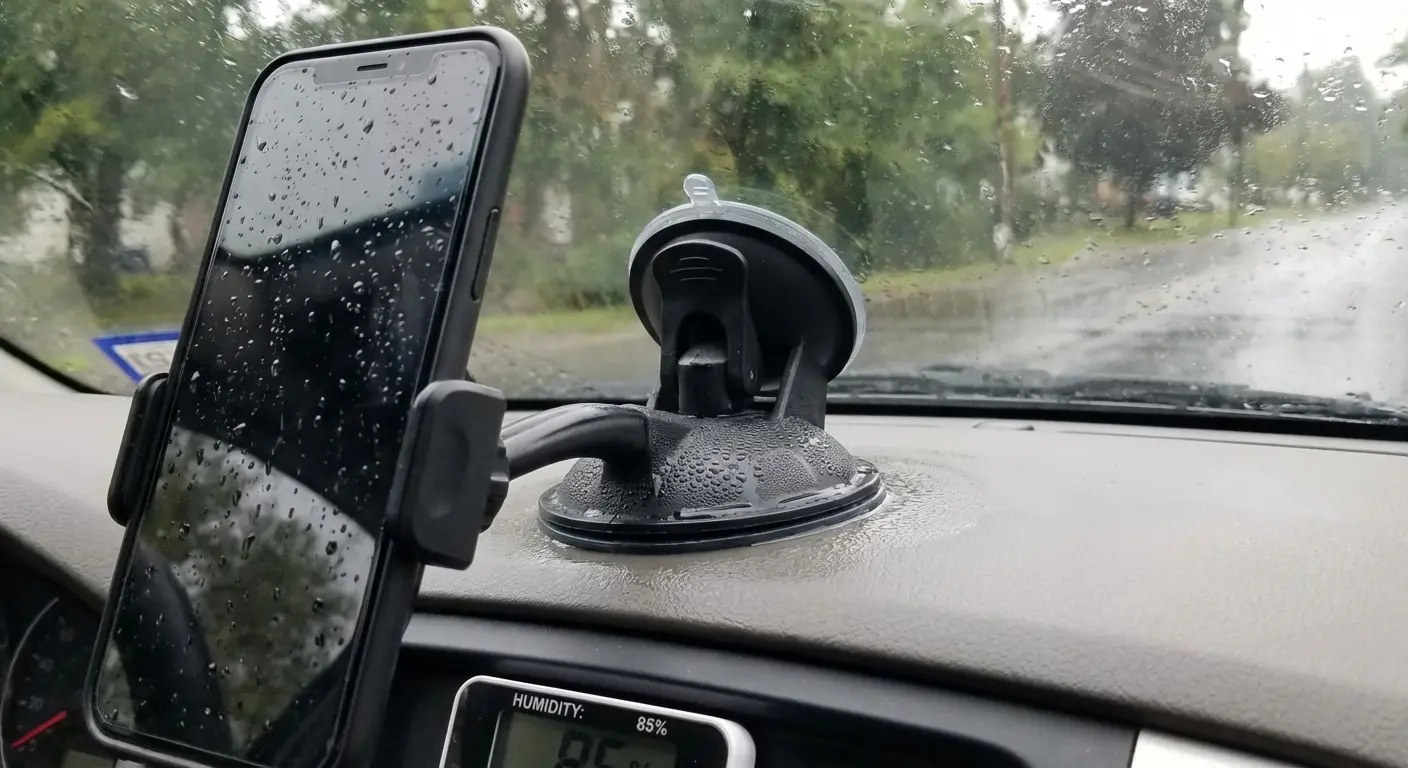
Temperature changes create condensation, and condensation is catastrophic for suction seals.
Walk out of your cold gym into your car that's been sitting in summer sun. You know how your glasses fog up instantly? Same thing's happening to your phone and that mount. You wipe it off with your shirt, seems dry, and stick it on anyway.
Spoiler: it's not actually dry, and this isn't going to end well.
That moisture layer, even if invisible, prevents the seal from forming. You're not creating a vacuum. You're creating a thin water layer with air bubbles trapped throughout. The grip might hold initially (surface tension can provide temporary adhesion), but it will fail as soon as any lateral force is applied.
Material Science: Why Your Phone Case Matters More Than You Think
Phone cases are engineered for drop protection, grip, and aesthetics.
None of these priorities align with creating a suction-compatible surface.
Many of the properties that make a case protective (shock absorption, texture, flexibility) directly undermine suction adhesion. The relationship between phone protection and mounting compatibility creates a significant market tension. According to industry research, the widespread adoption of smartphones has elevated ergonomic concerns, prompting the rise of phone grips as a solution for enhanced comfort and reduced strain during extended use.

