


Look, I've probably wasted $200 on screen protectors that cracked within two weeks. And every time, the guy at the store told me the same thing: "This is 9H tempered glass, military-grade protection." You know what actually mattered? Whether the damn thing fit with my case.
According to ZAGG's research, tempered glass protectors can be up to 10x stronger than average glass screen protectors. Great. But I've watched people go through three "premium" protectors in a month because of edge lifting and case incompatibility. Meanwhile, their coworker's budget film protector survived six months of the same abuse.
Edge coverage, adhesive quality, and case compatibility matter more than whether you've chosen the "premium" option or not. Material is like fourth on the list. Maybe fifth.
Table of Contents
Why Screen Protector Shopping Sucks
What "Protection" Actually Means
Tempered Glass: Everyone's Default Choice
PET Film: Better Than You Remember
TPU: The Flexible Option
Hybrid and Nano-Liquid: Mostly Marketing
Edge Coverage: The Spec That Actually Matters
Installation: Where Everything Goes Wrong
When Rokform's Approach Makes Sense
Why Screen Protector Shopping Sucks
We've been trained to walk into a store or browse online and immediately filter by material type. Glass or film? Premium or budget? 9H hardness or military-grade protection?
Want to know what's actually going on? That warehouse worker who bought a premium tempered glass protector rated at 9H hardness watched it crack within two weeks. Not from a dramatic drop. Just constant pressure from his phone case pushing against the protector's edges. Meanwhile, his coworker's budget PET film protector, installed with full adhesive coverage and paired with a case-friendly design, survived six months of the same environment.
The difference wasn't material quality. It was edge coverage and case compatibility.
I've seen this pattern repeat constantly. The construction worker whose "premium" protector lifted at the corners after a week. The office professional whose expensive glass protector shattered from a two-foot drop onto carpet. The parent whose cheap film protector outlasted three glass replacements because it flexed with impacts instead of absorbing them rigidly.
The frustration is real, and it's expensive. You're spending $30-50 on protectors that fail within weeks, not because the material is inferior, but because the aspects that determine real-world durability get buried three paragraphs deep in product descriptions. How the protector handles your phone's curved edges, whether it plays nicely with your case's raised lip, how well the adhesive bonds across the entire surface.
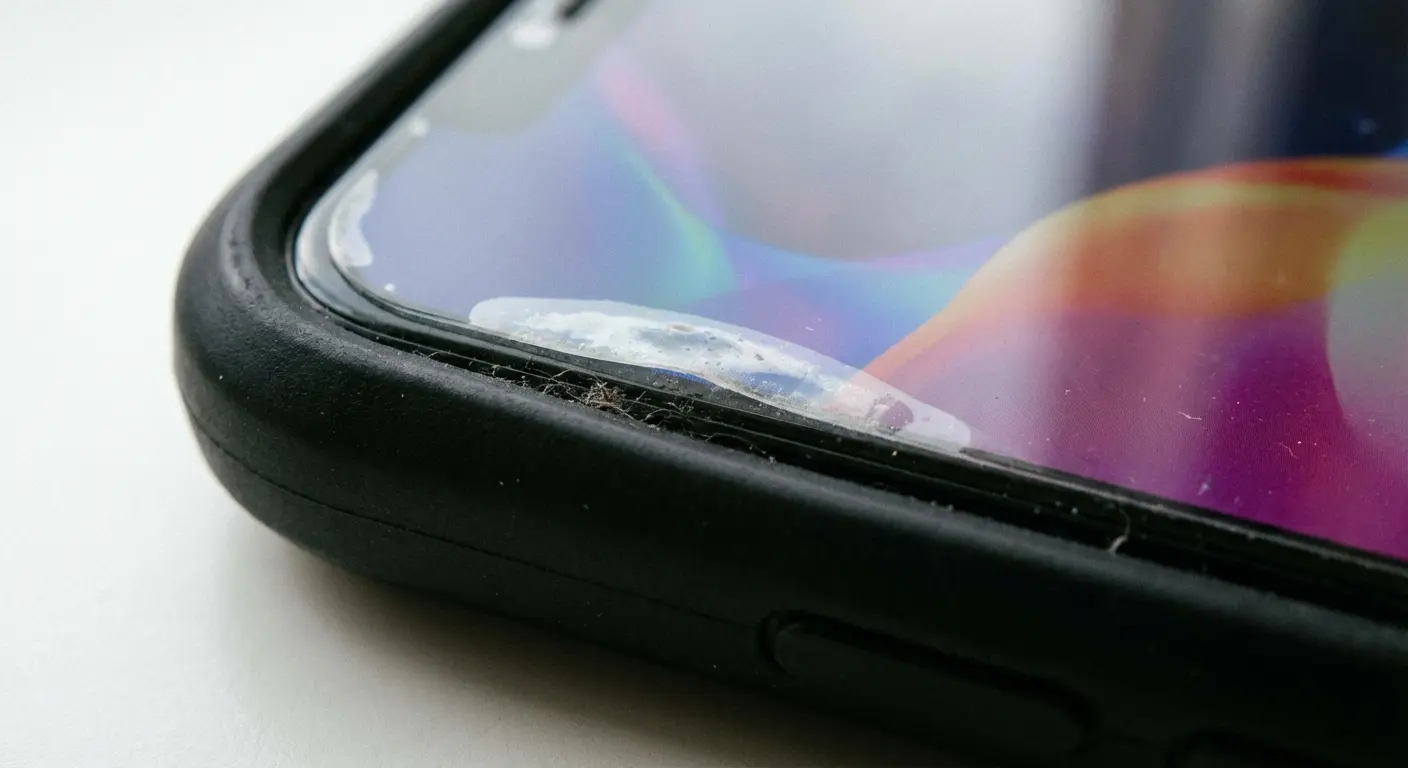
Start with your case. Then consider your edge coverage needs. Then think about installation method. Material type is where you end up, not where you begin.
What "Protection" Actually Means
When we talk about protecting your screen, we're addressing three completely different types of damage. No single protector excels at all three.
Impact protection is what happens when your phone falls from standing height onto concrete. The screen experiences sudden, concentrated force, usually at a corner or edge. This is where cracks originate. Not from the center of your screen, but from those vulnerable curved areas where force concentrates. A protector designed for impact needs to distribute that force across a wider area or absorb it through flexibility.
Scratch resistance is the daily wear from keys in your pocket, setting your phone face-down on rough surfaces, or that one time you dropped it on a sandy beach and then slid it into your bag. Modern phone screens have become remarkably durable on their own. According to Apple and glass manufacturer Corning, who partnered to manufacture all iPhone and Apple Watch cover glass in the US, the latest iPhone 16 and 16 Plus feature Ceramic Shield with "an advanced formulation that is 50 percent tougher than the first generation and 2x tougher than glass on any other smartphone."
Your baseline protection is already substantial before adding any aftermarket protector. Scratch protection now is about preventing those micro-abrasions that accumulate over months, not defending against catastrophic gouges.
Edge protection is the most overlooked category, yet it's where most screen damage originates. Those curved edges on modern phones look beautiful, but they're structural weak points. When your phone lands corner-first, which happens in roughly 70% of drops, the impact force concentrates at the edge. A protector that doesn't cover these edges, or that lifts away from them due to poor adhesive or case interference, leaves your most vulnerable area exposed.
Nobody clarifies which type of protection their product prioritizes. They'll tout 9H hardness (scratch resistance) while showing drop-test videos (impact protection) and displaying edge-to-edge coverage photos (edge protection). You're left assuming one product delivers all three equally, which is physically impossible given the trade-offs involved.
Do you drop your phone frequently, or do you scratch it gradually? That question should determine your entire approach. The office worker who sets their phone on desks all day faces a completely different threat than the parent who juggles their device while wrangling kids. One needs scratch resistance; the other needs impact absorption.
Tempered Glass: Everyone's Default Choice
There's something psychologically satisfying about tempered glass. When you run your finger across it, the sensation is indistinguishable from your bare screen. Smooth, responsive, premium. The visual clarity is excellent. Colors pop. Text is sharp. You paid $1,000+ for a phone with a beautiful display, and glass doesn't compromise that investment.
Then there's the dramatic crack absorption effect. We've all seen it: a protector shatters into a spiderweb pattern while the screen underneath remains pristine. That visible sacrifice feels like proof of protection, validation that your $30 purchase saved you a $300 screen replacement.
OtterBox tempered glass screen protectors typically start at $29.95, positioning them as the premium choice compared to plastic alternatives that sell for under $10. This price point reinforces the perception that glass equals superior protection, regardless of whether that protection aligns with your actual usage pattern.
Glass is the default, the standard, the option that requires no justification. Choosing anything else feels like settling.
The Compatibility Problem
Tempered glass protectors frequently don't play well with protective cases. The physics are straightforward: glass can't bend around curved edges without compromising its structural integrity. When your phone has even slight edge curves, a rigid protector must make a choice. Stop short of the edge, or attempt full coverage and risk lifting.
Most manufacturers choose the former, leaving a 1-2mm gap around your screen's perimeter. That gap is exactly where cracks start during corner impacts. When choosing between different phone case materials, compatibility with your screen protector becomes critical. A case with a pronounced lip that extends over your screen edges will push against that protector perimeter, creating the infamous "halo effect." A visible air gap that collects dust and eventually causes the protector to lift entirely.
I've watched this scenario play out repeatedly. You buy a premium tempered glass protector. You install it perfectly. Then you snap on your case, and within days, you notice the edges lifting. You press them down. They lift again. Dust creeps underneath. Within two weeks, you're peeling off a $40 protector and starting over.
The installation challenge has become so significant that retailers now offer professional services. According to ZDNET's testing of iPhone 15 screen protectors, carriers like AT&T now offer lifetime warranties on their protectors and provide in-store installation services, which is particularly helpful for users who don't trust themselves to achieve a seamless application, especially with rigid glass protectors that offer no margin for error once the adhesive makes contact.
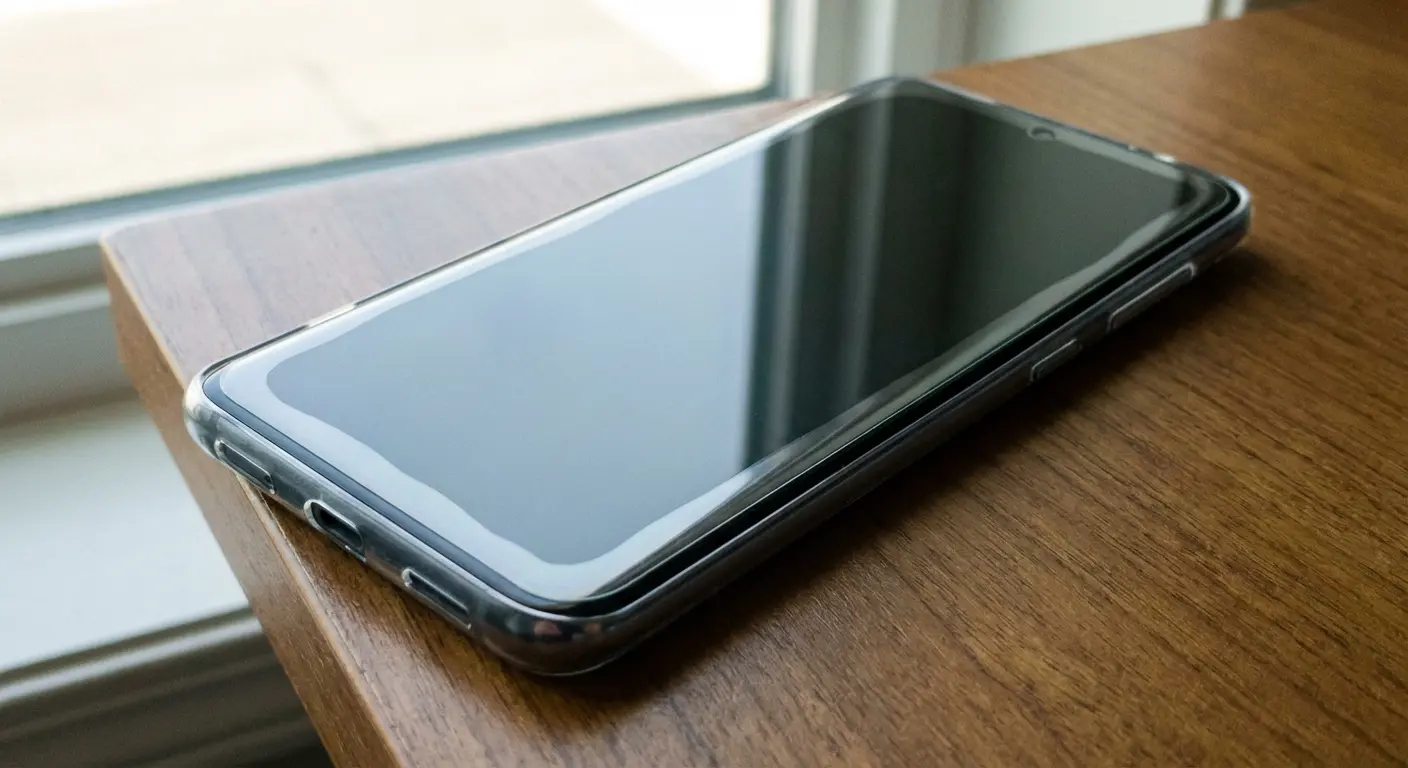
Curved screens amplify these problems exponentially. Phones with aggressive edge curves, Samsung's Edge displays, newer iPhones with their curved transitions, are notoriously difficult to protect with tempered glass. Manufacturers attempt solutions: dot-matrix adhesive that only bonds at the edges, UV-cured liquid adhesive that requires special installation equipment, reduced coverage that leaves edges exposed. Each solution creates new problems.
When Glass Makes Sense
For all these complications, tempered glass remains the right choice for specific scenarios. If you have a flat-screen phone, the compatibility issues largely disappear. If you prioritize scratch resistance over drop protection, maybe you're careful with your phone but work in an environment with abrasive dust or frequently set it on rough surfaces, glass's 9H hardness rating directly addresses your primary threat.
The office worker who keeps their phone on a desk most of the day, occasionally sliding it across surfaces or setting it face-down during meetings, benefits enormously from tempered glass. Their primary threat isn't catastrophic drops. It's the accumulated micro-scratches from daily desk contact and the occasional keys-in-pocket scenario during lunch breaks. For this user, glass's hardness rating directly addresses their actual risk pattern, and the premium feel justifies the cost since they interact with their screen constantly for work.
Users who prefer slim cases or no case at all also benefit from glass. Without a case lip to interfere with edges, installation becomes straightforward, and the protector can sit flush across the entire screen surface.
PET Film: Better Than You Remember
Film's Bad Reputation
PET film protectors dominated the market before tempered glass became affordable. Back then, they were the only option, which meant every cheap, poorly-made protector was film. The association stuck: film equals budget, equals inferior, equals compromise.
The criticisms have merit. Film scratches more easily than glass. That's basic material science. The plastic feel is noticeable when you're used to glass. Cheap versions develop an orange-peel texture that distorts your display. The oleophobic coating wears off faster, leaving you with a fingerprint magnet within months.
But here's the thing. Do these drawbacks matter as much as the industry suggests? If you're replacing your phone every two years, does the protector need to last five? If you use a case that already changes the tactile experience, does the difference between glass and film feel significant? If your primary concern is edge protection rather than scratch resistance, why are you optimizing for hardness?
The Edge Coverage Advantage
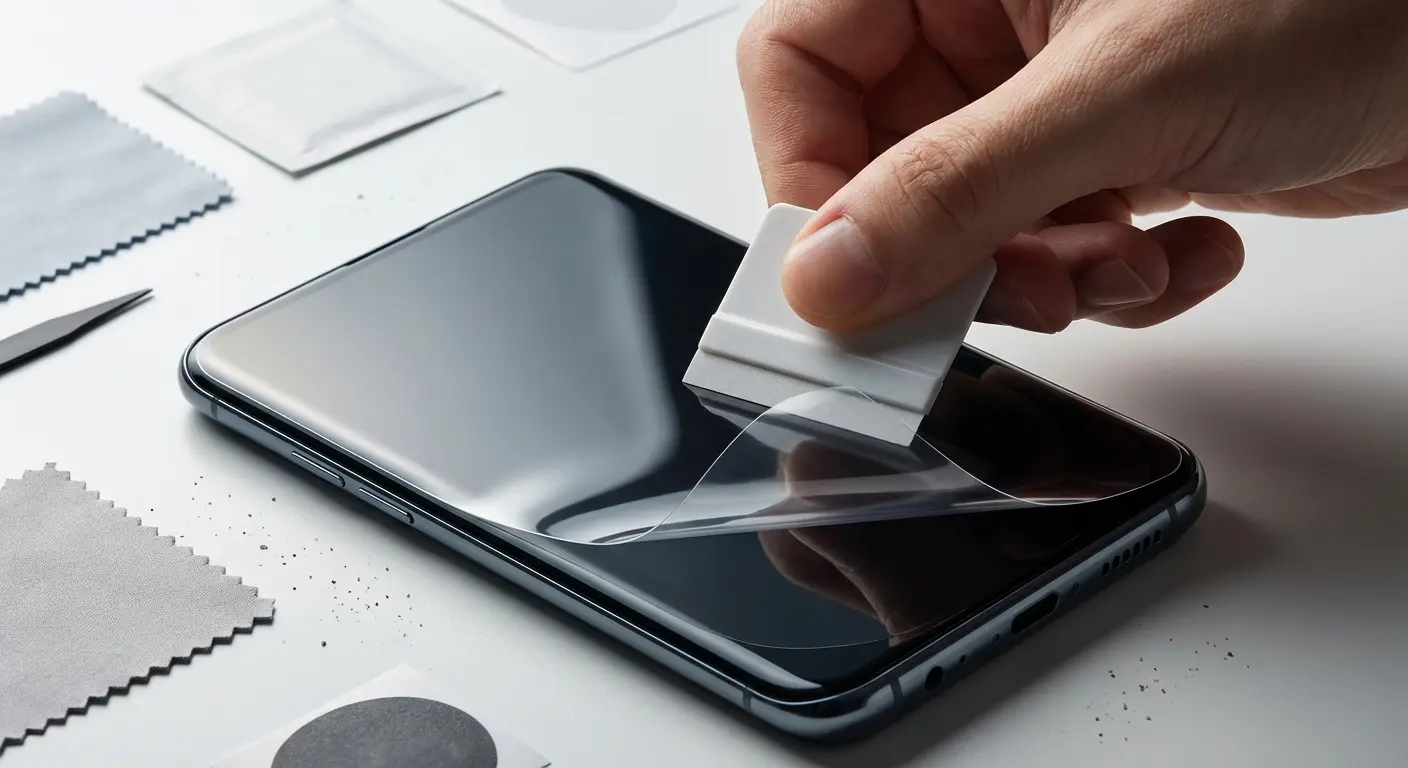
Film's biggest practical benefit is true edge-to-edge coverage without lifting or halo effects. Because the material is flexible, it can wrap slightly around curved edges and sit flush under even the most aggressive case lips. This isn't a minor detail. It's fundamental to protection.
Most screen cracks start at edges, not centers. When your phone lands corner-first, the impact force concentrates at that edge point. A protector that stops 2mm short of the edge, or that has lifted away from the edge due to case pressure, leaves your most vulnerable area exposed. Film's flexibility allows it to maintain contact with edges even under case pressure, even on curved screens.
The material also absorbs impact differently than rigid glass. Instead of distributing force across a rigid plane (which works well for center impacts), film flexes with the impact, dissipating energy through deformation. For corner drops, the most common scenario, this flexibility can be more effective than rigidity.
Film makes sense if you've already cracked a couple glass protectors, if your phone has curved edges, or if your case has a thick lip that keeps pushing glass protectors off. If you've been fighting with glass, try film.
Modern Film Has Improved
If you haven't considered a film protector in several years, the technology has improved substantially. Better scratch-resistance coatings extend lifespan. Multi-layer construction improves clarity to near-glass levels. Oleophobic treatments now last months rather than weeks.
I'm not claiming film matches glass for scratch resistance or premium feel. But the gap has narrowed considerably, and for users whose primary concern is edge protection and case compatibility, film's advantages outweigh its compromises.
TPU: The Flexible Option
The Self-Healing Thing
TPU's signature selling point is the ability to "heal" minor scratches through heat or time. The chemistry is straightforward: thermoplastic polymer chains can realign when heated, causing surface scratches to disappear. Run your fingernail across a TPU protector, creating a visible scratch. Wait a few hours, or apply gentle heat, and watch it fade.
This works, but within specific parameters. Light surface scratches, the kind you get from sliding your phone across a table or brief contact with keys, will disappear. Deep gouges, punctures, or scratches that penetrate through the top layer won't heal. The feature is real, but it's not magic.
According to OtterBox's analysis, TPU screen protectors' elasticity makes them self-healing, with minor scratches fading quickly, and the material doesn't break even when exposed to several serious falls. However, the material can peel or bubble with wear and tear, meaning the self-healing benefit applies primarily to surface-level damage rather than structural compromise.
Does this matter for your usage? If you're constantly getting light scratches from daily carry, TPU's self-healing properties genuinely extend the protector's useful life. If you're worried about one big impact or deep scratches, it's less relevant.
Why TPU Looks Cloudy
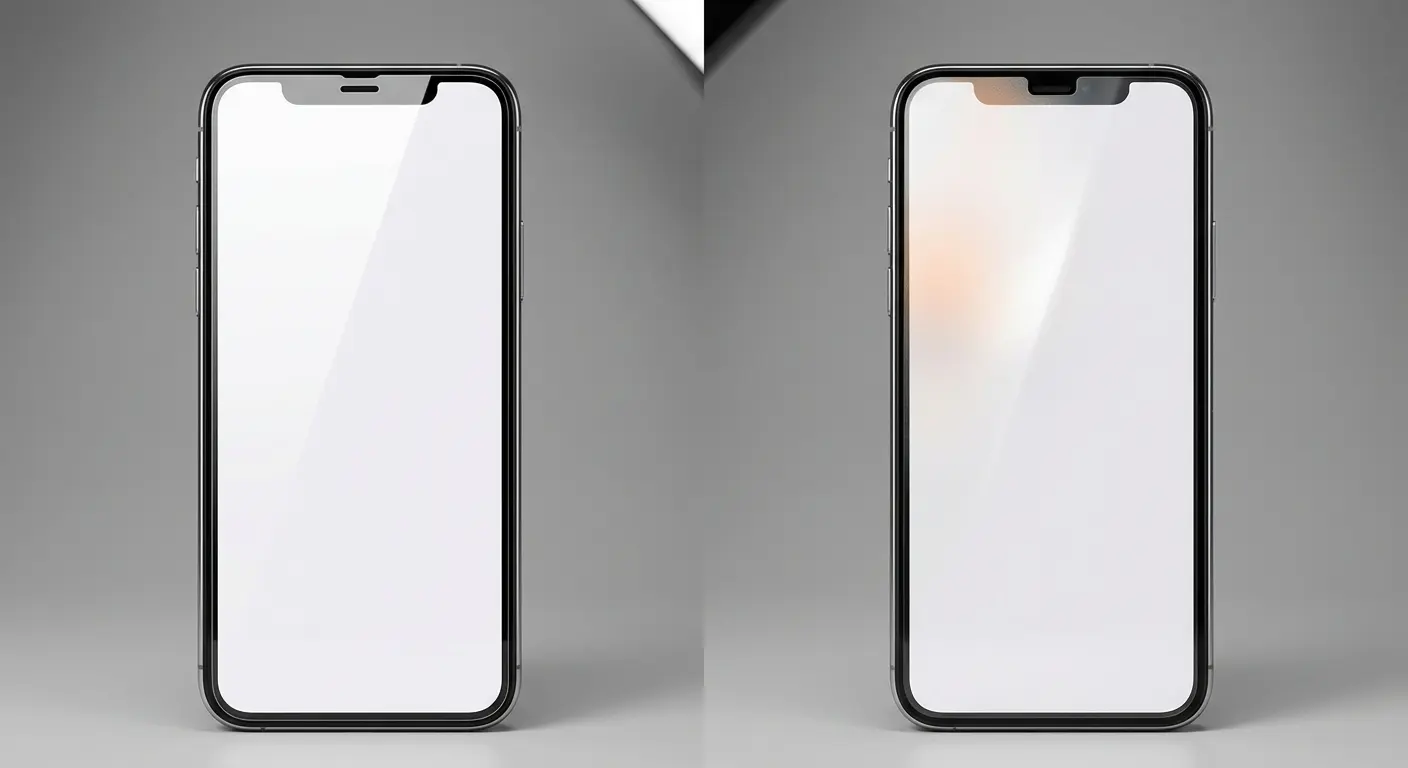
TPU is inherently less clear than glass or quality PET film. There's a slightly rubbery appearance that some users find distracting, particularly when viewing the screen at angles or in bright light. The material has a different refractive index than glass, which means light passes through it differently, creating a subtle haziness.
For users who obsess over display quality, photographers editing images, designers reviewing color-critical work, anyone who paid extra for an OLED display and wants to experience it fully, this compromise is difficult to accept. The self-healing properties and flexibility don't compensate for reduced visual fidelity.
But context matters. If you use your phone primarily outdoors in bright conditions, the slight haziness becomes unnoticeable. If you're scrolling social media, reading emails, or navigating maps, the clarity difference is negligible.
What are you optimizing for? Perfect clarity or practical durability?
Installation Challenges
TPU protectors are notoriously difficult to install without bubbles or dust particles. The material's flexibility, its primary advantage for edge coverage, becomes a liability during application. The protector wants to stick to itself, to your fingers, to anything except your screen in perfect alignment.
The adhesive often feels tacky or overly grippy, which sounds like a benefit until you're trying to reposition the protector and it's already bonded in the wrong spot. Unlike glass, which you can sometimes lift and reapply, TPU's adhesive is less forgiving.
Improved installation tools have helped. Some manufacturers include spray solutions that temporarily reduce adhesive tack, allowing you to position the protector before squeezing out the liquid. Others provide rigid alignment frames similar to glass protector kits. These tools work, but they add complexity to what should be a straightforward process.
Hybrid and Nano-Liquid: Mostly Marketing
What "Hybrid" Actually Means
The term "hybrid" gets thrown around liberally in screen protector marketing, often without clear definition. In most cases, it refers to protectors that combine a rigid backing layer with a flexible top layer, or incorporate impact-absorbing polymers between glass layers.
The intended benefit is combining glass's clarity and feel with film's flexibility and edge coverage. A rigid base provides the smooth touch experience users expect, while a flexible top layer allows the protector to absorb impacts without shattering. Some designs use a glass front with TPU edges, attempting to solve the edge-lifting problem while maintaining center clarity.
Execution varies wildly between manufacturers. Some hybrids are genuinely engineered solutions with distinct material layers serving specific functions. Others are marketing exercises. A slightly thicker film protector rebranded as "hybrid" to justify premium pricing.
Hybrid protectors are difficult to evaluate objectively. Tempered glass has standardized hardness ratings, even if those ratings are somewhat misleading. Basic film has thickness measurements and material specifications. Hybrid protectors make protection claims that lack industry-standard testing.
A manufacturer might claim their hybrid design offers "3x better impact protection" than standard glass. Better than which glass? Tested how? Under what conditions? Without independent verification, you're trusting manufacturer claims, which have obvious bias.
Some manufacturers are starting to address this verification gap. ZDNET's recent testing of the Torras Diamond Shield revealed it certifiably meets the Department of Defense's MIL-STD-810G spec for durability, using a shatterproof composite layer to deliver protection for up to an eight-foot drop. One customer even reported sitting on a pair of pliers with their phone in their pocket, with the Torras protector blocking any screen damage. When hybrid claims are backed by military-grade standards, the performance can exceed traditional materials.
This is the exception, not the rule. Most hybrid protectors offer compelling marketing language without the testing credentials to back it up.
Nano Liquid Coatings Are Garbage
Nano-liquid coatings use silicon dioxide particles that bond to your screen at a molecular level, theoretically adding a thin layer of scratch resistance. The application process is appealingly simple: wipe the liquid across your screen, buff it off, wait for it to cure. No alignment issues, no bubbles, no case compatibility problems.
The appeal is invisible protection that doesn't interfere with cases, screen sensitivity, or visual clarity. You maintain the bare-screen experience while supposedly adding a protective layer measured in nanometers.
But liquid protectors offer minimal impact protection. A coating measured in nanometers isn't absorbing the force of a four-foot drop onto concrete. The scratch resistance is marginal at best, adding hardness that might prevent the lightest surface abrasions but won't stop anything a modern phone screen wouldn't already resist on its own.
Durability is impossible to verify visually. You can't tell when the coating has worn off. Manufacturers claim 6-12 month effectiveness, but you're taking that on faith. There's no visible indicator, no way to test whether the coating is still present or has degraded to uselessness.
Most liquid protectors void your ability to make warranty claims if your screen does crack. The manufacturer argues you added an aftermarket coating that may have interfered with the screen's original properties. Your phone manufacturer argues the liquid protector should have prevented the damage. You're caught in the middle with a cracked screen and no recourse.
They might make sense as a supplement to other protection. Applied to a phone with a protective case and raised bezel, adding a marginal layer of scratch resistance to an already-protected device. As a replacement for physical protectors? The risk outweighs the convenience.
Edge Coverage: The Spec That Actually Matters
Full-Adhesive vs. Edge-Adhesive
Screen protectors use two primary adhesive methods, and this choice affects everything from clarity to longevity to case compatibility.
Full-adhesive protectors bond across the entire surface. The adhesive layer covers every millimeter of your screen, creating complete contact between protector and display. This provides better clarity (no air gaps to refract light), improved touch sensitivity (no dead zones where the protector isn't making contact), and more uniform protection.
The downside is installation difficulty. Any dust particle, any misalignment, any bubble becomes immediately visible and difficult to correct. You get one shot at perfect placement, and if you miss, you're peeling off the protector and starting over.
Edge-adhesive (or dot-matrix adhesive) protectors only stick around the perimeter or in a pattern of dots across the surface. This makes installation more forgiving. You can reposition the protector before pressing down the edges to activate the adhesive. Bubbles in the center often work themselves out over time since there's no adhesive holding them in place.
The trade-off is a visible pattern or slight air gap in areas without adhesive. In certain lighting, you can see the dot matrix pattern. Touch sensitivity can feel slightly different in adhesive versus non-adhesive areas. Over time, dust can migrate into the gaps, creating visible lines or spots.
2.5D and 3D Coverage
2.5D refers to protectors with curved edges that sit flush with your screen's edges but don't wrap around. The protector follows the slight curve at your screen's perimeter, preventing the sharp edge you'd get with a completely flat protector. This improves the feel when you swipe from screen edges and reduces the chance of the protector catching on case lips.
3D (or full-coverage) protectors attempt to cover curved screen edges entirely, wrapping around the sides of your display. This is extremely difficult to achieve with rigid materials, which is why true 3D coverage usually requires flexible materials like TPU or specialized hybrid constructions.
Many "full coverage" protectors still leave a small gap at edges. The marketing shows edge-to-edge coverage, but the fine print reveals a 0.5-1mm gap to "prevent edge lifting and ensure case compatibility." This gap is exactly where cracks start during corner impacts.
The Case Compatibility Problem
Case manufacturers can't account for every protector variation. Protector manufacturers can't test with every case. You're left navigating compatibility on your own, and the consequences of getting it wrong are expensive.
Understanding the most protective phone cases helps you choose a screen protector that won't compromise your overall device protection strategy. If you've already invested in a case you love, choose your protector to match it, often meaning thinner or more flexible options. If you're starting fresh, consider integrated solutions.
Before purchasing a screen protector, think about your case. If your case has a lip height over 1mm, consider full-adhesive tempered glass or any film/TPU. If the lip curves inward, avoid thick glass and choose film or thin glass with reduced edges. If your case is tight-fitting, make sure the protector is at least 1mm smaller on all sides. If your case has textured interior edges, full-adhesive protectors prevent dust accumulation better than edge-adhesive.
Red flags: "Full coverage" glass protector plus a case with aggressive lip equals likely edge lifting. Edge-adhesive protector plus tight case equals dust lines forming under protector edges. Thick protector over 0.4mm plus a case designed for bare phone equals poor fit.
Installation: Where Everything Goes Wrong
Alignment Tools Matter
The best screen protector is worthless if you can't install it properly. We've all been there. Carefully cleaning the screen, peeling back the adhesive backing, watching in horror as the protector lands 2mm off-center with no way to correct it without introducing bubbles or dust.
Premium protectors increasingly include alignment tools: plastic frames that snap onto your phone, creating guides that ensure perfect placement. You drop the protector into the frame, and it lands exactly where it needs to be. These tools are worth paying extra for, particularly with rigid glass protectors that offer no forgiveness once the adhesive makes contact.
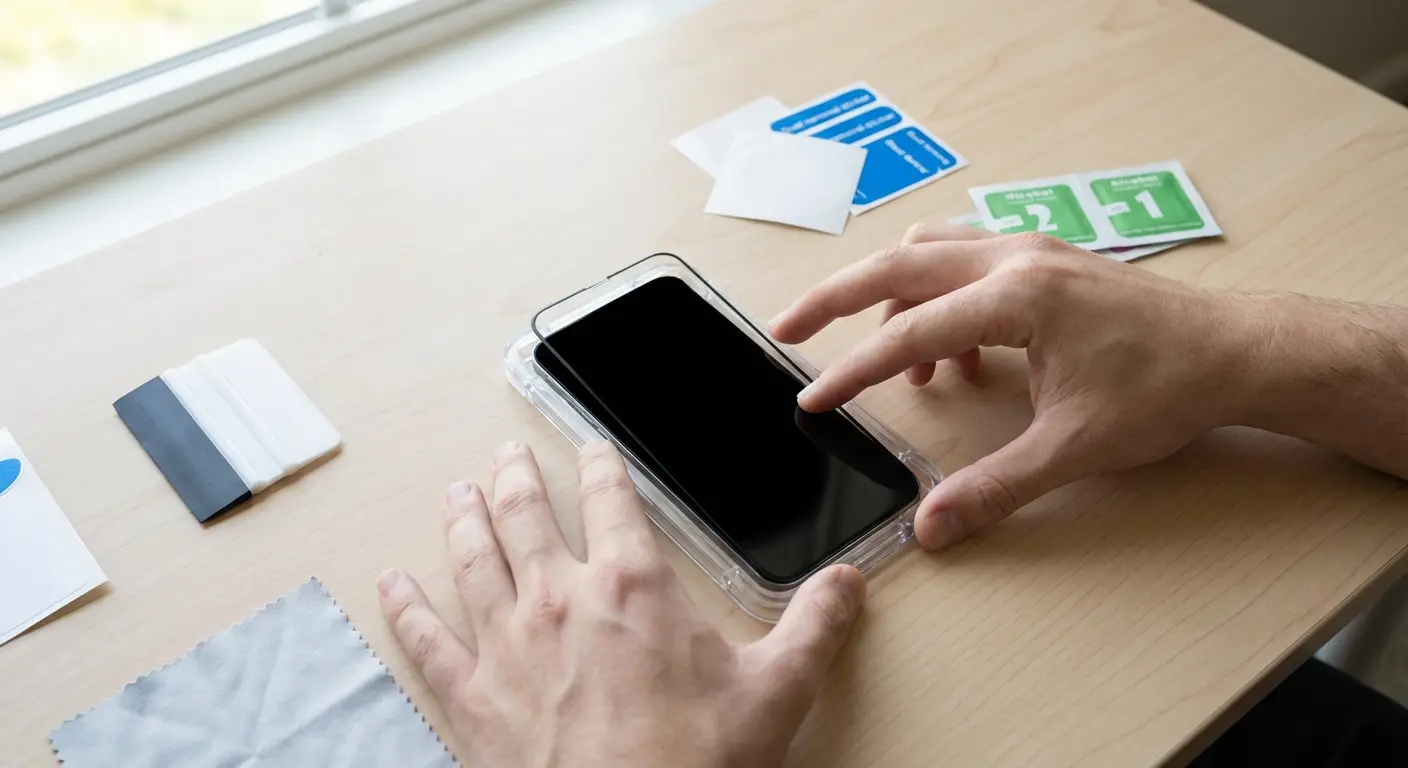
Some manufacturers include installation kits with cleaning wipes, dust removal stickers, and squeegees. These aren't gimmicks. They're essential tools that dramatically improve installation success rates. The anxiety of installation is real, and anything that reduces that stress is valuable.
Adhesive Types
Different adhesive formulations affect both installation ease and long-term performance in ways that aren't obvious until you've used multiple protectors.
Silicone adhesives are reusable and more forgiving. If you get bubbles or misalignment, you can often peel up the protector and reapply it without losing adhesive strength. The bond feels slightly squishy, which some users notice when pressing firmly on their screen, but the flexibility allows the protector to conform to minor screen imperfections.
Acrylic adhesives create a permanent bond that feels thinner and more responsive. Once applied, the protector becomes nearly indistinguishable from the screen itself in terms of touch sensitivity. The downside is zero forgiveness during installation. Once it touches your screen, you're committed.
Bubbles fall into two categories: air bubbles (which work themselves out within 24-48 hours) and dust bubbles (which are permanent). Air bubbles appear as large, irregular shapes that move when you press on them. Dust bubbles are small, circular, and fixed in place. If you have more than 2-3 dust bubbles after installation, you've probably failed, and the protector will collect more dust over time as the adhesive weakens around those spots.
Professional Installation
Some phone retailers and kiosks offer professional protector installation, sometimes with warranties that cover replacement if the protector cracks. The service costs $10-20 on top of the protector price, which feels excessive for what should be a simple task.
But consider the math: if you've ruined two $30 protectors trying to install them yourself, that $15 installation fee suddenly looks reasonable. For expensive phones, curved screens, or users who've failed multiple DIY attempts, professional installation eliminates the risk entirely.
The warranty component matters more than the installation itself. Some retailers offer lifetime replacement. If your professionally-installed protector cracks, they'll replace it for free. Over a two-year phone ownership period, this can mean 3-4 free replacements, which justifies the upfront cost.
When Rokform's Approach Makes Sense
We've spent thousands of words discussing the compatibility nightmare between cases and protectors. Edge lifting. Halo effects. Cases that push against protector edges. Protectors that prevent cases from fitting properly. The entire ecosystem feels designed to frustrate you into buying multiple products until you stumble onto a combination that works.
As the #1 universal phone case and universal phone mount brand, Rokform designs cases with built-in screen protection considerations. Raised bezels that protect screens without requiring separately purchased protectors for many users. Precise tolerances that account for protector thickness. Case lips engineered to work with, rather than against, screen protection.
For readers frustrated by the protector-case compatibility issues we've discussed, there's an alternative: choosing a case system that builds screen protection into its design rather than treating it as an aftermarket add-on. When the case manufacturer controls both elements, the compatibility problems disappear.
Rokform's tempered glass screen protectors are designed specifically for case compatibility, engineered to work seamlessly with Rokform cases rather than forcing you to choose between full coverage and your preferred case. The integrated approach solves the fundamental problem we've been discussing: protection shouldn't require compromise.
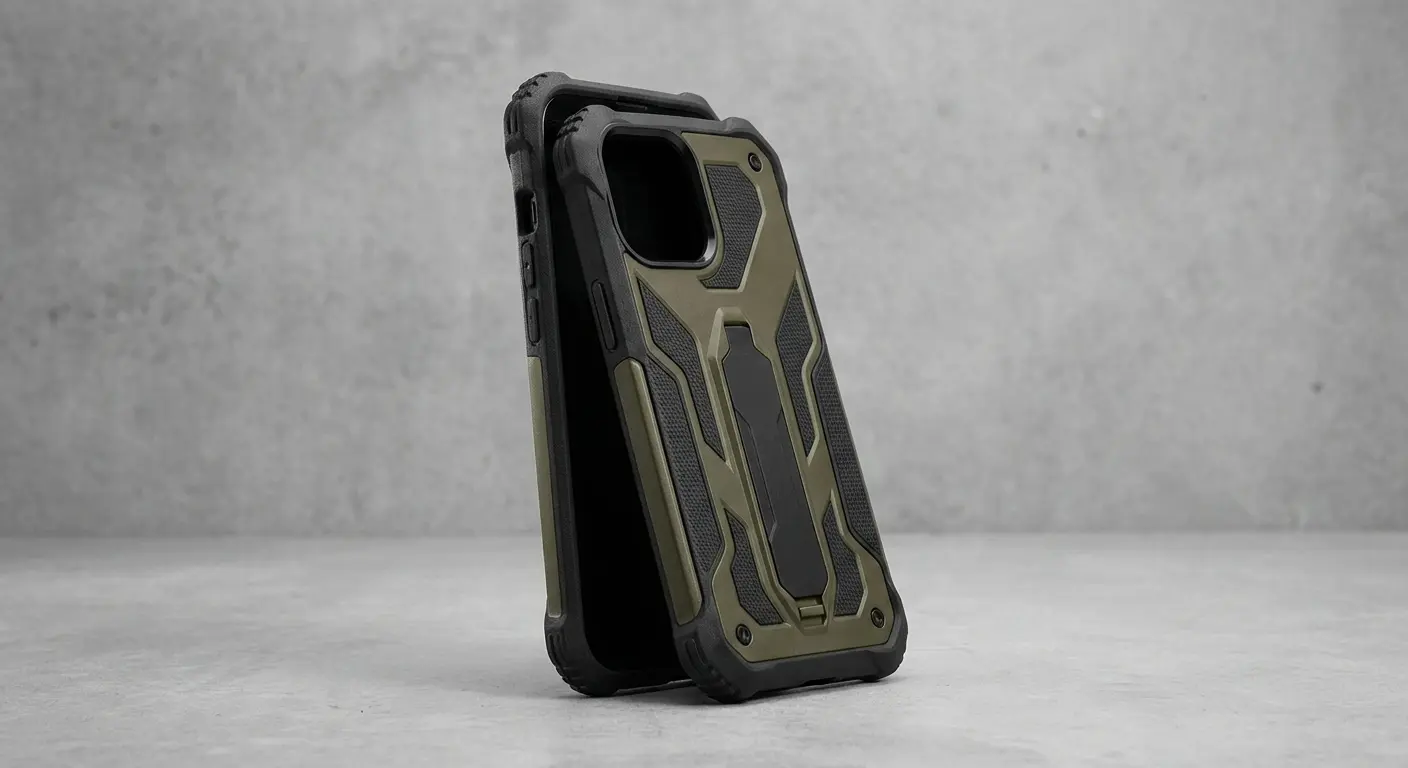
This isn't about abandoning standalone protectors entirely. But if you're on your third attempt at finding a protector that doesn't lift with your case, or you're tired of choosing between edge coverage and case fit, integrated solutions deserve consideration.
What Your Phone Actually Needs
Your Real Risk Factors
Let's have an honest conversation about your actual usage patterns, not the idealized version you imagine when shopping for protection.
How often do you actually drop your phone? Not how often you worry about it. How often does it actually hit the ground? If you've dropped your phone twice in three years, optimizing for impact protection might be solving the wrong problem. If you drop it weekly, impact resistance becomes your primary concern.
Do you keep it in a pocket with keys or coins? The constant friction from metal objects creates micro-scratches that accumulate over months. If your phone lives in a dedicated pocket or bag compartment, scratch resistance becomes less critical.
Do you use it outdoors in bright sun regularly? Construction workers, delivery drivers, and outdoor enthusiasts have different needs than office workers.
Do you work in environments with dust or debris? Warehouse workers, mechanics, and tradespeople face threats that office workers never encounter. A protector that can handle abrasive particles becomes essential.
Think about your actual risk profile. If your drop risk is high (you drop your phone from standing height frequently, you use your phone while walking, you've cracked a screen before), prioritize tempered glass or hybrid with impact ratings. If your scratch risk is high (you carry your phone with keys, you set it face-down on surfaces, you work in dusty environments), prioritize 9H hardness glass or TPU with self-healing. If you need privacy in public spaces or experience glare issues, prioritize specialty protectors and accept the visual trade-offs.
When You Don't Need a Protector
For readers with newer phones featuring advanced screen technology (Ceramic Shield, Gorilla Glass Victus 2), who use protective cases with raised bezels, and who aren't particularly rough on devices, you might not need a screen protector.
Before deciding on a protector, learn how phone cases protect your phone to understand if a raised bezel case provides sufficient screen protection. Modern phone screens are remarkably durable for scratch resistance. A quality case with a 1-2mm raised bezel prevents your screen from contacting surfaces when placed face-down, eliminating the primary source of scratches.
Some protectors introduce more problems than they solve. Reduced clarity affects your daily viewing experience. Touch sensitivity issues create frustration during typing or gaming. Installation anxiety and the cost of replacements add stress and expense. If your actual risk factors don't justify these compromises, going without a protector becomes a valid choice.
This isn't advocating for or against protectors universally. It's encouraging you to make informed decisions rather than automatic purchases based on what everyone else does.
The Replacement Reality
Even the best screen protector degrades over time. Oleophobic coatings wear off, making fingerprints more visible and cleaning more difficult. Micro-scratches accumulate, reducing clarity. Adhesive weakens around edges, allowing dust to creep underneath. The protector that looked perfect at installation develops a worn, grimy appearance after 6-12 months of heavy use.
This degradation is normal, not a sign of product failure. Setting expectations about replacement frequency helps you budget appropriately and choose between premium protectors with longer lifespans or budget options you'll replace more frequently.
Heavy users, people who interact with their screens constantly for work, gaming, or content consumption, should expect to replace protectors every 6-9 months. Moderate users might stretch that to 12-18 months. Light users could potentially use a single protector for the life of their phone, though the oleophobic coating will degrade regardless of usage.
Does it make sense to buy a $50 protector that lasts 18 months, or three $15 protectors that you replace every 6 months? The math works out similarly, but the experience differs. Premium protectors offer better clarity, easier installation, and superior feel throughout their lifespan. Budget protectors get the job done but show their age more quickly.
Factor replacement cost into your decision. A $30 protector that needs replacing twice a year costs $60 annually. A $15 protector replaced three times costs $45. The cheaper option might actually be more expensive if the premium version lasts longer.
Bottom Line
Stop shopping by material type first. It's backwards.
Edge coverage, case compatibility, and installation quality matter more than whether you choose glass, film, or TPU. A perfectly-installed film protector with full edge coverage will outperform a premium glass protector that lifts at the corners within a week. A budget protector that works seamlessly with your case provides better protection than an expensive option that forces you to choose between coverage and fit.
Start with your primary risk factor. Are you protecting against impacts, scratches, or privacy concerns? Work backward from there to material choice. If you drop your phone frequently, impact resistance matters most. Consider tempered glass or hybrid options with verified drop ratings. If you scratch your screen gradually through daily carry, prioritize 9H hardness or self-healing TPU. If you need privacy or glare reduction, accept the visual trade-offs that come with specialty protectors.
Your case choice should inform your protector decision, not the other way around. If you've already invested in a case you love, measure its lip height and edge design, then choose a protector engineered to work with those specifications. If you're starting fresh, consider integrated solutions from manufacturers who design cases and protectors together.
Perfect protection doesn't exist. Every option involves trade-offs. Tempered glass offers premium feel and scratch resistance but struggles with curved edges and case compatibility. Film provides excellent edge coverage and flexibility but scratches more easily. TPU self-heals minor damage but compromises clarity. Hybrid protectors promise the best of all worlds but lack standardized testing to verify their claims.
The goal isn't finding the objectively "best screen protector." It's matching trade-offs to your specific needs. The warehouse worker who drops their phone daily needs different protection than the office worker who sets it on desks. The outdoor enthusiast who uses their phone in bright sunlight has different priorities than the healthcare professional who reviews sensitive information on public transit.
Edge coverage. Case compatibility. Installation method. Your actual risk factors rather than imagined worst-case scenarios. Material type is where you end up after considering these factors, not where you begin.
For comprehensive device protection, consider pairing your choice with Rokform's tempered glass screen protectors.

