


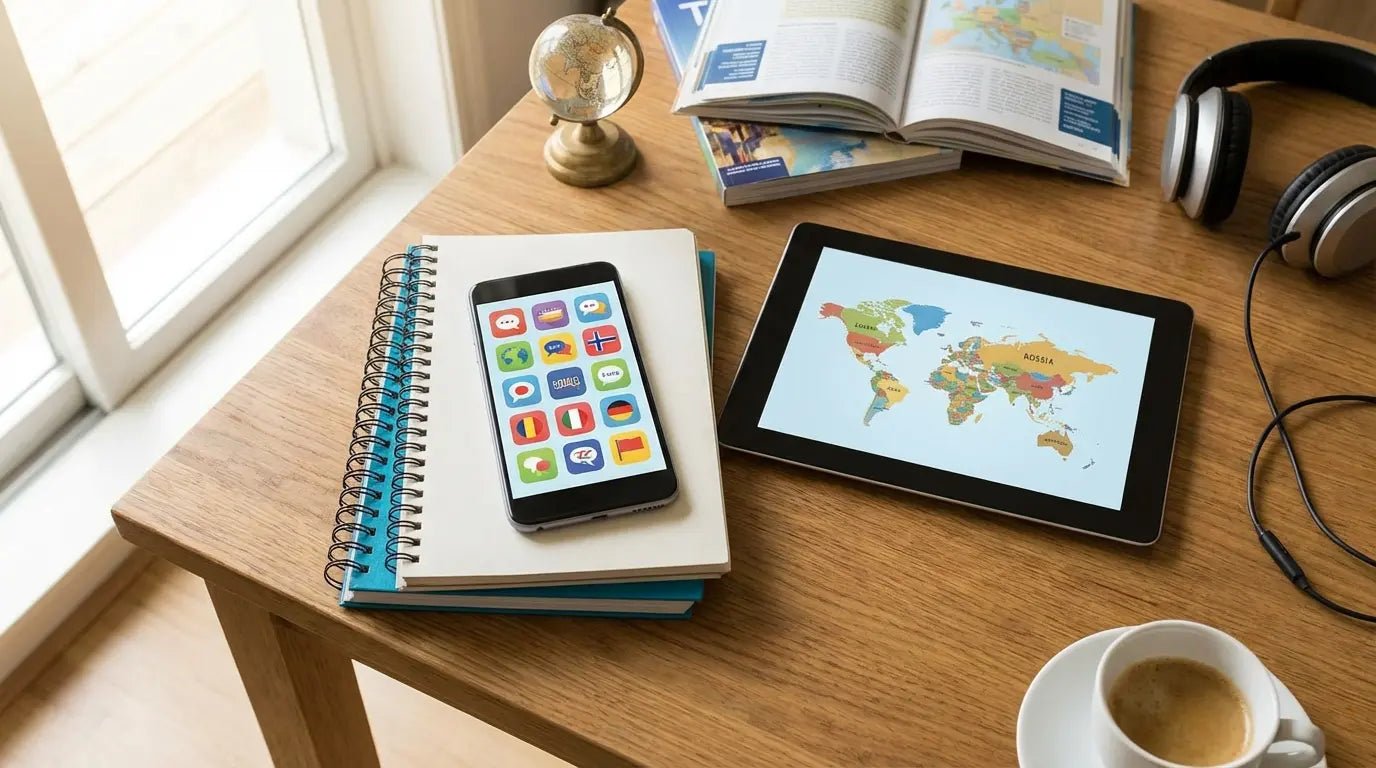
If you’ve been on a train, a bus, or in a waiting room lately, you’ve seen it. I saw it just last week: four people in the same train car, aggressively tapping their screens, trying to appease a demanding green owl. Statista says Duolingo was the most downloaded education app last year, and honestly, I believe it.
But here’s the thing: having a 300-day streak doesn't mean you can order a coffee in Paris without panic-sweating. Popularity isn't the same thing as proficiency.
You want to actually speak the language, not just play a matching game. So, I’ve tested the top contenders to find the tools that are actually worth your time (and money) in 2026.
Table of Contents
The "Too Long; Didn't Read" Summary
How I Rated These Apps
The All-Rounders (Structured Courses)
Speaking & Real Humans
Vocab & Flashcards (The Memory Hacks)
Asian Languages (Scripts & Tones)
Immersion (Reading & Watching)
AI & The Future
Don't Break Your Phone Abroad
Final Thoughts
TL;DR: The Quick Summary
If you want to skip the deep dive and just start downloading, here is the gist:
There is no "Magic Bullet": You usually need one app for grammar and a different one for speaking.
AI is the new normal: In 2026, if an app isn't using AI for voice practice, it's already outdated.
Asian languages are different: Don't use a general European app to learn Chinese; you need specific tools for the characters.
Gear matters: If you're learning on the go (especially on a bike or motorcycle), you need to protect your tech.
How I Rated These Apps
Before you clutter your home screen with a dozen new icons, realize that different apps do different jobs. I judged these based on four things that actually matter to a learner.
The Vibe |
What I Looked For |
Why You Should Care |
|---|---|---|
Methodology |
Game vs. Class |
Do you want to play a game (fun) or actually study (effective)? |
Depth |
Tourist vs. Local |
Will this app be useless once you learn how to say "Hello"? |
Tech |
Smart Features |
Does the voice recognition actually understand you? |
Price |
Free vs. Paid |
Is it worth the subscription? |
The All-Rounders (Structured Courses)
These are your "main course" apps. They try to cover a bit of everything: reading, writing, listening, and speaking.
1. Duolingo
The giant in the room. You know the owl. It uses short, gamified lessons to keep you hooked.
The Good: It is incredibly addictive. If you struggle to build a habit, the streak counter works.
The Bad: It can get weird. Translating "The bear eats my sandwich" isn't super helpful for booking a hotel.
Verdict: Great for getting your feet wet, but won't make you fluent on its own.
2. Babbel
Think of Babbel as the more mature, serious older sibling to Duolingo. It focuses on conversation skills you’ll actually use, like introducing yourself or ordering food.
The "Game vs. Tool" Choice:
If you have 15 minutes to kill and want to feel productive, pick Duolingo. If you are moving to Berlin in two months and need to open a bank account, pick Babbel. It cuts the fluff and teaches you the cultural context immediately.
3. Busuu
Busuu follows a proper academic structure (A1 to C2). The killer feature here is the community aspect: you record yourself speaking, and actual native speakers correct you.
Why it works: Getting feedback from a real human beats an algorithm any day.
Cost: Freemium, but you need Premium for the official certificates.
4. Rosetta Stone
The OG. They pioneered "Dynamic Immersion." They don't give you translations; they show you a picture of a guy eating an apple and say the phrase in the target language. You have to figure it out.
Vibe: Old school, but effective for building "gut instinct" without translating in your head.
Tech: Their speech engine is strict—it won't let you pass until you say it right.
5. Mango Languages
Check your local library website—you might get this one for free. Mango is fantastic for breaking down sentence structures with color-coding so you can see how the grammar blocks fit together.
Speaking & Real Humans
Let's be real: tapping a screen is not speaking. If you want to talk, you have to open your mouth. These are the best tools for that.
6. iTalki
This isn't a "game" app; it's a marketplace. You find a tutor (say, in Tokyo), book a 30-minute slot for $10-$15, and have a video call.
Why it wins: Nothing beats talking to a human. It's terrifying at first, but it works faster than anything else.
Cost: Pay per lesson.
7. Preply
Similar to iTalki, but generally focuses more on structured lesson plans rather than just casual chat.
8. HelloTalk
A social network for languages. You chat with a Spanish speaker who wants to learn English. You correct their texts, they correct yours.
The Catch: It can sometimes feel like a dating app if you aren't careful. But for pure practice, the translation tools built into the chat are amazing.
9. Tandem
Very similar to HelloTalk but with a cleaner, more "millennial" interface. Great for finding people to hop on a quick voice call with.
10. Pimsleur
This is an audio-only course. No screens. You listen to a prompt, and you answer aloud. It is hands-down the best option for multitasking. I know people who do their daily lesson while commuting. Speaking of commuting—if you’re doing your lessons on a bike trip, check out this guide on long distance motorcycle riding to see how audio learning fits into the journey.
Vocabulary & Flashcards (The Memory Hacks)
How do you stop forgetting words the second you learn them? Spaced Repetition Systems (SRS).
11. Anki
Anki is ugly, complicated, and absolutely brilliant. It uses an algorithm to show you a flashcard right before you’re about to forget it. It’s the gold standard for polyglots.
Price: Free on Android/Web, paid on iPhone.
12. Memrise
They use "Learn with Locals"—video clips of real people saying the phrase. It helps you get used to how people actually mumble through words in real life.
13. Drops
If you have a short attention span, this is for you. It’s a 5-minute visual game. You drag illustrations to words. It’s very pretty and very fast.
14. Clozemaster
It looks like an 8-bit game from the 1980s. It teaches you vocab in context by making you fill in the blanks of thousands of sentences. Great for intermediate learners who are stuck.
Asian Languages & Script
Most general apps are terrible at teaching Japanese Kanji or Chinese tones. You need specialists here.
15. LingoDeer
Everyone calls this "Duolingo for Asia," but it’s actually much better. It explains the why behind the grammar, which is essential for Korean and Japanese.
16. WaniKani
If you want to learn to read Japanese, this is the cult favorite. It uses mnemonics (funny stories) to help you memorize 2,000 kanji. It takes about a year or two to finish, but you will be literate by the end.
17. HelloChinese
The best start for Mandarin. It actually makes you draw the characters on the screen to check your stroke order.
18. Skritter
Pure handwriting practice. If you want to learn to write Chinese characters from memory, this is the hardcore tool you need.
Immersion & Content
Once you pass the beginner stage, you need to consume media. But native TV is too fast. These apps bridge the gap.
19. LingQ
An e-reader on steroids. You import a news article or book, and it highlights every word you don't know. You click to translate, and it saves that word to your list.
20. FluentU
It takes YouTube videos (music videos, trailers, news) and adds interactive subtitles. You can click any word in the video to pause it and see the definition.
21. Beelinguapp
Audiobooks with side-by-side text. Read the Spanish on the left, check the English on the right, all while listening to a narrator.
AI & The Future (2026 Tech)
This is where things get wild. The new wave of apps uses generative AI to simulate real conversations.
22. Speak
This is my current favorite for overcoming anxiety. You talk to an AI. It acts like a barista, a taxi driver, or an angry neighbor. It listens to you, replies, and then tells you exactly how to fix your grammar. It’s cheaper than a tutor and less embarrassing.
23. Falou
Focuses on rapid-fire speaking drills. Good for getting your mouth muscles used to the new sounds.
24. Mondly
They are big on AR and VR. If you want to project a virtual teacher into your living room, this is the one.
25. ChatGPT (Voice Mode)
Not technically a "language app," but if you have the app, use the Voice Mode. Tell it: "Act as my French teacher and correct my mistakes." It is surprisingly effective.
Don't Break Your Phone While You Learn
Here is a practical reality check: In 2026, we are learning on the go. You're using Google Maps in Tokyo, listening to Pimsleur on a motorcycle trip, or checking translations while hiking.
When you are traveling, your phone is your lifeline. If you drop it on the cobblestones in Rome, your trip gets a lot more complicated. You need gear that handles the travel lifestyle.
Secure Your Commute
If you commute by bike or motorcycle, that’s prime study time for audio lessons. But you can't have your phone vibrating out of a cheap plastic mount. The benefits of bringing your phone on your bicycle rides are huge, but only if it stays attached to the bike.
I use Rokform’s mounts because of the Twist Lock system. You twist the phone onto the bike, and it locks in. It’s not going anywhere, even over bumps. (Also, if you're renting a car abroad, bring your own mount—check out these car mounts so you aren't fumbling with the GPS while navigating roundabouts).
Rugged Protection
Travel destroys electronics. Between rushing through airports and hiking for that perfect photo, you will drop things. Learning how to protect your phone while traveling is just as vital as learning the language. I recommend a case with serious magnets (like Rokform’s MAGMAX™) so you can stick your phone to a gym rack or a fridge while you study.
Also, make sure you have the best travel accessories—like a magnetic wallet or a rugged battery pack—so you aren't stuck with a dead battery when you're trying to translate a menu.
Final Thoughts
The best app isn't the most expensive one, or the one with the best AI. It’s the one you actually open. Even if it’s just 10 minutes a day on the toilet with Duolingo—that is better than zero minutes with a fancy textbook you never read.
Pick one, download it, and start today.

