


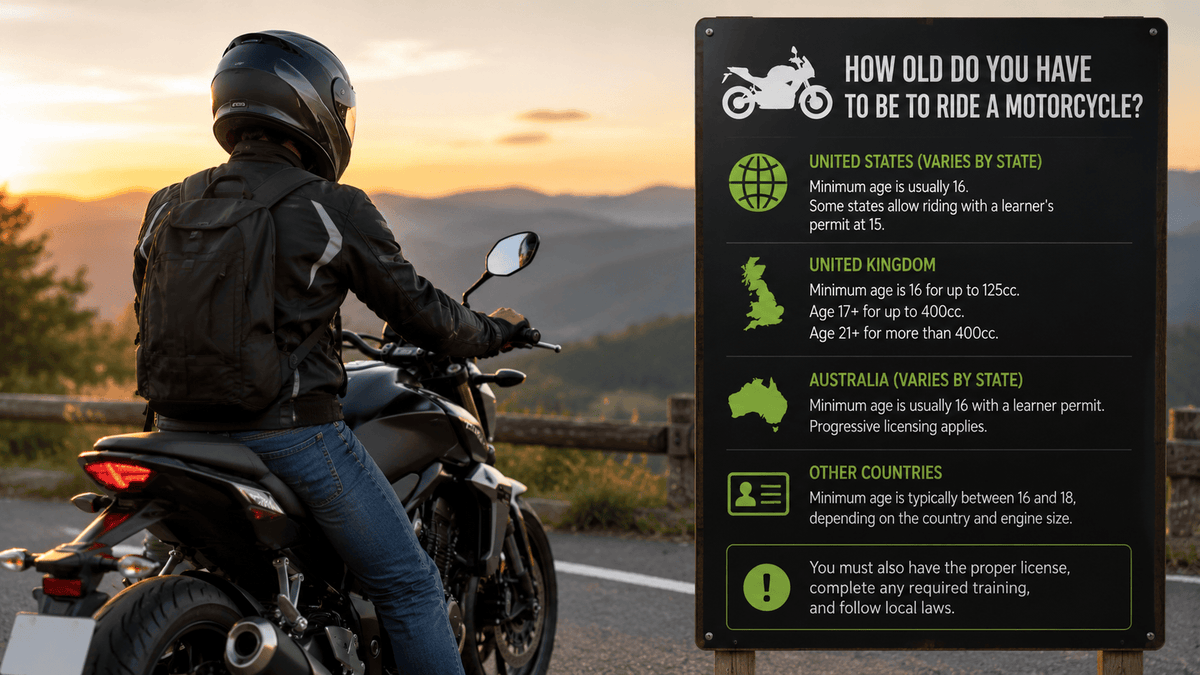
Every state has different age rules for motorcycle licenses, but here's what nobody tells you: those numbers are basically meaningless when it comes to whether someone's actually ready to ride. Sure, every state has its own legal framework, but those numbers don't account for maturity levels, physical capability, or the kind of motorcycle someone wants to ride. According to the National Highway Traffic Safety Administration, riders aged 16-20 account for approximately 7% of all motorcycle crash fatalities despite representing a much smaller portion of licensed riders. That's the real disconnect between legal eligibility and actual readiness. This piece breaks down age requirements across different contexts while examining what those laws miss and how riders (or parents of future riders) can make smarter decisions beyond just checking a birthday on a calendar.
Table of Contents
State-by-State Minimum Ages for Motorcycle Permits and Licenses
The Overlooked Gap Between Dirt Bikes and Street Bikes
Why Physical Size Matters More Than Most Age Laws Acknowledge
Supervision Requirements That Vary Wildly by Jurisdiction
The Insurance Industry's Take on Young Riders
Training Programs Designed for Younger Riders
How Parental Liability Shifts Based on Age Thresholds
International Age Requirements and What the U.S. Can Learn
The Disconnect Between Learner's Permits and Actual Road Experience
Rokform's Role in Building Safer Habits for New Riders
Final Thoughts
TL;DR
Most states allow motorcycle learner's permits starting at 14-16 years old, with full licenses available between 16-18
Dirt bike and off-road riding often has no minimum age requirement, creating a massive regulatory blind spot
Physical ability to control a bike's weight and reach controls matters more than arbitrary age cutoffs
Supervision rules range from total restrictions to vague "adult presence" requirements that lack enforcement
Insurance costs spike dramatically for riders under 25, regardless of training or experience
Completion of approved safety courses can lower minimum age requirements in some states
Parents remain legally liable for minors' riding accidents in ways that extend beyond typical vehicle operation
Countries like the UK use tiered licensing systems that restrict engine size based on age and experience
Learner's permit restrictions often create dangerous knowledge gaps about highway riding and night conditions
State-by-State Minimum Ages for Motorcycle Permits and Licenses
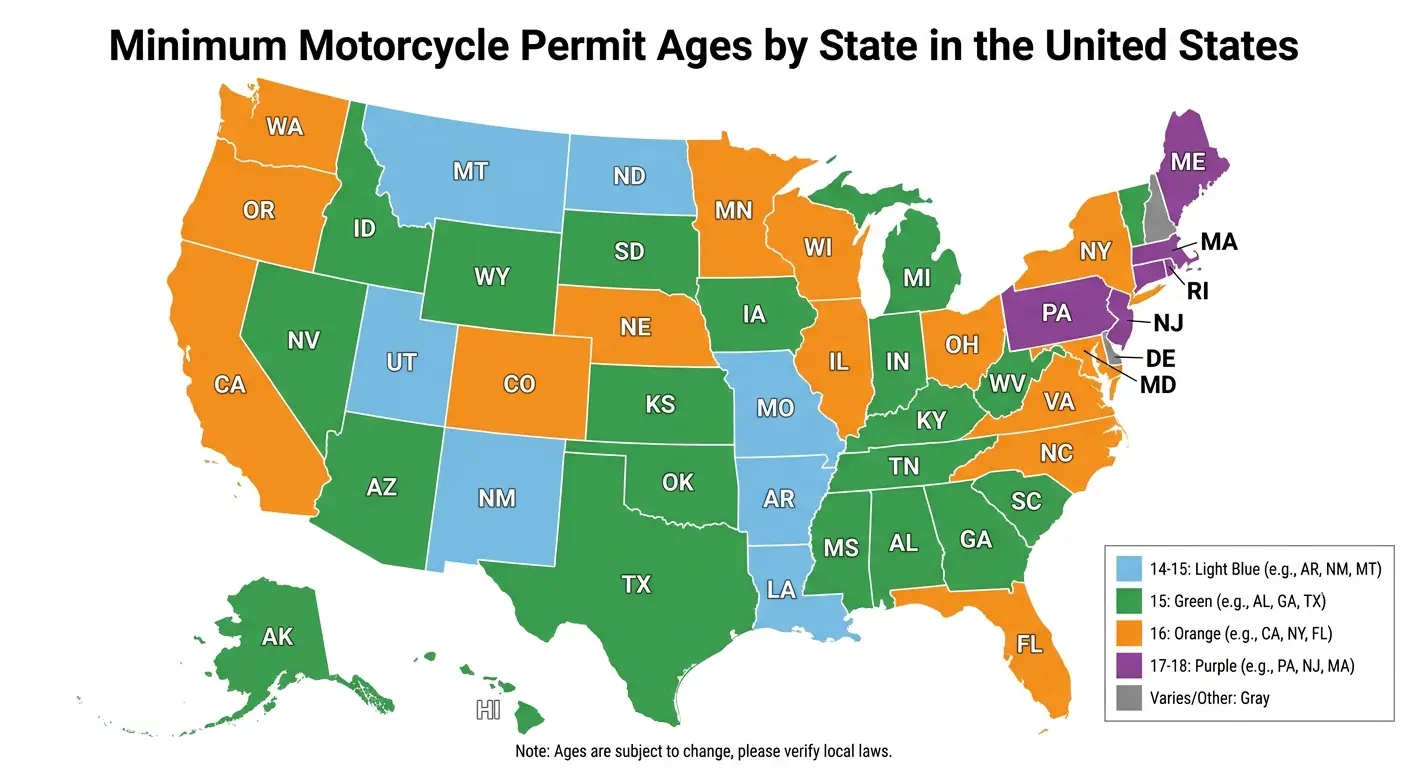
Trying to figure out motorcycle age requirements across the US? Good luck. We've got 50 states with 50 different answers, and the patchwork of regulations confuses even experienced riders helping younger family members get started. When people ask how old do you have to be to ride a motorcycle, the answer depends entirely on which state they're in. Some states set their learner's permit threshold at 14, while others won't issue any motorcycle credentials until 16 or later.
Alabama allows motorcycle learner's permits at 14, provided the rider completes an approved safety course. Arkansas follows a similar model. South Dakota goes even younger, technically allowing permits at 14 without additional prerequisites (though insurance companies make this functionally difficult).
According to the Insurance Institute for Highway Safety, 29 states allow motorcycle learner's permits at age 14 or 15, while 21 states require riders to be at least 16 years old before obtaining any motorcycle credentials. Most states cluster around 15 or 16 for permits. California, Texas, Florida, and New York all require riders to be at least 15.5 to 16 years old before applying for a motorcycle learner's permit. These permits come with restrictions: no passengers, no nighttime riding, and no freeway use in many jurisdictions.
Understanding how old do you have to be to ride a motorcycle in your specific state is just the starting point for navigating these complex regulations.
State Category |
Permit Age |
Full License Age |
Notable Requirements |
|---|---|---|---|
Early Permit States |
14-14.5 |
16 |
Safety course often mandatory |
Standard Permit States |
15-16 |
16-18 |
Written and skills test required |
Restricted States |
16+ |
17-18 |
Must hold driver's license first |
Graduated Systems |
15.5-16 |
18+ |
Multi-stage progression required |
Full, unrestricted motorcycle licenses typically become available at 16 to 18 years old, depending on the state. The gap between permit and full license exists to create a supervised learning period, though enforcement of supervision requirements remains inconsistent. Which is a whole other problem.
Several states tie motorcycle licensing directly to regular driver's license eligibility. You can't get a motorcycle permit in these jurisdictions until you're old enough to get a standard driver's permit. This bottleneck means the motorcycle age requirement becomes secondary to the general driving age.
Rhode Island and Hawaii set their full motorcycle license age at 16.5 and 17 respectively. Yes, really. The half-year matters. These fractional ages stem from graduated licensing systems meant to extend supervised practice periods, creating odd thresholds that don't align with typical birthday-based planning.
States also differ on whether they require a standard driver's license before issuing a motorcycle license. Some treat motorcycle operation as a standalone skill, while others view it as an advanced form of vehicle operation that requires basic driving competency first. The logic varies depending on who you ask.
Here's what parents should verify before the permit process:
Your state's minimum age and whether safety course completion is required or optional
Whether a standard driver's permit or license is a prerequisite
If your state accepts out-of-state training course completion
Insurance costs before committing to the permit process (this one's crucial)
Supervision requirements and whether you can realistically fulfill them
Whether your child can physically reach controls on street-legal motorcycles
Your liability insurance coverage and consider umbrella policy additions
The testing requirements vary just as much. Written tests, on-cycle skills assessments, and vision screenings appear in different combinations. States that accept Motorcycle Safety Foundation course completion as a substitute for testing create another variable in the equation. You could spend hours trying to figure out your specific state's requirements and still miss something.
The Overlooked Gap Between Dirt Bikes and Street Bikes
Here's something wild: a six-year-old can legally ride a dirt bike on private property in most states. No license, no training, no nothing. Just a kid and a bike. Off-road riding exists in a regulatory gray zone that most age-focused licensing discussions completely ignore. Private property dirt bike riding has no minimum age requirement in most states.
Thousands of kids spend years riding dirt bikes before they're old enough to get a street permit, which sounds great until you realize dirt bike skills don't prepare you for traffic. They're not counted in licensing statistics, they're not required to take safety courses, and they're building muscle memory and decision-making patterns without oversight. The age to ride a motorcycle on private property differs dramatically from street-legal requirements, creating confusion about what's permitted.
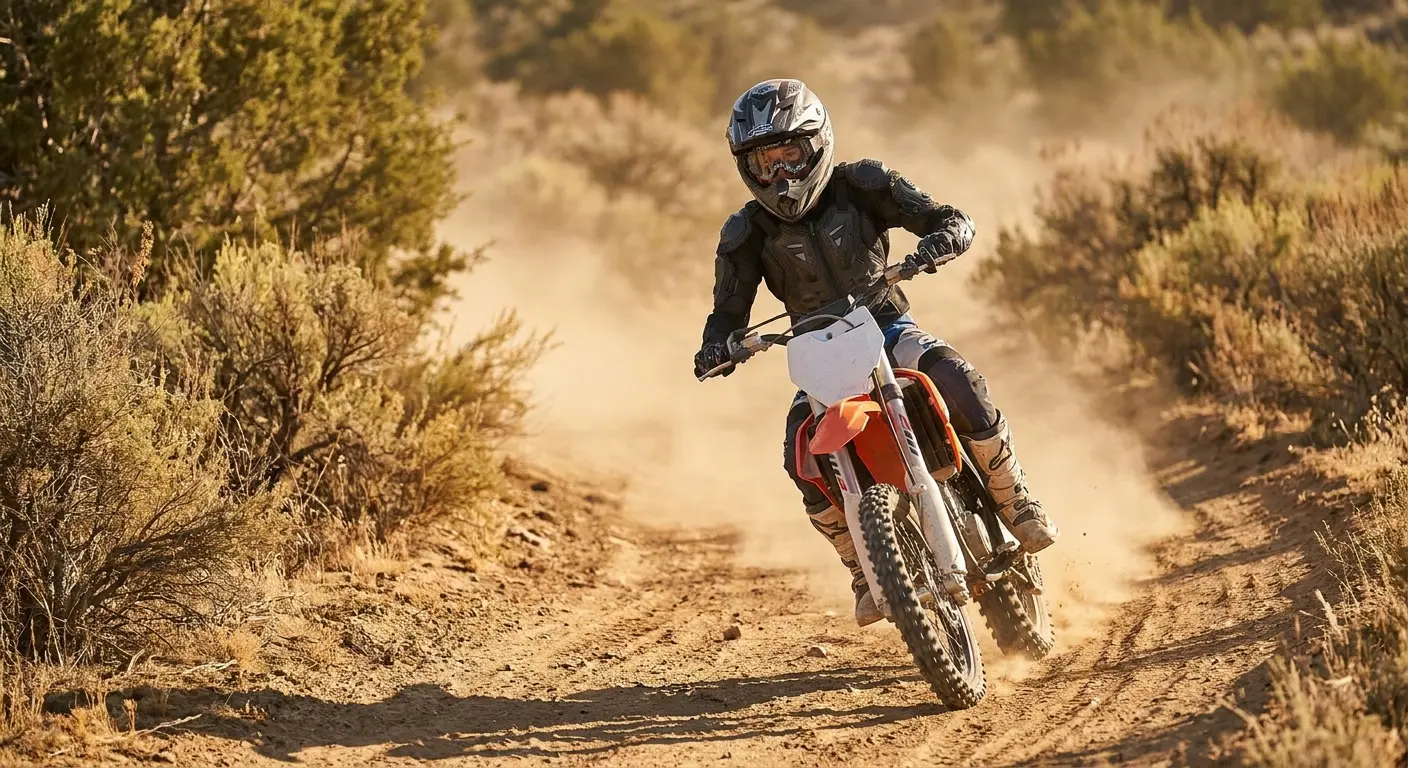
Public land use introduces some restrictions. Bureau of Land Management areas, national forests, and state parks require OHV (off-highway vehicle) permits and set minimum age guidelines. These usually start at 8 to 12 years old for youth-sized bikes under 90cc, with adult supervision required until 14 or 16.
Picture this: a 10-year-old in rural Montana spends every weekend riding a CRF110F on family property, developing throttle control and balance skills over several years. By the time that same rider turns 15 and gets a street permit, they've got thousands of hours of seat time but zero experience with traffic lights, blind spots, or cars making left turns across their path. Their dirt experience makes them confident but doesn't prepare them for the cognitive load of urban intersections.
The skills developed on dirt bikes differ significantly from street riding competencies. Dirt riding focuses on balance recovery, throttle control on loose surfaces, and body positioning for traction. Street riding demands traffic pattern recognition, defensive positioning, and consistent speed management on pavement. Two different worlds.
Young riders transitioning from years of dirt experience to street bikes struggle with aspects experienced dirt riders don't anticipate. Road positioning, mirror usage, and intersection navigation require completely different cognitive processing than trail riding decision-making. You can't just transfer those skills and expect everything to work.
A 16-year-old with eight years of motocross experience still needs to learn how to merge onto a highway, check blind spots while maintaining lane position, and predict car driver behavior at four-way stops. The assumption that dirt bike experience makes someone automatically ready for street riding at the minimum legal age overlooks these gaps.
Some states recognize this distinction and require street-specific training even for experienced off-road riders. Others treat any motorcycle experience as transferable, issuing licenses without accounting for the different risk profiles. The inconsistency is frustrating.
Parents use dirt bikes as a testing ground for whether their kids can handle the responsibility of motorized two-wheel vehicles. This makes practical sense, but it also means many young riders develop habits on forgiving terrain (where falls rarely involve other vehicles) that don't prepare them for unforgiving road conditions where a mistake can be fatal.
Why Physical Size Matters More Than Most Age Laws Acknowledge
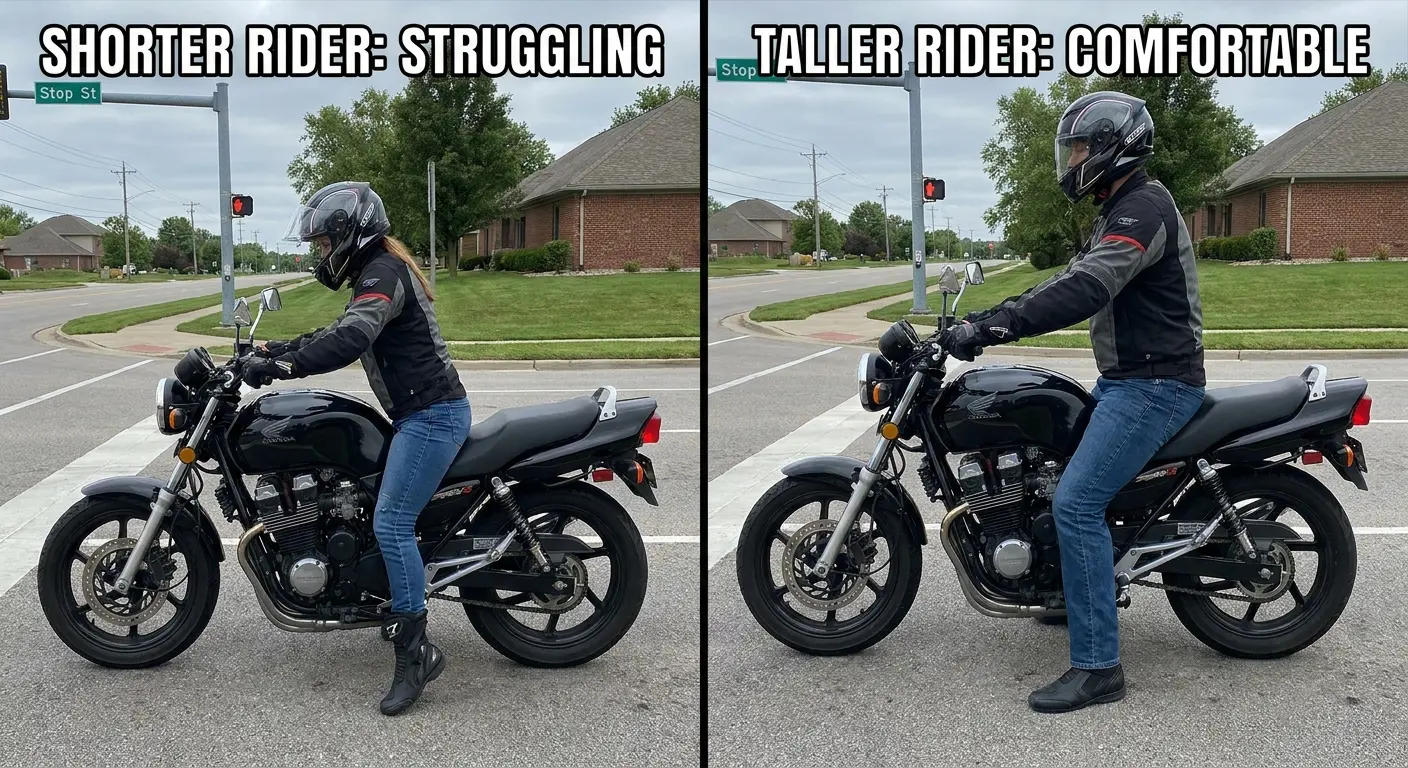
Age tells you nothing about whether someone can actually handle a motorcycle. I'm serious. Nothing. A tall, coordinated 15-year-old might handle a mid-size bike more safely than a short-statured adult who can barely touch the ground at stops. But the laws don't care about that.
Seat height creates the first physical barrier. Most adult motorcycles have seat heights between 30 and 34 inches. Riders need to plant at least one foot flat on the ground when stopped to prevent tip-overs. Someone who's 5'2" will struggle with bikes that a 5'10" rider manages easily, regardless of age. Simple physics.
Rider Height |
Manageable Seat Height |
Typical Bike Categories |
Weight Handling Limit |
|---|---|---|---|
Under 5'2" |
26-29 inches |
Youth models, mini bikes |
250 lbs max |
5'2" - 5'6" |
28-31 inches |
Small displacement street, cruisers |
350 lbs max |
5'6" - 5'10" |
30-32 inches |
Most standard and sport bikes |
450 lbs manageable |
Over 5'10" |
31-34 inches |
All categories comfortable |
500+ lbs manageable |
Weight becomes critical during low-speed maneuvers and parking situations. A 400-pound motorcycle requires real strength to hold upright when it starts to lean. Dropping a bike isn't just embarrassing. It can cause injury if the rider can't get out from under the weight quickly enough.
Control reach affects safety in immediate ways. Brake and clutch levers need to be within comfortable reach for quick reactions. If a rider has to stretch to fully pull the clutch, they'll fatigue quickly and may not be able to execute emergency stops effectively. Aftermarket levers can adjust for smaller hands, but most young riders (and their parents) don't know these modifications exist.
Throttle control requires wrist strength and fine motor control that develops at different rates. Some 14-year-olds have the dexterity to modulate throttle smoothly, while others will jerk through gear changes for years. You can't predict this based on age alone.
Youth-sized motorcycles address some of these issues. Bikes like the Honda CRF110F or Yamaha TT-R125 feature lower seat heights (26-30 inches), reduced weight (150-200 pounds), and smaller control spacing. These bikes make sense for learning, but they're not street-legal in most states. Which brings us to the weird part.
Young riders can legally obtain a permit at 14 or 15 but can't safely operate any street-legal motorcycle due to physical size constraints. The law says they're old enough, but physics says otherwise. How does that make sense?
Take this scenario: a 15-year-old who's 5'4" and weighs 120 pounds receives their learner's permit in Texas. Their parent buys a used Kawasaki Ninja 300 (a popular beginner bike) with a 30.9-inch seat height and 385-pound wet weight. At stops, the teen can only get the balls of both feet down, creating an unstable platform. During their first week of practice, they drop the bike twice in parking lots simply because they couldn't hold it upright when it leaned unexpectedly. The bike's considered a beginner-friendly model, but the rider's physical size makes it objectively too large for safe operation.
The industry has responded with some smaller-displacement street bikes. The Honda Grom, Kawasaki Z125, and similar models offer lower seat heights (30 inches) and lighter weight (around 225 pounds) while remaining street-legal. These bikes work for physically smaller riders, but they're limited to local roads due to their small engines (125cc) and low top speeds (55-60 mph). You can't take them on the highway.
Parents and new riders rarely consider these physical factors when checking age requirements. They see "eligible at 15" and assume any bike is fair game, leading to situations where young riders attempt to control motorcycles they literally cannot hold upright. I've watched this happen more times than I can count.
Supervision Requirements That Vary Wildly by Jurisdiction
Supervision requirements for motorcycle learner's permits sound reasonable in theory but fall apart in real life. Most states require "adult supervision" for permit holders, but the definition of supervision varies so much it's almost meaningless.
Some states specify that a licensed motorcycle rider must accompany the permit holder. Sounds clear until you realize it doesn't specify how. Can the supervising rider follow in a car? Must they ride alongside? What distance counts as "accompanying"? Nobody knows.
California requires permit holders to be supervised by a licensed rider 21 or older who has held their license for at least a year. The law doesn't specify proximity. Interpretation varies by law enforcement officer, which means you might get pulled over and ticketed or you might not, depending on who stops you.
Other states use even vaguer language. "Under the supervision of a licensed adult" appears in several state codes without defining what supervision means for a vehicle that only seats one person. This isn't comparable to supervising a car driver where the adult sits in the passenger seat. How do you supervise someone on a motorcycle?
Some jurisdictions interpret supervision as meaning the adult must ride their own motorcycle alongside the permit holder. This requires the supervising adult to own or have access to a motorcycle, creating a barrier for families where only one person rides. Not exactly practical.
The enforcement of these rules remains sporadic at best. Police officers can't easily determine if a young-looking rider has a permit or a full license without pulling them over. Even then, proving the absence of supervision requires catching the rider alone, which only happens if they're stopped for another reason.
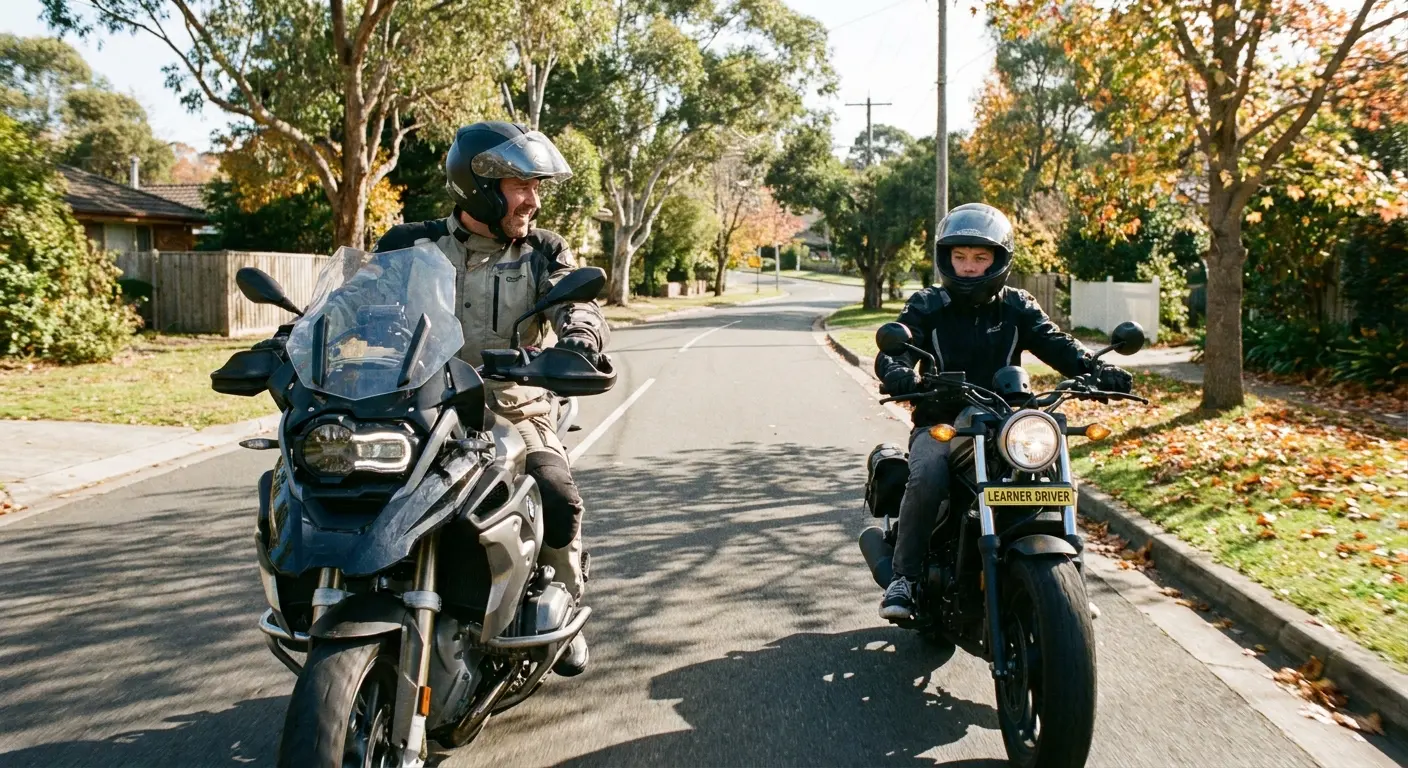
Nighttime riding restrictions appear in most permit conditions. Permit holders can't ride between sunset and sunrise. These restrictions make sense for reducing risk, but they also mean young riders get zero practice in conditions they'll eventually face. More on that later.
Passenger restrictions universally apply to permit holders. No state allows learner's permit riders to carry passengers. This rule is easier to enforce visually and makes clear safety sense, but it also means new riders don't learn how passenger weight affects bike handling until after they've passed their test and are riding unsupervised.
Highway and freeway restrictions create another common supervision element. Many states prohibit permit holders from riding on limited-access highways. This protects inexperienced riders from high-speed traffic but also means they never practice highway merging, lane changes at speed, or sustained high-speed riding until they're licensed. Which is insane when you think about it.
The gap between supervision requirements and real-world practice is huge. Most young riders with permits ride alone frequently, whether to school, work, or recreational destinations. Parents can't always follow on another motorcycle, and the alternative (not riding at all) defeats the purpose of the permit period. So everyone just ignores the rules and hopes they don't get caught.
The Insurance Industry's Take on Young Riders
Want to know what insurance companies really think about teenage riders? Look at the premiums. Insurance companies don't care much about the minimum legal riding age. They care about crash statistics that show riders under 25 (and especially under 21) crash at significantly higher rates than older riders.
According to Progressive Insurance data, motorcycle insurance premiums for riders aged 18-24 average 2.5 to 3 times higher than rates for riders aged 30-50 with similar coverage levels and riding records. Most insurers set their highest rate brackets for riders 16-20 years old. We're talking about premiums that can run $3,000 to $8,000 annually for basic coverage on a small displacement bike. Comprehensive coverage on a 600cc sport bike for an 18-year-old can exceed $10,000 per year in some states.
Yeah, you read that right. Ten grand a year to insure a $4,000 bike. The insurance industry is basically saying "please don't let your teenager ride."
These rates make legal riding financially impossible even when a young person qualifies for a license. Parents face the choice of paying insurance costs that exceed the bike's value or telling their newly licensed child they can't ride. Most choose the latter.
Some insurance companies simply refuse to write policies for riders under 18 or 21, regardless of licensing status. You can have a legal motorcycle license but can't legally operate a motorcycle because you can't obtain required insurance. The system's broken.
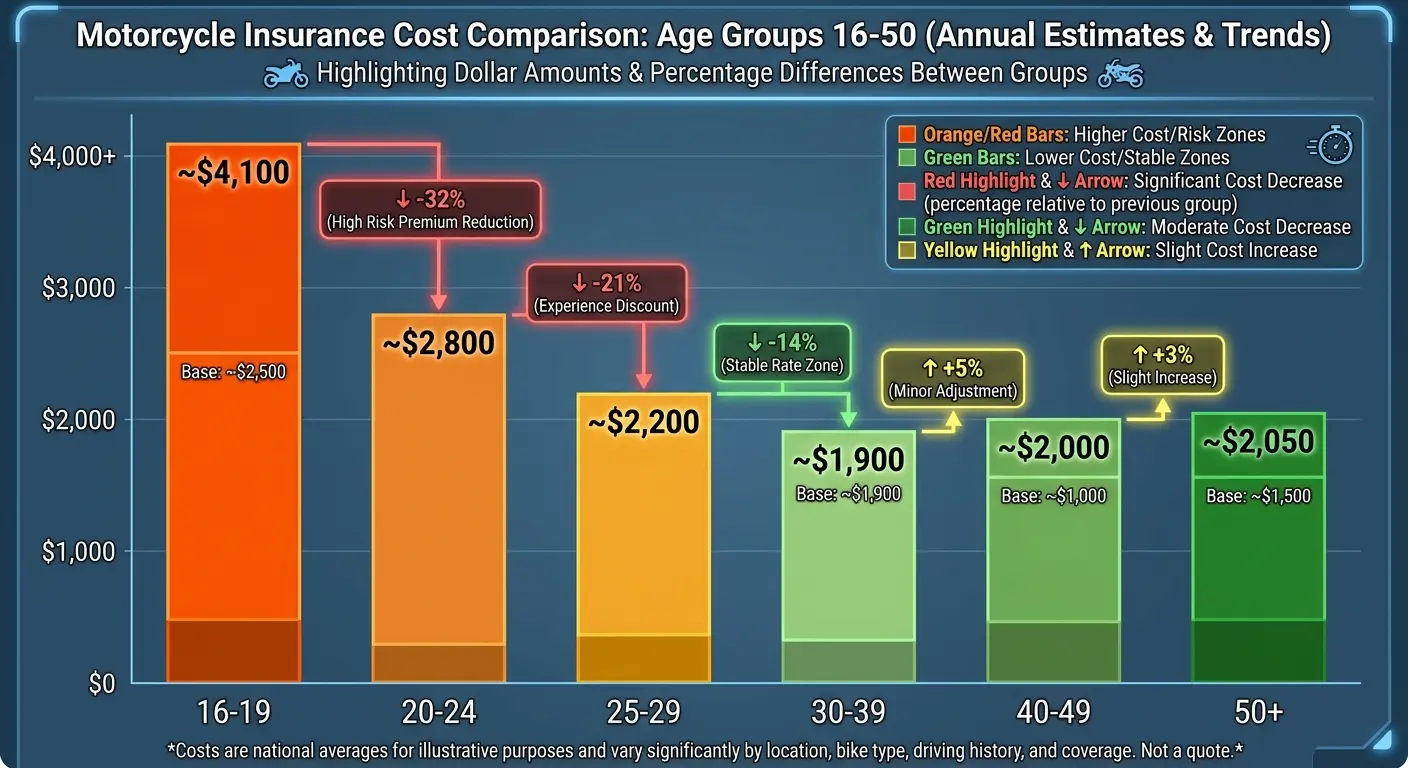
The insurance industry does recognize training and safety course completion. Riders who complete Motorcycle Safety Foundation courses or equivalent state-approved programs get 10-15% premium discounts. Some insurers offer up to 20% off for young riders who complete advanced courses.
These discounts help but rarely offset the base premium inflation for young riders. A 15% discount on an $8,000 premium still leaves a $6,800 annual cost, which remains prohibitive for most teenagers and young adults. Still completely unaffordable.
Multi-policy bundling offers another avenue for reducing costs. Young riders on their parents' insurance policies (bundled with home and auto) generally pay less than those seeking standalone motorcycle coverage. This creates a dependency that affects when and how young adults can establish independent insurance histories. You're stuck on your parents' policy well into your twenties.
The type of motorcycle dramatically affects insurability and cost for young riders. Sport bikes (even small-displacement models marketed to beginners) trigger the highest rates. Cruisers, standards, and touring bikes receive more favorable treatment from underwriters.
Here's where it gets weird: a 17-year-old might be able to afford insurance on a 750cc cruiser but not on a 300cc sport bike, even though the smaller bike has less power. Insurance companies base rates on crash statistics, and sport bikes crash more frequently in young riders' hands. The numbers don't lie.
Some states require insurance companies to offer coverage to all licensed riders, preventing outright refusal. These guaranteed issue requirements force insurers to provide quotes, but they don't cap the premiums, leading to technically available but practically unaffordable policies. Thanks for nothing.
Young riders end up on their parents' policies long after they'd normally establish independent coverage, simply because it's the only affordable option. This extends financial dependence and complicates situations when young adults move out of state or need to prove independent insurance history. The whole system pushes adulthood further down the road.
Training Programs Designed for Younger Riders
Motorcycle Safety Foundation courses represent the gold standard for rider training in the U.S., but they're designed for adults and don't accommodate riders under 15 or 16. The Basic RiderCourse requires participants to be at least 15 years old in most locations (though some sites set their own minimums at 16). So if you're 14 with a permit in Alabama, you're out of luck.
These courses run over a weekend, combining classroom instruction with parking lot practice on small training bikes (usually 250cc or smaller). Students learn basic control, emergency braking, swerving, and low-speed maneuvers. It's solid foundational stuff.
Completion of an MSF course substitutes for the riding skills test in most states. This streamlines licensing and ensures new riders receive standardized instruction. The courses cost $200 to $400 depending on location, which is reasonable compared to the alternative of learning through trial and error (or worse, crashing).
But here's the catch: MSF courses don't include any on-road riding. Everything happens in controlled parking lot environments. Students learn to execute maneuvers but don't practice them in traffic, at highway speeds, or in real-world conditions where car drivers create unpredictable situations. You're learning to ride without actually riding anywhere.
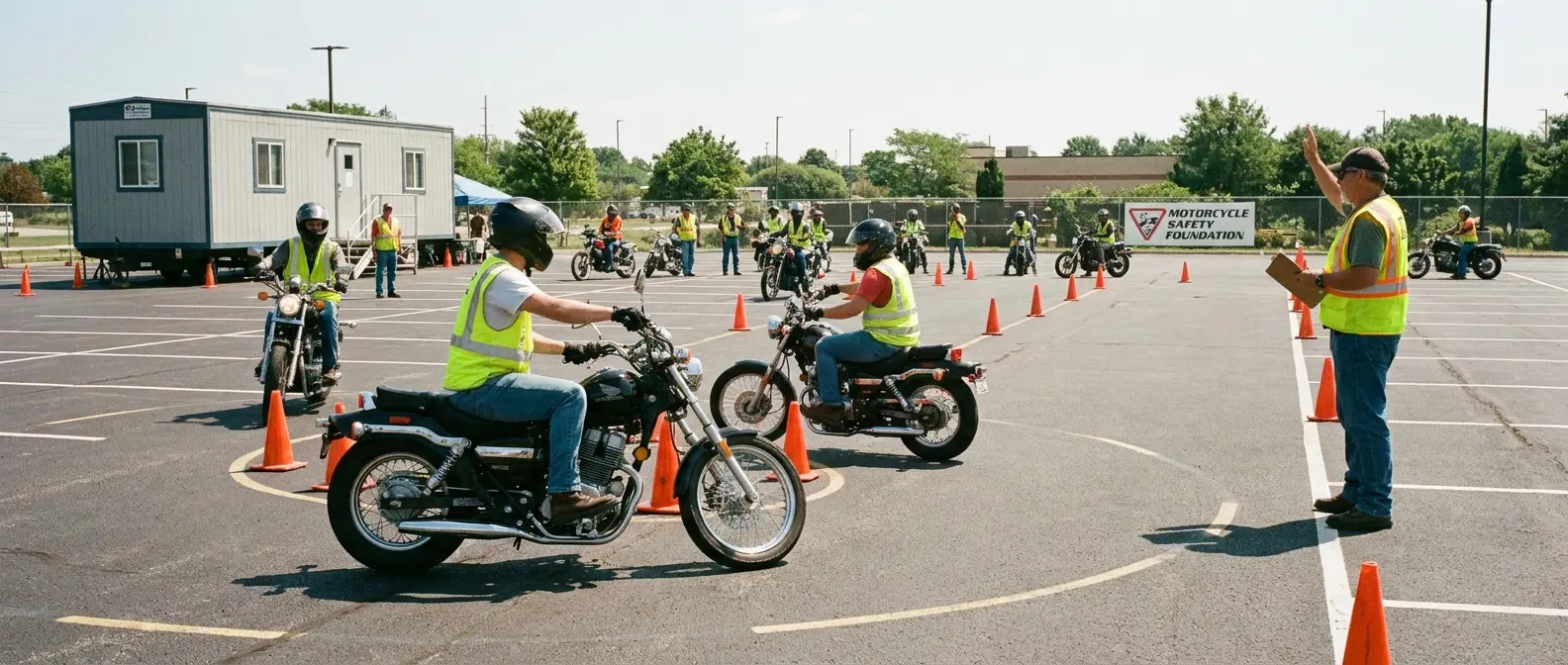
Some states offer youth-specific programs. The Motorcycle Safety Foundation's Dirt Bike School caters to riders as young as 6, focusing on off-road skills in controlled environments. These programs teach throttle control, braking, and body positioning but don't address street riding. Still useful, just limited.
Private training schools fill some gaps. Companies like Total Control Advanced Riding Clinic and Ride Like a Pro offer advanced courses that go beyond basic MSF content. These programs cost more ($300 to $600) but include techniques for emergency situations, advanced cornering, and real-world traffic strategies. You get what you pay for.
Track days and closed-course training give young riders experience at higher speeds in safe environments. Organizations like California Superbike School accept riders as young as 12 for their junior programs, teaching sport riding techniques without the risks of public roads. This stuff actually works.
The problem? None of these programs are required in most states. A young rider can take the DMV skills test (which varies wildly in difficulty by state) and receive a full license without ever taking a formal course. Some states offer insurance discounts or expedited licensing for course completion, but they don't mandate it. So most people skip it.
Training quality varies dramatically between providers. Some MSF courses are taught by experienced instructors who've been riding for decades. Others are led by people who barely meet the minimum instructor qualifications and may have limited real-world riding experience themselves. You're rolling the dice.
Before enrolling in any program, verify these details:
Instructor credentials and years of actual riding experience (not just teaching experience)
Student-to-instructor ratio (ideal is 6:1 or better)
Whether the program includes both low-speed and higher-speed skill development
If bikes are provided or if you must bring your own
Course completion waives DMV testing requirements in your state
Insurance discount eligibility before enrollment
Recent student reviews focusing on real-world preparation comments
The course covers emergency braking, swerving, and cornering techniques
Weather policies and makeup session availability
Young riders who complete training programs still face a knowledge gap about group riding etiquette, long-distance riding fatigue management, and how to handle mechanical issues on the road. These skills develop through experience, but there's no structured way to gain that experience safely. You just figure it out as you go.
How Parental Liability Shifts Based on Age Thresholds
Parents who allow their minor children to ride motorcycles assume legal liability that extends far beyond what they face with car driving. This isn't something most families think about until it's too late. Negligent entrustment laws apply when parents provide access to a dangerous instrument (which courts often classify motorcycles as) to someone they know or should know is incompetent or reckless.
Parents can be held directly liable for crashes their minor children cause, even if the parent wasn't present. If a 16-year-old with a new license crashes into another vehicle, injuring the other driver, that driver can sue both the teen and the parents under negligent entrustment theory. Both of you are on the hook.
The standard for negligent entrustment is lower than many parents realize. Plaintiffs don't need to prove the parent knew their child was a bad rider. They only need to show the parent should have known the child lacked the maturity, skill, or judgment to ride safely. A few weeks of permit holding rarely defeats this argument. Good luck in court.
Vicarious liability creates another exposure point. Under family purpose doctrine (recognized in some states), parents can be held liable for their children's vehicle-related torts when the vehicle is maintained for family use. This applies even when the parent didn't explicitly authorize the specific trip where the crash occurred. Doesn't matter if you said they could ride that day or not.
These liability concerns persist until the child reaches the age of majority (18 in most states, 19 in Alabama and Nebraska, 21 in Mississippi). Parents of 17-year-old licensed riders carry the same legal exposure as parents of 15-year-old permit holders. The risk doesn't diminish just because they passed a test.
Insurance coverage complicates the picture. When a minor causes a crash, insurance companies look to the parents' assets to satisfy judgments that exceed policy limits. Umbrella policies help, but many families don't carry them or don't have limits high enough to cover serious injury claims. Your house could be at risk.
Some states impose specific parental responsibility statutes for minors operating vehicles. These laws create automatic parental liability up to certain dollar amounts (often $5,000 to $15,000) without requiring proof of negligent entrustment. The amounts seem small, but they represent liability that exists before considering larger negligence claims.
Here's a real scenario: a 17-year-old in Georgia with a full motorcycle license runs a red light and collides with a car, causing serious injuries to the other driver. The driver's medical bills exceed $200,000. Georgia law holds parents liable for up to $10,000 automatically under its parental responsibility statute. Beyond that, the injured driver's attorney files a negligent entrustment claim against the parents, arguing they should have known their son wasn't ready for a 650cc sport bike after only six months of riding experience. The parents' homeowners insurance and umbrella policy become involved, and they face potential personal asset exposure if judgments exceed their coverage limits. This actually happens.
Parents must also sign motorcycle permit applications for minors in every state. This signature isn't just administrative paperwork. It creates a record that the parent affirmatively authorized their child to ride, which plaintiffs' attorneys use to establish the parent-child relationship and justify extending liability. You signed on the dotted line.
The financial consequences extend beyond crash liability. Parents whose minor children accumulate traffic violations face insurance rate increases on all family vehicles. A speeding ticket on a motorcycle can raise premiums on the family's cars, home insurance, and umbrella policies. Everything goes up.
Emancipated minors create an interesting exception. In states that allow legal emancipation before age 18, emancipated teens can hold motorcycle licenses without parental liability attachment. However, emancipation requires court proceedings and proof of financial independence, making it rare. Not a practical solution for most families.
Parents don't consult attorneys before allowing their children to get motorcycle permits. They treat it similarly to car licensing, not realizing the liability profile differs significantly. The combination of vehicle danger perception and minor operator status creates legal exposure that catches families off guard after crashes occur. By then it's too late.
International Age Requirements and What the U.S. Can Learn
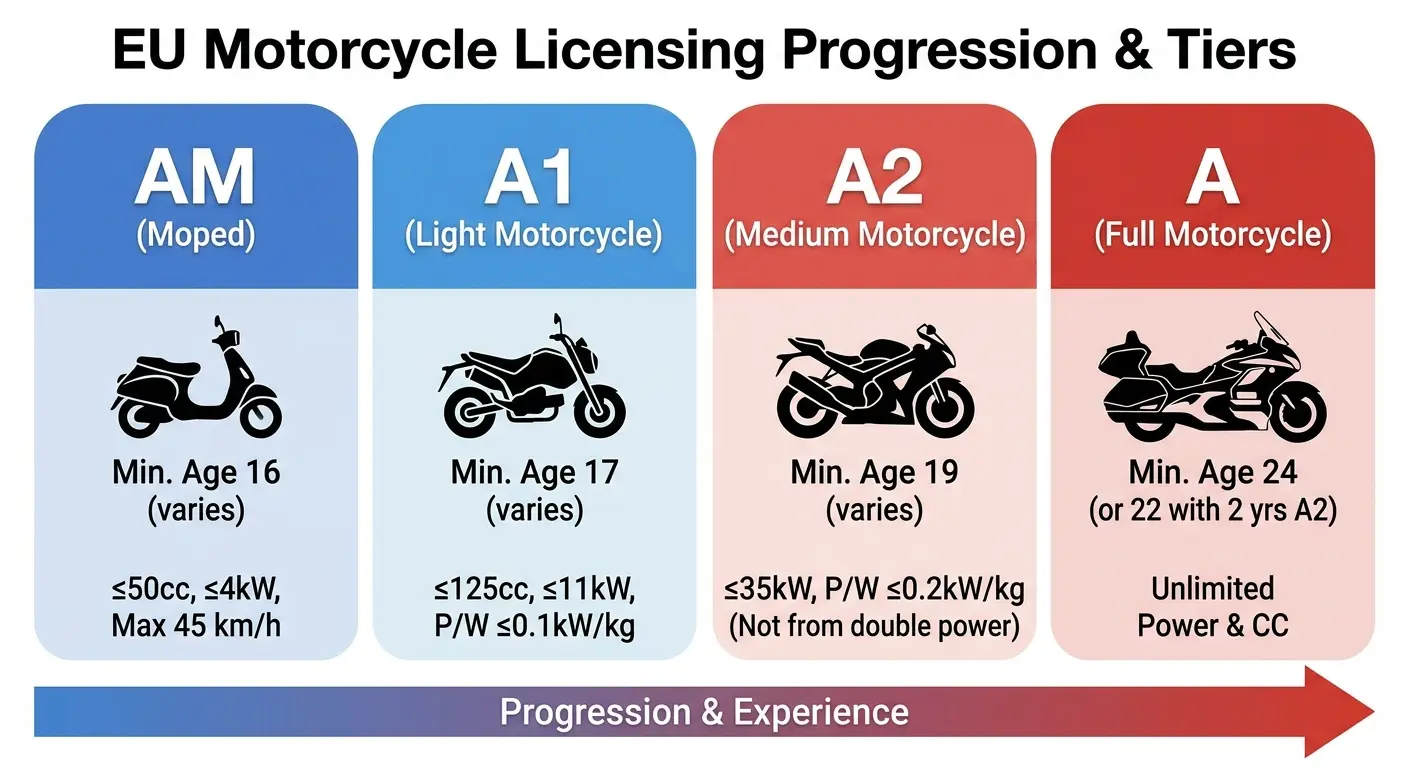
European Union countries use a tiered licensing system that restricts motorcycle power based on age and experience. The AM category allows 50cc scooters at age 16. The A1 category permits 125cc bikes with maximum 11kW power at age 17. The A2 category allows bikes up to 35kW at age 19. Full A category licenses (no restrictions) become available at age 24 or after two years holding an A2 license. It's a gradual progression.
According to the European Transport Safety Council, countries with tiered motorcycle licensing systems show 23% lower fatality rates among riders under 25 compared to countries with single-tier licensing approaches. The numbers suggest this approach works.
This graduated system assumes that younger riders need time to develop skills on less powerful machines before progressing to larger bikes. The U.S. approach (where a 16-year-old can legally ride a 1000cc sport bike in many states) skips this entire learning curve. We just throw kids on whatever and hope for the best.
The UK follows the EU framework but adds additional testing requirements. Riders must complete Compulsory Basic Training (CBT), pass a theory test, and complete two practical riding tests (Module 1 off-road and Module 2 on-road) before receiving full licenses. The process takes months and costs several hundred pounds. It's rigorous.
Australia implements a similar staged system. Learner permits require supervised riding and prohibit passengers, nighttime riding, and high-powered bikes. Provisional licenses (available after 3 to 12 months depending on the state) allow unsupervised riding but maintain power restrictions. Full licenses require holding a provisional license for 1 to 3 years. You work your way up.
Japan restricts riders under 16 to 50cc bikes and requires separate licenses for different displacement categories. Riders must pass both written and practical tests for each license class. The testing is notoriously difficult, with pass rates below 50% for first-time test takers. They don't mess around.
These international systems share a common philosophy: motorcycle operation is dangerous enough to require gradual skill building with appropriate machines. The U.S. treats it more like car licensing, where passing a basic test grants access to nearly any vehicle in the category. Two completely different approaches.
Do these restrictions actually work? European countries show lower motorcycle fatality rates per capita than the U.S., but multiple factors contribute (better road infrastructure, different riding culture, mandatory gear laws). Isolating the effect of tiered licensing is difficult. The data looks good but isn't conclusive.
Critics of tiered systems argue they create financial barriers without proven safety benefits. Riders in the UK must purchase or rent multiple bikes as they progress through categories, and they pay for multiple rounds of testing and training. This makes motorcycling accessible only to those with disposable income. Fair point.
The U.S. could adopt displacement or power restrictions for younger riders without completely overhauling the licensing system. A rule limiting riders under 18 to bikes under 500cc or 47hp (35kW) would align with international A2 category standards and prevent the most egregious mismatches between rider experience and bike capability. Makes sense on paper.
Enforcement would challenge such restrictions. Police officers can't easily determine a bike's power output during traffic stops. Registration systems would need updating to flag restricted riders operating non-compliant bikes. Implementation would be messy.
Some U.S. states have experimented with graduated motorcycle licensing. Oregon and New Jersey have implemented systems that restrict new riders (regardless of age) for the first year. These programs show promise but haven't been adopted widely. Most states aren't interested.
The cultural difference matters too. European riders more readily accept government restrictions on vehicle choice. Americans hate being told what bike they can ride. Any attempt to implement EU-style tiered licensing would face significant political resistance. It's just not happening anytime soon.
The Disconnect Between Learner's Permits and Actual Road Experience
Learner's permit restrictions exist to protect new riders, but they also guarantee that newly licensed riders will face certain situations for the first time without any supervised practice. The system builds in predictable failure points.
Highway riding represents the biggest gap. Most states prohibit permit holders from riding on limited-access highways. This protects inexperienced riders from high-speed traffic, which makes sense. But when someone passes their test, they immediately have full legal access to interstates without ever having practiced merging at 70 mph, maintaining highway speeds, or executing lane changes in dense traffic. First time for everything, right?
The skills required for highway riding differ fundamentally from parking lot maneuvers and surface street riding. Wind buffeting from passing trucks, maintaining focus during extended high-speed riding, and judging closing speeds when changing lanes all require practice to master safely. You can't learn this in a parking lot.
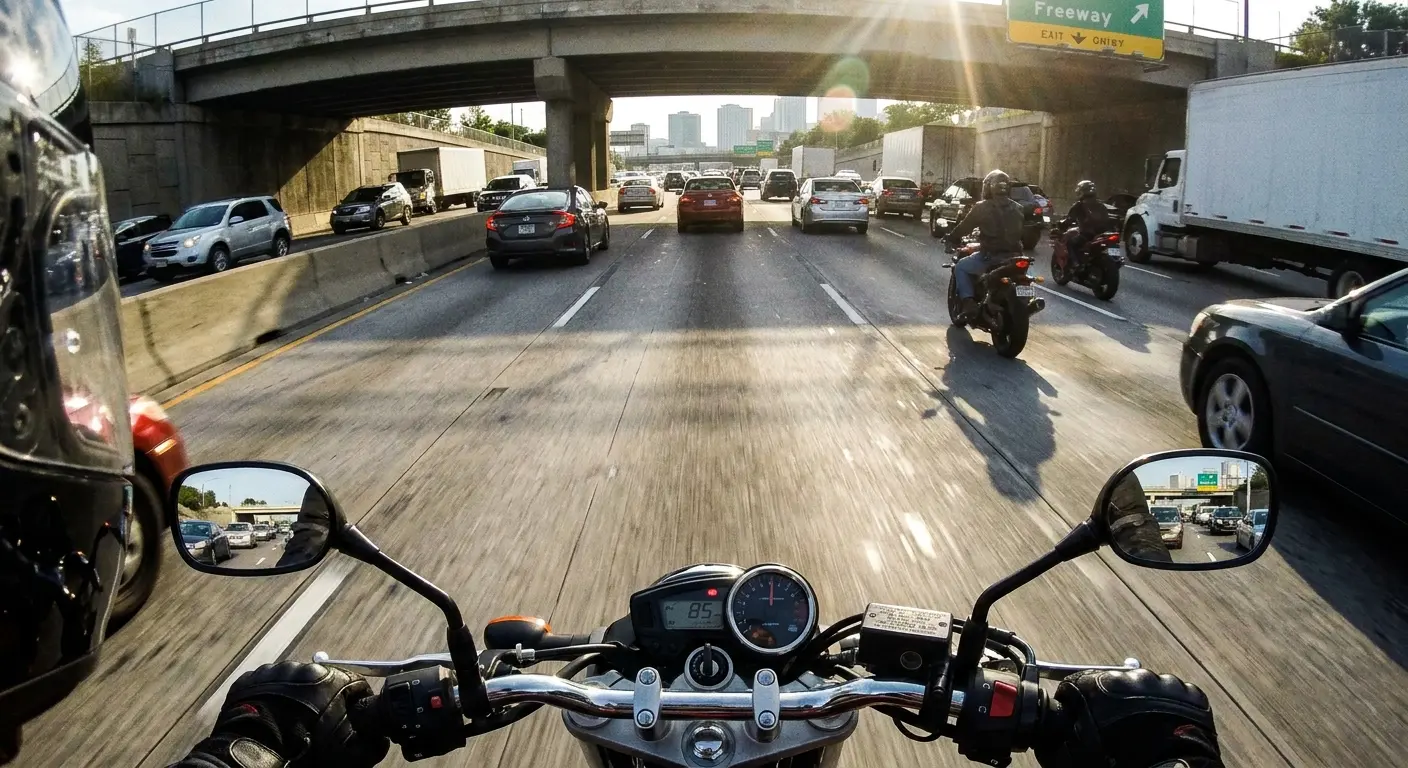
New riders with fresh licenses attempt their first highway ride alone, having never experienced how their bike handles at sustained high speeds. They discover too late that their 300cc bike struggles to maintain 75 mph, or that crosswinds affect their bike more than they anticipated. Learning these lessons at highway speeds is terrifying.
Nighttime riding creates similar gaps. Permit restrictions universally prohibit riding after dark. This protects new riders from reduced visibility conditions, but it also means their first night ride happens unsupervised after licensing. Nobody's there to help.
Night riding requires different visual strategies. Riders must use their peripheral vision more effectively, judge distances with limited depth perception, and watch for animals and debris that appear suddenly in headlight range. These skills don't transfer from daytime riding experience. You're figuring it out as you go.
The first time a newly licensed 16-year-old rides home after dark from a friend's house, they're learning these skills in real-time with real consequences. No amount of parking lot practice prepares riders for how different everything feels when visibility drops. Understanding how old do you have to be to ride a motorcycle legally doesn't mean you're prepared for every riding condition you'll encounter.
Passenger carrying represents another first-time experience that happens post-licensing. Permit holders can't carry passengers in any state. This restriction makes obvious safety sense, but it guarantees that every rider's first passenger experience happens without supervision. Hope you figure it out.
A passenger changes everything about how a motorcycle handles. The extra weight affects braking distances, acceleration, and how the bike leans into corners. The passenger's movements can upset the bike's balance if they don't know proper technique. It's a completely different ride.
Newly licensed riders carry their first passenger within days of getting their license, having never felt how the bike responds differently. They learn through experience that they need to brake earlier and accelerate more gradually, sometimes learning these lessons through near-misses or crashes. Trial by fire.
The permit period doesn't address decision-making in complex traffic situations either. Parking lot courses teach control skills but not how to position yourself at a four-way stop where drivers might not see you, or how to handle aggressive drivers who tailgate or cut you off. Real-world traffic is chaos.
These judgment calls develop through experience, but the permit period's restrictions limit the variety of experiences new riders encounter. They practice in controlled conditions and on familiar routes, never building the pattern recognition needed for unusual situations. Then they get their license and everything's fair game.
Weather riding gets zero attention in most training. Permit holders avoid rain (and are sometimes explicitly prohibited from riding in adverse weather). Their first experience with reduced traction, decreased visibility, and slippery road markings happens after licensing. Good luck out there.
Rain changes everything about motorcycle operation. Braking distances double or triple, painted road markings become ice-like, and visibility through a wet visor requires techniques that aren't intuitive. Riders who encounter rain for the first time on their commute to work face a steep and dangerous learning curve. I've seen people panic and freeze up.
The gap between permit restrictions and full license privileges is too wide. Riders go from highly restricted practice to complete freedom without any intermediate step. A more effective system would gradually lift restrictions, allowing supervised highway practice and daytime passenger carrying before full licensing. But that's not how we do it.
Rokform's Role in Building Safer Habits for New Riders
Young riders face a challenge that older generations didn't encounter when they started riding: smartphones. Riders who learned before smartphones became ubiquitous developed habits without the constant pull of notifications and messages. New riders, especially teenagers and young adults, have never known life without instant connectivity. The phone's always there.
The temptation to check phones while riding is real and dangerous. Riders under 25 are significantly more likely to use their phones while riding than older riders. This includes texting, checking social media, and changing music. All terrible ideas on a motorcycle.
Handling a phone while riding requires taking a hand off the controls, shifting visual attention from the road, and splitting cognitive focus. Even a two-second glance at a phone means traveling 176 feet at 60 mph without full attention on riding. That distance is enough to miss a car changing lanes, a pedestrian stepping into the road, or a pothole that could cause a crash. Two seconds is all it takes.
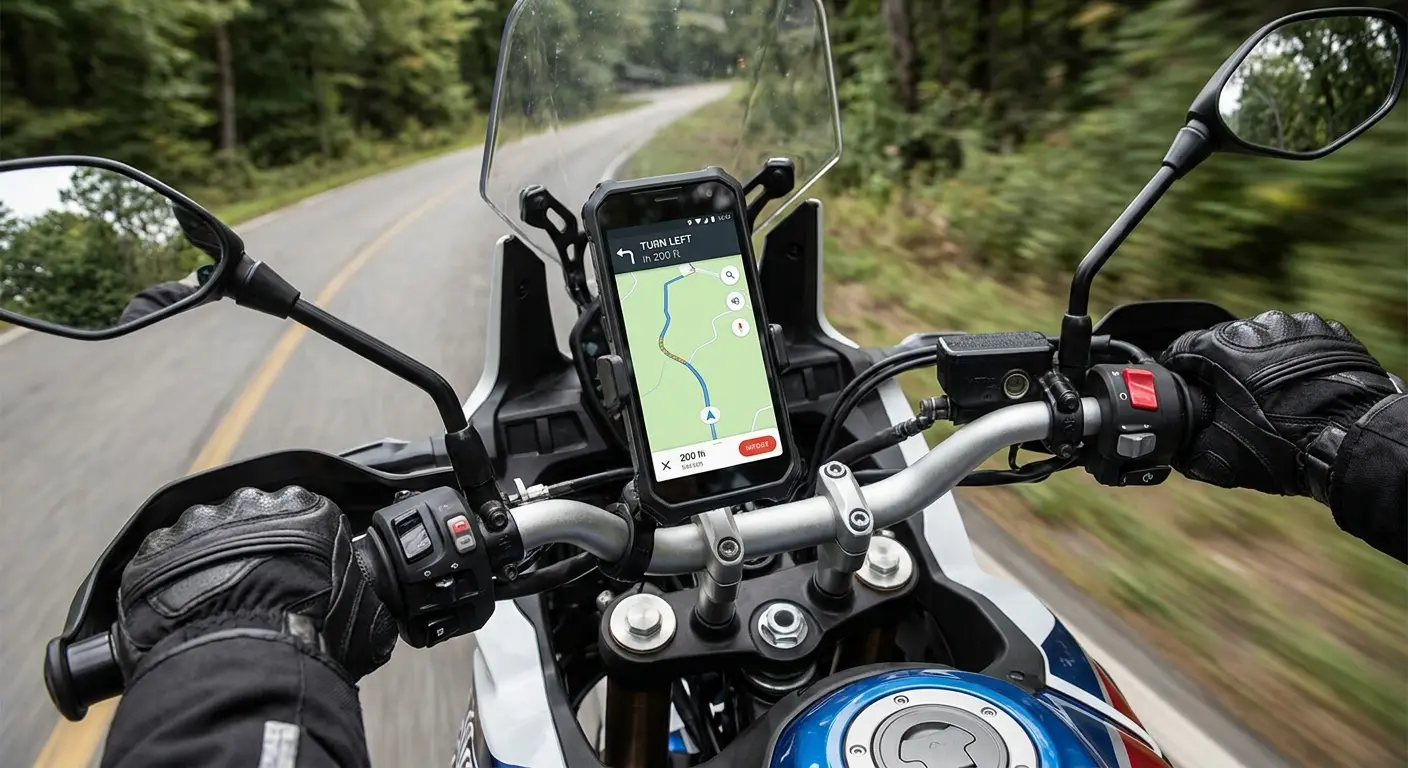
Look, teenage riders are going to have their phones with them. That's reality. The question is whether they're digging in their pockets at 60 mph or whether the phone's mounted where they can glance at GPS without taking their hands off the bars. Rokform makes mounts that actually stay put (magnetic plus twist-lock system), which matters when you're dealing with motorcycle vibration and rough roads.
Navigation represents the legitimate reason most riders need phone access. Young riders exploring new routes or commuting to unfamiliar locations rely on GPS more than experienced riders who've memorized their regular routes. A properly mounted phone lets riders check directions at stoplights without the fumbling and distraction of pulling a phone from a pocket. Quick glance, back to riding.
The difference between a mounted phone and a phone in a pocket is the difference between a quick glance (similar to checking a mirror) and a multi-step distraction that removes both hands from controls. Rokform's system keeps phones visible and accessible while maintaining the security needed for motorcycle vibration and movement. Your phone stays where you put it.
Communication with other riders or family members creates another need for phone access. Young riders whose parents want regular check-ins or who ride in groups that coordinate via messaging apps face pressure to respond quickly. A mounted phone lets them see incoming messages and respond at safe stopping points rather than trying to text while riding. Wait until you're stopped, then respond.
The rugged case design matters for new riders who are statistically more likely to drop their bikes during low-speed maneuvers. A phone that survives a parking lot tip-over because it's in a protective case mounted to the bike is better than a shattered screen from a phone that flew out of a pocket. New riders drop bikes. It happens.
You can check out Rokform's motorcycle mounts here: motorcycle phone mount collection.
Beyond phone mounting, building safer habits means thinking about the complete riding ecosystem. Rokform also offers rugged phone cases designed specifically for active lifestyles, which means they handle the vibration, weather exposure, and occasional drops that come with motorcycle riding. For young riders still learning proper bike control, having gear that can withstand mistakes makes practical sense.
The integration between proper mounting systems and protective cases creates a setup where phones remain functional tools rather than dangerous distractions. Young riders can use navigation, track their routes, and stay connected with family without the risky behavior of handling devices while moving. Phone stays mounted, hands stay on the bars.
Final Thoughts
So how old do you have to be to ride a motorcycle? Legally? Depends on your state. Anywhere from 14 to 16 for a permit. Actually? That's the wrong question.
The right questions are: Can you physically control the bike you want to ride? Can your family afford $5,000-plus in insurance? Are you mature enough to resist checking your phone at 70 mph? Will you practice the skills you can't learn during the permit period? Do you understand that passing a test doesn't mean you're ready for highways, night riding, rain, or carrying passengers?
The current age-based system provides a framework, but it's incomplete. Real readiness comes from a combination of age, physical capability, training, supervised experience, and honest self-assessment. The legal minimum is just the starting point for a much more important conversation that most families never have until after something goes wrong.
I've watched three different families go through this process, and not one of them knew about the insurance costs until after the kid had their permit. Not one considered whether their child could physically reach the ground on the bike they wanted to buy. Not one thought about the legal liability that extends until age 18. They just saw the minimum age requirement and assumed that meant their kid was ready.
This isn't academic. We're talking about kids dying because they got a license before they were ready. The insurance companies know something the DMV doesn't: teenagers on motorcycles are a disaster waiting to happen. The statistics don't lie. Young riders crash more, get injured more, and die more than any other age group.
Does that mean no one under 18 should ride? No. It means the decision requires way more thought than checking a birthday on a calendar. It means parents need to look beyond the legal minimum and ask harder questions. It means young riders need to recognize that meeting the age requirement doesn't mean they're prepared for every situation they'll encounter.
The permit restrictions exist for reasons. The skills you can't practice during that period will challenge you immediately after licensing. Highway riding, night conditions, and passenger carrying all require respect and gradual skill building. Don't rush it just because you legally can.
The system's broken in a lot of ways. The 50-state patchwork makes no sense. The dirt bike regulatory gap is ridiculous. Physical size requirements don't exist when they should. Supervision rules are unenforceable. Insurance costs price out most young riders regardless of skill. Training programs teach parking lot skills but not real-world decision-making.
But you work with the system you have, not the one you wish existed. If you're a parent considering whether to let your kid get a motorcycle permit, do your homework. If you're a young rider who just became eligible, understand that the legal minimum is just that. Minimum. Not ideal, not recommended, just the bare minimum the state requires.
The age to ride a motorcycle legally is one thing. The age when you're actually ready is something else entirely. Figure out the difference before you twist the throttle.

