


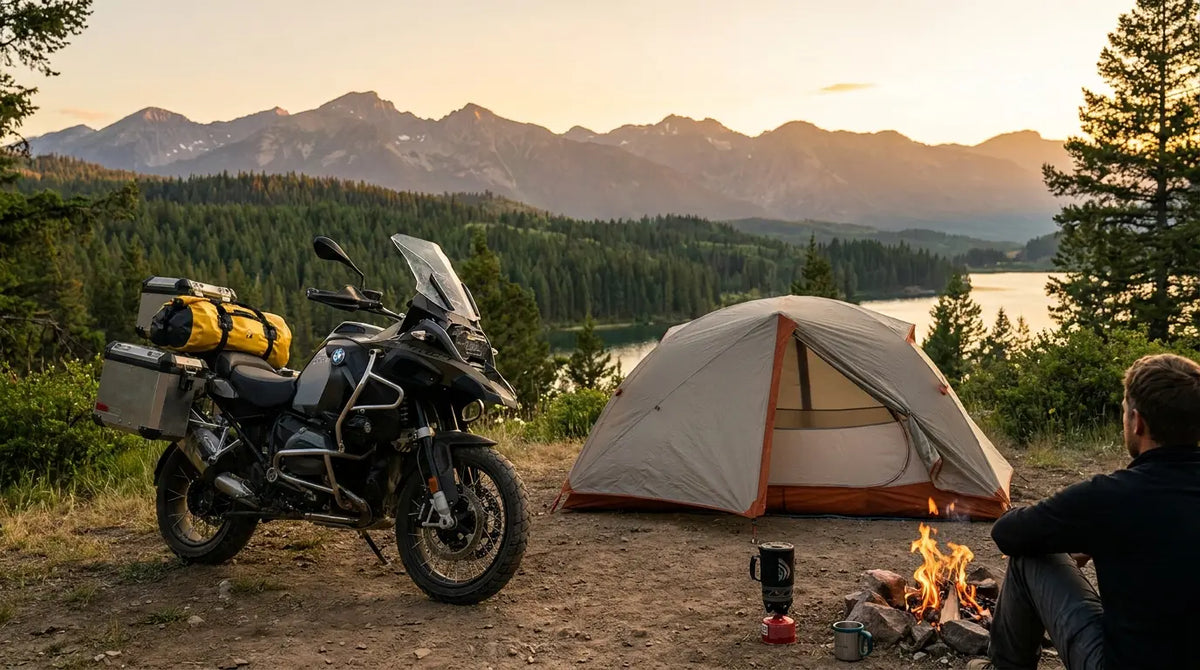
So I'm three hours deep in a Reddit thread about titanium tent stakes at 2 AM, and I realize I've completely lost the plot. This was supposed to be about throwing some gear on my bike and riding into the mountains, not optimizing pack weight down to the gram like I'm summiting Everest. But here I am, comparing the thermal efficiency of different sleeping pad materials while my bike sits in the garage, not going anywhere.
Look, I've screwed this up enough times to know that most motorcycle camping advice misses the point entirely. The real challenge isn't finding the lightest titanium spork or the most compact sleeping bag. It's learning how to think differently about what you actually need when your storage space is measured in liters, not cubic feet. Once you figure that out, the whole experience gets better. You sleep better, ride looser, and actually enjoy setting up camp instead of dreading the gear Tetris.
Table of Contents
The Phone Problem Everyone Ignores Until Mile 200
Why Your Packing Strategy Is Backwards
The Weight Distribution Myth That's Wrecking Your Ride
Connectivity Gear That Actually Earns Its Space
Sleep Systems Beyond the Usual Suspects
Food Planning When You Can't Bring the Kitchen
The Minimalist Tool Kit That Works
Weather Protection Without the Bulk
Finding Campsites That Match Your Setup
Documentation and Navigation Tools Worth Carrying
TL;DR - Just the stuff that'll actually screw up your trip:
Your phone will die at the worst possible moment, sort this out first
Pack for "what will I actually do" not "what might theoretically happen"
Weight up high makes you wrestle your bike through corners (learned this the hard way in the Ozarks)
Satellite communicator if you're going truly remote and solo, otherwise skip it
Bad sleep equals dangerous riding the next day, don't cheap out here
Meal planning should focus on calories and simplicity, not gourmet ambitions
Bring a kickstand puck, seriously
Digital and physical backup systems for navigation prevent minor issues from becoming major problems
The Phone Problem Everyone Ignores Until Mile 200
Your phone becomes your lifeline on extended motorcycle camping trips, but most riders treat it as an afterthought until they're 200 miles from civilization with a dead battery and no idea where the next water source is. I'm not talking about staying connected to social media. I'm talking about the fact that your phone likely handles your GPS navigation, offline maps, weather radar, emergency communication, campsite research, and potentially your bike's diagnostic tools if you're running a Bluetooth OBD system.
The standard approach fails immediately. Throwing your phone in a tank bag means you can't glance at navigation without taking your eyes off the road for dangerous stretches. Keeping it in your pocket subjects it to vibration damage, which kills cameras and components faster than most people realize. Cheap RAM mounts work until you hit washboard dirt roads, then your phone's bouncing so hard you can't read the screen anyway.
Why Standard Protection Fails on Multi-Day Trips
Phone cases designed for everyday drops don't account for sustained vibration, temperature swings from morning frost to afternoon sun beating down on black plastic, or the dust that infiltrates everything when you're riding unpaved forest roads to reach that perfect dispersed camping spot. Waterproof ratings mean nothing when condensation builds up inside the case during elevation changes.
You need a mounting system that dampens vibration, keeps the phone accessible for quick glances, and protects against impacts without adding bulk that catches wind. The connection point matters more than the case itself. Magnetic systems work until they don't, usually at the worst possible moment when you hit an unexpected pothole.
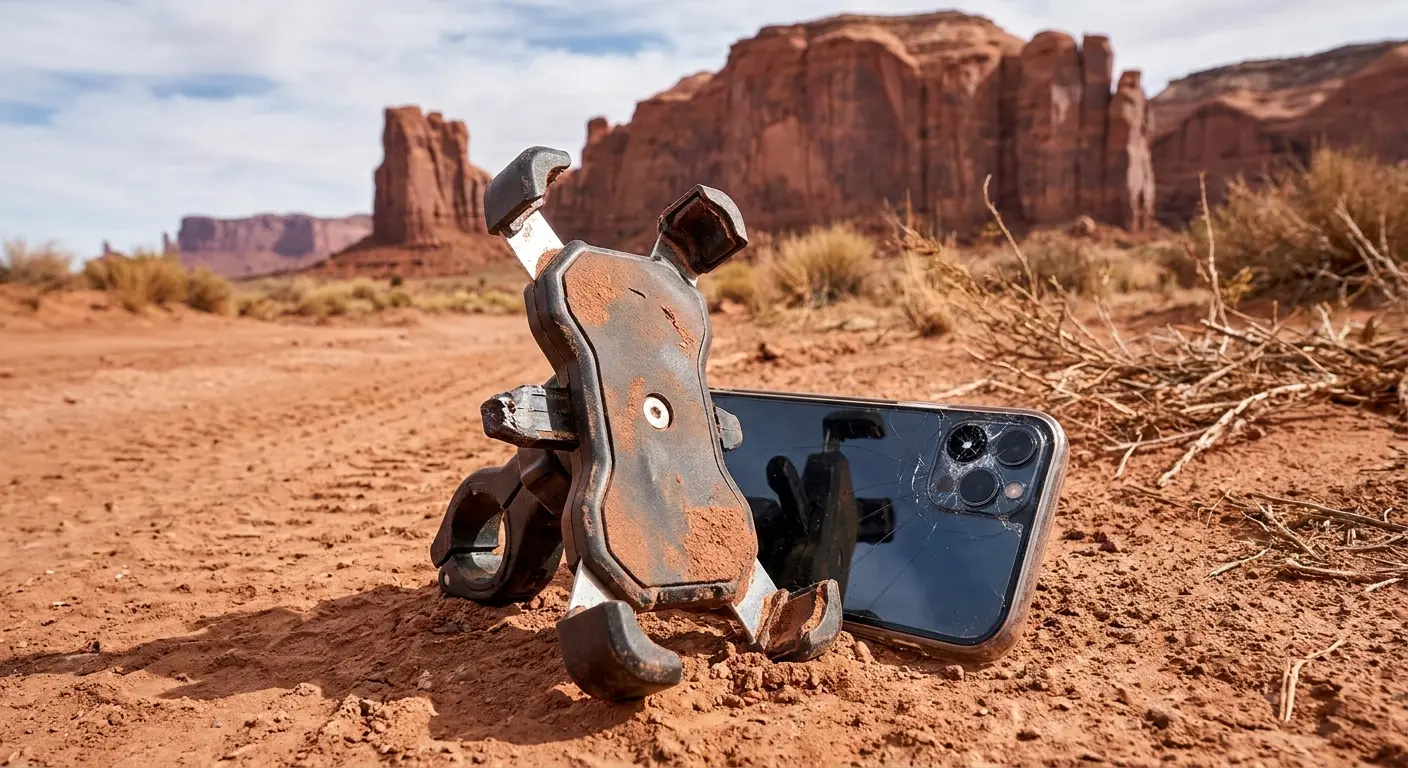
Outside Moab (this was June, stupid hot, and I was already pissed because I'd missed the turn for the campground and added 20 miles) my phone launched off the mount on a washboard section. I watched it bounce in my mirror, which was its own kind of horror. Thought about turning around, but I was doing like 45 and by the time I stopped and walked back, some mountain biker had already grabbed it and was waving me down. Nice guy. Canadian. Anyway, the screen was fine but the camera was toast, and I spent the rest of that trip using a gas station map I bought for $6 that was copyright 2003 and showed roads that didn't exist anymore.
Charging Solutions That Actually Work Off-Grid
Solar panels sound great until you realize you're riding through forested areas where your bike's parked in shade most of the day. Battery banks add weight and require their own charging strategy. The real solution involves understanding your actual power consumption and building redundancy into your system.
Battery banks are the boring answer that actually works. Yeah, solar panels sound cool, and I tried them for a season. Know what I learned? Trees exist. You're riding through forests, parking in shade, and your fancy solar panel is generating jack squat while adding a pound to your load. Skip it unless you're riding the salt flats.
USB ports wired directly to your bike's battery work, but they drain your starting power if you're not careful about monitoring usage. A dedicated battery system isolated from your starting circuit gives you peace of mind. Calculate your phone's battery capacity, your typical daily usage, and build in a 50% buffer for the days when you need to run GPS continuously through unfamiliar terrain.
Charging Method |
Weight |
Reliability |
Best Use Case |
Limitations |
|---|---|---|---|---|
Hardwired USB Port |
Minimal |
High |
Daily top-ups while riding |
Drains bike battery if overused |
Portable Battery Bank (20,000mAh) |
~12 oz |
High |
3-5 full phone charges |
Requires pre-charging, adds weight |
Solar Panel (Foldable 20W) |
~18 oz |
Medium |
Extended trips in open terrain |
Useless in forests or cloudy weather |
Battery Tender with Adapter |
~8 oz |
High |
Overnight charging at camp |
Requires bike battery access |
Mounting Positions That Balance Access and Safety
The standard handlebar mount creates tunnel vision. You're staring at your phone instead of reading the road. A position slightly below your natural sight line works better, letting you catch navigation prompts with minimal eye movement. This matters more during long days in the saddle when fatigue already compromises your reaction time.
I've been using Rokform's mounts for two seasons now (yeah, they sent me one to try, full disclosure) and it's the first system where I'm not constantly checking if my phone's still attached. The twist-lock thing actually works, even on shit roads. Their magnetic mounts use a twist-lock mechanism that keeps phones secure through rough terrain while allowing quick removal for photos or campsite use, and their cases are designed specifically to handle sustained vibration without the bulk that creates wind resistance. The RokLock system lets you position your phone exactly where you need it without permanent modifications to your bike. When selecting the right setup for your needs, consider exploring options like the motorcycle handlebar mount that provides secure attachment points for various riding conditions.
Consider a secondary charging cable already plugged in and routed cleanly so you can top up your battery during riding without fumbling with connections. This redundancy means you're never choosing between running navigation and preserving battery for emergency communication.
Why Your Packing Strategy Is Backwards
Most packing advice tells you to lay everything out, then remove half of it. That's lazy thinking that doesn't actually help you make decisions. You need a framework that accounts for how you'll actually use items, not just their weight or volume.
Start with scenarios, not gear categories. What happens if it rains for two days straight? What if you can't find a campsite with water? What if your chain needs adjustment 300 miles from the nearest shop? Build your packing list around these specific situations rather than trying to prepare for every theoretical possibility. Understanding the right motorcycle camping gear requires thinking through real-world challenges you'll face on the road.
Stuff You Use Every Day vs. Stuff That Saves Your Trip
There's stuff you use every day that doesn't really matter if you forget, like, I've eaten dinner with my fingers because I forgot a spork. Whatever. Then there's stuff you'll probably never need, but if you DO need it and don't have it, your trip is over. Tire plug kit. Spare fuses. That stuff.
The hard calls are the middle ground. Do you need a real towel or can you dry off with a t-shirt? Can you skip the camp pillow and stuff clothes in a stuff sack? I usually go with: if it does multiple completely different things, it comes. If it does one thing really well, it probably stays home unless that one thing is critical.
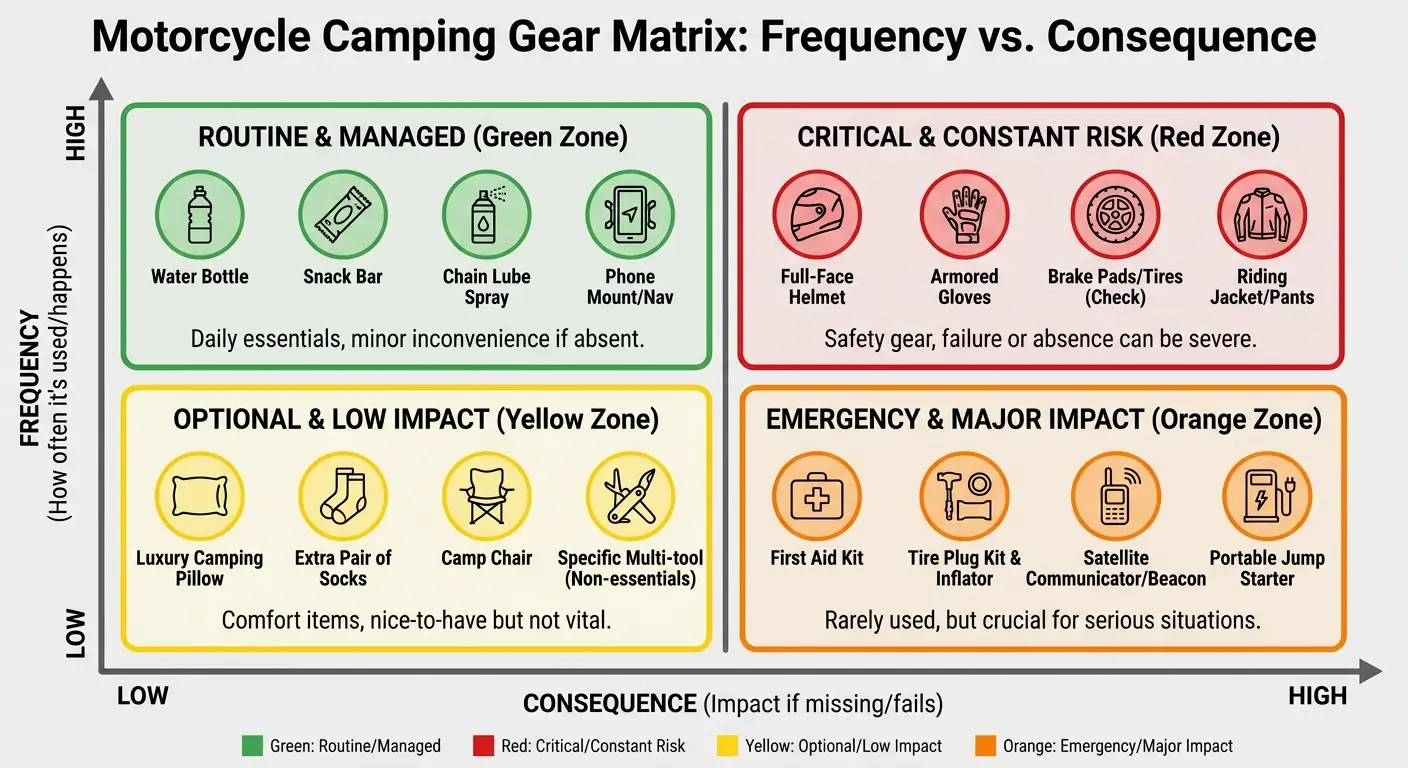
High-frequency, low-consequence items can be minimal or improvised. Your camp chair sounds nice, but you've sat on your helmet before and survived. Low-frequency, high-consequence items are non-negotiable. That tire plug kit might stay in your bag for years, but the one time you need it, nothing else matters.
Item Category |
Frequency |
Consequence of Absence |
Packing Priority |
Example Items |
|---|---|---|---|---|
High-Freq, Low-Consequence |
Daily |
Inconvenient |
Optional/Improvise |
Camp chair, pillow, extra clothing |
High-Freq, High-Consequence |
Daily |
Trip-ending |
Essential |
Phone charger, water bottles, base layers |
Low-Freq, Low-Consequence |
Rarely |
Inconvenient |
Leave behind |
Specialty cookware, comfort items |
Low-Freq, High-Consequence |
Rarely |
Trip-ending |
Essential |
Tire repair kit, first aid, spare fuses |
Medium-Freq, Medium-Consequence |
Several times |
Significant hassle |
Multi-use preferred |
Duct tape, paracord, bandana |
Multi-Use Items That Actually Earn Their Weight
Everyone talks about multi-use gear, then lists the same obvious examples. Duct tape repairs gear, patches holes, and secures loose items. Paracord sets up shelters, hangs wet clothes, and replaces broken straps. A lightweight tarp becomes a ground cloth, rain shelter, or bike cover. These items solve problems across multiple categories, not just multiple variations of one problem. When evaluating motorcycle camping gear, prioritize pieces that handle three or more distinct functions.
Your rain gear should work as a windbreaker and extra insulation layer, not just keep you dry. Your headlamp needs a red light mode for camp use that doesn't destroy your night vision. Your water bottle should nest inside your cook pot. This kind of integration cuts weight without sacrificing capability. Quality motorcycle camping gear earns its place through versatility.
I once watched a rider at a campground in Colorado struggle with a torn pannier that was dumping gear every time he hit a bump. He didn't have duct tape. I handed him a six-foot strip from my roll, and he patched it well enough to make it through the remaining 400 miles of his trip. That roll weighs two ounces and has fixed torn rain gear, secured a loose heat shield, patched a hole in my tent, and temporarily reattached a mirror that vibrated loose. One item, dozens of uses across three seasons of riding.
Testing Your System Before You're Committed
Pack everything for a weekend trip within 50 miles of home. Use only what you've packed. You'll discover immediately what you actually reach for versus what stays buried in your bags. The items you never touched get cut. The moments you wished you had something get noted.
Your shakedown trip should be close enough to bail if things go sideways (maybe 50 miles out) but far enough that you can't just run home for the thing you forgot. Two nights minimum, because one night tells you nothing. Bring only what's on your list, no "just in case" extras, and actually track what you use. I keep a note on my phone and mark down every time I reach for something. The stuff that stays packed the whole trip? That's your cut list right there.
Run this test in different weather conditions if possible. Your packing list for desert camping differs from mountain camping, but the core decision-making framework stays consistent. You're learning what you personally need, not following someone else's generic list.
Weight Distribution: Or Why My Bike Handled Like Shit in the Ozarks
You've probably heard to keep weight low and centered. That's technically correct but practically useless because it doesn't tell you how to make decisions when you're loading your bike.
I learned this lesson the hard way riding through the Ozarks with a 40-pound tail bag mounted high on a luggage rack. Every corner felt wrong. The bike wanted to stand up mid-turn, fighting my inputs. I was exhausted after 150 miles of wrestling the handlebars. That night at camp, I redistributed the load, moving heavy items into my panniers down low. The next day's ride through the same type of twisty roads felt completely different.
The bike felt like a completely different machine.
Weight distribution affects your bike's handling in ways that total weight doesn't. Fifty pounds in your tail bag will make your bike want to stand up in corners. The same fifty pounds split between low-mounted panniers barely changes your riding style. This isn't about following rules; it's about understanding how your specific bike responds to different loading configurations for motorcycle camping.
How Load Placement Changes Your Bike's Personality
High-mounted weight raises your center of gravity, making the bike feel taller and less stable at low speeds. You'll notice this immediately in parking lots and gas stations. Low-mounted weight lowers your center of gravity but can make the bike feel planted to the point of sluggishness in quick direction changes.
Rear-biased weight lightens your front end, reducing steering precision and making the bike want to push wide in corners. Front-biased weight loads your steering, increasing effort and reducing high-speed stability. Neither is inherently wrong; you just need to know what you're dealing with and adjust your riding accordingly.
Strategic Loading for Different Bike Types
Adventure bikes with high-mounted luggage systems already have a higher center of gravity. Adding weight up high amplifies this, but these bikes are designed to handle it. Your riding style needs to account for the increased leverage during slow-speed maneuvers, especially when setting up your motorcycle camping base.
Sport-touring bikes with low-mounted hard bags prefer weight down low and forward. Their suspension is tuned for this configuration. Loading them rear-heavy fights their design intent and compromises handling during motorcycle camping excursions.
Smaller displacement bikes feel weight more acutely. Every pound matters more on a 400cc bike than a 1200cc machine. Prioritize weight savings more aggressively, and keep loads as central as possible.
Adjusting Suspension for Loaded Riding
Your suspension settings for solo riding don't work when you're carrying 40 pounds of camping gear. Preload needs adjustment at minimum. Rebound damping might need tweaking depending on how much weight you've added.
Start with preload. Add enough to restore your bike's ride height to approximately where it sits with just you aboard. This maintains proper suspension geometry and ground clearance. If you're bottoming out over bumps, add more. If the ride feels harsh, you've gone too far.
Rebound controls how fast your suspension springs back after it compresses. Add 40 pounds of camping gear and suddenly your bike's bouncing around like it's trying to buck you off on rough roads. Slow down the rebound a couple clicks and see if it settles.
Connectivity Gear That Actually Earns Its Space
Connectivity gear walks a fine line between essential safety equipment and unnecessary tether to civilization. The question isn't whether to bring communication tools, but which ones serve genuine purposes versus feeding our inability to unplug.
Solo motorcycle camping puts you in situations where help isn't just a phone call away. Cell coverage disappears quickly once you leave main highways. Your phone's emergency features don't work without signal. This reality requires thinking beyond your standard communication setup when planning motorcycle camping adventures.
When Satellite Communication Makes Sense
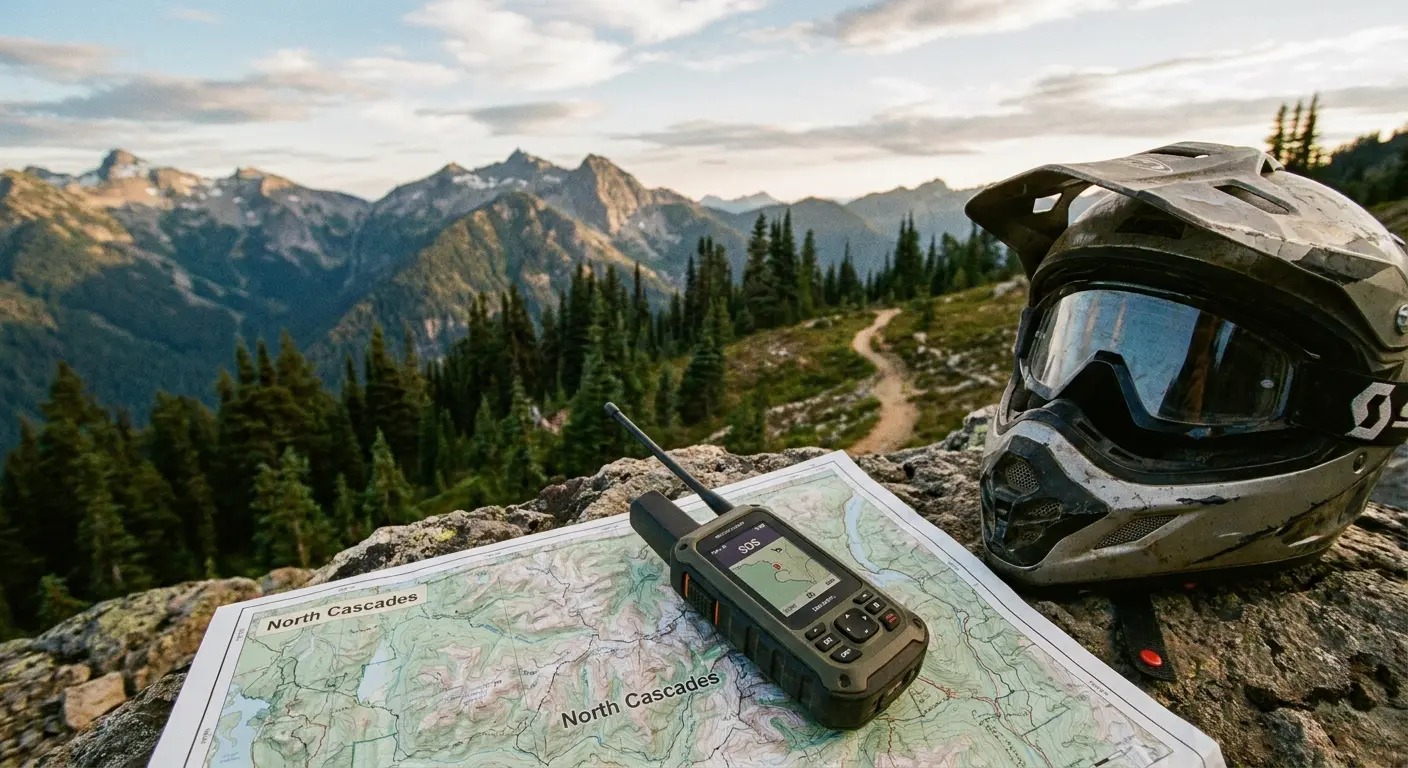
Satellite communicators aren't for everyone, but they solve specific problems that matter during motorcycle camping. If you're riding routes where cell coverage is unreliable and you're traveling solo, the ability to send an "I'm okay" message or trigger emergency services becomes significant.
The newer devices offer two-way messaging, weather updates, and tracking features that let people back home follow your progress without constant check-ins. This peace of mind matters more when you're responsible for someone else's worry, not just your own safety. For extended motorcycle camping trips in remote areas, satellite communication transitions from luxury to necessity.
Cost is the barrier. Monthly subscription fees plus device purchase make this a significant investment. Evaluate honestly whether your typical riding puts you in situations where this capability matters. Weekend trips to established campgrounds don't justify the expense. Multi-week trips through remote areas might.
Mesh Communication for Group Rides
Bluetooth communicators work until your group spreads out beyond their limited range. Mesh systems maintain connectivity across much larger distances, letting groups of riders stay coordinated without cell service.
This matters for motorcycle camping because you're often making real-time decisions about routes, fuel stops, and camp site selection. Being able to communicate these decisions without pulling over constantly improves the flow of your day and keeps everyone informed about plan changes.
The downside is cost multiplied by group size. Everyone needs compatible equipment. If you regularly ride with the same people and tackle trips where coordination matters, the investment pays off. For occasional group rides, simpler solutions work fine.
Offline Mapping and Navigation Backup
Your phone's navigation app probably requires data connectivity to download maps. Offline mapping apps let you download entire regions before your trip, ensuring navigation works regardless of signal availability.
This redundancy matters more than you'd think. GPS signal works without cellular data, but map rendering requires those downloaded tiles. Having offline maps means you can navigate confidently through areas where your phone shows no bars.
Physical maps still have a place. They don't run out of battery, they give you broader geographic context than a phone screen, and they work when electronics fail. A waterproof map case strapped to your tank gives you navigation backup that weighs almost nothing and requires zero power.
Sleep Systems Beyond the Usual Suspects
Your sleep system determines whether you wake up ready to ride or spend the morning recovering from a terrible night. Poor sleep directly impacts your reaction time, decision-making, and ability to handle your bike safely. This isn't about comfort for comfort's sake.
Most motorcycle camping advice defaults to ultralight backpacking tents. These work, but they're not your only option, and depending on where you camp, they might not be your best option for motorcycle camping.
Bivy Sacks for Minimalist Camping
A quality bivy sack weighs less than two pounds, packs smaller than a water bottle, and sets up in under a minute. You're trading interior space for simplicity and packability. This trade works well if you're comfortable with confined sleeping and you're not spending long periods inside your shelter.
Condensation becomes your main enemy. Breathable waterproof fabrics help, but you'll still wake up with moisture inside the bivy on cold nights. Proper site selection matters more with a bivy than a tent. You need natural drainage and protection from wind that a tent would provide structurally.
The speed factor matters more than most riders realize. After a long day of riding, the ability to roll out your sleeping pad, slide into your bivy, and be done in minutes has real appeal. No poles to assemble, no stakes to place, no rain fly to tension properly. For motorcycle camping focused on efficiency, bivys excel.
Hammock Systems for Forest Camping
Hammocks eliminate the need to find level ground, which matters in mountainous or heavily forested areas where flat tent sites are scarce. A proper camping hammock with integrated bug net and rain fly packs nearly as small as a bivy and sets up almost as quickly once you've practiced.
The learning curve is real. Proper hang angle, tension, and positioning take practice to get comfortable. Your first few nights might be rough. But once you've dialed in your system, hammock sleeping offers advantages that ground systems can't match for motorcycle camping in wooded terrain.
Temperature management differs completely from ground sleeping. You need insulation underneath you, not just a sleeping bag. Underquilts or sleeping pads designed for hammocks solve this, but they add weight and complexity. Cold air circulating beneath you will suck heat away faster than sleeping on the ground.
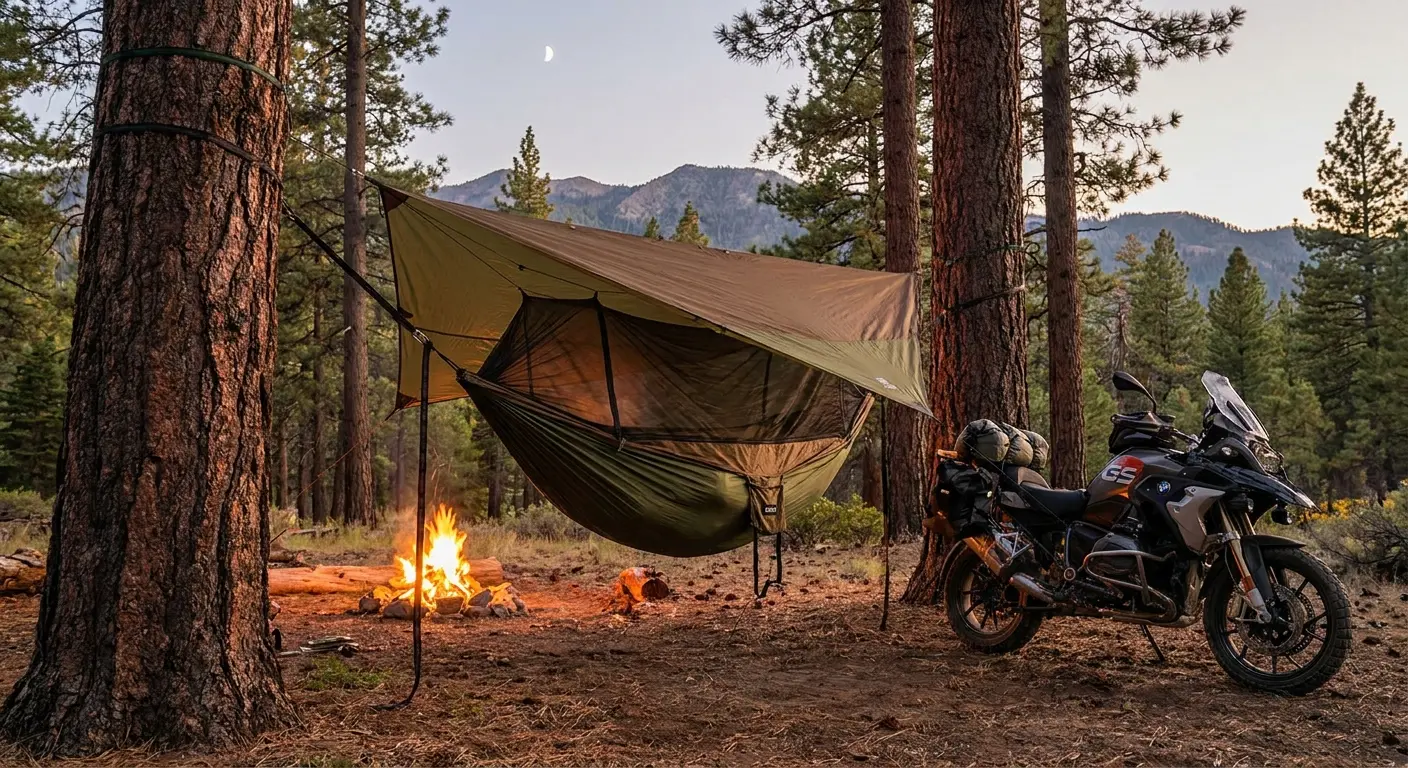
Weight limits matter. Your hammock and suspension system need to handle your weight plus the dynamic forces of getting in and out. Cheap hammocks fail catastrophically. This isn't gear where you want to cut corners, especially for motorcycle camping where you're already managing limited space.
The hammock thing is divisive. Some people are religious about it. I'm not one of them, but I get the appeal, especially in the Southeast where the ground is basically a bug convention center six months of the year.
Ground Sleeping Without Traditional Tents
Tarp shelters offer maximum versatility with minimal weight. A single tarp can configure dozens of ways depending on available anchor points, weather conditions, and terrain. You're trading simplicity of setup for flexibility and weight savings. I compared motorcycle tents on their own.
The skill requirement is higher. You need to understand basic shelter geometry, knot tying, and how to read weather and terrain to position your shelter effectively. This knowledge takes time to develop, but it makes you more adaptable than relying on a single-purpose tent.
Cowboy camping (sleeping with no shelter at all) works in dry climates and clear weather. Your sleeping bag and pad go directly on the ground. This is minimalism taken to its logical conclusion. You're completely exposed to weather changes, so this only works when you're confident in your forecast and willing to accept some risk.
Food Planning When You Can't Bring the Kitchen
Food planning for motorcycle camping requires different thinking than car camping or backpacking. You need calorie-dense options that don't require refrigeration, cooking systems that pack small but work reliably, and meals that don't demand extensive preparation after you're exhausted from riding all day.
The freeze-dried meal approach works but gets expensive and boring quickly. You're also locked into their portion sizes and flavor options, which might not match your actual needs or preferences for motorcycle camping nutrition.
Calorie Density Matters More Than You Think
Riding a motorcycle all day burns more calories than most people realize. You're fighting wind resistance, managing the bike's weight, and maintaining focus for hours. Your food needs to deliver serious energy in minimal volume and weight.
Nuts, nut butters, and dried fruits pack massive calories into small spaces. Olive oil adds caloric density to any meal. Hard cheeses don't require refrigeration for several days. Cured meats like salami last without cooling. These staples form the foundation of efficient motorcycle camping nutrition.
Instant rice and couscous cook quickly with just boiling water. Add olive oil, dried vegetables, and some protein, and you've got a legitimate meal that required one pot and ten minutes. This efficiency matters when you're setting up camp in fading light.
Single-Pot Cooking Systems
Your cooking setup should break down to a single pot that nests your stove and fuel canister. Anything more complex than this adds weight and hassle you don't need. A 900ml pot handles most solo meals and boils water for coffee or tea.
Canister stoves work in most conditions and pack smaller than liquid fuel systems. They're less efficient in extreme cold, but for three-season camping, they're hard to beat for convenience. The fuel canisters are your main limitation since you can't fly with them and finding the right thread type internationally can be challenging.
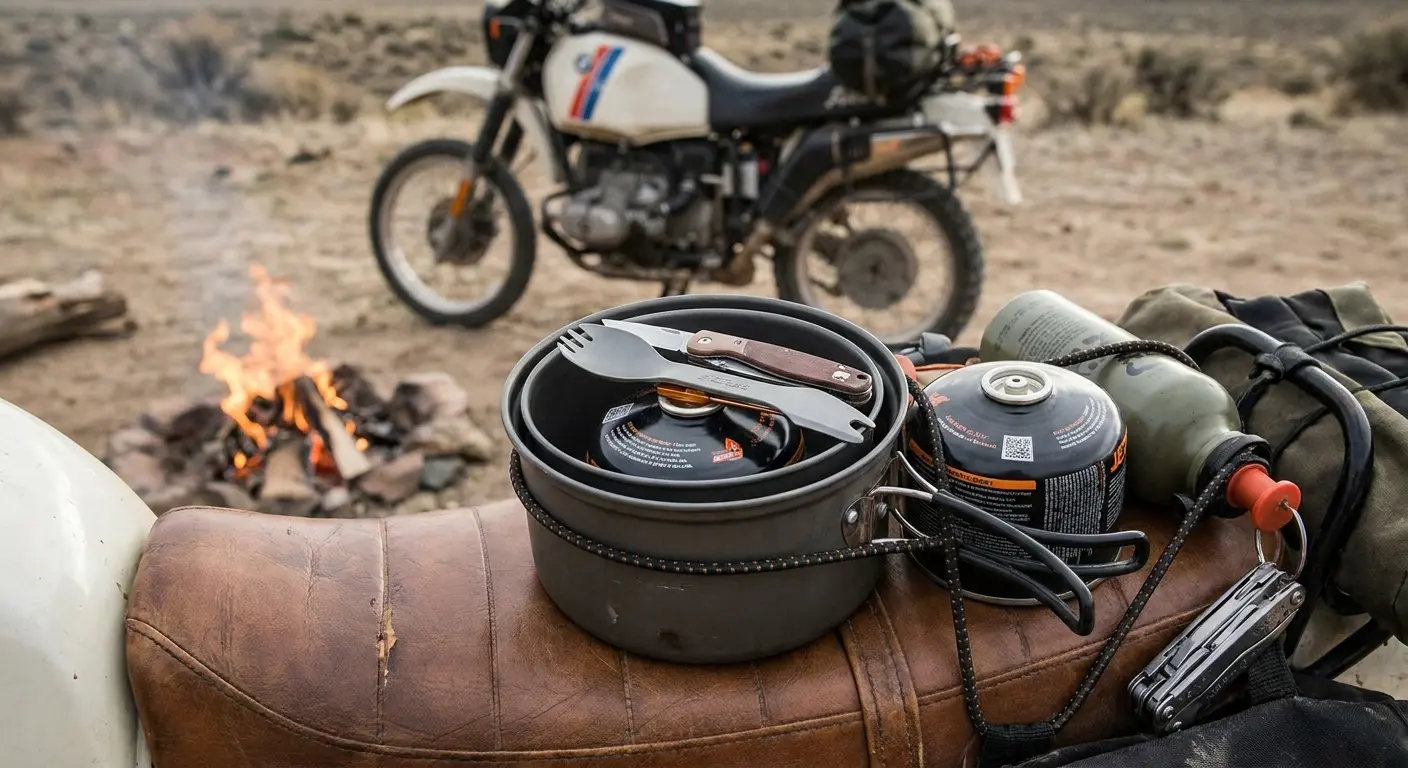
Alcohol stoves weigh almost nothing and fuel is available everywhere, but they're slower and less efficient. White gas stoves are bombproof and work in any conditions, but they're heavier and require more maintenance. Match your stove choice to your typical camping conditions, not theoretical extremes.
No-Cook Options That Don't Suck
Some days you'll arrive at camp too tired to cook or you'll be camping somewhere that prohibits fires and stoves. Having no-cook options prevents you from going hungry or forcing yourself through meal prep when you're depleted.
Tortillas stay fresh for days and wrap around anything. Peanut butter, honey, and banana makes a solid meal. Hummus and vegetables work. Canned fish with crackers delivers protein and calories. These aren't gourmet, but they're functional and require zero preparation.
Energy bars and trail mix work for lunch while riding. Pull over at a scenic spot, eat standing next to your bike, and get back on the road. This approach saves time and eliminates the need to set up a lunch cooking system.
Resupply Strategy for Extended Trips
Planning resupply points lets you carry less food at any given time. Small towns along your route have grocery stores. You don't need to carry a week's worth of food if you'll pass through civilization every few days during your motorcycle camping journey.
This requires route planning that accounts for store locations and your consumption rate. Build in buffer for the times when a store is closed or doesn't have what you expected. Carrying an extra day's worth of food provides this margin.
Dehydrating your own meals at home gives you better flavors and portion control than commercial options, but it requires upfront time investment and storage space for the dehydrated meals. This works well if you regularly take motorcycle camping trips and can spread out the work across multiple adventures.
Tool Kit: What Actually Matters
Your tool kit should match three factors: your bike's specific needs, your mechanical ability, and how remote your riding will be. Carrying tools you don't know how to use helps nobody. Skipping tools for repairs you could perform is equally foolish.
Start with your bike's manual and identify routine adjustments you might need to make. Chain tension, clutch cable adjustment, brake lever position. These are high-probability needs that require specific tools. Build your motorcycle camping gear list around these tasks first.
Bike-Specific Essentials
Every bike has particular quirks and common failure points. Research your model's known issues. If your bike's voltage regulator fails regularly, carrying a spare makes sense. If it's bulletproof, that space is wasted.
Metric versus standard tools matter. Don't carry both unless your bike uses both. Know your bike's fastener sizes and carry only what you need. A compact socket set covering your bike's bolt sizes weighs less than a full set covering every possible size. This focused approach keeps your motorcycle camping gear list lean.
Tire repair capability is non-negotiable. Plugs, patches, or both depending on your preference and tire type. A way to inflate the tire after repair (CO2 cartridges or compact pump). The tools to remove whatever's punctured your tire. Practice this repair at home so you're not learning during a roadside emergency.
Chain adjustment requires specific tools based on your bike's design. Some bikes need just a wrench. Others require special tools to access the adjustment bolts. Know what your bike needs and carry those specific tools. Chain lube is essential for longer trips. A small bottle goes far. Your chain needs regular lubrication, especially if you're riding in dusty or wet conditions.
A chain breaker and spare master link give you options if your chain fails completely. This is advanced repair territory, but if you're riding truly remote areas, it might save your trip. Know how to use these tools before you need them in an emergency.
Multi-Tools Versus Individual Tools
Quality multi-tools pack many functions into compact spaces, but they compromise on leverage and ergonomics. Individual tools work better but take more space. The right answer depends on your specific needs.
For routine adjustments and minor repairs, a good multi-tool handles most situations. For tasks requiring serious torque or precision, dedicated tools work better. Many riders carry both: a multi-tool for convenience and a few specific tools for known high-torque or precision tasks.
Leatherman and similar brands make motorcycle-specific multi-tools with common metric sizes and features including bit drivers. These work well for general use. Add individual wrenches for your bike's axle nuts or any fasteners that require significant torque.
Spare Parts Worth Carrying
Fuses are tiny, weigh nothing, and their failure will strand you. Carry spares for every fuse type on your bike. Label them clearly so you can identify the right replacement quickly.
Clutch and throttle cables fail. Carrying spares is cheap insurance, but only if you know how to install them. Practice the replacement at home. It's not intuitive, and fumbling through it roadside wastes hours.
Zip ties, duct tape, and wire fix temporary problems until you can reach proper repair facilities. These items solve problems you can't anticipate. They're light enough that carrying extras costs you nothing.
Weather Protection Without the Bulk
Weather protection for motorcycle camping means solving two different problems: staying comfortable while riding and staying comfortable in camp. Gear that excels at one often fails at the other. You need items that work adequately for both or a minimal system that covers both scenarios without redundancy.
Layering beats specialized gear almost every time. Three versatile layers handle more conditions than six specialized pieces, and they pack smaller while offering more configuration options for motorcycle camping.
Base Layer Strategy
Merino wool or synthetic base layers regulate temperature, manage moisture, and don't smell terrible after multiple days of wear. Cotton kills (this rule matters when you're motorcycle camping). Wet cotton sucks heat away from your body and takes forever to dry.
One or two base layers handle most conditions. A lightweight option for warm weather and moderate days. A midweight option for cold mornings and evenings. You can wear both together in seriously cold conditions. This two-piece system covers a massive temperature range without filling your bags during motorcycle camping trips.
Base layers should fit close to your skin without restricting movement. Loose base layers bunch under other clothing and reduce their effectiveness. Too tight and they're uncomfortable for all-day wear. Find the balance that works for your body.
Insulation That Packs Small
Down jackets compress to nearly nothing and provide serious warmth for minimal weight. They fail when wet, so you need to keep them dry. Synthetic insulation works when wet but packs larger and weighs more. Choose based on your typical conditions.
A puffy jacket works for camp and as an emergency layer while riding if weather turns colder than expected. It should fit over your base layer but under your rain shell. This layering compatibility matters more than the jacket's standalone features for motorcycle camping versatility.
Insulated pants sound excessive until you're trying to sleep in 35-degree weather and your sleeping bag's temperature rating was optimistic. Lightweight insulated pants pack small, add warmth to your sleep system, and work as a camp layer on cold evenings.
Rain Protection That Works
I still can't figure out the perfect rain gear situation. I've tried four different setups and they all suck in different ways. Too waterproof and I'm swimming in sweat. Too breathable and I'm soaked in rain. Currently using a two-piece suit that at least keeps me mostly dry, but I'm open to suggestions.
Rain gear for motorcycle riding needs to block wind and water at 60 mph while not turning into a sauna when you slow down. Two-piece rain suits (jacket and pants) work better than one-piece options for motorcycle use. You can add or remove pieces based on conditions. Pants go on over your boots and riding pants. Jackets should fit over your riding jacket without being so loose they catch wind and flap.
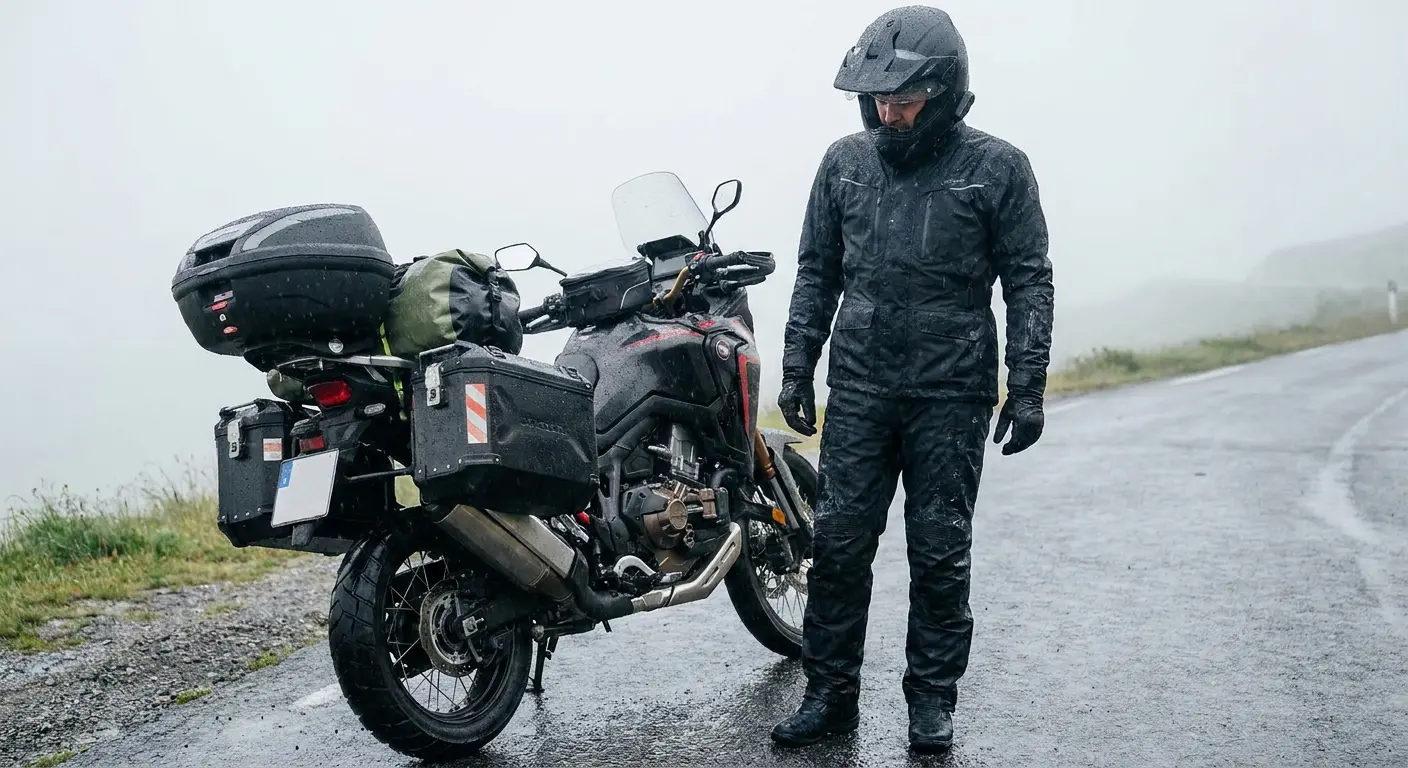
Sealed seams and waterproof zippers matter. Cheap rain gear fails at the seams first. Water finds every unsealed stitch. Investing in quality rain gear pays off the first time you ride through hours of rain and arrive dry.
Wet gear needs to dry before it mildews or becomes useless. This is harder than it sounds when you're camping. You can't throw things in a dryer. Hanging wet items in your tent creates condensation problems.
String a clothesline between trees at camp. Even if items don't fully dry overnight, they'll be less wet than when you hung them. Morning sun helps finish the job while you're making coffee and breaking down camp.
Stuff sacks with waterproof liners keep dry items dry even if the outside of your luggage gets soaked. This separation prevents one wet item from contaminating everything else. Pack your sleep system and insulation in waterproof stuff sacks regardless of your luggage's waterproof claims.
Finding Campsites That Match Your Setup
Campsite selection changes when you're on a motorcycle. You need different ground conditions than car campers, you have different security concerns, and your ability to access remote sites differs from both cars and backpackers. Your motorcycle camping setup requires thoughtful site selection.
Established campgrounds offer amenities but often charge fees comparable to budget motels. The value proposition weakens when you're paying $30 to pitch a tent in a crowded campground with RVs running generators. Sometimes it's worth it for the shower and security. Other times you're better off finding dispersed camping for your motocamping adventure.
Dispersed Camping on Public Land
National forests, BLM land, and some state lands allow dispersed camping. You can camp free almost anywhere outside designated wilderness areas, usually with a 14-day limit. This freedom is incredible for motorcycle camping, but it requires more planning and self-sufficiency.
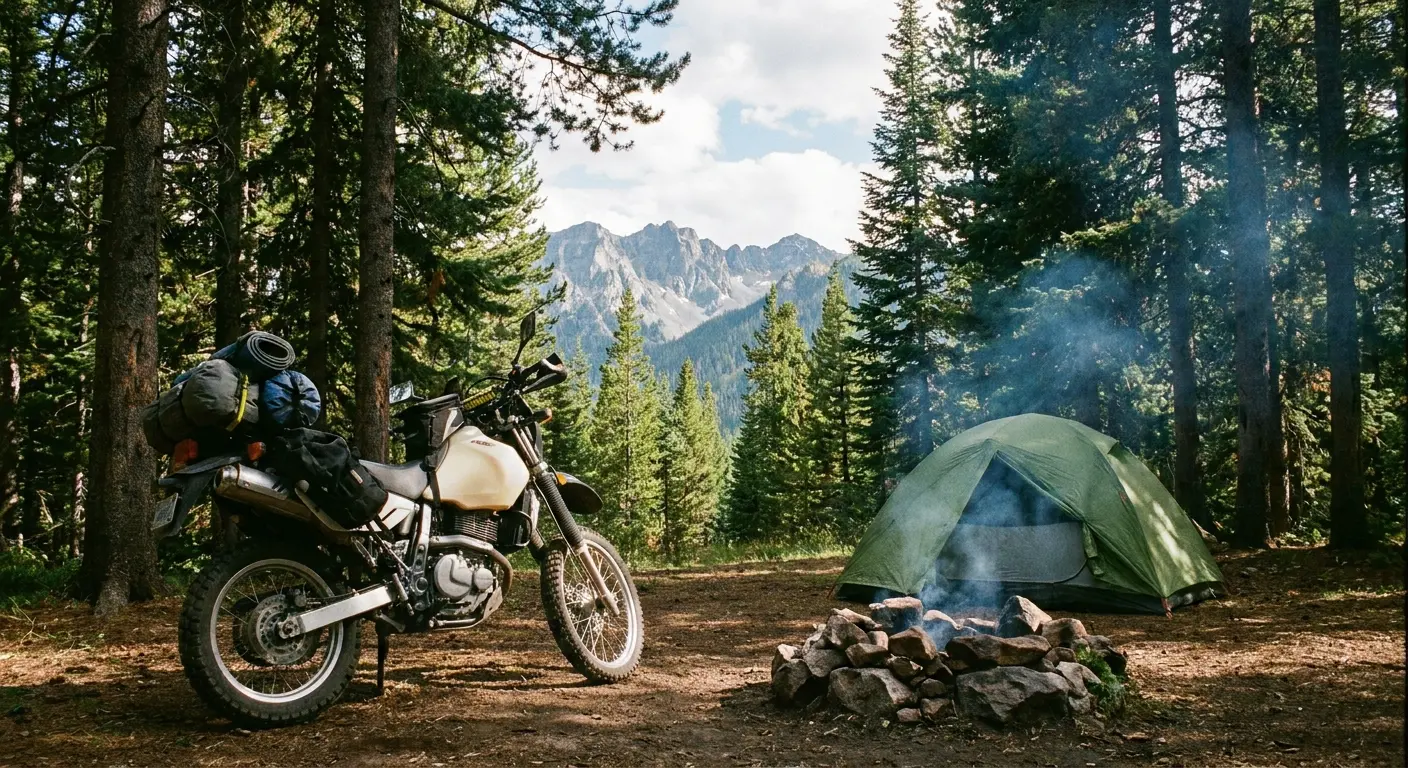
Finding good dispersed sites takes practice. Forest service roads leading away from main routes often have established sites where previous campers have cleared ground and created fire rings. These sites offer the advantages of dispersed camping with some of the convenience of established spots for your motocamping setup.
Water access becomes your primary concern. You need to know where you can refill or carry enough for your stay. Filtering from natural sources works if you have the right equipment and knowledge. Many dispersed sites are nowhere near water, requiring you to pack in everything you'll need.
Ground Surface Considerations
Your bike's kickstand needs solid ground. Soft dirt, sand, or loose gravel lets the kickstand sink, potentially dropping your bike. Carrying a kickstand puck (a small plate that distributes weight) solves this problem and weighs almost nothing for your motorcycle camping setup.
Level ground matters more for your bike than your tent. You can sleep on a slight slope. Your bike can't stand safely on one. Scout the site before you start unloading. Moving your bike after you've unpacked everything is frustrating during your motocamping experience.
Drainage matters if there's any chance of rain. Low spots collect water. Sleeping in a puddle ruins your night and potentially your gear. Look for slight elevation and natural drainage paths away from where you'll sleep.
Security When Camping Solo
Your bike and gear represent significant value sitting unattended at a campsite. Dispersed camping in remote areas usually means low theft risk because there's nobody around. Established campgrounds near population centers carry higher risk during motocamping trips.
A disc lock with alarm provides basic security and weighs little. The alarm triggers if someone moves your bike, which might deter opportunistic theft. It won't stop a determined thief with a truck, but most motorcycle theft is opportunistic.
Camping near other motorcycle travelers provides informal security through numbers. You look out for each other's gear. This community aspect is one of the benefits of established motorcycle camping areas and rally sites.
Keep valuables with you in your tent. Your phone, wallet, and keys should never be left on your bike overnight. If something happens to your bike, you still have the means to call for help and prove your identity.
Documentation and Navigation Tools Worth Carrying
Navigation and documentation deserve more thought than most riders give them. Your phone handles most of this until it doesn't, then you're stuck without backup options. Building redundancy into your navigation and information systems prevents minor issues from becoming trip-ending problems. These items belong on every motorcycle camping gear list.
Digital tools work great until batteries die, screens break, or you drop your phone off a cliff trying to get a photo. Physical backups weigh almost nothing and work regardless of power or connectivity (essential camping gear for motorcycle camping).
Route Planning Before You Leave
Planning your route involves more than drawing a line between start and finish points. You need to consider fuel range, campsite availability, road conditions, and seasonal closures. This research prevents you from riding 200 miles out of your way because a mountain pass is still snowed in.
Offline route planning tools let you build detailed routes with waypoints, fuel stops, and potential campsites marked. Export these routes to your GPS device and phone. Having the same route on multiple devices provides backup if one fails.
Build flexibility into your plans. Rigid itineraries create stress when weather changes or you find a spot worth exploring. Mark potential campsites every 50-100 miles so you have options based on how far you ride each day. Some days you'll feel strong and cover more ground. Other days you'll want to stop early.
Physical Maps as Backup Systems
A waterproof map covering your general route area costs $10 and works when everything electronic fails. You don't need detailed maps of every back road. You need enough geographic context to find major routes and towns if your GPS dies.
Mark your planned route on the physical map before you leave. Add fuel stops and known camping areas. This preparation means the map is immediately useful if you need it, not just a piece of paper requiring interpretation during an emergency.
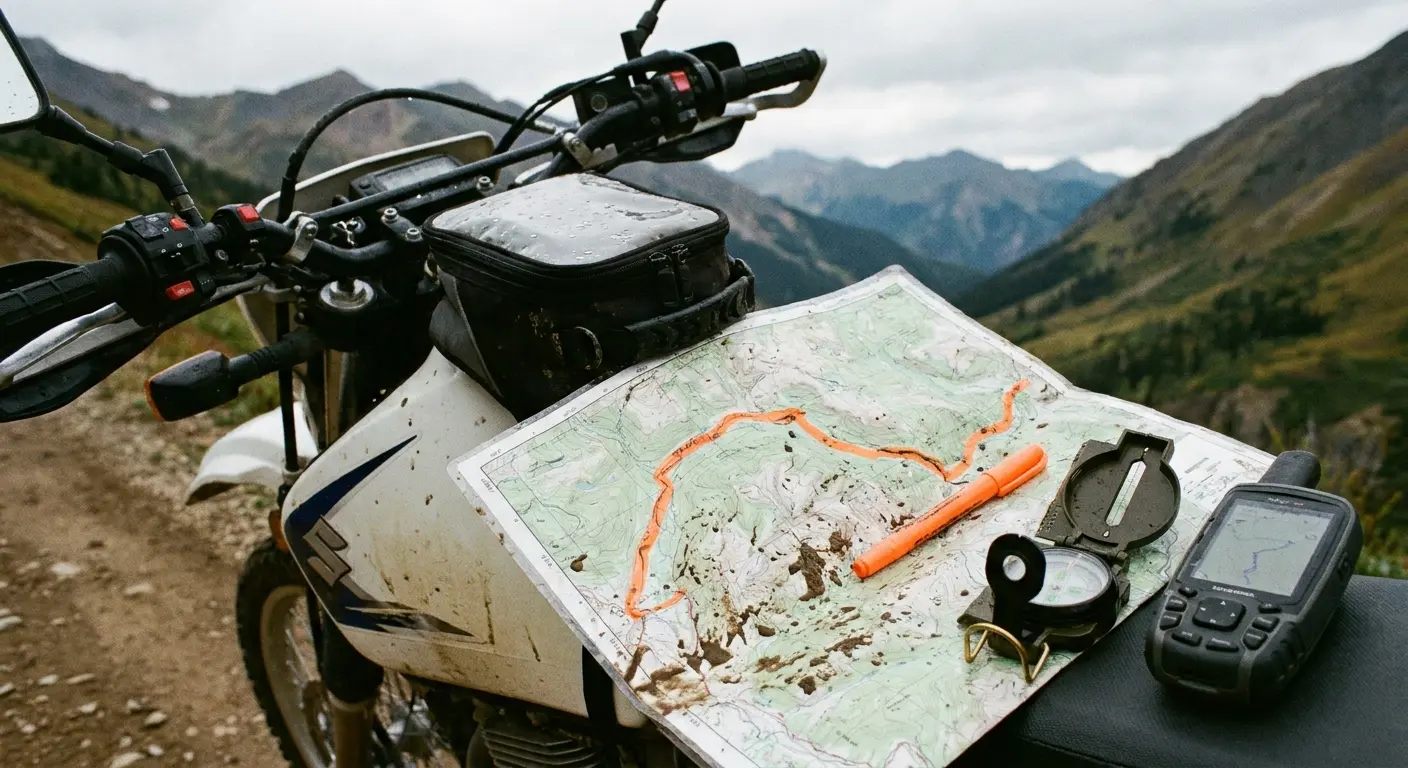
Gas station maps work in a pinch. Grab them when you fuel up in unfamiliar areas. They're free, cover the local region, and give you basic navigation capability. The quality varies, but something is better than nothing.
Documentation for Different Scenarios
Your motorcycle's registration and insurance documents should be accessible without unpacking your entire luggage system. A waterproof document pouch strapped somewhere you can reach it quickly solves this. You'll need these documents at border crossings, checkpoints, and if you're stopped by law enforcement.
Camping permits for national parks and some wilderness areas require advance reservation. Print these confirmations and carry them with your other documents. Rangers checking permits don't always have connectivity to verify digital confirmations.
Emergency contact information should be written down and stored separately from your phone. If something happens to you, first responders need to know who to call. A laminated card with emergency contacts, medical information, and insurance details belongs in your wallet or jacket pocket.
International motorcycle camping adds documentation complexity. You need your passport, potentially visas depending on destination, and vehicle importation paperwork for some countries. Research requirements months before your trip because some documents take weeks to obtain.
Vehicle insurance often doesn't cover you across borders. You might need to purchase separate coverage at the border or arrange international coverage before you leave. Riding without proper insurance in a foreign country creates massive liability if something goes wrong.
Carnet de passages serves as a temporary vehicle import document for certain countries. This isn't required everywhere, but some nations won't let you enter without it. The process involves posting a bond and working through an automobile association. Start this process early if your trip requires it.
So What Have We Learned Here
Look, I've written like 5,000 words about strapping camping gear to motorcycles, which is either helpful or a sign I need more hobbies. The real point is simpler than all this: start with a weekend trip, bring too much stuff, figure out what you didn't use, leave it home next time. Repeat until you've got a system that works for you, not some internet stranger's idea of the perfect setup.
Everything I'm saying here is biased toward where I ride (mostly Rockies and Southwest). If you're in the humid Southeast or Pacific Northwest, your priorities shift. Rain gear moves way up the list. Ventilation becomes critical. I'm probably the wrong person to advise on that.
There's this ongoing argument on ADVrider about whether satellite communicators are worth it. I've read probably 40 pages of people arguing about it. My take: if you're going truly remote and solo, yeah. Otherwise, save your money. But I get why people disagree.
Met a guy at a campsite in Idaho who had the most ridiculous setup I'd ever seen (dude had a portable espresso maker). We're talking about ultralight camping and this guy's making lattes. But you know what? He was happy. That's the point I guess.
I once brought a camp chair. A full-size camp chair. It was amazing for exactly one evening before I realized I'd basically strapped a La-Z-Boy to my bike and looked like I was moving apartments. It went in a gas station dumpster in Utah.
Then go ride somewhere cool and sleep outside. That's the whole point.
For more insights on optimizing your motorcycle setup for adventure, check out our guide on essential motorcycle accessories and explore protective cases designed specifically for riders who demand durability without compromise.

