


Table of Contents
-
Power Source Variations
Gas-Powered Golf Carts
Electric Golf Carts
Solar-Assisted Electric Carts
Hybrid Golf Carts
Lithium-Ion Battery Carts
-
Design and Build Configurations
Two-Seater Standard Carts
Four-Seater Extended Carts
Six-Seater Stretch Carts
Lifted Golf Carts
Low-Speed Vehicle (LSV) Carts
Utility and Cargo Carts
-
Specialty and Niche Applications
Street-Legal Golf Carts
Off-Road and All-Terrain Carts
Custom-Built Golf Carts
Vintage and Restored Carts
Rental Fleet Carts
TL;DR - The Stuff That Actually Matters
Lithium batteries cost more upfront but you'll save money over 10 years. Do the math.
Six-seater carts are almost always a mistake unless you're hauling groups multiple times per week
Lifted carts look cool and handle like crap on pavement. Don't buy one for a flat neighborhood.
Custom builds tank in resale value. Build one if you're rich and don't care about money.
Ex-rental fleet carts are ugly but reliable and cheap. Best value in the used market.
Most people don't need gas. Electric works fine if you're not covering huge distances daily.
Power Source Variations
Here's what I see every week: someone walks into the shop, looks at price tags, and buys the cheapest cart on the lot. Six months later they're back, pissed off, because their batteries died or they can't climb the hill to their house.
The sticker price is literally the least important number you should be looking at.
Power source, seating configuration, intended use. These determine whether you'll love your cart or hate it. Gas or electric? Lead-acid or lithium? Get this wrong and you'll regret it for years.
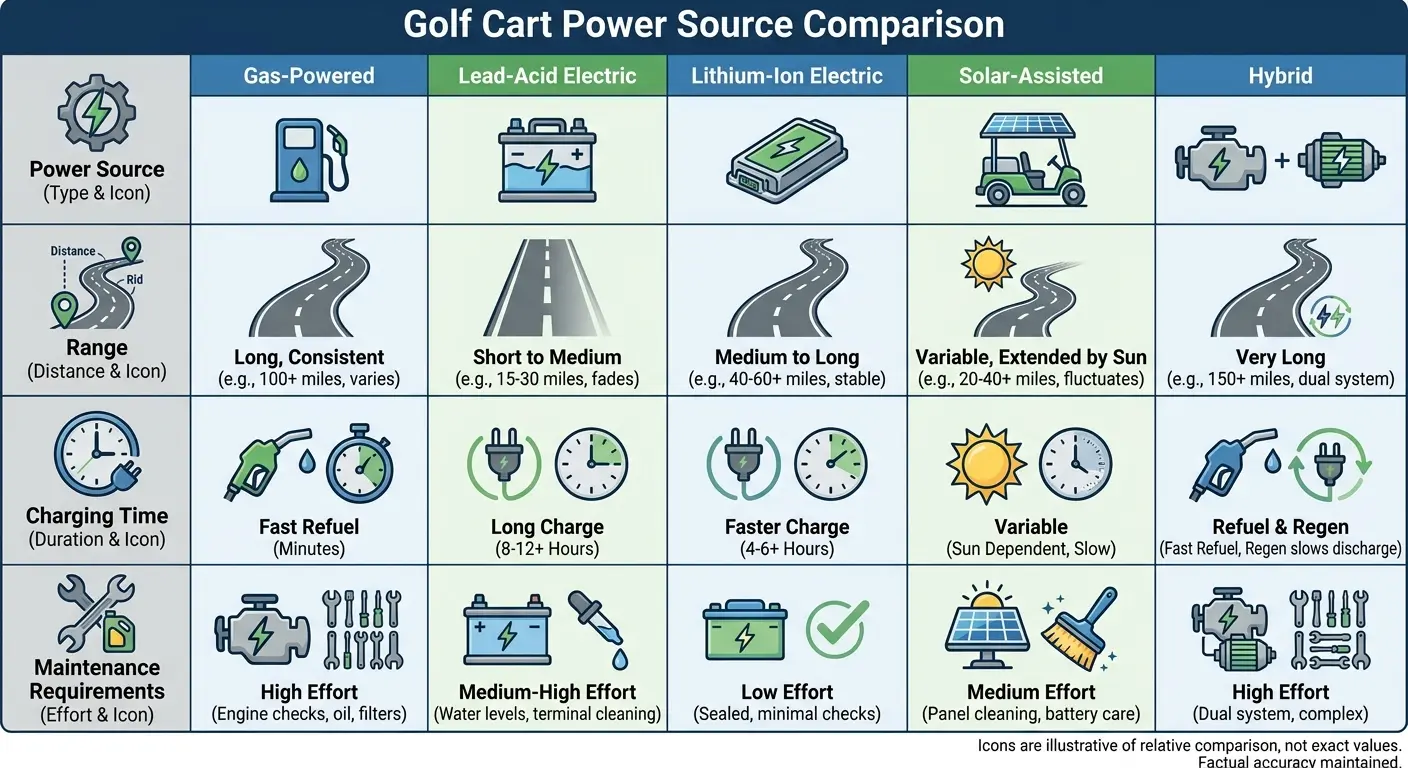
Power Source |
Typical Range |
Refuel/Recharge Time |
Maintenance Headache Factor |
Who Actually Needs This |
|---|---|---|---|---|
Gas-Powered |
100-180 miles per tank |
5 minutes |
High (oil changes, filters, spark plugs) |
Large properties, commercial operations |
Electric (Lead-Acid) |
20-30 miles per charge* |
6-8 hours |
Low (battery water checks) |
Golf courses, short daily routes |
Electric (Lithium-Ion) |
30-50 miles per charge |
2-3 hours |
Very Low |
Daily commuting, frequent use |
Solar-Assisted Electric |
25-40 miles per charge |
6-8 hours + solar trickle |
Low |
Sunny climates, outdoor parking |
Hybrid |
60-100 miles |
Minimal (self-charging) |
High (dual systems) |
Commercial applications, extended range needs |
*In ideal conditions. Real-world performance? Cut these numbers by 20%.
1. Gas-Powered Golf Carts
Gas golf carts deliver consistent power regardless of how long you've been driving. The throttle response stays crisp whether you're on mile one or mile fifty. No gradual power fade like electric models show as batteries drain.
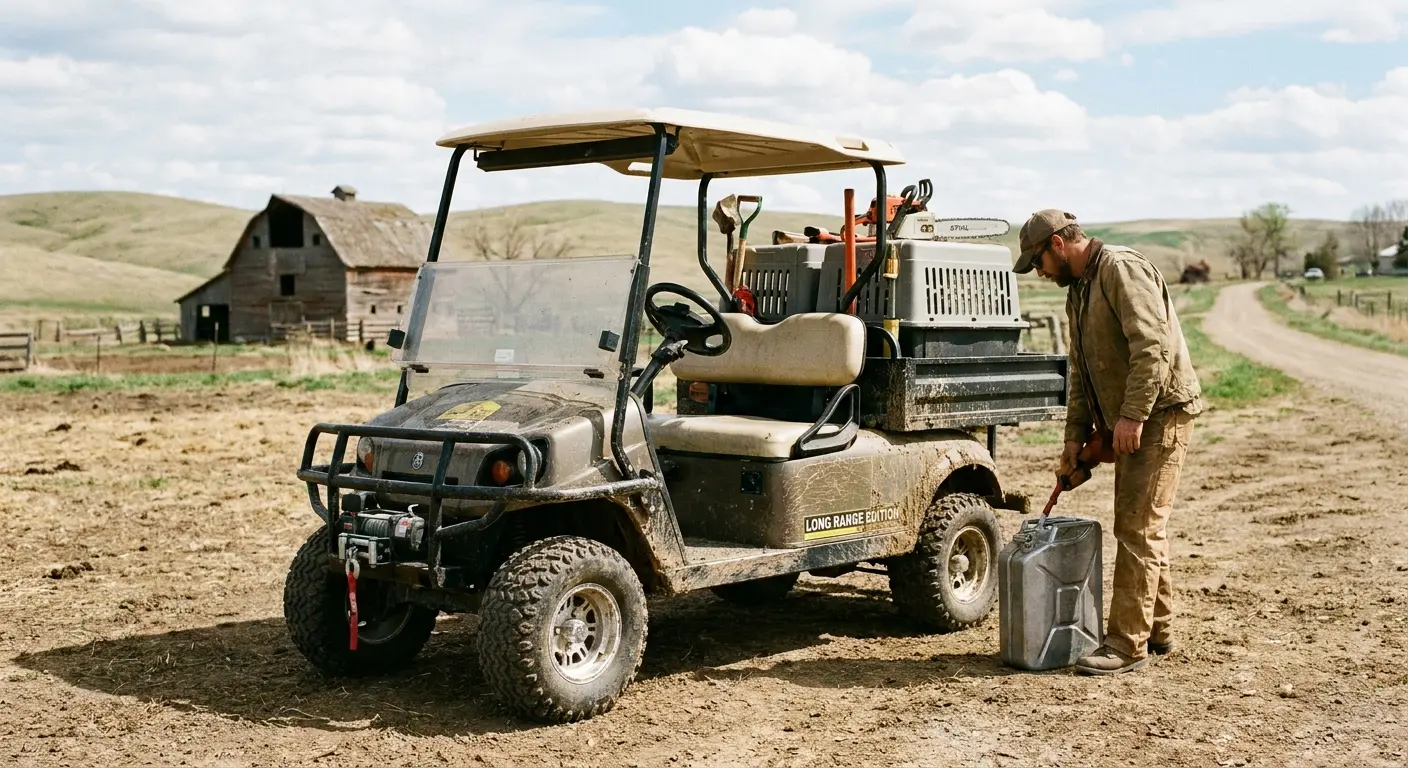
These carts excel when you need extended range without access to charging infrastructure. I've seen them dominate large properties, hunting leases, and commercial operations where downtime for charging isn't practical. A gas cart can run all day with just a quick fuel stop.
Maintenance is a pain though. Oil changes every 50 hours. Air filters. Spark plugs. Gas storage. It adds up fast. Budget $300-500 per year in maintenance you won't have with electric. Fuel costs fluctuate with gas prices too.
These things are loud. Like riding-lawnmower loud. Your neighbors will hear you coming from three houses away. Some people love the engine rumble. Others hate it. There's no middle ground.
Club Car and Yamaha make solid gas carts. I've seen 20-year-old models still running.
2. Electric Golf Carts
Electric golf carts have become the default choice for golf courses because they're quieter and require less routine maintenance. No oil changes, fuel filters, or exhaust system concerns. The power delivery feels smoother, and you won't smell exhaust fumes during operation.
Range anxiety is real though.
Most traditional electric carts with lead-acid batteries claim 20-30 miles per charge. That's on flat ground, no cargo, perfect weather. Add hills? Cold weather? Passengers? You're looking at 15 miles, maybe less. You'll spend half your time worrying about making it home.
Charging takes 6-8 hours typically, so you need to plan ahead. The upfront cost runs lower than gas models, but battery replacement every 4-6 years at $900-1,200 per set is a real expense. Yamaha electrics are reliable. Not exciting, but they work.
Here's what the sales guy won't mention: electric carts slow down as the battery drains. Not just range but actual speed and power. That last 20% of battery charge? Your cart will feel sluggish. Lithium doesn't have this problem, but lead-acid absolutely does.
Do the math on your daily mileage. Seriously. If you're going to be cutting it close on range every day, you'll hate your life. Constantly checking the battery meter gets old fast.
3. Solar-Assisted Electric Carts
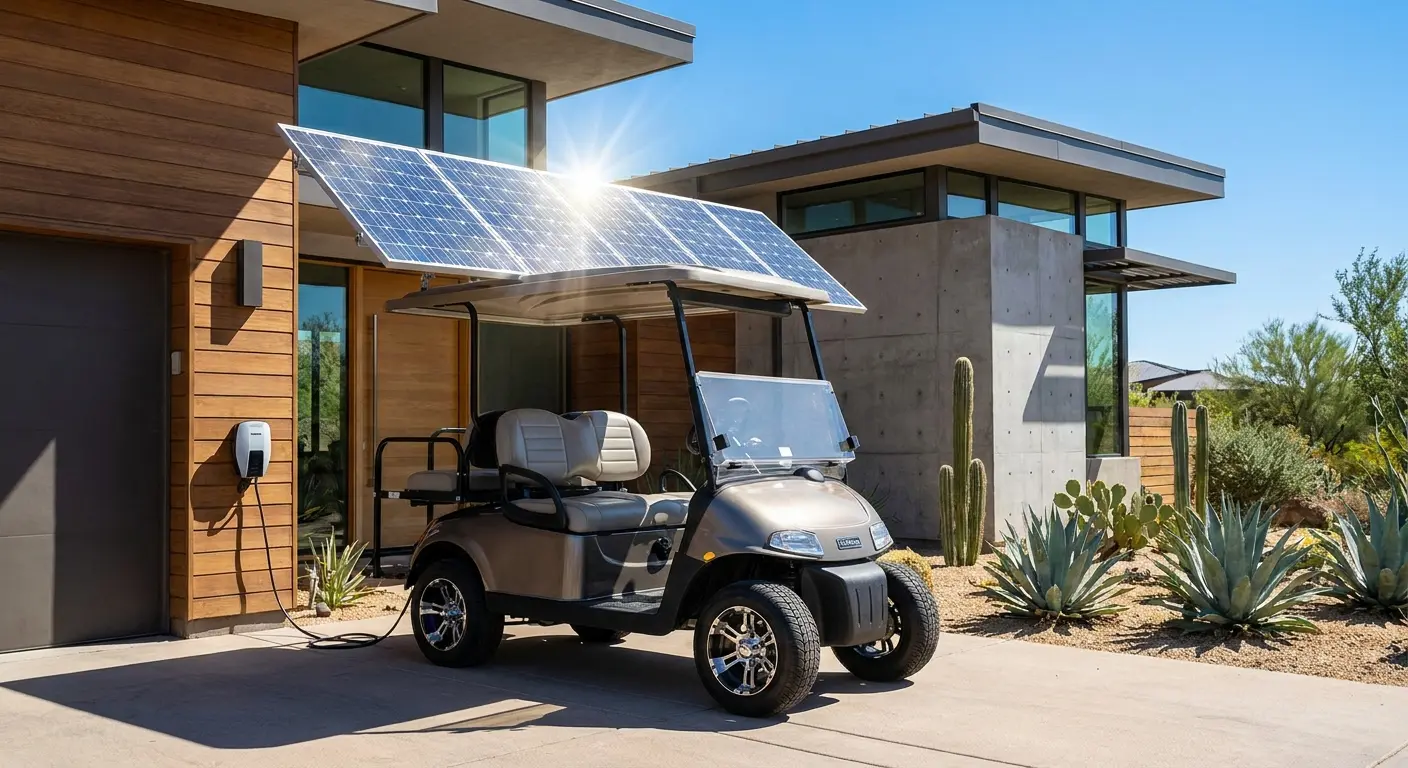
Let's be clear: solar panels won't power your cart. They help a little. Maybe 5-10 extra miles on a sunny day. That's it.
The real benefit comes from extending battery life by reducing discharge depth during use. Your batteries stay healthier longer when they're constantly receiving trickle charging. This translates to fewer replacement cycles and lower long-term costs.
Installation costs add $800-1,500. For that money, you could upgrade to lithium batteries, which would actually improve your range. These systems make the most sense in sunny climates where carts sit outside during the day. If you park in a garage or covered area, you're not capitalizing on the solar advantage.
Look, if you want solar panels because they make you feel good about the environment, go for it. Just don't expect them to actually solve your range problems. They won't.
4. Hybrid Golf Carts
Hybrid golf carts are a solution looking for a problem. They cost twice as much as regular carts, combine all the maintenance headaches of gas AND electric, and solve basically nothing for normal people.
The gas engine acts as a generator, charging batteries while you drive or when stationary. Extended range without long charging times sounds great in theory. In practice? These things run $12,000-18,000 new. You could buy two standard electric carts for that price.
Maintaining both a gas engine and an electric system means double the potential failure points. The technology hasn't achieved widespread adoption in the golf cart market the way it has in automotive applications. Availability is limited, and finding qualified technicians can be challenging outside major metropolitan areas.
Unless you're running a commercial operation where downtime costs you money, skip these entirely. I've seen maybe three recreational buyers who actually needed a hybrid. Three. In fifteen years.
5. Lithium-Ion Battery Carts
The first time you drive a lithium cart after lead-acid, you'll think something's wrong. It's that much more responsive. The acceleration feels like you upgraded to a sports cart.
Lithium batteries cut battery weight by 60-70% compared to lead-acid. That's the difference between 400 pounds and 140 pounds. You'll feel it immediately in acceleration and hill climbing. Instead of 25 miles per charge, you're getting 30-35. That's the difference between making it home and walking the last mile.
Charging time drops to 2-3 hours for a full charge. The batteries last 10+ years typically, eliminating the frequent replacement cycle of lead-acid options.
Lithium costs $3-5K more upfront. But here's the math: lead-acid batteries need replacing every 4-6 years at $900-1,200 per set. Over 10 years, you'll replace them twice. That's $1,800-2,400 in batteries alone.
Lithium lasts the full 10 years. The premium pays for itself.
A lithium cart performs the same whether the battery is at 90% or 20% charge. Lead-acid carts noticeably slow down as they drain. Cold weather performance is superior too. If you're buying a new golf cart and plan to keep it long-term, lithium batteries are worth the investment.
Get the lithium batteries if you can afford them. I don't care what the salesman says about lead-acid being "good enough." It's not.
Design and Build Configurations
A two-seater handles nothing like a six-seater. Nothing.
The physical layout and construction determines daily usability more than brand names or cosmetic features. A standard two-seater handles completely differently than a stretched six-passenger model. Lifted carts with oversized tires create capability but introduce new limitations.
This section focuses on matching cart design to your specific needs. Whether you're transporting a family around a retirement community, hauling equipment on a farm, or meeting street-legal requirements for neighborhood driving, the right configuration makes all the difference.
6. Two-Seater Standard Carts
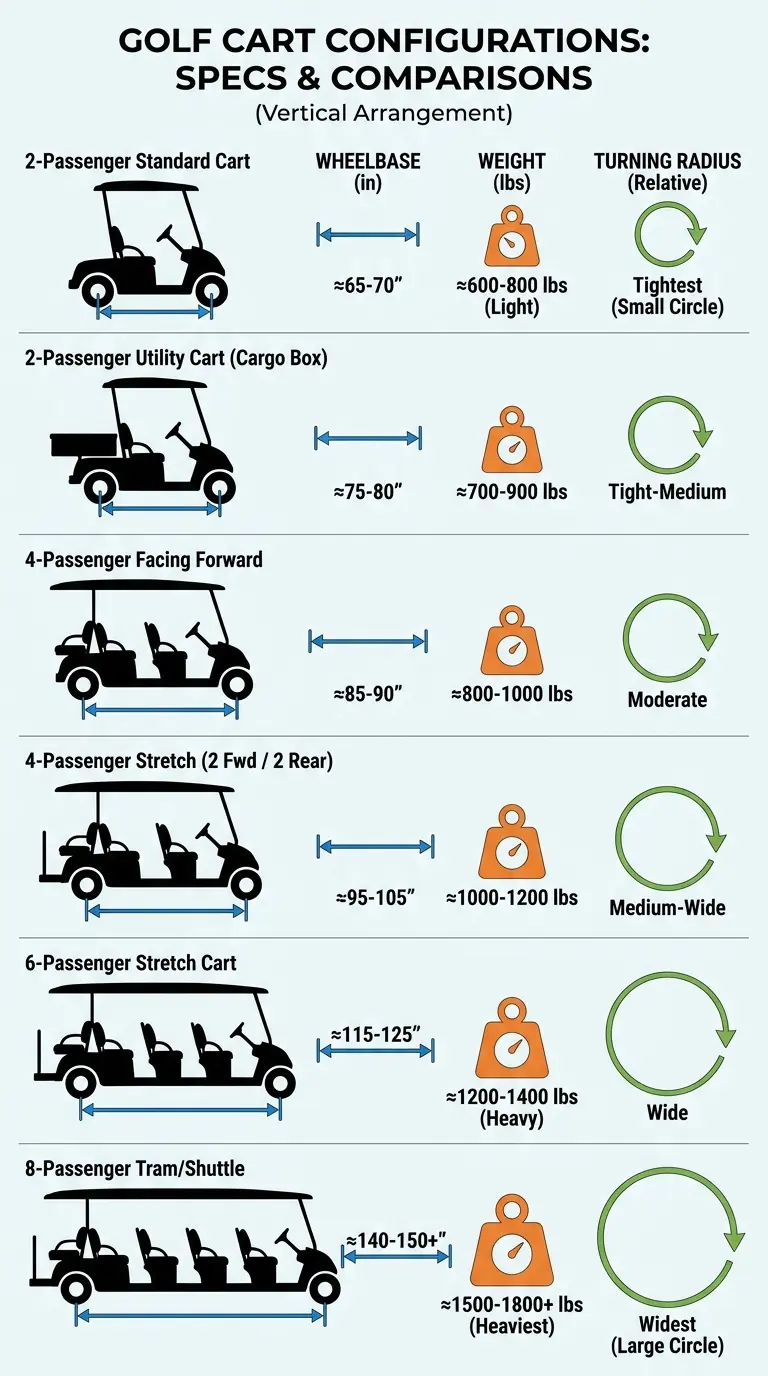
Standard two-seater carts represent the baseline design that golf courses have used for decades. Compact footprint that handles narrow cart paths and tight turns easily. The shorter wheelbase makes parking simple and allows you to maneuver in congested areas.
These carts typically weigh 700-900 pounds, making them the most efficient option for battery life and power consumption. Rear cargo space is limited to golf bags and small items. Club Car two-seaters are tanks. They last forever.
Buy a two-seater if you're mostly solo or with one other person. That's it. Simple formula. Don't overthink it.
Fewer parts, less weight, cheaper to run. Plus you can actually maneuver the thing in tight spaces. Resale value stays strong because this size has the broadest market appeal.

7. Four-Seater Extended Carts
Four-seater carts add a rear-facing bench seat behind the front seats. The wheelbase extends by about 20 inches, which affects turning radius and maneuverability in noticeable ways.
These carts work well for families or small groups who need to stay together. The rear seat typically folds down to create cargo space when you're not carrying passengers. Weight increases to 900-1,100 pounds, which impacts battery range and acceleration compared to two-seaters.
Hills will humble you with four people onboard. What your two-seater climbed easily? The four-seater struggles. Factor that in if your property isn't flat.
Tight parking spaces and narrow paths become a problem. The extra length makes parking harder and the cart feels less stable on slopes. You'll notice it every time you drive.
Yamaha makes solid four-seaters if you go this route. Decent quality, fair pricing.
8. Six-Seater Stretch Carts
Think you need six seats?
Six-seater stretch carts accommodate large groups but introduce serious handling compromises. The wheelbase extends 40-50 inches beyond standard length. Turning radius expands dramatically, making U-turns on standard cart paths difficult or impossible.
Weight climbs to 1,200-1,400 pounds empty, which means you need robust motors and substantial battery capacity. Hills become a real challenge with a full passenger load. I've seen these carts struggle on inclines that standard models handle easily.
I see these sitting in driveways all the time. Bought for family reunions or group outings. Used at capacity maybe five times a year. The other 360 days? The owner is driving solo, fighting with the turning radius, and struggling up hills.
Terrible trade-off.
Don't buy a six-seater unless you're hauling six people multiple times per week. Not month. Week. Parking requires careful planning because you're dealing with a vehicle that's approaching the length of a compact car. Maintenance costs run higher due to increased wear on suspension components and tires.

9. Lifted Golf Carts
Lifted carts are tippy. I'm not exaggerating. The higher center of gravity makes them want to roll in turns. Take a corner too fast and you'll feel it lean hard.
Lifted golf carts feature suspension modifications that raise the chassis 4-6 inches higher than stock. Larger tires, typically 20-23 inches instead of standard 18-inch wheels, and extended shocks. Ground clearance increases substantially, allowing you to cross rough terrain, shallow water, and obstacles that would stop a standard cart.
People roll these. Not often, but it happens. Usually showing off, taking a turn too fast, or hitting uneven ground at speed. The higher center of gravity is real physics, not just theory.
Speed typically increases due to larger tire diameter, but acceleration suffers. Battery drain accelerates because you're fighting increased rolling resistance and weight. Lifted carts often add 150-200 pounds to the base weight. These modifications usually void manufacturer warranties.
For hunting leases or beach properties with rough terrain? Fine. For cruising around a flat golf community ? Stupid and potentially dangerous. Don't be the guy who rolls his cart showing off.
10. Low-Speed Vehicle (LSV) Carts
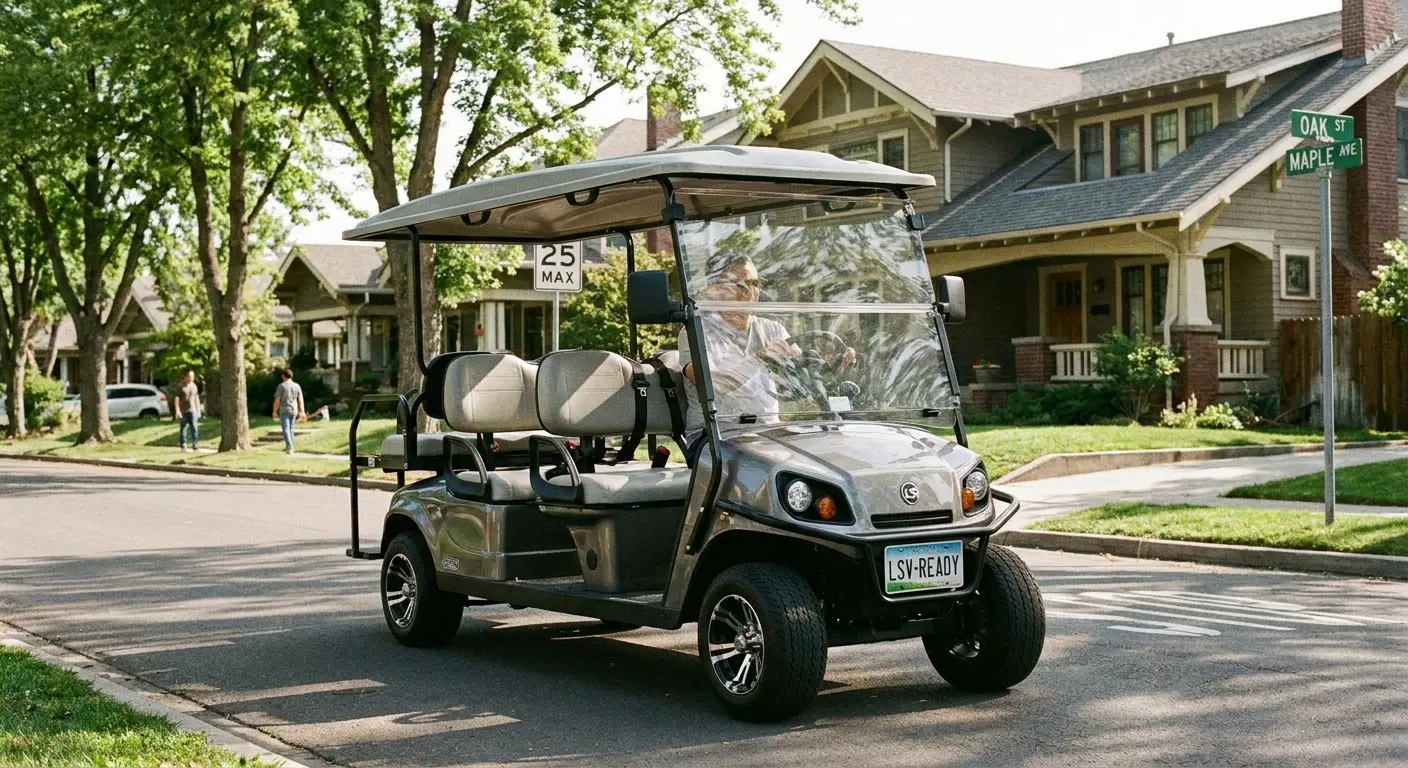
LSV carts meet federal safety standards (FMVSS 500) that allow them to operate on roads with speed limits up to 35 mph. Headlights, taillights, turn signals, mirrors, seat belts, and a VIN number are required. The cart must be capable of reaching 20-25 mph.
These features add cost but provide legal street access in many jurisdictions. You'll need to register the vehicle, carry insurance, and in most states, have a valid driver's license to operate one.
LSV laws are a mess. What's legal in Florida might get you ticketed in Georgia. Some neighborhoods allow them, some don't. Some cities require them on certain roads, ban them on others.
Call your local DMV before you buy. I've seen people drop $15K on an LSV cart they can't legally drive where they live. Don't be that person.
LSV carts bridge the gap between traditional golf carts and full automobiles. They work well in master-planned communities, beach towns, and areas with established low-speed vehicle infrastructure. The safety equipment adds weight and complexity compared to standard carts.
11. Utility and Cargo Carts
Utility carts replace passenger seating with flatbed cargo areas or dump beds. Load capacities range from 500 to 1,200 pounds depending on the model. These carts feature reinforced frames, heavy-duty suspensions, and often include gas engines for sustained power under load.
The bed design varies from simple flat platforms to hydraulic dump beds that tilt for easy unloading. Club Car utility carts take serious abuse. I've seen them on construction sites for 10+ years.
They're built for work rather than comfort. Ride quality is rough, and speed is typically limited to 15-20 mph maximum. You sacrifice passenger capacity entirely, so these carts serve as supplementary vehicles rather than primary transportation.
Ask yourself: do I haul stuff at least twice a week? If yes, get a utility cart. If no, rent one the three times a year you need it.
These carts do one thing really well. Everything else? They suck at it. Make sure that one thing matters enough.
Cart Configuration |
Wheelbase Extension |
Typical Weight |
Turning Radius |
Primary Advantage |
Main Limitation |
|---|---|---|---|---|---|
Two-Seater Standard |
Baseline |
700-900 lbs |
Tightest |
Maneuverability and efficiency |
Limited passenger/cargo space |
Four-Seater Extended |
+20 inches |
900-1,100 lbs |
Moderate |
Family transportation |
Reduced agility on narrow paths |
Six-Seater Stretch |
+40-50 inches |
1,200-1,400 lbs |
Widest |
Group capacity |
Poor maneuverability, hill performance |
Lifted |
Varies |
+150-200 lbs |
Moderate |
Off-road capability |
Stability and on-road comfort |
LSV |
Varies |
900-1,200 lbs |
Moderate |
Street-legal operation |
Higher cost, registration required |
Utility/Cargo |
Varies |
800-1,100 lbs |
Moderate |
Load capacity (500-1,200 lbs) |
No passenger seating |
Specialty and Niche Applications
Now for the weird stuff. Specialty carts that most people don't need but some people swear by.
Some golf carts exist outside mainstream categories, serving specific purposes or reflecting unique owner priorities. Street-legal configurations that extend beyond basic LSV requirements, purpose-built off-road models, custom creations, vintage restorations, and commercial rental fleet vehicles.
Understanding these specialty options helps you identify whether a niche solution might be your best fit, even if it's not what most people are buying. Sometimes the unconventional choice turns out to be the perfect answer.
12. Street-Legal Golf Carts
Street-legal carts go beyond basic LSV requirements to include additional safety and comfort features. Windshields, upgraded seating, enhanced lighting systems, and sometimes even doors and climate control. These carts are designed for regular road use as a primary vehicle within limited geographic areas.
Speed capabilities reach 25-35 mph, which feels adequate for neighborhood roads but is insufficient for highways or major thoroughfares. The build quality and component selection more closely resembles automotive standards than traditional golf cart construction.
$10-20K for a street-legal cart. Plus insurance. Plus registration. Plus maintenance on all the extra equipment.
For that money, you could buy a used car. So the question is: does the convenience of a small, easy-to-park vehicle justify the cost? In a beach town or retirement community, maybe. In a regular suburb? Probably not.
The fuel efficiency and parking advantages are significant. I've seen owners reduce their car usage by 50% or more after adding a street-legal cart. Weather protection is limited even in fully enclosed models, and safety in collisions with full-size vehicles is a legitimate concern.
13. Off-Road and All-Terrain Carts
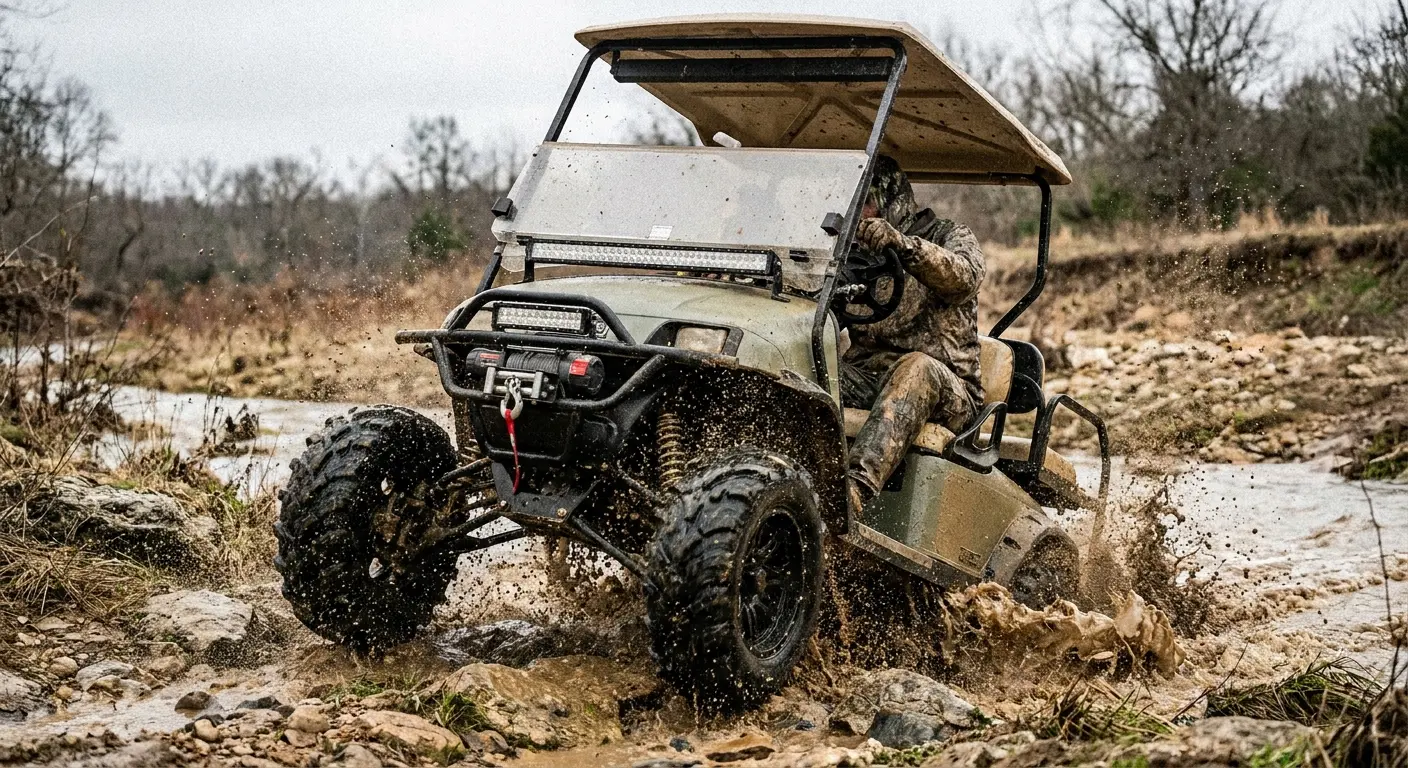
Purpose-built off-road carts feature aggressive tread tires, reinforced suspensions, skid plates, and powerful motors designed for challenging terrain. These aren't modified street carts but rather vehicles engineered specifically for rough conditions.
These carts handle mud, sand, rocks, and steep inclines that would immobilize standard models. Ground clearance typically exceeds 8 inches. Four-wheel drive systems are common in premium models.
These are toys as much as tools. Yeah, they're practical for rough property. But let's be honest. Half the people who buy them just think tearing through mud is fun.
If that's you, own it. Just know what you're getting: a cart that rides rough on pavement, costs more, and drinks batteries like crazy. Worth it? Depends if you value fun over practicality.
Pricing starts around $8,000 and climbs quickly with added features. I see these carts used primarily on hunting leases, large rural properties, and by outdoor enthusiasts who need to access remote areas. They're specialized tools rather than general-purpose vehicles.
If your property includes significant off-road terrain and you regularly need to traverse it, an all-terrain cart justifies its cost and compromises. For occasional trail riding, you're better off with a standard cart and careful route selection.
14. Custom-Built Golf Carts
Are custom carts worth the money?
Custom golf carts are money pits. I'll say it louder for the people in back: MONEY PITS.
You'll spend $15-50K building your dream cart. When you try to sell it? Maybe you get half that back. Maybe. The custom paint, the lifted suspension, the premium sound system. Nobody else wants your exact setup.
Build a custom cart if: (1) you're keeping it forever, and (2) you have money to burn. Otherwise, buy used and save yourself the financial pain.
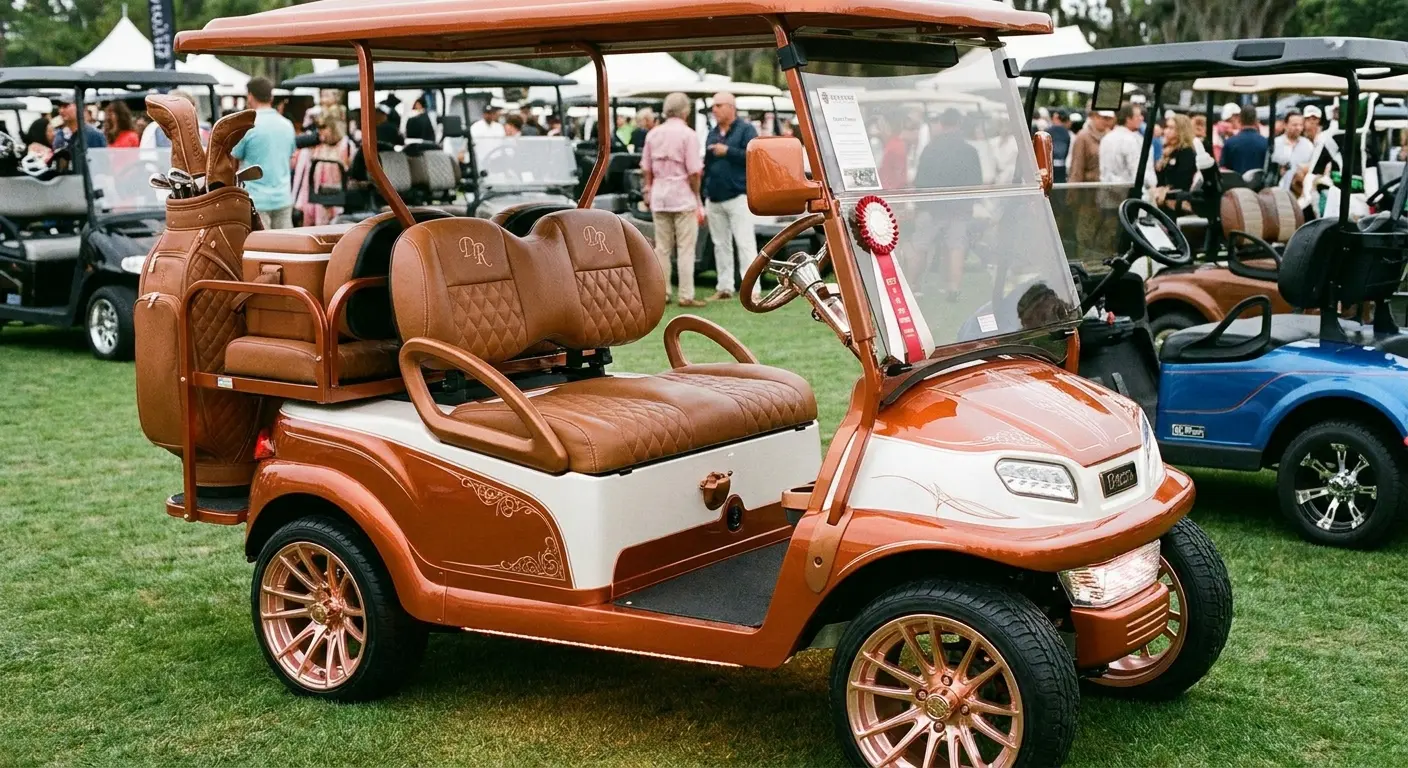
Custom golf carts reflect personal style and specific functional requirements. Builders modify standard carts or create unique designs from scratch. Customization ranges from simple cosmetic changes (paint, seats, wheels) to complete overhauls involving new bodies, upgraded motors, enhanced suspensions, and luxury amenities.
The possibilities are nearly unlimited, which is both the appeal and the problem. Costs escalate quickly. A moderately customized cart runs $12,000-20,000, while extreme builds can exceed $50,000.
I've seen people dump $40,000 into custom carts they can't sell for $15,000 three years later. The leather seats and custom paint job that seemed essential? Nobody else wants them. Build a custom cart if you're keeping it forever and money doesn't matter. Otherwise, you're lighting cash on fire.
Maintenance becomes more complicated because you're working with non-standard components. Finding parts and qualified technicians gets harder. Custom carts make sense when you have specific requirements that factory options don't address, or when personal expression matters more than financial practicality.
Full disclosure: I own a custom cart. Yes, I know I just spent 200 words telling you they're a terrible investment. I'm aware of the irony. In my defense, I built it myself and I'm never selling it, so the resale value doesn't matter. Do as I say, not as I do.
15. Vintage and Restored Carts
Vintage carts are for collectors and tinkerers, not transportation.
Vintage golf carts from the 1960s-1980s have developed a collector following. Nostalgia and design aesthetics that modern carts don't replicate. Restoration projects range from simple cosmetic refreshes to complete mechanical rebuilds.
Parts? Good luck. You'll be fabricating stuff, hunting eBay, or paying premium prices for NOS components. Performance? Terrible by modern standards. Reliability? You'll spend more time fixing than driving.
This is a hobby, not a practical purchase. Treat it like restoring a classic car. Expect to spend more than it's worth and do it for love, not money.
Original parts are increasingly difficult to source, which drives up restoration costs and timelines. You'll often need to fabricate custom solutions or adapt modern components to work with vintage frames.
These carts rarely match modern performance standards. Older battery technology, less efficient motors, and outdated suspension designs. The appeal is purely aesthetic and emotional.
Restored carts can command premium prices from collectors, but the market is small and specialized. Maintenance requires either developing significant mechanical knowledge yourself or finding a technician familiar with older systems.
Rental Fleet Carts
Here's an actual smart money move: buy ex-rental fleet carts.
Rental fleet carts are built for durability and simplified maintenance rather than comfort or features. Stripped-down models with basic seating, minimal accessories, and components selected for longevity under heavy use.
Golf courses and rental operations prioritize carts that can handle multiple rounds daily with minimal downtime. These carts often feature keyed ignition systems, hour meters, and sometimes GPS tracking.
The ride quality is utilitarian. Seats are firm, suspensions are basic, and cosmetic details are minimal. Pricing reflects bulk purchasing, so individual units cost less than comparable consumer models.
Golf courses maintain these things religiously because downtime costs them money. So you're getting a cart with high hours but solid mechanicals. The seats are worn, the body has dings, the paint is faded. Who cares? You're paying 40-50% less than comparable used retail.
If you can tolerate ugly, this is the best value in the used market. Period.
When these carts reach the end of their rental life (typically 5-7 years), they enter the used market at attractive prices. High hours but usually decent mechanical condition because rental operators maintain them regularly to avoid downtime.
The lack of features and worn appearance turn off some buyers, but smart shoppers can acquire solid transportation at 40-50% below comparable used retail carts. If you can look past cosmetic wear and don't need luxury features, ex-rental carts offer genuine value.
Matching Your Cart to Real-World Use
Okay, we've covered 16 different cart types. That's a lot. Here's how to actually make a decision:
Stop thinking about what looks cool. Stop thinking about what your neighbor bought. Think about your actual daily life.
The worst purchase I ever witnessed? Guy bought a lifted cart with 23-inch mud tires because it looked badass. He lives in a flat retirement community with paved cart paths. The thing rides like a buckboard wagon and he hates it. Trying to sell it now at a $6,000 loss.
Don't be that guy.
A gas golf cart makes sense if you're covering large distances without convenient charging access. Electric carts with lithium batteries suit daily commuters who can charge overnight. Lifted models handle rough terrain but sacrifice stability. Street-legal configurations provide genuine transportation in the right environment.
Ask yourself:
How far do I drive daily? (Be honest)
How many passengers do I actually carry? (Not "might someday." Actually)
What's my terrain like? (Flat pavement or rough trails?)
Can I charge overnight? (For electric)
What's my budget for maintenance? (Not just purchase price)
Answer those honestly and the right cart type becomes obvious.
Whether you're considering a Club Car for reliability or a Yamaha for efficiency, the right cart should feel like it was designed specifically for your situation, not like you're making compromises to fit into a category that doesn't quite work. A Club Car built for course use won't satisfy someone who needs utility capacity for farm work.
Quick practical note: you need somewhere to mount your phone if you're using GPS or music.
I use Rokform mounts because golf carts vibrate like crazy and most phone mounts fall apart in six months. Magnetic system, actually stays put on rough terrain.
Not trying to hard-sell you, just mentioning it because I've tested a dozen different mounts and these are the only ones that don't suck. If you're running an off-road cart, get a rugged case too. I've seen phones bounce out of carts and get run over. Not fun.
Final Thoughts
Look, buying a golf cart isn't complicated. You just need to be honest about what you actually need versus what you think looks cool.
I've been doing this for years. The happiest customers are the ones who bought boring carts that perfectly matched their daily routine. The most miserable? People with expensive custom builds they can't sell, or lifted carts they can't maneuver, or six-seaters they use solo 90% of the time.
Buy what you need. Use it for years. Don't overthink it.
And for God's sake, get the lithium batteries if you can afford them. You'll thank me in five years.

