


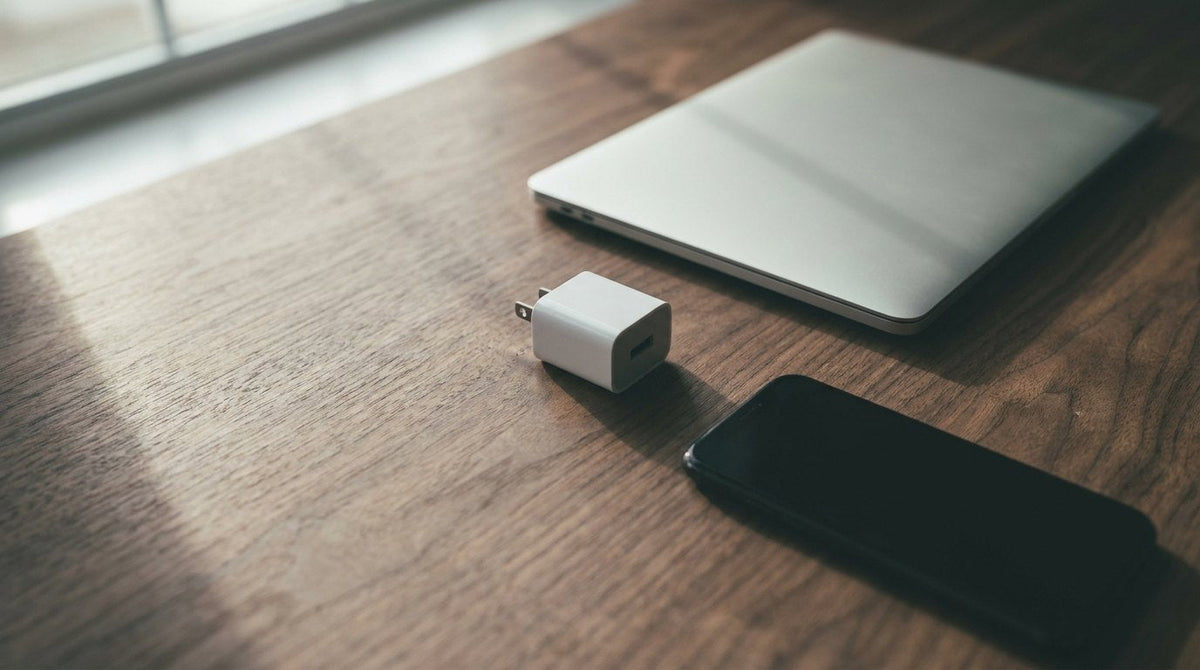
Rokform's PowerTrip 65W GaN fast charger, $49.99.
The brick in your bag shrank and nobody explained why. Retailer pages answer wrong, selling gallium nitride as speed. A GaN charger is a wall adapter whose switching transistors are built from gallium nitride instead of silicon. That swap changes the size and running temperature of a power supply, not how fast your battery fills. The shift is real money: the power GaN device market was worth $355 million in 2024 and is forecast to reach $3 billion by 2030, a 42 percent compound annual growth rate, according to Yole Group's Power GaN 2025 report in Semiconductor Today, with consumer and mobile products taking more than half that total. Those are market-research estimates, not audited revenue. Anyone asking what is a gan charger wants three things: the physics, the negotiation, and whether 65W hurts a phone.

Table of Contents
- The material swap
- Size versus speed
- The USB-C handshake
- What your devices really pull
- The 65W question
- Wireless charging in the same bag
- Buying without the myth
- The Rokform pick
- Final thoughts
TL;DR: The Short Answer on Gallium Nitride
- Gallium nitride is a wide bandgap semiconductor, roughly three times silicon's bandgap.
- Wider bandgap allows higher switching frequency, which sets the size of the transformer inside.
- Smaller magnetics and lower loss give a smaller, cooler brick at the same wattage.
- Wattage sets charge speed. Material does not. A 65W GaN and a 65W silicon unit fill a phone identically.
- USB-C Power Delivery is a negotiation. Your phone requests a voltage and gets only that.
- A high wattage charger is safe with a small phone. The brick's number is a ceiling, never a dose.
The Material Swap That Made the Brick Shrink
Silicon ran the inside of chargers for decades and still does in cheap ones. Gallium nitride is a different class of material. The US Department of Energy puts them side by side in its wide bandgap semiconductor factsheet: silicon sits at 1.1 eV, gallium nitride at 3.4 eV. A bandgap is the energy an electron needs before it carries current.
Raise that threshold and the material survives a far stronger electric field before breaking down. The same mains voltage can then be blocked across a much thinner slab. Thin slabs carry less resistance and hold less charge to shove around every time the switch flips, which answers what is a gan charger at the level of the material.
Why a Wider Bandgap Means a Thinner Switch
A power switch has two jobs that fight. It blocks the full input voltage while off and passes current with almost no loss while on. Silicon buys blocking ability by thickening the drift region, and every micron adds resistance.
GaN escapes part of that trade. EPC describes the working layer as a two dimensional electron gas with electron mobility between 1500 and 2000 cm2/V-s, plus higher breakdown strength and lower on-resistance. That is why a GaN transistor can be physically smaller than the silicon part it replaces while carrying the same current.
Switching Frequency Is the Whole Trick
Competing explainers stop at "GaN is more efficient" without naming the mechanism, which is switching frequency. Your charger rectifies mains AC, chops it at high speed, and pushes it through a small transformer to get low voltage DC. Chopping speed sets the size of that transformer and its output capacitors. Raise the frequency and every magnetic part stores less energy per cycle, so every one of them shrinks.
Texas Instruments states the consequence. Its GaN parts operate above 500kHz and up to 1MHz for smaller magnetics, and the same page claims consumer AC/DC designs as much as 50 percent smaller. Read those as a device maker's targets for its own parts, not a spec you can buy. The DOE puts it broadly: wide bandgap devices switch at least ten times faster than silicon. What you feel in your hand is a shrunken transformer, not shrunken electronics.

Where the Heat Goes
Every switch wastes energy twice, resistively while conducting and again during each transition. GaN cuts both, and the second matters more as frequency climbs. TI claims losses cut by up to 50 percent at 100kHz for its own parts, and the DOE describes wide bandgap technology as able to eliminate up to 90 percent of AC to DC conversion losses, a ceiling for the class rather than a rating for a wall plug.
Fewer wasted watts become less heat inside a sealed shell, so the same output fits into less volume without the case getting unpleasant to hold. That is the trade what is a gan charger really describes.
Size and Speed Are Two Different Specs
A 65W GaN charger and a 65W silicon charger deliver the same power to the same phone at the same rate. Nothing about the material gets electrons to your battery sooner. Speed comes from three places: what the charger offers, what the device agrees to take, and where the battery sits in its own curve. Readers chasing throughput should start with what super fast charging means. Anyone who answers what is a gan charger with the word "faster" skipped a step.
The rule holds off the cable too. Wireless charger fast charging is capped by the coil and the standard it follows, never by the material inside the adapter feeding it.
| Changes how fast your phone charges | Does not change it |
|---|---|
| Wattage the charger can offer | Whether the switches are GaN or silicon |
| Wattage and voltage the device requests | Physical size of the brick |
| Whether the cable can carry the current | Number of ports on the charger |
| Battery state of charge and temperature | Price or brand of the charger |
Why Every Charging Claim Stops at Fifty Percent
Manufacturers quote time to 50 percent, never to 100. Lithium cells take high current while empty and taper as they fill, so the second half takes longer, and a warm battery throttles itself on top.
The USB-C Handshake Nobody Explains
Power does not simply flow out of a USB-C port. The charger advertises a menu, the device picks one entry and requests it. The USB Implementers Forum describes devices that negotiate for only the power they require, and notes Revision 3.1 lifting the ceiling from 100W to 240W with 28V, 36V and 48V fixed voltages. Renesas lists the normative rungs as 5V, 9V, 15V and 20V. Until the device asks, a compliant port sits at 5V doing nothing. Ask what is a gan charger without that handshake and you worry about the wrong number.
PPS and the Fine-Grained Request
Programmable Power Supply replaces those fixed rungs with a dial. Renesas describes PPS as an optional USB-PD feature that lets the source change voltage in 20mV steps and current in 50mA steps, from 5V to 21V. The payoff lands inside the phone. A device requesting 8.24V instead of a flat 9V wastes less as heat in its own regulator, keeping the cell cooler and holding the fast phase open longer.
Support varies by handset. Apple documents adapter wattages and charging times for iPhone but never PPS support, so assume nothing unless your maker says so in writing.

The Cable Is Part of the Circuit
A charger's rating means nothing if the cable cannot carry the current. USB-C cables declare their capability electronically, and the older 100W tier needed a 5A rated cable. Higher tiers ride the same connector, so the difference is invisible. Swap the cable first when a trusted charger underperforms. It is the commonest cause of why your phone charges slowly.
What an iPhone and a MacBook Actually Pull
Apple publishes real numbers, so use those. Its fast charge documentation sets the floor at an 18W or greater adapter for iPhone 8 and later. With a 40W adapter or higher, iPhone 17, iPhone 17 Pro and iPhone 17 Pro Max hit 50 percent in roughly 20 minutes, while iPhone Air and iPhone 17e need 30 minutes to reach 50 percent on 20W. Notice what Apple never publishes: the wattage a phone draws. Any site quoting a peak figure invented it. Dual cell foldables run their own numbers, so check those ahead of the Z Fold 8 release date. The table below is where what is a gan charger turns practical.
| Device | Adapter wattage Apple lists | Published result |
|---|---|---|
| iPhone 8 and later | 18W or greater | Up to 50% in around 30 minutes |
| iPhone Air, iPhone 17e | 20W | Up to 50% in 30 minutes |
| iPhone 17, 17 Pro, 17 Pro Max | 40W or higher | Up to 50% in around 20 minutes |
| MacBook Air (2022 or later) | 30W, 35W, 67W, 70W | Fast charge from 67W up |
| 14-inch MacBook Pro (2021 or later) | 67W, 70W, 96W | Fast charge needs 96W or 140W |
| 16-inch MacBook Pro (2021 or later) | 140W | Fast charge needs 140W |
Apple Newsroom announced the 40W Dynamic Power Adapter with 60W Max on 9 September 2025 alongside iPhone 17, a $39 charger rated far above anything the phone sustains. Even Apple treats headline and delivered wattage as two numbers.
Laptops Are Where 65W Starts Earning Its Keep
Apple's adapter list covers 30W, 35W, 67W and 70W for MacBook Air models from 2022, 67W, 70W and 96W for the 14-inch MacBook Pro, and 140W for the 16-inch, and fast charge on a MacBook Air starts at 67W. A 65W brick runs a MacBook Air comfortably at working power, charges a 14-inch Pro at normal speed without reaching the fast tier, and will not fast charge a 16-inch Pro.
A photographer packing for a weekend shows the payoff. Laptop, phone and camera battery charger used to mean three adapters. One 65W unit and two cables replace them. Size the brick to the largest device and everything smaller falls inside it.
Will a 65W Charger Damage a Phone? No, and Here Is Why
No, and the reason sits in the handshake rather than in what is a gan charger as a product. The device requests its voltage and current, the charger supplies that, and a higher rated unit holds headroom nobody asks for. Apple states the position itself: you can charge a Mac with any USB-C power adapter, higher or lower wattage than the one recommended. Phones follow the same protocol.
Consider the inherited charger. Someone plugs a five year old handset into a 65W laptop brick in a hotel room. The phone negotiates 5V, pulls under 10W, and fills as it would from its original cube. Nothing lets the charger push the other 55W anywhere.
Two real risks exist and neither involves wattage: damaged cables, and heat from a hot car or a phone under a pillow. A handset refusing power altogether is a different problem, and the emergency override charging steps cover it.
Wireless Charging Sits on the Same Power Budget
Most people with a good brick own a pad too, and the two interact more than the packaging admits. A wireless charging charger is a two stage system: the adapter converts mains power, the coil moves it across an air gap, and both stages lose something. The pad's rating describes what the coil delivers, so the adapter behind it must be sized above that. Standards decide the rest, and how Qi2 compares to MagSafe explains which alignment your hardware follows. Pads are the slowest sensible way to move power into a phone, and a wireless charger charging pad that feels sluggish is usually starved by the cube behind it.
Pads, Stands and Multi-Device Stations
Flat pads leave the phone face up and out of reach. A wireless charger charging station clears the cable mess but concentrates heat in one enclosure, and heat ages a battery. Folding handsets sit awkwardly on flat surfaces, worth remembering when you shop our roundup of the best foldable phones this year. Any wireless charger charging pad runs warmer than a cable at the same delivered power, because coil coupling is never perfect.
A three device stand that keeps browning out makes the point. The watch drops off, the phone slows, the stand gets blamed. The stand is fine. Its 20W cube cannot feed three coils at once, so the wireless charger charging station rations what it has. Most people over-buy the pad and under-buy the adapter. Budget for both, since a wireless charger charging station is only as quick as the wireless charging charger feeding it.

Portable Power Is a Different Product
A wireless charging portable charger carries its own cell and hands that energy back later. A wall brick converts mains power and stores nothing, so the two are not interchangeable however similar the listings look. A portable charger with wireless charging trades efficiency for convenience, since the coil loses part of a battery you paid to fill. Odd shapes complicate alignment, and what a tri-fold phone changes is one example of hardware that will not sit flat.
Gallium nitride turns up inside some banks too. A wireless charging portable charger built that way is smaller for its capacity, and a portable charger with wireless charging still obeys every rule above. The material never becomes the feature. It only makes the enclosure honest, as in a wireless charging charger on the wall or a wireless charger charging pad on a desk.
How to Buy One Without Buying the Myth
Buy for the highest draw device you own, not the phone in your pocket. Multi-port units advertise a shared total, so a "100W" charger may give 65W on one port and 30W on another only while the second sits empty. Match the adapter class to the device, and our breakdown of the main types of phone chargers sorts the categories. The European Commission calculates that discarded and unused chargers account for about 11,000 tonnes of e-waste in the EU every year, with common charger rules saving consumers around 250 million euro annually. One good adapter beats five mediocre ones.
EU common charger requirements extend to laptops on 28 April 2026, according to the European Commission, so notebooks sold in Europe charge over USB-C and the single brick setup stops being a workaround.
Pre-purchase checklist, six lines you can run in a store:
- Name your highest draw device and find the adapter wattage its maker publishes.
- Check per-port wattage, not the headline total, on anything multi-port.
- Confirm which port carries the most wattage, since they are rarely equal.
- Match the cable to the wattage you need, not the one in the drawer.
- Confirm the plug shape and voltage range for where you travel.
- Ignore every claim that the material itself charges faster.
Sizing the Brick to the Bag
A 20W to 30W adapter covers phones, earbuds and small tablets. A 65W adapter covers that plus a thin laptop. Past 100W you buy for a 16-inch class machine, and the weight returns. Wireless charger fast charging needs less headroom than people assume, though the adapter must still clear the pad's rating.
Two-minute diagnostic for a charger that seems slow:
- Swap the cable and retest, because cables fail more often than bricks.
- Check what else shares the charger, since two ports usually split one budget.
- Look at which port you used, as the high wattage port is often one only.
- Note the phone's temperature, because a warm battery throttles charging.
- Check the battery percentage, since everything slows above 80 percent.
- Suspect the adapter last, after the other five come back clean.

One Brick That Handles the Phone and the Laptop
Carrying two adapters is the problem this article keeps circling. The small one cannot run a laptop, the big one is too heavy for a jacket, and both ride in the bag anyway. Rokform's PowerTrip 65W GaN fast charger at $49.99 answers that with one number. Sixty five watts clears the 40W threshold Apple documents for the quickest iPhone tier and sits inside the range Apple lists for its thin laptop. Gallium nitride is why that arrives at a size you will carry. Ask what is a gan charger good for in practice and this is the answer, and a wireless charging charger on the desk shares the socket without a second brick.
Final Thoughts
The material chose the size. The wattage and the negotiation chose the speed. Keeping those apart makes any charger listing readable, since half the box describes an enclosure and the rest describes the power contract your phone signs. Buy for your largest device, check the cable, and stop worrying that a big number will overwhelm a small battery. Whatever brought you to what is a gan charger, gallium nitride made a good charger smaller and cooler and left the charging where it was.

