


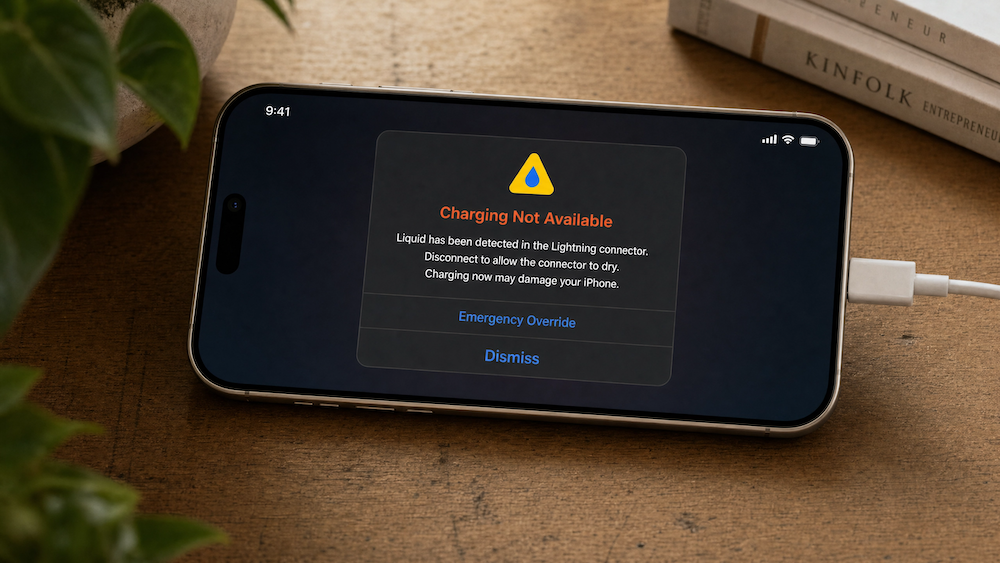
You see the warning. You plug in anyway. Hitting emergency override iPhone charging gets juice flowing, but it doesn’t make the moisture vanish or reset the risk. You’re telling the phone, “do it anyway,” and hoping the port, cable, and board all survive the call you’re about to make.
The real trouble starts after that choice. Moisture can sit in the port, chew on the metal, and turn into the “why is my iPhone not charging?” moment a few weeks later. That’s why the way you charge, the gear you use, and how often you hit override matter way more than that one pop-up box on your screen.
Quick Links
TL;DR
Emergency override shuts off moisture detection, not the water in your port
Corrosion starts fast once you push power through a wet connector
Every override adds tiny damage that stacks up over time
Most warranties don’t cover liquid damage, even if you used the warning the “right” way
Wet ports run hotter, which only makes the damage spread faster
Cases with real port covers keep most of the moisture off your charging hardware
A backup way to charge means you don’t lean on override every time you see the alert

What You’re Actually Forcing Through
What You’re Really Saying Yes To
What Still Has Your Back
Even with override on, the phone isn’t totally blind. It still watches the important stuff, just not the water.
Protection system |
Status during override |
What it’s still doing |
Moisture detection |
Disabled |
Normally watches resistance changes in the port |
Thermal monitoring |
Active |
Tracks heat while you’re charging |
Voltage regulation |
Active |
Keeps power delivery from getting sketchy |
Charging speed control |
Active |
Adjusts current based on what the phone sees |
Short circuit protection |
Active |
Cuts power if it detects a bad path |
Indubitably, it’s worth checking the basics before you ever get to this screen.
That Little Countdown Isn’t For Show
Apple gives you a short timer before the button goes away on emergency override iPhone. That’s not pressure, that’s a built-in pause so you can think instead of just hammering “continue.”
Most people use that countdown to talk themselves into it. The port’s still damp, the phone’s still fresh out of the shower or the rain, and they override because they want power now. That’s how a quick decision turns into the corrosion problem you meet a few weeks later.
Corrosion Timeline: What Happens After You Charge Wet
Corrosion doesn’t take a day off. The moment you push power through a damp port with emergency override, the damage starts. You don’t see it at first. You just see a phone that “still works,” so you think you got away with it.
The problem is all the action is happening where you can’t see it. Metal, moisture, and current start eating that connector from the inside out. By the time you feel it at the cable, the port’s been losing the fight for a while.
First 30 Minutes: Silent Hit
Hours 1–6: Things Get Weird
Days 1–7: You Can Finally See It
After a few days, the evidence shows up. You’ll see green or white gunk on the pins, flaky charging, and “hold it at this exact angle” behavior. At this point, emergency override has turned from a quick tap into a problem that wants tools, time, or a bench.
Here’s what that slide from “fine” to “fried” looks like laid out:
Timeline |
Corrosion stage |
What you see |
What charging does |
0–30 minutes |
Electrochemical reaction |
Nothing yet |
No obvious change |
1–6 hours |
Oxidation layer forms |
Still looks clean |
Slight resistance bump |
1–7 days |
Visible corrosion starts |
Green or white buildup on pins |
Intermittent connection issues |
2–4 weeks |
Structural damage kicks in |
Heavy discoloration, possible cracks |
Unreliable, frequent failures |
1–3 months |
Advanced deterioration |
Pins heavily damaged or missing |
Port often needs replacement |
Weeks 2–4: The Port Taps Out
Two to four weeks in, the connector is usually in serious trouble. The plating is chewed up, raw copper is exposed, and it’s breaking down fast. Sometimes the plastic around the port even shows stress marks or hairline cracks from everything happening inside.
By then, charging is so touchy most people finally admit something’s wrong. A quick clean doesn’t cut it. This is the point where you’re looking at a repair, not a wipe-down. If you’re already at that stage, you’re in “how to fix iPhone charging port” territory, not “ignore the warning and hope for the best.”

Charging Port Degradation After Override Use
Pin Wear
Data Pins Go First
Heat and Resistance
When “Just This Once” Turns Into a Habit
The Fake Sense of Safety
Convenience vs. Caution
We’re all wired for “right now.” You need your phone for maps, messages, or music, and waiting 20 minutes feels like punishment. The moisture alert starts to look like Apple being dramatic instead of your phone trying to protect itself. Every “nothing bad happened” override trains you to ignore the warning. That’s how occasional use slides into regular abuse of emergency override.
Some environments make this worse. Bathrooms, kitchens, job sites, hot and humid climates: you’ll see the alert more often. The phone doesn’t care if it’s a full splash or just heavy steam. Same warning, different risk. That’s where people start doing their own on-the-fly risk math and usually give in.
Override Decision Checklist
Before you smash that button, run through this quick gut check.
Is this actually an emergency? (calling 911, stranded and need navigation, critical work call)
Do I have wireless charging nearby? (car mount, desk charger, nightstand, anywhere you can drop it on a pad)
Can I wait 15–20 minutes and let it air out?
Is the port visibly wet? (if you can see droplets with a flashlight, don’t override)
Have I already overridden in the last week?
If this kills the port, how am I charging tomorrow?
If the answer to the first one is no and you’re hitting yes on any of the others, that’s your sign to back off. Drop it on a pad, unplug, or walk away for a bit. At Rokform, we already put together a guide to which iPhones with wireless charging can bail you out here, so you’re not stuck choosing between a dead battery and a fried port every time the warning shows up.
Wet Charging Turns Your Port Into a Space Heater
Why a Damp Port Runs Hot
Heat That Spreads Past the Port
That extra heat doesn’t stay put. It bleeds into the charging chip, the flex cables, and the lower part of the logic board. Those parts are built to handle normal temps, not constant spikes from wet charging and emergency override runs. Push them out of their comfort zone enough times and you’ll start seeing weird behavior: charging that cuts out, chargers the phone “doesn’t like,” or power that ramps up and down for no obvious reason.

Your Battery Takes the Hit Too
Insurance And Warranty Stuff Nobody Wants To Think About
How Override Looks On Paper
AppleCare and AppleCare+ treat liquid very differently from normal defects. AppleCare+ might help, but you’re still paying a service fee. Regular coverage usually taps out the second corrosion shows up. When you use emergency override on iPhone, you’re basically telling the device, “yeah, I know it’s wet, do it anyway.” If diagnostics later show moisture alerts plus a corroded port, it’s easy for a tech or adjuster to say this wasn’t random bad luck.
Third‑party plans and carrier insurance love terms like “reasonable care” and “proper use.” Repeated wet charging doesn’t look like either. The phone logs when moisture was detected and when you pushed past it. That data doesn’t auto‑deny your claim, but it does give the repair center a clear link between your choices and the damage. If you want cleaner options next time, building a safer setup with better Apple phone accessories is a lot cheaper than gambling on a claim that might not land in your favor.
Building A Plan After You’ve Already Hit Override
Step One: Check The Port You’ve Been Ignoring
Grab a flashlight and actually look at the port. You’re hunting for green, white, or dark spots on the pins. That’s corrosion, not “just dirt.” Catching it early gives you a shot at stopping the spread instead of jumping straight to a repair.
Here’s how to clean your iPhone's charging port
What you need
Wooden toothpick or plastic dental pick
90%+ isopropyl alcohol
Cotton swabs
Flashlight or phone light
Compressed air (optional)
What you do
Power the phone off
Check the port with the light and note any crud or color changes
Hit it with short bursts of compressed air to clear loose junk
Gently scrape buildup with the toothpick, working from the back of the port toward the edge
Lightly dampen a cotton swab with alcohol, then wipe the inside of the port
Let the phone sit and air dry for at least 30 minutes
Recheck with the light
Plug in and see if the connection feels solid
Repeat if charging still cuts out or feels loose
Do this right after any emergency override charging, once a month as maintenance, and any time your cable suddenly gets picky.
Step Two: Give Yourself A Backup Charger
Most overrides happen because you’ve got one way to charge and it’s the port in front of you. Kill that bottleneck. Add wireless into the mix so a wet port doesn’t force a bad decision.
Drop a MagSafe or Qi pad in the spots where you keep seeing that moisture warning: bathroom counter, kitchen, nightstand, desk, car mount. If the alert pops up, switch to the pad instead of forcing the cable. The phone still gets power. The port gets time to dry.
Step Three: Figure Out Where The Water’s Coming From
That alert keeps showing up for a reason. Steam from showers, sweat from runs, cooking humidity, rain, pocket condensation when you move between hot and cold. The phone doesn’t care, it just knows the sensor saw moisture.
Once you know your main culprit, you can change the routine:
Don’t leave your phone parked next to the shower
Keep it out of the line of fire when you’re cooking
Use a pocket or bag that isn’t trapping sweat against the port
Watch what happens when you walk from AC into humid air and plug in right away
You’re not trying to live in a lab. You’re just trying to stop feeding the same scenario that keeps dragging you back to override.
Step Four: Build A Fast-Dry Move
You don’t always have hours to wait it out. You can still speed up drying without cooking the phone.
Aim a fan straight at the port for 15–20 minutes
Don’t use a hair dryer or heater
Shake the phone gently with the port facing down to knock loose droplets
Set it port‑down on something absorbent and leave it alone
Do that before you ever think about plugging in again. Half the time, that window is all you need to clear the alert and avoid hitting override at all.

Case Design’s Job: Keep The Port Out Of The Fight
Your case either keeps the USB‑C opening out of trouble or it turns it into a splash zone. Most cases carve a big hole at the bottom and call it “access.” That’s fine until steam, sweat, or rain start living in that gap and you’re staring at the override screen again. At that point, you don’t need to know how to turn off emergency override. You need a setup that keeps the warning from showing up in the first place.
We built our newer Rugged, and Crystal cases around that idea. They’re designed to work with our USB‑C Port Cover 2‑Pack, a soft silicone plug that locks into the case and caps the port when you’re not charging. It keeps dust, grit, and splash out of the connector without getting in your way when it’s time to plug in.
Why Our Port Cover Setup Hits Different
We didn’t throw a random dust plug in the box and hope for the best. The USB‑C port covers are shaped to snap into Rokform cases and stay there. They sit flush, flex enough to move with the case, and don’t pop out every time you pocket the phone. You flip them out with one hand, plug in, and push them back when you’re done. No tiny tabs to rip, no stiff hinge to fight.
The combo is simple. Rugged or Crystal case on the outside, USB‑C cover guarding the opening, mounts and magnets still doing their thing everywhere else. That means less moisture in the connector, fewer “liquid detected” alerts, and fewer moments where you’re tempted to slam override just to get through the day.
Final Thoughts
Emergency override iPhone charging is there for the bad days, not the lazy ones. It’s meant for the “I have to get this call out” moment, not the “I don’t feel like waiting 15 minutes for this port to dry” moment. The feature does exactly what it says. It lets you charge through moisture. The catch is every time you use it, you’re trading a little bit of long‑term reliability for short‑term power.
That charging port is one of the only doors into the inside of your phone and it takes every hit from your environment. Every override is basically you saying, “yeah, I’m cool with risking this connector for a few percent right now.” Sometimes that’s the right call. Most of the time, it’s not. If you know which iPhone models you’re working with and how long you plan to keep them, it’s a lot easier to decide when that trade is worth it.
The smarter move is to build a setup that makes override almost never necessary. Pad on the desk. Pad in the car. Case that actually protects the port. Simple drying routine when the alert shows up. None of that is complicated. It just takes a little planning instead of hammering the button and hoping for the best.
At Rokform, we build gear for people who actually use their phones hard. If your phone is riding with you, working with you, and catching the same abuse you do, give it a case and setup that keeps the port alive and the battery fed without leaning on override. Don’t buy a fragile setup and baby it. Run a tougher kit that keeps up.

