


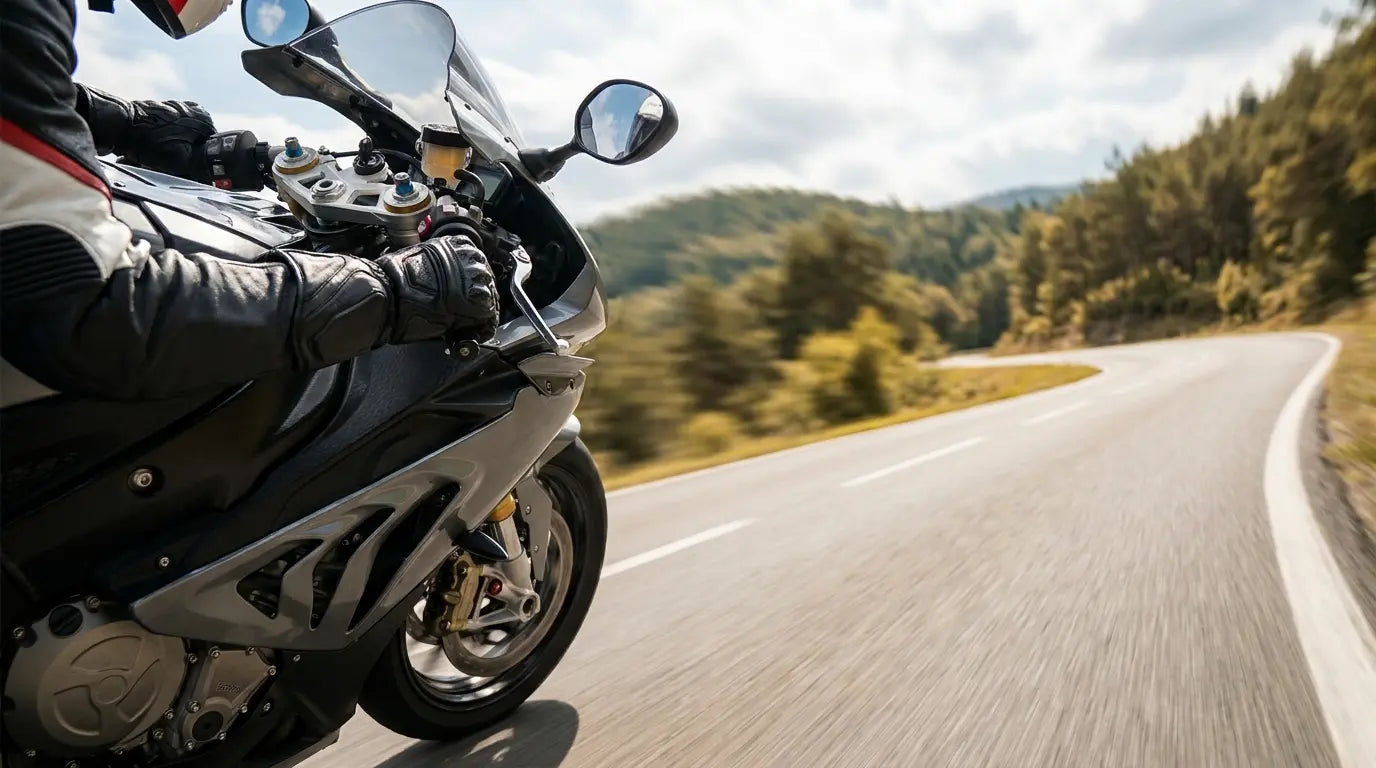
You've been countersteering since you were a kid. Every turn you've ever made on a motorcycle or bicycle happened because you pushed the handlebar the opposite direction from where you wanted to go.
Sounds insane? That's because it is. And that's exactly why most riders have no idea it's happening. Your body figured it out instinctively, probably around age seven on a bike with training wheels. Your brain still hasn't caught up.
Let's fix that.
Table of Contents
Why This Feels Completely Wrong (But Isn't)
Your Instincts Are Lying to You (Thank God)
The Physics Doing All the Work While You Panic
Speed Thresholds Where Everything Changes
What Happens When You Fight It
Why Nobody Actually Teaches This Stuff
How Modern Tech Is Finally Making the Invisible Visible
Where Countersteering Shows Up Beyond Motorcycles
The Muscle Memory Problem
Staying Connected to Your Machine
TL;DR
Countersteering means pushing the handlebar opposite to your intended turn. It's the only way to lean a two-wheeled vehicle at speed
Your body already does this automatically above 12-15 mph, but conscious understanding improves control dramatically
The technique works through gyroscopic precession and creates the lean angle necessary for turning
Low-speed turning uses different mechanics entirely, which is why parking lot maneuvers feel completely different
Fighting your instincts to "steer into" a turn at high speeds creates dangerous situations and delayed reactions
Most rider training glosses over the actual mechanics, focusing on practice without explanation
Modern smartphone mounts and recording tech can help you analyze and improve your countersteering technique in real time
Why This Feels Completely Wrong (But Isn't)
The Direction Paradox That Defines Two-Wheeled Motion
Push right to go right. Push left to go left.
This contradicts everything you know about steering. Cars, shopping carts, boats, wheelbarrows. They all turn the direction you point them. Motorcycles do the opposite. And yeah, that's as weird as it sounds.
The handlebar movement itself is subtle, often just a few degrees of rotation. You're not cranking the bars to the side. You're applying forward pressure on one grip, which initiates a lean in the opposite direction first, then the bike falls into the turn. The sequence matters more than the force.
Most riders do this perfectly without ever naming it. Your nervous system figured out the pattern through trial and error, probably during childhood bike rides. The conscious mind stayed out of it, which worked fine until you needed to make emergency maneuvers or refine your technique for performance riding.
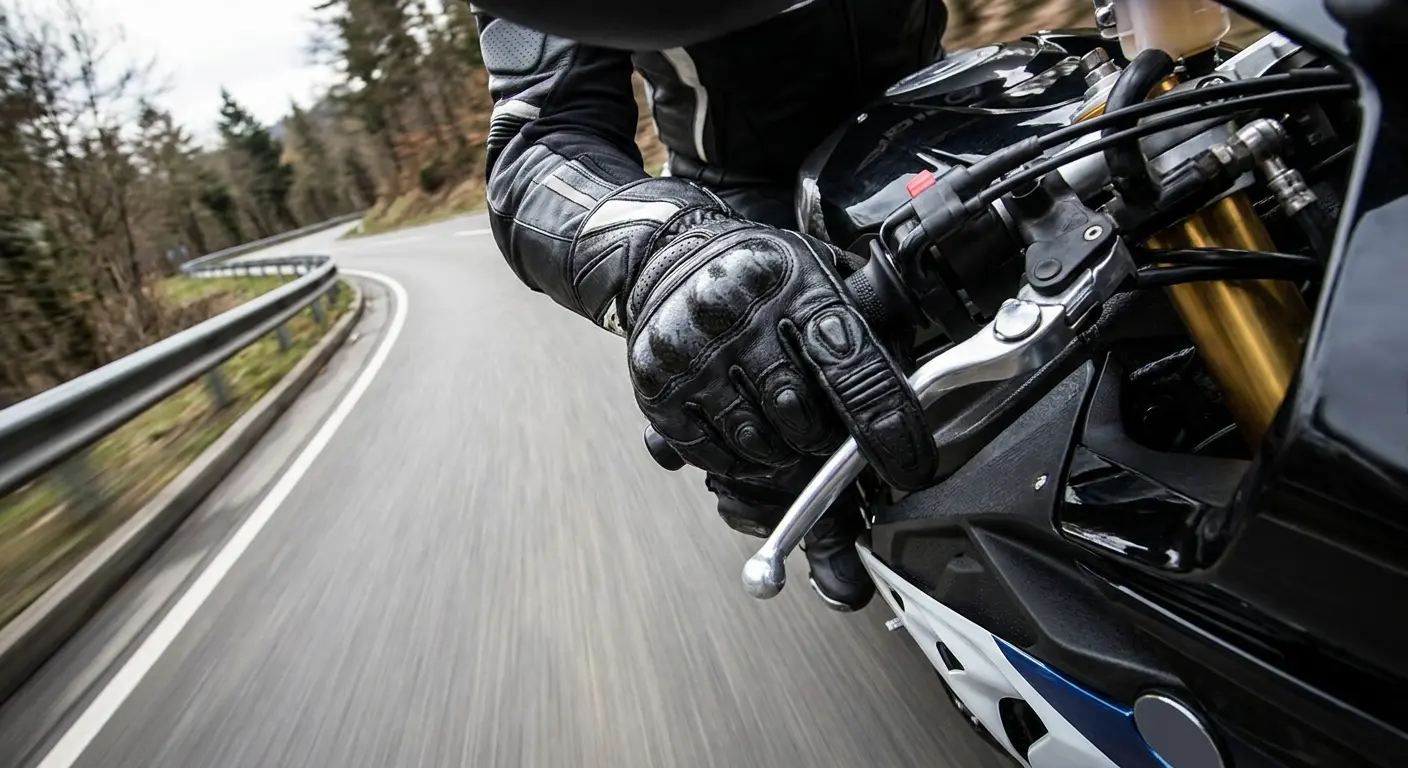
You're cruising through a highway sweeper at 55. Everything's smooth. Then you see it. A chunk of shredded tire tread, right in your line, maybe two seconds away.
Your eyes lock on a clean path to the right. Your right hand pushes forward without thinking. The bike tips right, carves around the debris. Done.
You didn't turn right. You pushed the bar left, which tipped the bike right, which carried you around the obstacle. All in the space of a heartbeat. And if someone asked what you did, you'd probably say "I swerved right" without any clue about the leftward push that made it possible.
So what actually happens at the handlebar? When you push forward on the right grip, the front wheel briefly steers left. This creates an imbalance that tips the entire bike to the right. Once leaned, the bike's geometry naturally steers into the turn. You're not steering the bike through the corner. You're using a steering input to create the lean angle that does the actual turning.
The motion feels wrong because it is wrong in every other steering context you've experienced. Four-wheeled vehicles turn by pointing the front wheels in your intended direction. Boats use rudders that push water in the opposite direction but still turn the bow where you aim. Two-wheeled vehicles require you to briefly steer away from your target to achieve the lean angle that enables the turn. Understanding countersteering becomes critical when you need precision control in emergency situations. This technique is the foundation of all motorcycle handling above walking speeds.
The Split-Second Sequence Your Brain Skips
The whole sequence is over before you can blink. You push the bar, maybe 50 milliseconds. The wheel deflects opposite in another tenth of a second, too fast to register. Then the bike starts tipping, and that's when you first feel it. By the time you're aware you're turning, you've already done the countersteering part and the bike's geometry has taken over.
Your inner ear processes this without asking permission. It feels the lean, adjusts your body, and moves on. You're aware you're turning. You're not aware of the four distinct phases that got you there.
Phase |
Duration |
What's Happening |
What You Feel |
|---|---|---|---|
Initial Input |
50-100ms |
Forward pressure applied to handlebar |
Grip push, minimal sensation |
Wheel Deflection |
100-150ms |
Front wheel steers opposite to intended turn |
Nothing yet, too fast to register |
Lean Initiation |
150-250ms |
Bike begins tipping toward turn direction |
First awareness of movement |
Geometry Takeover |
250ms+ |
Rake and trail steer wheel into turn |
Smooth carving sensation |
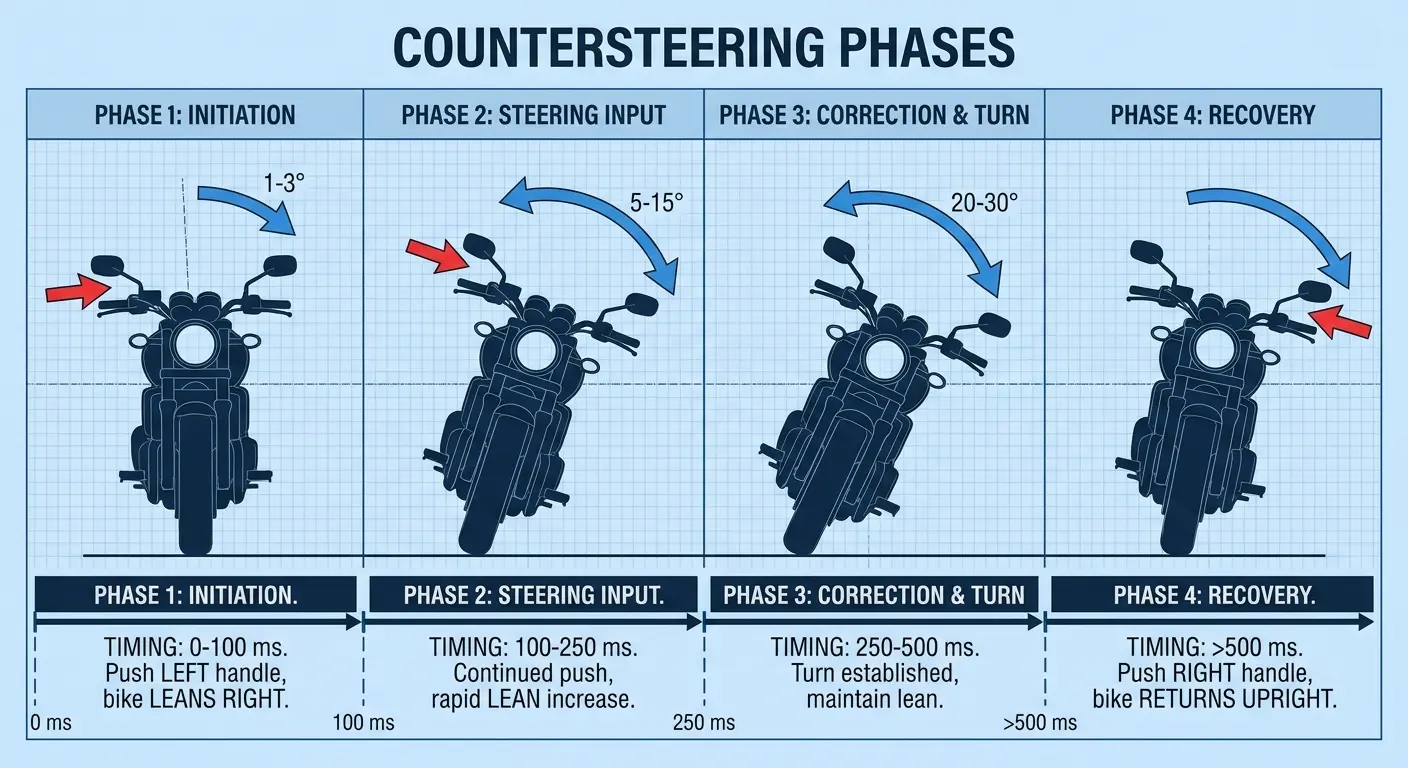
This speed creates a learning problem. You can't slow down the process to study it while you're doing it. Attempting to consciously control each micro-step interferes with the smooth execution your subconscious has already mastered. You need to understand the mechanics intellectually, then trust your trained reflexes to handle them.
The handlebar pressure required varies with speed. At 20 mph, you might need a firm push. At 70 mph, the same lean angle requires just a nudge because the gyroscopic forces are much stronger. Your brain calibrates this automatically based on experience, which is why new riders often oversteer at low speeds and understeer at high speeds until they build that calibration.
Your Instincts Are Lying to You (Thank God)
The Survival Mechanism That Works Against You
Your brain's threat detection system wasn't designed for vehicles that lean. When you see an obstacle approaching from the right, every survival instinct screams to steer left, away from danger. Countersteering requires you to push right (toward the threat) to lean left (away from the threat). That split-second of pushing toward danger contradicts millions of years of evolved response patterns.
This instinct override becomes critical in emergency situations. A Camry piloted by someone apparently texting their entire contact list pulls out in front of you, and you have maybe half a second to react. Riders who haven't internalized countersteering will freeze or make the wrong input. Riders who've trained the technique into muscle memory make the correct push without thinking.
The good news? Your instincts are already handling the execution. You've been countersteering successfully for years. The problem only emerges when conscious thought interrupts the process, usually during stress or when you're trying to make sharper-than-usual turns. Learning how to countersteer consciously helps you refine what your body already knows about steering on a motorcycle.
We see this disconnect play out in parking lots constantly. Riders who can carve perfect corners at highway speeds suddenly struggle with tight U-turns at walking pace. The mechanics are completely different, and their instincts keep trying to apply countersteering where it doesn't work.
When Conscious Override Becomes Dangerous
Target fixation kills riders. You stare at the obstacle, your hands unconsciously steer toward it, and you hit exactly what you were trying to avoid. Understanding countersteering provides the mental framework to break this pattern. You know that looking at the obstacle while pushing the opposite handlebar will move you away from it.
Panic braking mid-corner creates another dangerous scenario. The bike stands up when you brake hard, which reduces your lean angle and widens your turn radius. Riders who don't understand countersteering often brake when they should be maintaining or increasing their lean angle through continued handlebar pressure. The bike runs wide, they panic more, brake harder, and run off the road or into oncoming traffic.
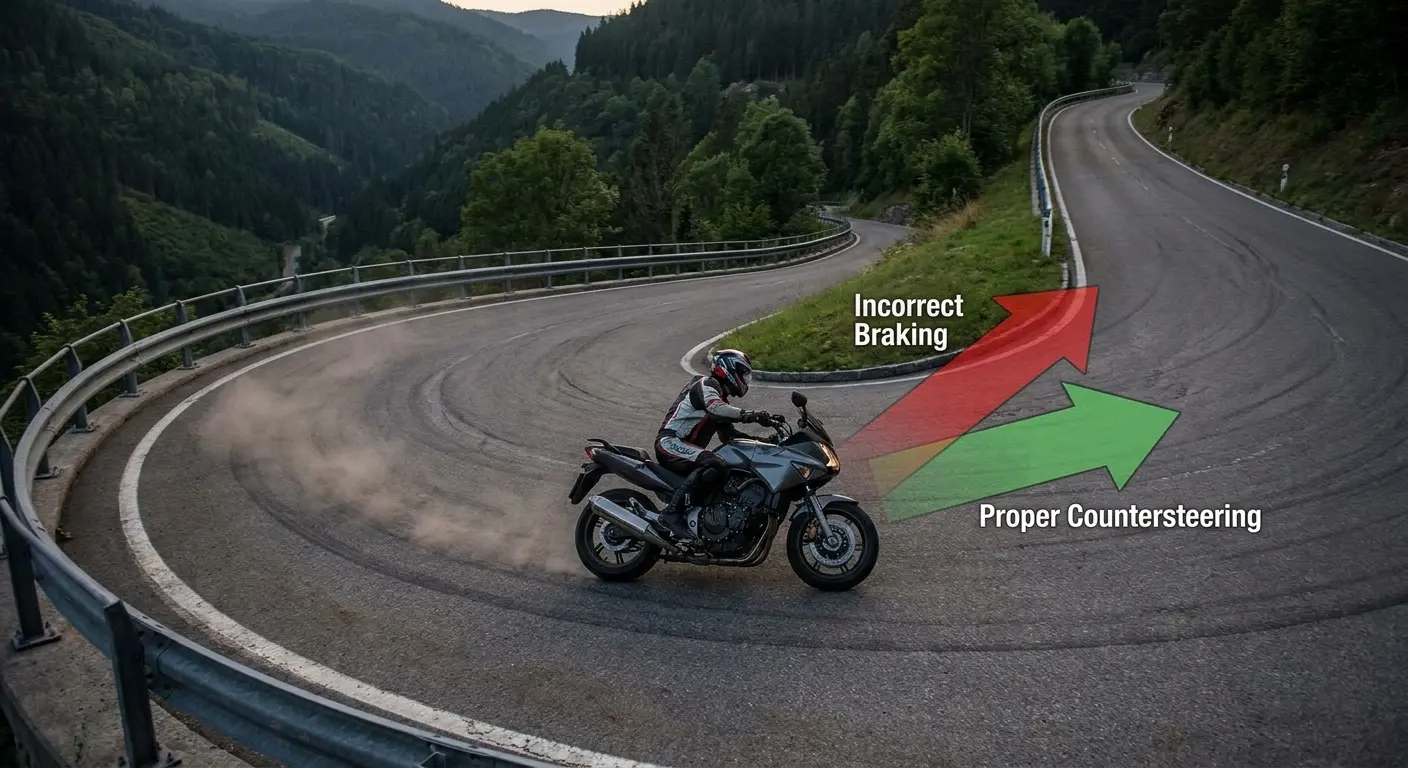
Picture this. A rider enters a decreasing-radius turn on a mountain road at 40 mph. The corner tightens halfway through, and suddenly the outside edge is coming up fast. Panic sets in. The rider's first instinct is to grab the brakes. The front suspension compresses, the bike stands up, and the turn radius widens even more. Now the bike is heading straight for the guardrail.
The correct response would have been to push harder on the inside handlebar, increasing the lean angle and tightening the turn radius. But without understanding countersteering mechanics, the rider's survival instincts chose braking over leaning, and what should have been a manageable corner became a crash.
Overcorrection happens when riders make the right initial input but then second-guess themselves and reverse it too quickly. You push right to lean right, the bike starts to tip, you get nervous about the lean angle and push left to stand it back up, but now you're steering into oncoming traffic or off the road edge. The correction becomes more dangerous than the original problem.
Training yourself out of these patterns requires deliberate practice in controlled environments. You need to experience the sensation of aggressive countersteering at various speeds until it becomes automatic. Your conscious mind needs to step back and let your trained reflexes do their job.
The Physics Doing All the Work While You Panic
Gyroscopic Precession and Why Wheels Resist Change
Spinning wheels create gyroscopic forces that resist changes to their orientation. When you push the handlebar, you're applying a force to the axis of a spinning gyroscope (the front wheel). The wheel doesn't respond by turning in the direction you pushed. Instead, it responds 90 degrees later in its rotation, which creates the lean.
The faster the wheel spins, the stronger these gyroscopic forces become. This is why countersteering becomes more effective and requires less force as your speed increases. At walking speeds, the gyroscopic effect is minimal, and you're mostly just steering the front wheel where you want to go.
Wheel size and weight affect the strength of gyroscopic forces. Larger, heavier wheels create stronger gyroscopic stability, which is why different motorcycles and bicycles feel different through corners despite using the same basic technique. A road bike with lightweight racing wheels responds more quickly than a cruiser with heavy spoke wheels.
The gyroscopic effect also explains why motorcycles are more stable at speed than when stationary or moving slowly. The spinning wheels actively resist tipping over. This is separate from the countersteering mechanism but works in concert with it to enable two-wheeled travel.
Rake, Trail, and the Geometry That Steers Itself
When selecting the right motorcycle handlebar mount, understanding your bike's geometry helps you position your device where it won't interfere with your line of sight or handlebar inputs.
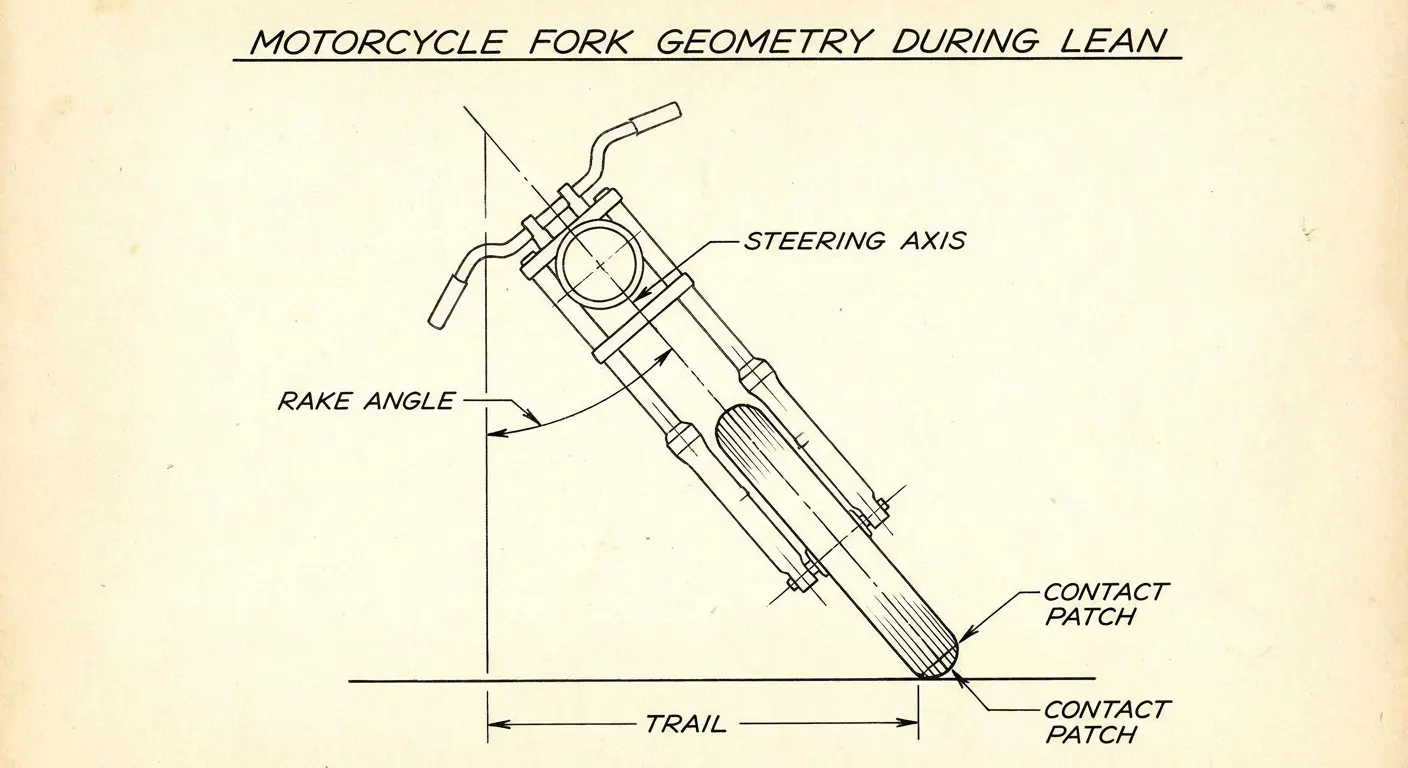
The front fork doesn't point straight down. It angles forward (that's the rake angle), and the front axle sits behind where a vertical line from the steering head would hit the ground (that's the trail measurement). These geometric features create a self-steering effect once the bike leans.
When you lean the bike right, gravity pulls the contact patch of the front tire toward the center of the turn. The trail measurement means the tire's contact patch is behind the steering axis, so this sideways force naturally turns the handlebars into the direction of the lean. The bike wants to carve the turn once you've established the lean angle.
Bike Type |
Typical Rake Angle |
Typical Trail |
Handling Characteristic |
|---|---|---|---|
Sport Bike |
23-24° |
85-95mm |
Quick, responsive, requires less countersteering force |
Standard/Naked |
25-26° |
95-105mm |
Balanced, neutral, predictable in all conditions |
Cruiser |
28-32° |
110-130mm |
Stable, planted, requires more deliberate inputs |
Chopper |
35-45° |
150mm+ |
Very stable straight-line, heavy steering effort |
Touring |
26-28° |
100-115mm |
Stable at speed, confidence-inspiring for long distances |
Different rake and trail measurements create different handling characteristics. Choppers with extreme rake angles are stable in straight lines but require more effort to countersteer into turns. Sport bikes with steep rake angles and less trail respond quickly but feel twitchy to inexperienced riders.
This self-steering geometry is why you can ride a bicycle with no hands. Once it's leaned and turning, the geometry maintains the turn without handlebar input. You shift your body weight to adjust the lean angle, which changes the turn radius, but the bike is essentially steering itself through the mechanical relationship between lean angle and front wheel direction.
The Contact Patch Dance
Your tires only touch the ground across a patch roughly the size of your palm. Everything about your bike's interaction with the road happens through these two small contact patches. When you lean, the contact patch shifts toward the edge of the tire, and the tire's profile creates a smaller effective radius on that side.
This smaller radius is what actually turns the bike. A leaned tire naturally wants to follow a curved path because of its profile shape. The countersteering input creates the lean, the lean shifts the contact patch, and the contact patch curvature carves the turn.
Tire pressure, tread pattern, and rubber compound all affect how the contact patch behaves during cornering. Underinflated tires create larger contact patches that can feel more stable but reduce precision. Overinflated tires create smaller contact patches that respond quickly but offer less traction.
Speed Thresholds Where Everything Changes
The Dead Zone Below 15 MPH
Below about 12-15 mph, countersteering becomes ineffective and can work against you. The gyroscopic forces aren't strong enough to create the lean response you need. You're back to basic steering, turning the handlebars in the direction you want to go.
This transition zone creates confusion for riders who are just learning about countersteering. They try to apply the technique at low speeds, it doesn't work, and they conclude they must be doing it wrong. They're not doing it wrong. They're just operating below the speed threshold where the physics kick in.
Low-Speed Maneuvering (What Actually Works in Parking Lots):
Keep your head up and eyes on your exit point, not the ground
Turn the handlebars in the direction you want to go (traditional steering)
Lean your body opposite to the bike's lean to maintain balance
Use the rear brake to control speed, not the front brake which can cause tip-over
Apply steady throttle to maintain momentum and gyroscopic stability
Look through the turn, your bike follows your eyes
Practice figure-eights in both directions to build equal proficiency
Parking lot U-turns, slow-speed weaving, and tight maneuvering all require traditional steering inputs combined with body positioning and rear brake control. You turn the handlebars where you want to go, lean your body to counterbalance the bike, and modulate the rear brake to control speed without upsetting stability.
The skill gap between high-speed countersteering and low-speed maneuvering explains why some riders are confident on the highway but nervous in parking lots, while others are the opposite. They're genuinely different skill sets that happen to use the same vehicle. At higher speeds, steering on a motorcycle relies entirely on the countersteer technique, while at lower speeds, traditional steering mechanics dominate.
The Sweet Spot for Learning
Before practicing countersteering techniques, make sure your phone is secured properly. A phone bouncing around on some cheap Amazon mount won't capture anything useful. Rokform's motorcycle perch mount actually stays put when you're recording your sessions.
The 25-45 mph range is ideal for practicing countersteering because the technique is fully active but the consequences of mistakes are less severe than at highway speeds. You can feel the handlebar input, perceive the lean response, and make corrections without dealing with the extreme forces and reduced reaction times of high-speed riding.
Empty parking lots and quiet residential streets provide safe environments to experiment. You want smooth pavement, no traffic, and enough space to make wide turns while you're building confidence. The goal is to make the technique conscious and deliberate before it becomes automatic again at a higher skill level.
Practice pushing each handlebar individually to feel how the bike responds. Push right, count to two, stand the bike back up. Push left, count to two, stand it back up. This deliberate separation helps your conscious mind connect the input to the response. Understanding what is countersteer means recognizing this direct relationship between handlebar pressure and lean angle, which becomes more intuitive with focused practice on steering on a motorcycle.
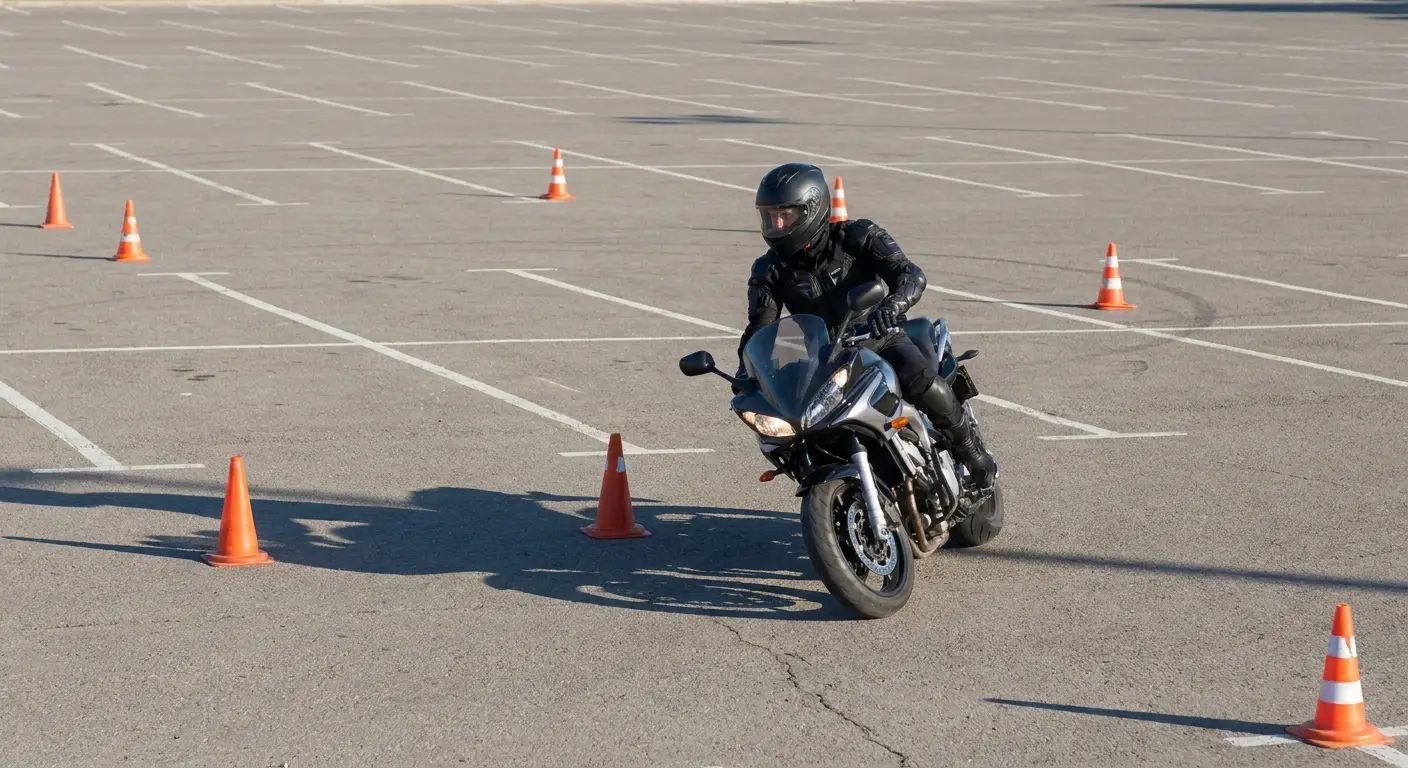
Gradually increase your lean angles as you build confidence. Start with gentle turns that barely tip the bike, then progressively lean further as you trust the technique. Your comfort with lean angle directly correlates to your ability to turn quickly when you need to.
What Happens When You Fight It
The Death Grip That Kills Cornering
Tense arms lock your elbows and shoulders, which prevents the subtle handlebar movements that initiate countersteering. You end up muscling the bike through turns instead of guiding it, which is exhausting and imprecise.
The death grip? Usually fear or cold.
You're nervous, so you clench. Your forearms burn out, which makes you more tense, which makes the bike handle like garbage, which makes you more nervous. And round and round you go, fighting the bike through every corner until your hands are cramping and you've forgotten why you even like riding.
Relaxed arms allow the bike to respond to minimal inputs. You should be able to wiggle your fingers on the grips while cornering. If you can't, you're holding too tight. The bike wants to turn, the geometry is designed to make it stable and predictable, but you have to let it do its job. Proper countersteering a motorcycle requires loose, relaxed arms that can make quick, precise inputs without fighting the bike's natural tendency to self-steer once leaned.
Proper body positioning helps eliminate arm tension. Your core should support your upper body weight, not your arms. If you're using the handlebars to hold yourself up, you can't use them to steer effectively.
Why Running Wide Means You're Not Pushing Hard Enough
You enter a corner, realize you're not going to make it, and your instinct is to brake or lean your body further off the bike. Neither of these solves the actual problem. You're running wide because you haven't leaned the bike enough, and you haven't leaned the bike enough because you haven't pushed the handlebar hard enough.
The solution is counterintuitive and scary: push harder on the inside handlebar to increase your lean angle. The bike will tighten its turn radius and carve back toward the inside of the corner. This works at any speed where countersteering is active.
Here's what actually happens. A rider approaches a 90-degree intersection turn at 30 mph. Midway through, they realize the turn is tighter than expected and they're drifting toward the outside lane. Instead of pushing harder on the right handlebar to increase lean and tighten the arc, they sit up straighter and try to steer the handlebars right using arm strength. The bike stands up further, the turn radius widens, and they end up in the oncoming lane. A car is approaching. Panic braking makes it worse.
The entire situation stemmed from insufficient countersteering input at the turn entry, and every subsequent action made the problem worse instead of applying the one solution that would have worked: more pressure on that inside grip.
Riders who don't understand this principle run off roads and into oncoming traffic regularly. They make the initial countersteering input, but when the turn tightens or they realize they're going too fast, they freeze or make the wrong correction. The bike continues on its wide arc straight toward disaster.
Trail braking (maintaining light brake pressure while leaned) can help tighten your line, but only if you're also maintaining proper countersteering pressure. Braking without handlebar input will stand the bike up and make the problem worse.
Why Nobody Actually Teaches This Stuff
The Training Gap That's Keeping Riders in the Dark
Most rider courses won't teach you this. They'll have you doing figure-eights and emergency swerves without ever saying the word "countersteering." They'll tell you to look where you want to go and trust the bike.
They're not wrong, but they're leaving out the one thing that could actually accelerate your learning. Why? Because riders who overthink it sometimes perform worse than riders who just do it. Your body already knows this from years of riding bicycles. Adding conscious thought can screw it up.
Which is true. But it's also lazy teaching.
This approach works fine for basic competency. You'll pass the course, get your license, and ride safely enough if you stay within your comfort zone. The problem emerges when you need to push beyond that comfort zone or make emergency maneuvers. Without understanding what you're doing, you can't deliberately improve it. The fundamentals of countersteering on a motorcycle remain hidden beneath instinct, making it difficult to refine technique or troubleshoot problems.
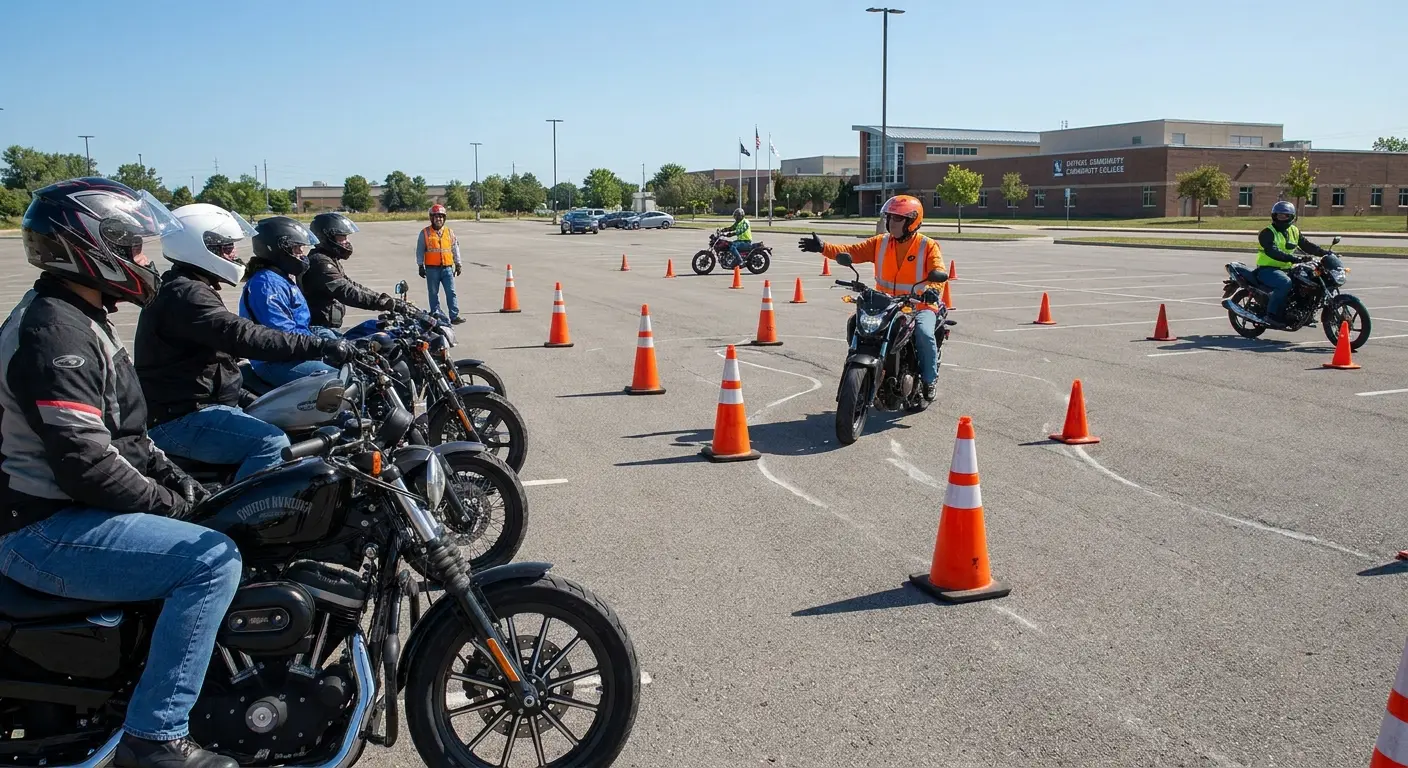
Advanced riding schools do teach countersteering explicitly. Track day organizations and performance riding courses spend significant time on the mechanics because precision matters at higher speeds and lean angles. The skill ceiling for riders who understand the technique is much higher than for those who just do it instinctively.
The YouTube Problem
Search "countersteering" on YouTube and you'll find hundreds of videos with conflicting advice and demonstrations. Some show exaggerated handlebar movements that don't reflect real-world riding. Others film from angles that make the inputs invisible. Many feature riders who are doing it correctly but explaining it incorrectly.
The fundamental issue is that countersteering inputs are subtle and happen quickly. A camera mounted on the bike or filming from the roadside can't capture the few degrees of handlebar rotation that initiate a turn. What looks like the rider just leaning the bike over is actually a push-pull motion that's too small and fast for the viewer to perceive.
Slow-motion footage helps but introduces its own problems. The exaggerated time scale makes the technique look more deliberate and forceful than it actually is. Riders watch these videos, try to replicate what they see, and end up overcorrecting because they're applying too much input for too long.
The comment sections become absolute dumpster fires where riders argue about whether countersteering is real, necessary, or just something sport bike riders do. This noise makes it harder for new riders to find accurate information and easier for them to dismiss the entire concept as controversial or optional.
How Modern Tech Is Finally Making the Invisible Visible
Smartphone Sensors That Track What You Can't Feel
Your phone contains the same sensors that stabilize aircraft and spacecraft. Accelerometers measure changes in velocity across three axes. Gyroscopes track rotational movement. Combined, they can record every lean angle change, every handlebar input, and every speed fluctuation during your ride.
Apps designed for motorcycle track days use this sensor data to show you exactly when and how hard you're countersteering. You can review your corner entry, see the lean angle graph, and identify where you're hesitating or making inconsistent inputs. The data doesn't lie or rely on your perception.
This technology makes it possible to practice deliberately instead of just logging miles and hoping you improve. You can try different techniques, review the data, and see what works versus what just feels different. The feedback loop that was previously only available to professional racers is now in your pocket.
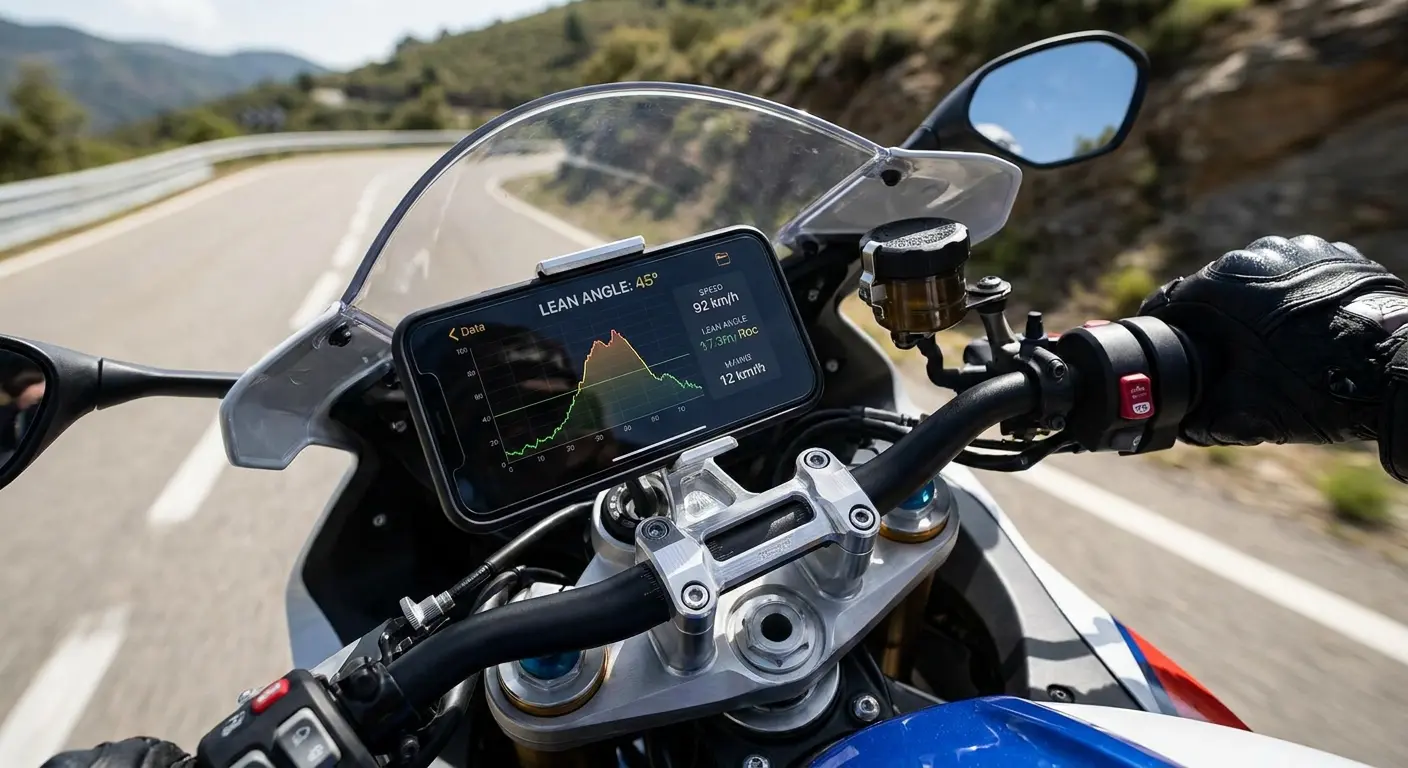
Mounting your phone securely becomes critical here. You need it positioned where it can record useful video while the sensors capture clean data. A loose mount or one that vibrates excessively will corrupt the sensor readings and make the data useless.
Rokform's motorcycle mounts solve this exact problem. We built our mounting system specifically for riders who need their phones accessible and stable during aggressive riding. The magnetic lock keeps your device secure through hard cornering and rough roads, so you can focus on your technique while your phone captures everything. Our cases protect against the inevitable drops and weather exposure that come with motorcycle riding. You're not just mounting a phone, you're building a mobile data collection and analysis system that rides with you.
Video Analysis That Actually Shows the Inputs
If you're capturing footage of your riding technique, you need a stable motorcycle stem mount that keeps your camera steady through corners and over rough pavement.
Handlebar-mounted cameras positioned to show your hands on the grips finally make countersteering visible. You can watch your right hand push forward, see the bike tip left, and observe the entire sequence in real time. This perspective is impossible to get while you're riding because you can't watch your hands and the road simultaneously.
Frame rate matters more than resolution for this type of analysis. You want 60 frames per second minimum, preferably 120 if your camera supports it. The higher frame rate captures the quick movements that get lost in standard 30fps video. You can slow the footage down and see exactly when your hand moves relative to when the bike leans. Analyzing your steering motorcycle technique frame-by-frame reveals subtle patterns you'd never notice in real-time riding.
Video Analysis Review Template:
Ride Date: ___________
Location: ___________
Speed Range: ___________
For Each Corner Reviewed:
Turn direction (left/right): ___________
Entry speed: ___________
Initial handlebar input visible? (Y/N): ___________
Delay between push and lean (estimate frames): ___________
Lean angle achieved (estimate degrees): ___________
Mid-corner corrections needed? (Y/N): ___________
Exit smoothness (1-10): ___________
Patterns Identified:
Consistent hesitation points: ___________
Stronger side (left vs right): ___________
Speed-related input variations: ___________
Next Session Focus:
___________
___________
___________
Watch for the push-pull motion across the handlebars. Your right hand pushes forward while your left hand pulls back slightly (or vice versa). This opposing force is more efficient than pushing one side alone because it creates faster rotation. Most riders do this naturally but don't realize they're doing it.
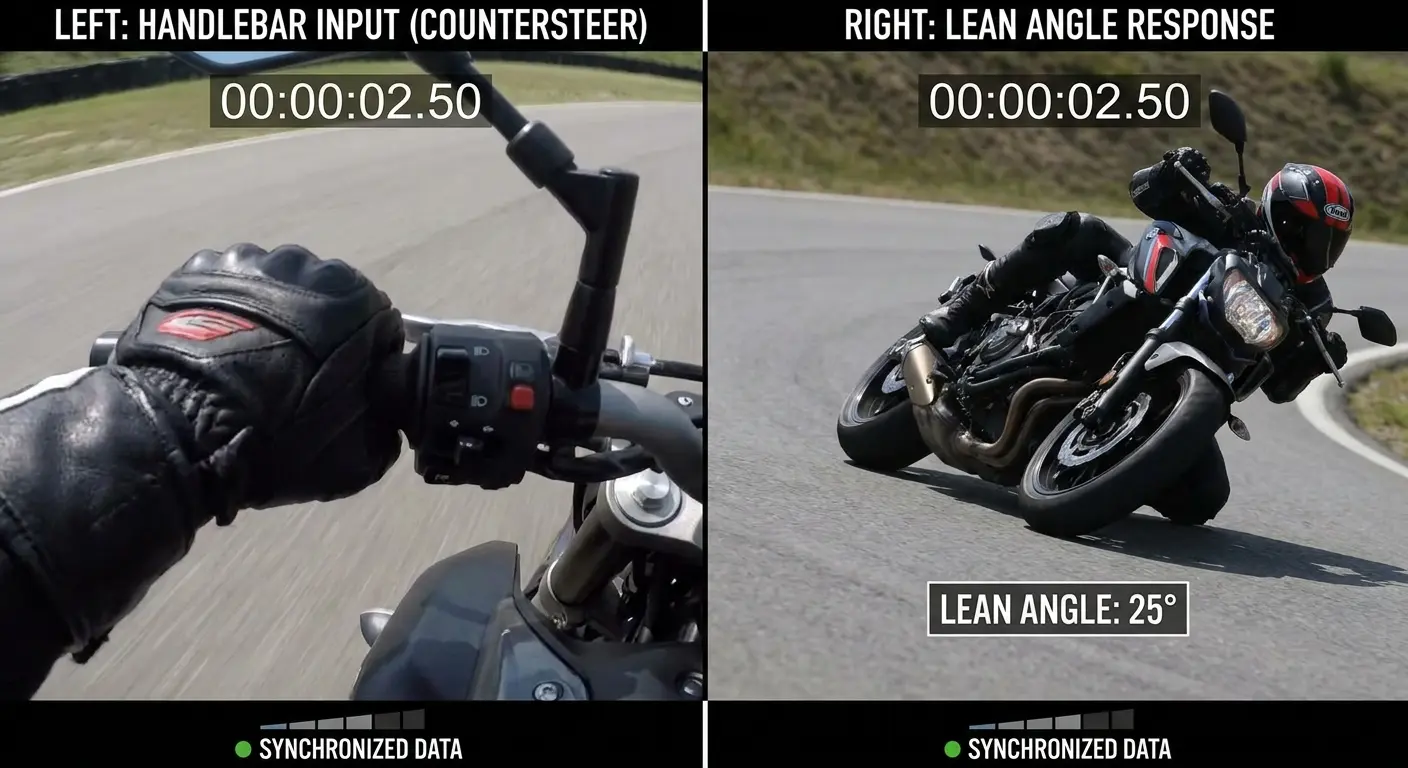
Compare your inputs across different corners. Are you pushing harder on right turns than left turns? Do you hesitate before initiating the lean? Are you making one smooth push or several small corrections? The patterns you see in video will highlight the habits you need to address.
Where Countersteering Shows Up Beyond Motorcycles
Bicycles, Scooters, and Anything With Two Wheels
Whether you're cycling or motorcycling, a secure bike mount keeps your phone accessible for navigation and recording without worrying about it flying off mid-ride.
Every two-wheeled vehicle uses countersteering above walking speed. Your road bike, your kid's scooter, electric unicycles, even those rental e-scooters cluttering the sidewalk. The physics don't change based on engine displacement or pedal power.
Bicycles make better platforms for learning and feeling countersteering because the speeds are lower and the consequences of mistakes are less severe. You can practice aggressive countersteering inputs on a bicycle at 20 mph and build the muscle memory that transfers directly to motorcycles at 60 mph.
The technique feels different across vehicles because of weight distribution and geometry differences. A bicycle with your weight centered over the frame responds more quickly than a motorcycle where you're sitting higher and further back. But the input is identical: push right to go right, push left to go left. The principles of steering on a motorcycle apply universally to all two-wheeled vehicles, making bicycle practice valuable for building motorcycle skills.
Electric scooters with small wheels require more dramatic countersteering inputs because the gyroscopic forces are weaker. The wheels are lighter and smaller, so they don't resist tipping as strongly. You have to be more deliberate with your handlebar movements to get the same lean response.
The Skateboard Exception That Proves the Rule
Skateboards get to cheat. You just lean and the trucks do the work. Motorcycles make you earn it.
Skateboards lean to turn but don't countersteer. You shift your weight to tip the board, the trucks pivot, and the wheels turn in the direction of the lean. There's no handlebar to push and no need to steer opposite your intended direction.
This difference? It's all about the steering mechanism. Skateboard trucks are designed to turn the wheels in the direction of the lean automatically. Bicycle and motorcycle geometry does the opposite. The front wheel naturally wants to stay straight or turn into a fall. You have to force the initial imbalance through countersteering.
The Muscle Memory Problem
Why You Can't Unlearn It (And Shouldn't Try)
Your nervous system has encoded countersteering into automatic motor patterns. You can't unlearn it any more than you can unlearn how to walk. Attempting to consciously control every input will make you a worse rider, not a better one.
The goal isn't to think about countersteering while you ride. The goal is to understand it intellectually so you can practice it deliberately, then let it become automatic again at a higher skill level. You're upgrading the unconscious program, not replacing automatic execution with conscious control. Learning how to countersteer properly means understanding the mechanics well enough to practice them deliberately, then trusting your reflexes to handle them automatically during actual riding.
This is why track riders can focus on braking points, throttle control, and line selection without thinking about how to lean the bike. The countersteering is handled by trained reflexes that work perfectly without conscious attention. They've practiced it so much that the technique is bulletproof even under pressure. Proper motorcycle countersteering becomes second nature through repetition and understanding.
New riders often feel like they're doing everything wrong once they learn about countersteering. They become hyperaware of their inputs and second-guess every turn. This phase passes. You'll integrate the knowledge and return to automatic execution, but with better technique and more confidence.
Building Better Reflexes Through Deliberate Practice
Track your practice sessions and progress using a vibration dampener mount that protects your phone during repeated maneuvers and keeps sensor data clean.
Dedicate specific practice sessions to countersteering drills. Find an empty parking lot or quiet road and spend 20 minutes doing nothing but turn entries. Push right, lean right, stand it up. Push left, lean left, stand it up. Repeat until your arms are tired.
Vary your speed during practice. Make the same turn at 25 mph, then 35 mph, then 45 mph. Feel how the required input changes with speed. Your brain is calibrating the force-to-speed relationship that will become automatic.
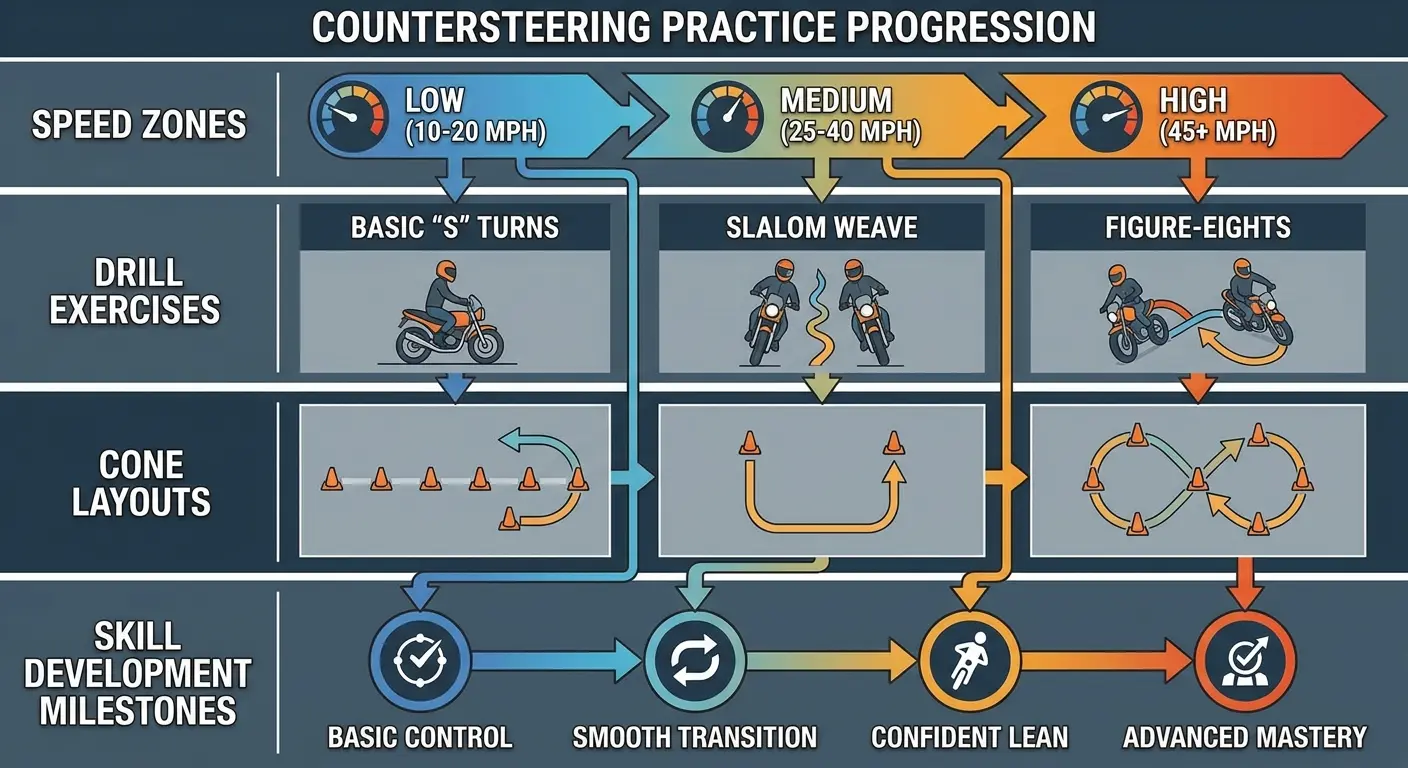
Practice emergency swerves at increasing speeds. Set up cones or markers and practice swerving around them as if they're obstacles that appeared suddenly. This builds the panic-proof reflexes that might save your life when a car pulls out in front of you.
Film your practice sessions and review them. Watch for hesitation, inconsistent inputs, or any pattern that indicates you're not handling things cleanly. Make corrections in the next session and film again. The improvement becomes visible over time.
Staying Connected to Your Machine
Countersteering isn't a technique you learn. It's a technique you've been using that you're now understanding. That understanding transforms you from someone who can turn a motorcycle into someone who can control a motorcycle with precision and confidence.
The physics work whether you acknowledge them or not. The bike leans when you push the handlebar, the geometry takes over, and you carve through the turn. But riders who understand what's happening can push harder, lean further, and react faster when situations demand it. Understanding what is countersteer at a conscious level allows you to refine what your body already handles instinctively.
You'll forget about countersteering during most of your riding. That's fine. The technique will be there in your muscle memory, working perfectly while you focus on traffic, road conditions, and where you're going. But when you need to make an emergency maneuver or push your skills to the next level, the conscious understanding will be there to guide your practice and build better reflexes. The motorcycle countersteer technique becomes your foundation for confident, controlled riding at any speed.
The gap between knowing you're countersteering and understanding why you're countersteering is the gap between competent and skilled. You're closing that gap right now.
Keep your navigation and recording devices secure during every ride with Rokform's complete line of motorcycle mounts designed for serious riders.
Protect your investment with rugged phone cases built to withstand the demands of motorcycle riding.

