


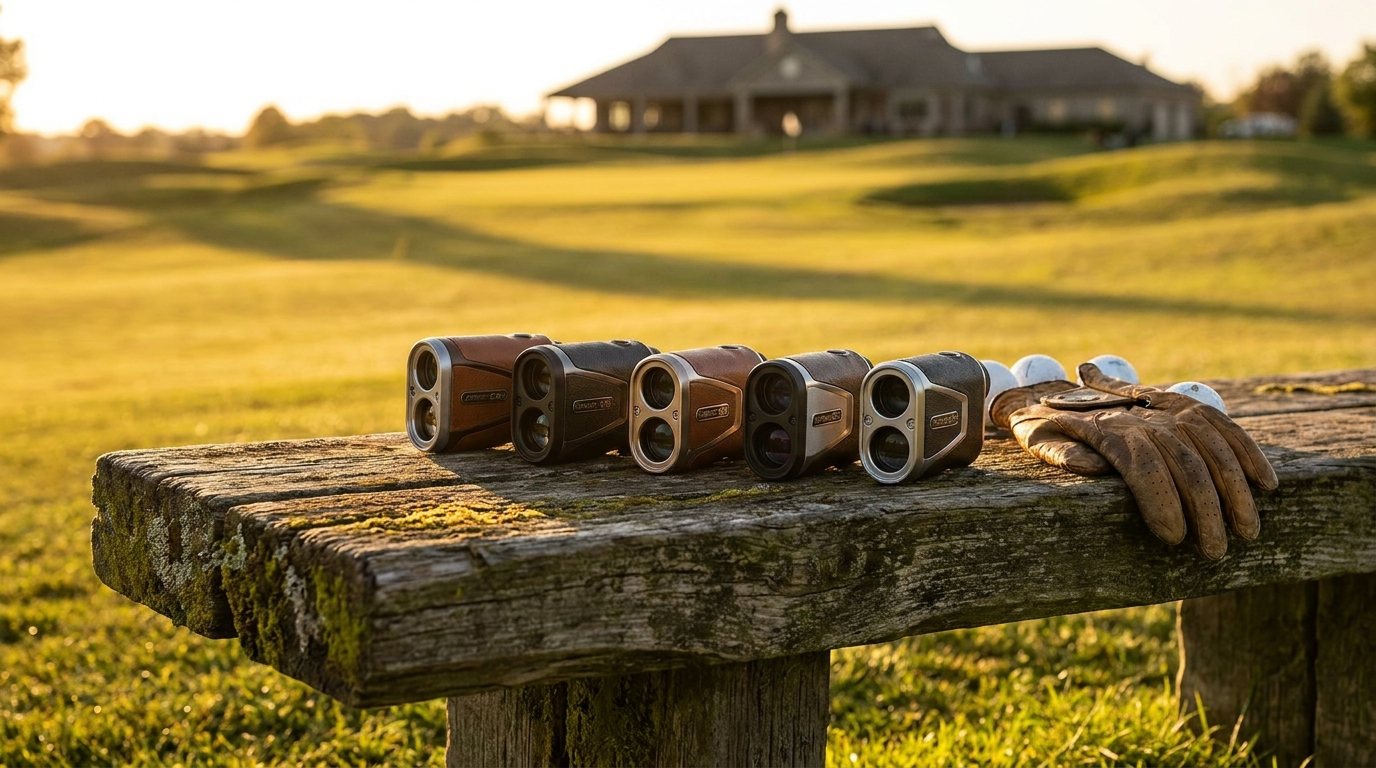
Rokform 18x: 8x to 18x zoom, arriving September.
18 best golf rangefinders judged on lock reliability, confirmation type and warranty terms rather than the accuracy spec they all tie on.
Accuracy is a solved problem, and almost every buying guide is still built around it.
Critical Golf tested multiple rangefinders simultaneously and concluded that all of the devices were essentially equal when it came to accuracy, with manufacturer claims of a yard or better holding up across the board. Their more useful finding was that the real separator is not precision at all. It is the ability to lock on to a target.
That matches what a July 2026 Shot Scope survey found about who is actually buying: 51% of golfers use a laser rangefinder, 88% check a device on every hole, and 84% rate ease of use as something they value. Ease of use. Not accuracy to a tenth of a yard.
So I ranked these 18 on what genuinely differs between them: how reliably they lock a pin against a treeline, how they confirm it, whether the weather rating survives contact with the warranty, and whether you can operate one comfortably. That last one matters more than the category admits, because the same survey found 64% of respondents were 55 or older.
Table of Contents
- How I Judged These
- The Premium Tier
- The Value Tier
- The Budget Tier
- The Specialists
- What The Big Review Outlets Do Not Test
- What Rokform Is Bringing To This In September
- Final Thoughts
TL;DR
- Every rangefinder in this piece measures distance accurately. Accuracy is a bad way to choose one.
- Lock reliability against a backdrop is the real differentiator, and it does not correlate with price.
- Bushnell pairs vibration with a red ring flash, which is the most redundant confirmation in the category.
- Shot Scope's Pro L2 at $149.99 tested on par with lasers costing three times as much.
- Nikon is the only brand publishing eye relief and diopter figures, which matters for the 55-plus majority who buy these.
- The Rokform Golf Range Finder 18x lands September 2026 with 8x to 18x magnification and Find My tracking built in.
How I Judged These
Six filters, in the order they actually change your round.
Lock reliability comes first, because a device that needs five attempts against a treeline is worse than a cheaper one that locks first time. Confirmation type second, since a lock you cannot perceive is a lock you will second-guess. Then weather rating cross-checked against the warranty, because several brands publish a water claim and exclude water damage in writing. Then slope verifiability, ergonomics, and only then price.


The Filter Nobody Applies
Ask what happens when the device fails rather than what happens when it works. Warranty terms in this category range from one year to unlimited lifetime, and the spread does not track price.
Vortex repairs or replaces regardless of how it happened, whose fault it was, or where you bought it, with no receipt required. Shot Scope excludes water damage in writing. TecTecTec excludes both spills and moisture. Arccos excludes water damage beyond its rated specification. Read the exclusions before the spec sheet, because that paragraph tells you what the company privately believes about its own build. Our guide to golf accessories for accuracy covers the rest of the kit worth the same scrutiny.
The Premium Tier
Five devices above roughly $400. What you buy at this level is glass, sealing and confirmation redundancy rather than a better number.
1. Bushnell Pro X3+ LINK
7x magnification, 1,300 yards, 600-plus to the flag, IPX7 fully waterproof, $599.99. The most complete package here.
PinSeeker with Visual JOLT flashes a red ring around the yardage as the unit vibrates, so confirmation reaches you through gloves or bright light. The slope switch is the only genuinely locking mechanism in the category, requiring a side latch to be pulled before it moves. Elements mode adds air pressure and temperature to the slope calculation. Dual Display toggles between a bright red readout and a crisp black one across four brightness levels, which is the single best answer to flat overcast light.
2. Garmin Approach Z82
6x with image stabilization, 5.5 to 450 yards, accuracy within 10 inches of the flag, IPX7, $599.99. The confirmation is unusual and genuinely useful: the device vibrates, a flag icon appears, the distance arc turns yellow, and the hole view map zooms to a close-up of the green.
You get spatial context rather than a bare number, so you know whether you are short of the green or past the front edge. Tournament Mode is a software setting with a solid blue LED on the top deck as the external tell. Garmin publishes no accuracy tolerance at all, which is worth knowing given the price.

3. Nikon Coolshot ProIII Stabilized
$529.95, 6x, and the only brand publishing the specs that matter to older eyes: 18mm eye relief and plus or minus 4 diopter adjustment. Stabilization reduces viewfinder shake substantially, which is what holds the beam on a distant pin long enough to acquire it.
Nikon also publishes the most granular accuracy spec in the category and frames its slope output as a guide rather than a prediction. The ProIII replaced the ProII and moved to vibration-based lock confirmation. If you wear glasses or your hands are not steady, start here rather than with a spec comparison.
4. Voice Caddie SL3
$599.99, 6X, 1,000 yards, hybrid laser and GPS with course data fully onboard and no phone required. Pin Tracer is a mode you engage by holding the power button, built for flags with trees behind them.
One finding before you buy. Breaking Eighty found the separate GPS Pin Assist feature actively degraded acquisition, and switching it off solved it. Slope lives two taps into a touchscreen, which makes it the hardest device here for a playing partner to audit.

5. Bushnell Tour Hybrid
$499.99, 6x, 5 to 1,300 yards, accurate to a yard at 500, 8.7 oz, IPX6, magnetic cart mount. A genuine single-unit laser and GPS combination rather than two devices in a bundle.
It shows slope-compensated laser distances and slope-compensated GPS distances at the same time, which means you get the pin number and the front and back of green numbers together. That solves the biggest structural limitation of a laser, which is that it cannot tell you anything about a target you cannot see.
The Value Tier
Five devices between roughly $150 and $400, and this is where the category is most competitive.
6. Bushnell Tour V7 Shift
$399.99, 6x, 5 to 1,300 yards, 500 to a flag, IPX6. A dual colour red and green OLED separates the actual yardage from the slope-adjusted number on screen simultaneously.
Slide the switch left and an orange indicator band appears with a second display row. Reviewers call it the fastest unit Bushnell has built, with the number appearing the instant you release the button. One caution: the red and green colour coding is the worst case for the most common form of colour blindness.
7. Shot Scope Pro L2
$149.99, x6, 700 yards, plus or minus one yard. Plugged In Golf found it every bit as fast as the most expensive rangefinders tested and performing on par with lasers costing three times as much.
A single button on top handles power and measurement, slope runs on a slider, and the yardage stays on screen an extra couple of seconds after the lock. Golf Insider's testing scored it 100% on accuracy. The catch sits in the warranty, which explicitly excludes damage caused by water, flood or fire.
8. Precision Pro NX10
$279.99, 6x, 5 to 999 yards, 400 yard flag lock, three year warranty plus a lost-rangefinder replacement discount. The wide circular reticle forgives an imperfect hold, which is a real advantage on a cold first tee.
Precision Pro publishes no accuracy tolerance for either number, and its IP67 claim sits in body copy rather than the visible spec table. The three year term is among the longest here and the guarantee is scoped to how the device was built.
9. Vortex Blade Slope
$249.99 street against a $399.99 MSRP, 6x, up to 1,400 yards reflective, 350 to a flag. Hold Menu for roughly two seconds, select Slope, and external green LEDs illuminate to show it is live.
Then the reason it keeps appearing in these lists: an unlimited, unconditional, lifetime VIP warranty that is fully transferable and needs no receipt. The vaguest water spec in the category paired with the only warranty that would actually pay for water damage.

10. Callaway 300 Pro
MSRP $299.99 with street pricing down around $125 to $180, 6X, 5 to 1,000 yards, 300 yard pin lock. The only unit here confirming with both a chirp and a vibrating burst, which covers gloved hands and bright light at once.
The manual is unusually candid, publishing an IPX3 weather-resistant rating and warning that heavy rain and thick fog can limit maximum range. Warranty is one year through IZZO. That street price usually signals end-of-life inventory, so treat it as a bargain rather than a long-term bet. Worth reading alongside our best golf rangefinders guide for the wider field.

The Budget Tier
Four devices under $150 that are genuinely worth owning. Golf Insider's testing found slope on all seven budget models it examined, so slope has stopped being a reason to spend more.
11. GOGOGO Sport Vpro GS24
$89.90 direct and often under $80 at retail, 6x, flag lock with vibration. National Club Golfer's testing measured reliable flagpole lock at 150 yards, extending to 250 with the flag unfurled, against an advertised range far higher.
That gap is the honest picture of what a sub-$100 laser does. Inside 200 yards it is a real rangefinder. Beyond that you are working for the number.
12. WOSPORTS L14
$129.99, 7X, 5 to 1,500 yards, 350 yard target lock, two year warranty, magnets built in. WOSPORTS publishes target lock distance separately from max range across its entire line, which most premium brands still refuse to do.
Read the switch carefully. WOSPORTS runs the colour convention backwards, with red showing meaning slope is off and black meaning it is on.
13. REDTIGER GolfVue Series 1
$109.99, 7X, 1,200 yards, accurate to half a yard, IP54, magnetic stripe with a belt clip. Flag lock sits inside a six mode selector rather than being the default behaviour, so you have to be in the right mode.
REDTIGER states outright that the IP54 rating is unsuited to rainy or foggy rounds, which is unusually direct.

14. TecTecTec KLYR
$199.99, 6x, 800 yards, and the lightest device in this entire roundup at 118 grams. TecTecTec's own answer on water is the most explicit in the category: water resistant, cannot be submerged, dry it immediately and air dry before it goes back in the case.
The warranty then excludes spills and moisture exposure, which sits awkwardly beside that advice.
The Specialists
Four devices that win a specific job rather than a general comparison.

15. Arccos Smart Laser Rangefinder
$299.99 including the first year of membership, roughly $199.99 a year after, 6.1x, IP44. The widest environmental model here: slope, wind speed, gusts, direction, temperature, humidity and altitude, plus AI club and target recommendations.
Two things to weigh. Arccos names water damage in its exclusions as damage beyond rated specifications, and the club recommendation feature is squarely what Rule 4.3a(1) prohibits during a round. Tournament Mode disables both the slope and weather layers together.
16. Leupold GX-5c
Discounted hard to $149.99 from $499.99, 6x, 800 yards reflective, 450 to a pin flag. Three named systems do three jobs, and Prism Lock beeps only when it detects a reflector-equipped flagstick from 30 yards out.
That is the most specific confirmation in this piece, because the tone means the pin rather than something. The drawback is that it is the only device here with no external slope indicator at all.
17. Blue Tees Series 3 Max+
$199.98, 6x, 900 yards, USB-C rechargeable, magnetic strip mount, and three separate display elements for distance, adjusted distance and slope angle. More transparency than several units three times the price manage.
The weakness is acquisition rather than display. MyGolfSpy found the pin seeker needing five or six attempts past roughly 150 to 200 yards against a backdrop.
18. Garmin Approach G12
$99.97, and the odd one out because it is not a laser at all. A clip-on GPS puck with 42,000-plus preloaded courses, up to 30 hours of battery, and a big-numbers mode that is the only named large-font option I found anywhere in this category.
It belongs here because a laser cannot help you on a blind shot, a dogleg or a ball in the trees, and GPS can. MyGolfSpy is blunt that GPS does not match a laser for precision, and Shot Scope's survey found 41% of golfers carry both. Our roundup of GPS golf apps covers the software side.
What The Big Review Outlets Do Not Test
Reading the major buying guides back to back reveals the same two criteria everywhere: accuracy and speed. Both are effectively tied across the field.
Nobody weather-tests these devices. Nobody validates the slope-adjusted number against where a ball finishes. Nobody publishes ergonomic assessment, button counts, weight comparisons or eyeglass compatibility. That last omission is the strangest, given the buying population skews so heavily older.
| What gets tested | What does not |
|---|---|
| Distance accuracy against a known target | Lock reliability against a wooded backdrop |
| Acquisition speed | Whether the water rating survives the warranty |
| Optical clarity | Slope-adjusted accuracy against real ball flight |
| Display readability | Eye relief, diopter range, weight, button count |
| Feature checklists | Whether you can operate it one-handed in a glove |

The Ergonomics Gap Is The Real Story
Nikon publishes 18mm eye relief and plus or minus 4 diopter on the ProIII, 17mm and plus or minus 3 on the 50i GII. Almost nobody else publishes either figure. Weight ranges from 118 grams on the TecTecTec KLYR to 8.7 ounces on the Bushnell Tour Hybrid, which is a meaningful difference over eighteen holes and a walking round.
Only the Shot Scope Pro L2 was verifiably a single-button device. Everything else asks you to learn a mode sequence, which is the same reason we care about aiming correctly before worrying about the last two yards. A rangefinder you fumble is a rangefinder you stop pulling out, which is how expensive devices end up in the bottom of a bag. Our types of golf clubs breakdown pairs well with this, because a yardage only helps once you trust the club at that number.

The Loss Problem Nobody Prices In
No published data exists on how often golfers lose rangefinders, but the market behaves as though it happens constantly. Precision Pro builds a 30% replacement discount for a lost unit into its standing guarantee. Spigen built an AirTag slot into a rangefinder wrap. Bushnell, Precision Pro, Shot Scope and Blue Tees all sell replacement cases as standalone products.
Manufacturers do not productise a problem that is not happening. A device that lives on a cart rail for four hours and moves between four bags is exactly the object that gets left behind, which is worth factoring into what you spend. Our golf etiquette guide covers the on-course habits that prevent half of it.
What Rokform Is Bringing To This In September
The Rokform Golf Range Finder 18x arrives September 2026 and answers several of the gaps above at once.
8x to 18x adjustable magnification is a category first, and no other golf laser rangefinder offers that range. Nothing else in this roundup goes past 7x. Zoom in on the flag on a long par 5, dial back for a quick read on a short approach. Flag lock with vibration confirms the pin the moment you lock it, so there is no guessing whether you got the flag or the bunker behind it. The 1,200 yard range reads anything visible on the course, a tournament-legal slope toggle covers practice and competition on one device, and IPX6 handles dew, rain delays and humid summer rounds.
Then the answer to the loss problem. Apple Find My and Android Find Hub tracking are built in, so an expensive rangefinder never gets left on a tee box or lost in a cart again. Nothing else in this list can be located from your phone. MagMax magnetic mounting snaps it to cart rails and any MagMax surface, carrying over from our top golf cart accessories lineup. Two year warranty, 60 day money back, $499.99.
Reserve yours ahead of the September launch: Rokform Golf Range Finder 18x. Swing hard, make putts.
Final Thoughts
Stop shopping on accuracy. Every device on this page measures distance to within a yard, and the buying guides that rank on that number are ranking on a tie.
Shop on the three things that actually vary: whether it locks the pin first time against trees, whether the confirmation reaches you through a glove, and whether the company will still talk to you after it fails. Then handle one before you buy if you can, because weight, eye relief and button layout decide whether it stays in your pocket or in the bag. The best golf rangefinder is the one you pull out on every hole rather than the one with the longest spec list, and our most common golf mistakes piece covers what costs you more strokes than any yardage ever will.

