


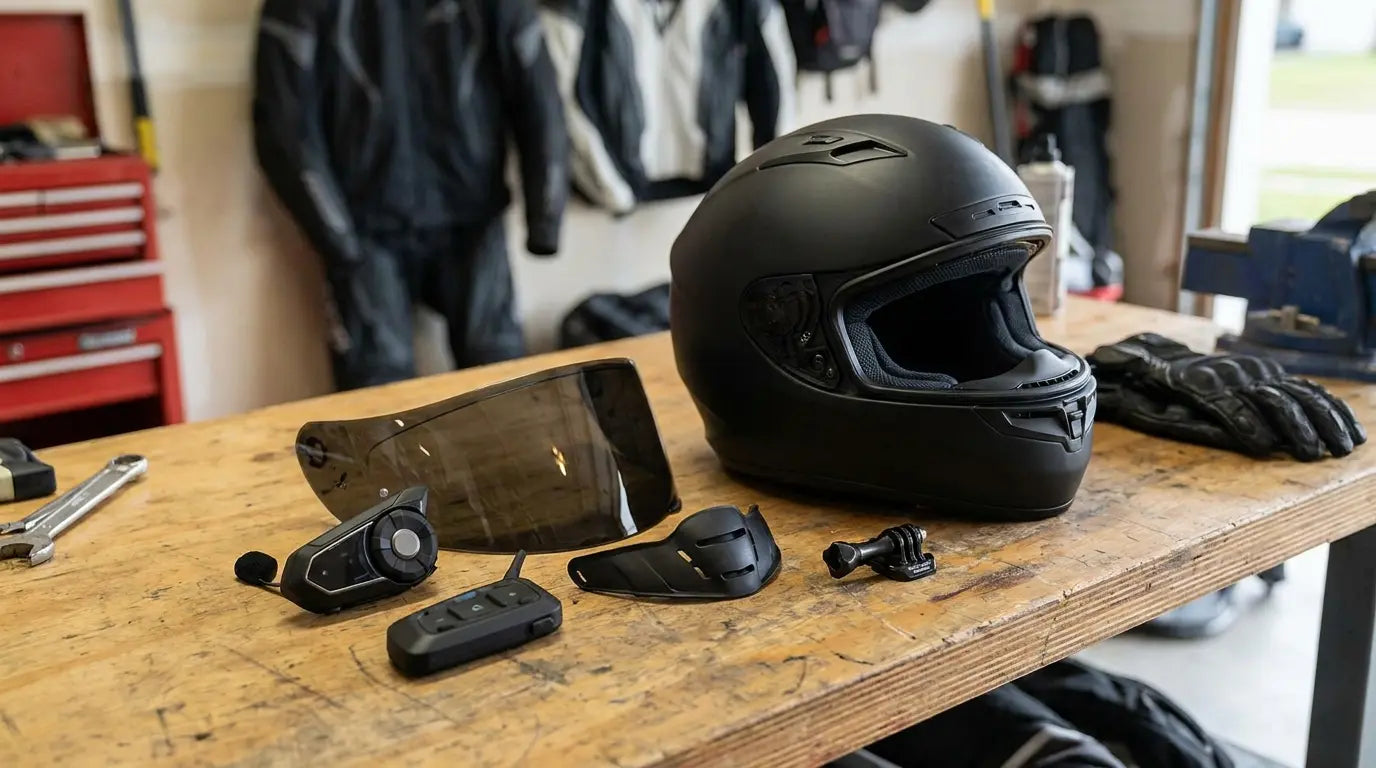
You know what nobody tells you about motorcycle helmets? They're perfect for about 45 minutes.
Then your visor fogs up in traffic. Or your buddy's trying to tell you something over the intercom and all you hear is static and wind noise. Or that "perfect fit" from the shop starts feeling like a vice grip on your temples.
I'm not gonna tell you to buy a new helmet. That's stupid. What I am gonna tell you is that there are 18 accessories that'll fix the specific things driving you crazy right now. Some cost $15. Some cost $300. But they all solve real problems, not theoretical ones.
Here's what we're covering (bookmark this if you need to):
Talking to Your Buddies
Bluetooth Communication Systems
Helmet Speaker Pads
Microphone Boom Kits
Intercom Extender Antennas
Audio Adapter Cables
Remote Control Buttons
Making It Not Hurt
Breath Deflectors
Chin Curtains
Wind Skirts
Neck Rolls
Cheek Pad Inserts
Crown Pad Liners
Seeing and Being Seen
Pinlock Anti-Fog Inserts
Tinted Visor Shields
Helmet Camera Mounts
Phone Mounting Systems
Reflective Decal Kits
Visor Tear-Offs
What You Actually Need to Know First
Before you start Amazon-carting random accessories, here's what matters:
Speaker placement isn't just "stick them in there." Your helmet's shape determines whether you get concert-quality sound or something that sounds like a drive-through speaker from 1987.
Your head changes shape during rides. Seriously. Padding compresses, you sweat, things shift. That "perfect fit" at the dealership feels different three hours into a highway run. Standard sizing assumes everyone's head fits the same pattern, which we know isn't true after the first hour on the road.
Anti-fog stuff is mostly about airflow, not chemicals. Those spray treatments? They work great until they don't, usually right when you hit cold morning air. The accessories that actually work redirect your breath instead of coating your visor with something that quits after two weeks.
Visor tinting isn't just "dark or clear." Light transmission percentages matter way more than you'd think. The wrong tint can be as dangerous as no tint at all, especially when you're switching between bright sun and shaded curves.
Mounts need to handle vibration, not just stay attached. A mount that holds firm but transmits every bump to your device will destroy your phone's camera stabilization in about three months. Ask me how I know.
Here's the thing about protective add-ons: don't install everything at once. Each piece changes how your helmet fits and performs, so add them one at a time and actually figure out what's helping.
Phone integration requires more than a strong mount when you're dealing with helmet aerodynamics. Weight distribution and cable routing become critical factors that affect both comfort and how functional everything actually is.
Talking to Your Buddies (Communication Stuff)
1. Bluetooth Communication Systems
Modern Bluetooth systems have evolved past simple music playback. We're talking mesh networking that connects up to 15 riders at once, voice-activated controls that work with heavy gloves, and noise cancellation designed specifically for wind speeds above 60 mph.
The difference between cheap and premium units shows up most when you're pushing highway speeds. I've been on group rides where half the guys are shouting into their mics like it's 1995 because they cheaped out on the comm system. Don't be that guy. Premium systems use multiple microphones to filter wind noise before it reaches your riding partners, which means you're not constantly repeating yourself.
Battery life is all over the place, anywhere from half a day to a full weekend. That matters when you're planning multi-day trips without reliable charging access. For riders looking to enhance their long-distance motorcycle riding experience, these motorcycle helmet accessories make the difference between staying connected and riding in isolation.
Installation? Depends on your helmet. Some shells have speaker pockets already built in. Others require creative problem-solving with adhesive mounts and careful wire routing. It's not rocket science, but it's also not always stupid-easy.
Bluetooth System Feature |
Entry-Level |
Premium |
What You're Actually Getting |
|---|---|---|---|
Mesh Network Capacity |
4-6 riders |
12-15 riders |
Group ride coordination without constant reconnection |
Battery Life |
8-10 hours |
18-20 hours |
Multi-day trips without charging stops |
Wind Noise Cancellation |
Single mic, basic filtering |
Multiple mics, smart algorithms |
Clear communication above 60 mph |
Intercom Range |
500-800 meters |
1,200-2,000 meters |
Connection when riders spread out |
Audio Quality (Hz) |
20-16,000 Hz |
20-20,000 Hz |
Fuller sound for music and voice |
Voice Command Accuracy |
Works maybe 3 out of 4 times |
Pretty much always |
Reliable hands-free with gloves |
These are ballpark figures. Your mileage will literally vary.
Real talk: If you only buy three things from this list, make it the Bluetooth system, Pinlock insert, and decent cheek pads. Everything else is gravy.
2. Helmet Speaker Pads
So your Bluetooth came with garbage speakers. Join the club.
Aftermarket pads fix this. Bigger drivers, better magnets, actual bass response instead of tinny nonsense. But here's where people screw up: they buy pads that are too thick and end up with speakers pressing into their ears for 6 hours straight. Not fun.
You're working within maybe 3-4 millimeters of space between that speaker and your ear. That's it. The good ones use memory foam that molds to your ear shape over time, reducing fatigue on rides exceeding three hours. Takes a week or so to break in, but then? Chef's kiss.
Fair warning: not all speakers play nice with all systems. You'll need to verify connector types before purchasing. And poorly designed pads broadcast your music to everyone at stoplights, which gets annoying fast.
3. Microphone Boom Kits
Boom microphones outperform those adhesive stick-on mics in almost every scenario involving sustained speeds. The boom positions the mic element directly in front of your mouth, cutting down the distance sound travels and minimizing wind interference.
Quick side note: if you've got a big beard, boom mics work way better than the stick-on ones. Nobody tells you this, but it's true.
Adjustability is what most riders overlook. You need to reposition the boom based on whether you're wearing a neck gaiter, balaclava, or nothing at all. Foam windscreens degrade over time (especially in humid climates), so having replacements on hand prevents that muffled sound quality that creeps up gradually.
Some boom kits use flexible wire cores that hold their shape after bending. Cheaper versions use rigid plastic that either fits perfectly or doesn't fit at all. Mounting methods vary between adhesive pads, clip systems, and hook-and-loop attachments. Clips tend to last longest under vibration stress.
4. Intercom Extender Antennas
Range limitations frustrate riders who spread out on group rides or tour through areas with terrain interference. Extender antennas boost transmission distance by maybe 30-50%, depends on your base system's capabilities.
These work best in open terrain where line-of-sight communication is possible but distances exceed your standard range. Urban environments with buildings and overpasses see less dramatic improvements because the limitation shifts from antenna power to signal obstruction.
Installing these means accessing your communication system's antenna port, which isn't always user-friendly depending on your model. Sena and Cardo (who basically own the Bluetooth market) use different connectors, so you'll need to match your system. Weight distribution matters more than you'd think. A poorly balanced antenna creates a subtle pulling sensation that becomes annoying after an hour.
5. Audio Adapter Cables
Compatibility gaps between your helmet communication system and other devices create frustration that adapter cables solve. GPS units, action cameras, two-way radios... they all use different connector types and signal levels.
These cables bridge different connector types and sometimes include inline amplification for devices with weak output signals. Cable routing inside your helmet requires planning because excess length creates noise from cable movement while insufficient length creates tension on connectors.
Shielding quality determines whether you'll experience electrical interference. Cheap cables pick up noise from your bike's ignition system or nearby electronics, adding a constant buzz to your audio. Right-angle connectors work better than straight connectors in tight spaces, reducing strain on connection points. Weatherproofing becomes essential if your adapter connects to external devices exposed to rain or road spray.
6. Remote Control Buttons
Handlebar-mounted controls let you manage communication functions without releasing your grip or fumbling with helmet-mounted buttons. These remotes connect wirelessly to your Bluetooth system and offer programmable buttons for frequently used features.
Placement on your handlebars affects usability. Too close to your grips and you'll hit buttons accidentally during turns, too far and you'll struggle to reach them comfortably. Button tactility matters when you're wearing thick winter gloves. You need clear feedback that confirms your input. Riders who invest in quality motorcycle gloves will appreciate the difference immediately.
Waterproofing quality is all over the place across brands. Cheaper units fail after a single heavy rainstorm. Battery life in remote units usually exceeds your main communication system, but you're adding another device to your charging routine. Some advanced remotes include small displays showing caller ID or track information, though readability while riding remains questionable.
Making It Not Hurt (Comfort Fixes)
7. Breath Deflectors
Breath deflectors redirect exhaled air downward and away from your visor, addressing fogging at its source rather than treating symptoms. These motorcycle helmet accessories attach to your helmet's chin bar and create a seal against your chin and lower face.
Here's the catch though: a gap of even a few millimeters lets breath escape upward toward your visor, defeating the entire purpose. Material flexibility matters because your jaw moves constantly while riding (talking, adjusting position, drinking water). Rigid deflectors lose their seal quickly.
Some designs include replaceable foam edges that compress over time, maintaining the seal longer than solid plastic alternatives. But on a 90-degree day, that same deflector turns your chin area into a sauna. So you're picking between a foggy visor or sweating like crazy. Installation methods range from adhesive strips to clip systems, with clips offering easier removal for summer riding.
8. Chin Curtains
Chin curtains seal the bottom opening of your helmet, blocking wind and rain from entering through the chin bar area. This seemingly minor upgrade dramatically reduces wind noise by eliminating turbulent air from reaching your ears.
The curtain also prevents rain from being forced upward into your helmet during highway-speed storms. Material choice affects both durability and comfort. Synthetic fabrics resist water absorption better than natural materials but can feel clammy against your skin.
Some curtains use snaps that integrate with existing helmet mounting points while others rely on adhesive backing. Thickness influences effectiveness but also affects how the curtain interacts with your neck and collar. Bulky curtains bunch up uncomfortably inside jacket collars. These things absorb sweat, oils, and road grime faster than other helmet components, so you'll need to wash them regularly.
9. Wind Skirts
Wind skirts create a flexible barrier between your helmet's neck opening and your jacket collar, preventing wind from rushing up your back and creating lift under your helmet. This addresses the buffeting sensation that occurs at highway speeds when air gets trapped between your helmet and shoulders.
Skirts work best when paired with jackets that have tall collars, creating an overlapping seal. Finding the right combination of protective gear is essential, which is why I wrote a whole breakdown of the best motorcycle jackets that actually work with these wind skirts.
Material needs to be flexible enough to move with your head but substantial enough to resist wind pressure, a balance that cheaper skirts fail to achieve. Some designs include weighted edges (kind of like those weighted blankets everyone's obsessed with, except this one keeps wind from shooting up your back at 75 mph) that help the skirt maintain contact with your shoulders during head movement.
Summer riding presents a problem because wind skirts block cooling airflow, forcing you to choose between comfort and reduced buffeting.
10. Neck Rolls
Neck rolls fill the gap between your helmet's neck opening and your neck, providing cushioning that reduces fatigue during long rides. These absorb vibration that would otherwise transfer directly from your helmet to your cervical spine.
Some people love neck rolls. I can't stand them. Try before you commit.
Thickness varies from minimal padding to substantial cushions, with the right choice depending on your helmet fit and neck length. Memory foam versions conform to your specific anatomy over time, while traditional foam maintains consistent support but may feel less personalized.
Removable covers make cleaning easier because neck rolls absorb significant amounts of sweat. Some designs include cooling gel inserts that provide temperature regulation during summer rides. Riders with longer necks benefit most from neck rolls because standard helmets often leave larger gaps in this area.
11. Cheek Pad Inserts
Cheek pads compress and thin out over time (usually around the 6-month mark, faster if you sweat a lot or live somewhere humid), creating a looser helmet fit that compromises both comfort and safety. Replacement inserts restore your helmet's original snugness without requiring a complete helmet replacement.
These come in varying thicknesses, so you can fine-tune fit as your original pads break down. Material density affects how quickly new pads compress, with higher-density foams maintaining their shape longer but requiring a longer break-in period. Some riders intentionally use thicker pads than stock to achieve a tighter fit, particularly if they're between helmet sizes.
Moisture-wicking fabrics in premium pads reduce sweat accumulation and the bacterial growth that creates helmet odor. Installing these ranges from "stupid easy" to "why did I start this" depending on your helmet model. Some designs use simple snap-in systems while others require partial helmet disassembly. Asymmetric face shapes benefit from mixing pad thicknesses (thicker on one side) to achieve balanced pressure distribution.
12. Crown Pad Liners
Crown pads sit at the top of your helmet, distributing pressure across the top of your head and absorbing impact energy. Upgraded liners use multi-density foams that provide both comfort and enhanced protection. These pads degrade with age and sweat exposure, losing their cushioning properties even when they appear visually intact.
Thickness adjustments here affect overall helmet fit, particularly for riders whose heads compress the stock padding excessively. Ventilation channels in premium crown pads improve airflow through your helmet's top vents, reducing heat buildup.
Antimicrobial treatments help control odor but require reapplication or replacement as the treatment wears off. Some designs include emergency information pockets where you can store medical details or emergency contact information. Installation typically requires removing your helmet's inner liner completely, which provides a good opportunity to inspect the EPS foam shell for hidden damage.
Seeing and Being Seen
13. Pinlock Anti-Fog Inserts
Pinlock is basically the only anti-fog system that works. These inserts create a dual-pane visor system using a silicone seal that traps insulating air between layers. This prevents the temperature differential that causes fogging, working far more reliably than spray-on treatments that quit halfway through your ride.
Installation requires a visor with Pinlock posts, which most modern helmets include but older models may lack. The silicone seal degrades over time (a year, maybe two if you're lucky), losing its ability to maintain the air gap and requiring insert replacement.
Cleaning requires care because scratching the insert's soft coating reduces optical clarity. Some riders experience slight optical distortion at the edges where the insert curves, though premium inserts minimize this effect. Insert tinting options let you combine anti-fog properties with light reduction, though this limits nighttime visibility.
Don't leave compressed inserts sitting around because they'll develop permanent cre ases that create visual distortions. These motorcycle helmet accessories prove their worth the first time you ride through a cold morning without your visor fogging over.
14. Tinted Visor Shields
Tinted visors reduce eye strain and improve contrast in bright conditions, but choosing the right tint percentage requires understanding your typical riding conditions. Light transmission percentages range from 5% (very dark) to 50% (subtle tint), with most riders finding 15-20% ideal for daytime highway riding.
Mirror coatings add glare reduction but scratch more easily than standard tints. Photochromic visors that darken in sunlight sound ideal but transition too slowly for rapid lighting changes (entering tunnels, riding through tree cover). Honestly not sure if they're worth the premium. Haven't tested them enough.
Installing these depends on your helmet brand. Some use tool-free quick-release systems while others require screwdrivers. You'll need to carry a clear visor for unexpected nighttime riding because dark tints are dangerous (and illegal in many areas) after sunset. And yes, you'll probably buy the wrong tint percentage first. We all do. That's why you see used visors on eBay.
Anti-scratch coatings extend visor life but add cost, creating a trade-off between durability and initial investment.
Visor Tint Percentage |
Light Transmission |
Best Use |
Nighttime Legal |
What It Actually Looks Like |
|---|---|---|---|---|
5-10% (Very Dark) |
Blocks 90-95% of light |
Bright desert riding, high-altitude sun |
No (most places) |
Maximum glare reduction, high contrast |
15-20% (Dark) |
Blocks 80-85% of light |
Highway riding, sunny days |
No (most places) |
Balanced protection, minimal color distortion |
25-35% (Medium) |
Blocks 65-75% of light |
Variable conditions, partly cloudy |
Borderline (check local laws) |
Moderate glare reduction, good depth perception |
40-50% (Light) |
Blocks 50-60% of light |
Overcast days, dawn/dusk |
Yes (most places) |
Subtle enhancement, maintains visibility |
80-90% (Clear with tint) |
Blocks 10-20% of light |
All-day riding with minimal swaps |
Yes |
Slight contrast boost, full nighttime visibility |
Photochromic |
Adjusts 20-80% based on UV |
Riders who hate changing visors |
Depends on darkest state |
Convenience with slower transition speed |
Look, I ride with 15-20% most of the time and carry a clear shield in my bag. That's it. You don't need six different visors unless you're really into gear.
15. Helmet Camera Mounts
Camera mounts need to balance secure attachment with aerodynamic efficiency and safety considerations. Adhesive mounts create the strongest bond but become permanent installations that leave residue if removed.
Side-mounted cameras create less aerodynamic drag than top-mounted options but limit your field of view. Chin mounts provide the most natural perspective but are most vulnerable to impact damage. Vibration dampening separates usable footage from shaky, unwatchable video, yet many mounts overlook this entirely.
Here's the annoying part: some helmet manufacturers void warranties if you attach anything to the shell, arguing that mounts create penetration points that compromise structural integrity. Check your warranty before drilling or sticking anything permanent.
Weight distribution affects neck fatigue on long rides. Even lightweight cameras create noticeable strain when mounted far from your helmet's center of gravity. Quick-release mechanisms let you remove cameras at stops but introduce potential failure points where the camera could detach during riding.
16. Phone Mounting Systems
Mounting your phone to your helmet provides easier GPS visibility than handlebar mounts, keeping navigation in your peripheral vision. But vibration remains the primary enemy of helmet phone mounts. High-frequency oscillations damage camera stabilization systems in modern smartphones.
Okay, full disclosure time: we make mounting systems. That's literally what Rokform does.
But here's why I'm bringing it up. Every accessory on this list needs to actually stay on your helmet. And most mounting solutions either trash your helmet's finish or fall off the first time you drop it in a parking lot.
We've been obsessing over this problem for years because, honestly, it's annoying when your $400 phone goes flying because some adhesive mount couldn't handle vibration.
The short version: our Rokform Motorcycle Phone Mounts use multi-layer vibration dampening that protects your device while maintaining secure attachment. We integrate with helmet surfaces using aerospace-grade adhesive that withstands extreme temperatures and wind pressure without adding bulk. There. Pitch over.
Weight becomes critical because helmet-mounted phones sit far from your neck's center of support, creating leverage that increases fatigue. Waterproofing needs to account for rain approaching from multiple angles at speed, not just vertical precipitation. Touchscreen accessibility while wearing gloves requires either capacitive-touch-compatible gloves or voice-activated controls. Cable routing for power connections creates clutter that interferes with helmet removal unless carefully planned. When you shop motorcycle helmet accessories, prioritize compatibility with your existing gear.
17. Reflective Decal Kits
Reflective materials increase your visibility to other drivers in low-light conditions, addressing one of motorcycling's primary safety concerns. For more ways to stay visible, I put together a guide on best motorcycle accessories that covers the full setup.
Decal placement affects effectiveness. Side-panel positioning provides visibility to perpendicular traffic while rear placement helps following vehicles. Reflective intensity varies across materials, with microprismatic designs outperforming standard glass-bead reflectives by 3-5 times. Durability under UV exposure determines whether decals maintain reflectivity or fade to useless decorations within a season.
Contoured application on curved helmet surfaces requires heat application and patience to avoid bubbles and wrinkles. Some jurisdictions have regulations about reflective material colors and placements on helmets, requiring verification before installation. Aesthetic concerns lead many riders to choose subtle reflective accents rather than large coverage areas, balancing safety with appearance preferences. Removal difficulty varies, with some adhesives leaving residue that requires careful cleaning to avoid damaging helmet finishes.
18. Visor Tear-Offs
Tear-offs are exactly what they sound like. Thin, optically-clear films that stack on your visor. Each layer peels away to reveal a clean surface underneath.
Installation requires posts or tabs on your visor's edges to anchor the tear-off stack. Stack thickness affects optical clarity, with each layer adding minimal but cumulative distortion. Racing applications use tear-offs extensively, but street riders benefit during spring bug season or unexpected rain that turns road grime into vision-blocking smears.
Cost per use makes tear-offs expensive compared to stopping to clean your visor, but the convenience during critical moments justifies the expense for many riders. I know a guy who rides with five tear-offs stacked on his visor at all times. Excessive? Maybe. But he's never squinting through bug guts, so who's really winning?
Storage of unused tear-offs requires protection from UV light and heat, which can cause the films to bond together permanently. Disposal becomes an environmental consideration because you're generating plastic waste with each use, though some manufacturers now offer biodegradable options.
Building Your Setup (Without Going Broke)
Motorcycle helmet accessories solve problems that become apparent only after you've logged serious miles. The gap between a stock helmet and a truly functional setup isn't about luxury additions. These upgrades address the specific challenges your riding style and environment create.
Communication upgrades mean you can actually talk to your buddies instead of just waving at them. Comfort enhancements let you focus on the road instead of pressure points and fogging. Visibility solutions tackle the reality that you're sharing roads with distracted drivers who need every possible cue to notice your presence.
Start with whatever's driving you crazy right now. For most people, that's communication (because riding solo gets boring) or anti-fog (because safety). Riders interested in documenting their journeys should check out my beginner's guide on filming motorcycle trips. Your helmet is already a complex system, and each addition changes how other components perform.
Test individual upgrades, understand how they interact with your existing setup, and build your accessory collection based on actual riding experience rather than theoretical benefits. Whether you're commuting daily or planning weekend adventures, understanding motorcycle riding tips enhances every aspect.
Don't buy all 18 of these things. Buy the 3-4 that solve your specific problems.
Your helmet already does the important job (keeping your brain inside your skull). These just make the rest of the experience suck less.
Now get out there and ride.

